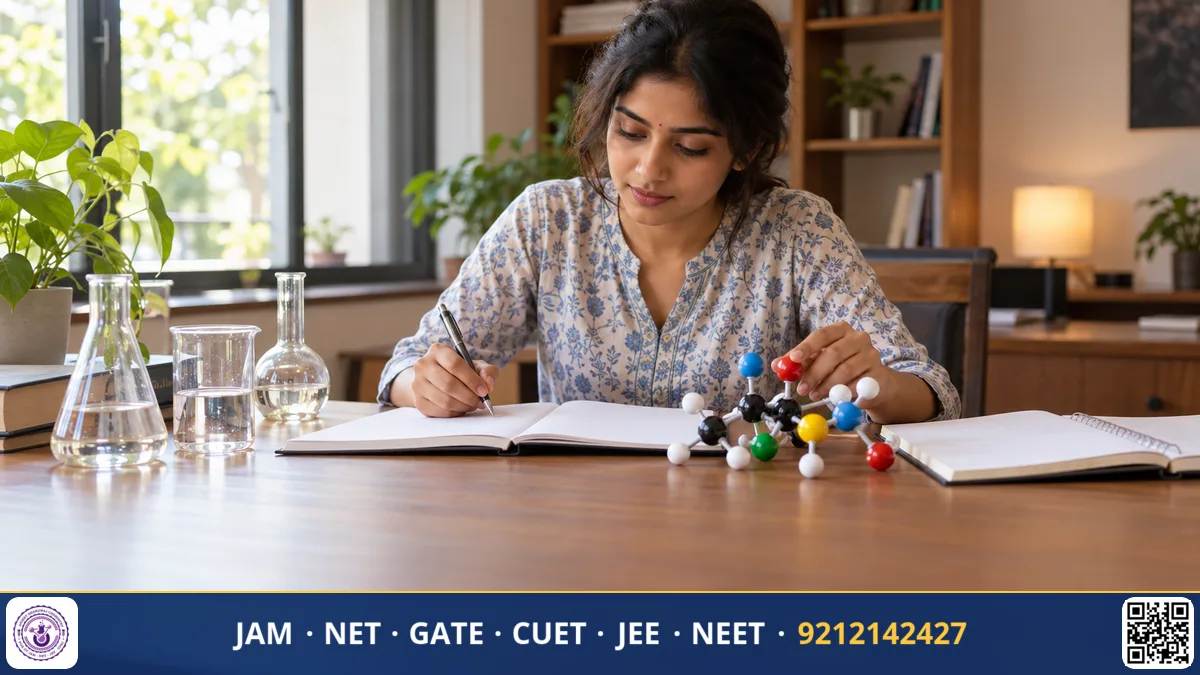
GATE Chemical Science Organic Chemistry: Weightage and Must-Do Topics
A structured guide to core syllabus modules, reaction mechanisms, spectroscopy, and preparation strategy for GATE Chemical Science aspirants.
Understanding the Organic Chemistry Component in GATE Chemical Science
The Graduate Aptitude Test in Engineering (GATE) for Chemical Science (CY) serves as a gateway for admissions to doctoral and master's programs across premier Indian institutions, as well as recruitment into public sector undertakings (PSUs). To approach this competitive examination effectively, aspirants must understand the overall structure of the paper and how organic chemistry integrates into the syllabus.
The GATE Chemical Science examination consists of two main divisions: General Aptitude and the subject-specific chemistry section. Within the chemistry component, questions span three fundamental disciplines: Physical Chemistry, Inorganic Chemistry, and Organic Chemistry. Unlike tests that prescribe a rigid, fixed percentage of marks to individual branches, GATE does not enforce a predetermined mark-allocation formula. The relative weightage of Organic Chemistry varies from year to year depending on the organizing Indian Institute of Technology (IIT) and the specific committee responsible for setting the paper. Aspirants should consult the official information brochure issued by the organizing institute for the current examination cycle to verify the official structure, rather than relying on informal estimates.
To plan your preparation systematically across the entire curriculum, it is valuable to review the overarching structure outlined in our GATE Chemical Science complete syllabus guide alongside our companion analysis on the GATE Physical Chemistry syllabus and weightage guide.
Aspirants must also navigate three distinct question formats introduced in the test:
- Multiple Choice Questions (MCQ): Traditional objective questions carrying one or two marks, where each question has four options with only one correct choice. Negative marking applies to incorrect answers in this format.
- Multiple Select Questions (MSQ): Advanced conceptual questions where one, two, three, or all four options may be correct. Full marks are awarded only when all correct options—and no incorrect ones—are selected. There is no partial marking and no negative marking, making these questions a rigorous test of theoretical thoroughness.
- Numerical Answer Type (NAT): Questions where the response is a signed number entered via an on-screen virtual keypad. While NAT questions are heavily associated with physical chemistry, organic chemistry frequently features NAT problems based on counting stereoisomers, calculating degrees of unsaturation, determining specific rotation, or counting peaks in nuclear magnetic resonance (NMR) spectra.
Core Organic Chemistry Syllabus Modules and Must-Do Topics
The official GATE syllabus for Organic Chemistry demands both foundational depth and advanced problem-solving skill. Instead of memorizing isolated facts, aspirants must develop an integrated grasp of reaction pathways, orbital symmetry, stereoelectronic factors, and spectroscopic analysis.
The following table outlines the major syllabus modules in Organic Chemistry, their fundamental conceptual pillars, and the common analytical skills evaluated in the examination.
| Syllabus Module | Key Conceptual Focus Areas | Question Framing & Analytical Skills |
|---|---|---|
| Stereochemistry & Conformation | Chirality, topicity, axial/planar chirality, cyclohexane conformations, Curtin-Hammett principle, asymmetric induction models. | Stereodescriptor assignment (R/S, E/Z), conformational stability, stereoselective additions to chiral carbonyls. |
| Reaction Mechanisms & Intermediates | Carbocations, carbanions, free radicals, carbenes, nitrenes, arynes; substitution, elimination, neighboring group participation (NGP). | Predicting major products, kinetic vs thermodynamic pathways, identifying non-classical intermediates, stereochemical inversion vs retention. |
| Organic Synthesis & Named Reactions | Enolate alkylation, aldol, olefination (Wittig, HWE, Peterson), modern cross-coupling, molecular rearrangements. | Multi-step synthetic sequences, reagent chemoselectivity, predicting migratory aptitudes in rearrangements. |
| Pericyclic & Photochemical Reactions | Woodward-Hoffmann rules, FMO theory, electrocyclizations, cycloadditions, sigmatropic shifts, photochemical cleavages. | Thermal vs photochemical stereospecificity, secondary orbital interactions, predicting regiochemistry and photoproducts. |
| Heterocyclic Chemistry & Biomolecules | Synthesis and reactivity of five- and six-membered heterocycles, fused heterocycles, amino acids, peptides, carbohydrates. | Electrophilic vs nucleophilic aromatic substitution orientation, protecting group logic, mutarotation, anomeric effects. |
| Organic Spectroscopy | UV-Vis, IR, 1H NMR, 13C NMR, DEPT, Mass Spectrometry (MS). | Deducing unknown structures from combined spectral data, distinguishing regioisomers and diastereomers. |
1. Stereochemistry and Conformational Analysis
Stereochemistry forms the architectural backbone of organic chemistry. Questions in GATE rigorously test both static stereochemistry and dynamic conformational behavior:
- Optical Activity and Symmetry: Concepts of chirality, elements of symmetry (planes, centers, and alternating axes of symmetry), and the relationship between symmetry elements and optical activity.
- Specialized Forms of Chirality: Axial chirality in allenes, alkylidene cyclohexanes, and ortho-substituted biphenyls (atropisomerism); planar chirality in ansa compounds and trans-cyclooctene; and helical chirality in helicenes.
- Topicity and Prochirality: Differentiating between homotopic, enantiotopic, and diastereotopic ligands and faces using the substitution addition criterion or symmetry operations. This distinction is critical for interpreting NMR spectra and predicting asymmetric additions.
- Conformational Analysis: Stability and conformational equilibria of acyclic molecules and substituted cyclohexanes. Calculating steric strain using A-values (1,3-diaxial interactions), understanding the conformational lock in tert-butylcyclohexanes, and analyzing fused ring systems such as cis- and trans-decalins.
- Dynamic Stereochemistry: The Curtin-Hammett principle, which governs product distributions when interconverting conformers react with distinct rates. Aspirants must also master asymmetric induction models such as the Felkin-Anh open-chain model, the Cornforth model, and the Cram chelate model for additions to carbonyl centers bearing an adjacent stereocenter.
2. Reaction Mechanisms and Reactive Intermediates
An accurate understanding of reaction mechanisms (अभिक्रिया क्रियाविधि) requires clear electron-pushing logic and familiarity with transient reactive intermediates:
- Reactive Intermediates: Generation, structure, stability, and reactivity of carbocations (including non-classical ions and rearrangements), carbanions, carbon radicals, carbenes (singlet vs triplet spin states and their stereospecific additions), nitrenes, and benzynes.
- Aliphatic Nucleophilic Substitution: Competing SN1, SN2, and SNi pathways, solvent effects, leaving group abilities, and nucleophilicity trends. Particular emphasis must be given to neighboring group participation (NGP), where internal heteroatoms or pi bonds accelerate substitution rates and preserve overall stereochemical configuration (anchimeric assistance).
- Elimination Reactions: Competition between E1, E2, and E1cB mechanisms. Regiochemical outcomes (Zaitsev vs Hofmann rules) and stereoelectronic requirements (anti-periplanar geometry in acyclic and cyclic substrates). Syn-eliminations such as the Chugaev reaction, Cope elimination, and selenoxide pyrolyses are also frequently evaluated.
- Aromatic Substitution: Electrophilic aromatic substitutions (orientation and activation effects) and nucleophilic aromatic substitutions, including the addition-elimination (SNAr) mechanism and the elimination-addition pathway via benzyne intermediates.
3. Organic Synthesis, Named Reactions, and Reagents
Modern organic chemistry in GATE focuses heavily on constructive carbon-carbon bond transformations, molecular rearrangements, and functional group interconversions:
- Enolate Chemistry: Generation of kinetic versus thermodynamic enolates using sterically hindered bases like lithium diisopropylamide (LDA). Regioselective alkylations, aldol reactions, Claisen condensations, Dieckmann cyclizations, Michael additions, and Robinson annulations. Understanding the role of silyl enol ethers in Mukaiyama aldol additions.
- Olefination Methodologies: Phosphonium ylide chemistry (Wittig reaction with stabilized vs non-stabilized ylides yielding E or Z alkenes), Horner-Wadsworth-Emmons (HWE) olefination, and the Peterson olefination under acidic and basic conditions.
- Transition-Metal Catalysis: Cross-coupling transformations such as the Suzuki-Miyaura, Heck, Sonogashira, Stille, and Negishi reactions. Candidates should understand the fundamental organometallic steps: oxidative addition, transmetalation, migratory insertion, and reductive elimination.
- Rearrangement Reactions: Migrations to electron-deficient carbon, nitrogen, and oxygen centers. Essential examples include the Beckmann, Hofmann, Curtius, Schmidt, Lossen, Baeyer-Villiger, Favorskii, pinacol-pinacolone, and benzil-benzilic acid rearrangements.
- Reagents and Selectivity: Mastering selective transformations is crucial. Review our detailed guide on chemoselective and stereoselective reduction methods for hydride reagents, dissolved metal reductions, and catalytic hydrogenations, as well as our guide on protecting group strategies in multi-step synthesis.
4. Pericyclic Reactions and Organic Photochemistry
Pericyclic reactions are concerted transformations governed by the conservation of orbital symmetry. Because these reactions are stereospecific, questions in this module demand exact mastery of Frontier Molecular Orbital (FMO) analysis and the Woodward-Hoffmann rules:
- Electrocyclic Reactions: Thermal and photochemical ring opening and ring closure of conjugated polyenes. Determining whether a 4n or (4n+2) pi-electron system proceeds via conrotatory or disrotatory motion under thermal or photochemical activation.
- Cycloadditions: The [4+2] Diels-Alder reaction, focusing on the endo rule, secondary orbital interactions, regiochemical alignment of unsymmetrical dienes and dienophiles, and stereospecificity. Photochemical [2+2] cycloadditions of alkenes and cycloadditions involving ketenes.
- Sigmatropic Rearrangements: Suprafacial and antarafacial migration pathways. Core examples include the [3,3]-sigmatropic rearrangements (Cope, oxy-Cope, and Claisen rearrangements) and [2,3]-sigmatropic shifts (such as the [2,3]-Wittig rearrangement), along with [1,5]-hydride shifts.
- Organic Photochemistry: Principles of electronic transitions (n-to-pi* and pi-to-pi*), the Jablonski diagram, intersystem crossing, and fluorescence/phosphorescence. Important photochemical transformations include Norrish Type I and Type II cleavages of carbonyls, the Paterno-Büchi reaction forming oxetanes, and di-pi-methane rearrangements.
5. Heterocyclic Chemistry and Biomolecules
Heterocyclic systems and naturally occurring organic molecules represent a significant segment of the syllabus:
- Heterocycles: Synthesis, aromaticity, and reactivity of five-membered rings (pyrrole, furan, thiophene) and six-membered rings (pyridine). Electrophilic attack preferences (C-2 vs C-3 in five-membered heterocycles; C-3 in pyridine) and nucleophilic aromatic substitutions such as the Chichibabin reaction. Fused heterocycles including indole, quinoline, and isoquinoline (Skraup and Bischler-Napieralski syntheses).
- Biomolecules: Structural features of alpha-amino acids, their zwitterionic character, and isoelectric point (pI) calculations. Solid-phase peptide synthesis and sequencing. Carbohydrate chemistry, including Fischer and Haworth projections, mutarotation, the anomeric effect, and selective glycosylation. Basic chemical architecture of nucleic acids, terpenes, and steroids.
Mastering Spectroscopy-Linked Structure Elucidation
One of the hallmark features of GATE Chemical Science is the combined spectroscopy problem. Instead of presenting simple, isolated spectral queries, the exam regularly asks students to deduce the complete structure of an unknown compound from correlated spectroscopic data, and then determine its behavior in a subsequent chemical reaction.
Solving structure elucidation (संरचना निर्धारण) problems requires an orderly, multi-step analytical workflow:
- Calculate the Degree of Unsaturation: Determine the Index of Hydrogen Deficiency (IHD) from the molecular formula. This immediately establishes the sum of rings and pi bonds present in the molecule.
- Analyze the Infrared (IR) Spectrum: Scan for diagnostic functional group absorptions. Pay close attention to carbonyl stretching frequencies (around 1650 to 1800 cm-1) to distinguish between amides, esters, ketones, aldehydes, and acid chlorides, taking into account conjugation and ring-strain shifts. Observe O-H and N-H stretching regions (3200 to 3600 cm-1) and C-H stretching modes (sp, sp2, sp3).
- Interpret Proton NMR (1H NMR) Spectra: Integrate signal areas to determine the number of equivalent protons. Use chemical shifts (delta values) to deduce electronic environments, and employ the (n+1) rule along with coupling constants (J values) to establish connectivity. Note stereochemical relationships: trans-alkenyl protons exhibit larger J values (typically 14 to 18 Hz) than cis-alkenyl protons (typically 7 to 12 Hz), while aromatic spin systems exhibit distinct ortho (6 to 9 Hz), meta (1 to 3 Hz), and para (0 to 1 Hz) couplings.
- Correlate with Carbon-13 (13C) and DEPT NMR: Count unique carbon environments. Use Distortionless Enhancement by Polarization Transfer (DEPT-45, DEPT-90, DEPT-135) to categorize carbons into methyl (-CH3), methylene (-CH2-), methine (-CH=), and quaternary carbon centers.
- Examine Mass Spectrometry (MS) Patterns: Identify the molecular ion peak (M+•) to confirm the molecular weight. Look for diagnostic isotopic signatures: a 3:1 ratio of M to (M+2) indicates one chlorine atom, while an approximately 1:1 ratio indicates one bromine atom. Analyze characteristic fragmentations, such as alpha-cleavages and the McLafferty rearrangement in carbonyl compounds.
Selectivity Principles: Chemoselectivity, Regioselectivity, and Stereoselectivity
In advanced organic synthesis, achieving control over multiple potential reaction sites is the central challenge. The GATE syllabus evaluates three interconnected selectivity dimensions:
1. Chemoselectivity: The preferential reaction of a reagent with one specific functional group in the presence of others. For instance, reducing an aldehyde or ketone in the presence of an ester requires mild hydride donors such as sodium borohydride (NaBH4), whereas lithium aluminum hydride (LiAlH4) non-selectively reduces both. Understanding the selective behavior of reagents such as DIBAL-H, sodium cyanoborohydride (NaBH3CN), and the Luche reagent (NaBH4/CeCl3) is essential.
2. Regioselectivity: The preferential formation of one positional isomer over another when multiple constitutional isomers are possible. Examples include Markovnikov versus anti-Markovnikov additions to unsymmetrical olefins, electrophilic aromatic substitutions on disubstituted benzenes, and nucleophilic ring-opening of unsymmetrical epoxides. Under basic conditions, nucleophiles attack the less sterically hindered carbon, whereas under acidic conditions, reaction occurs predominantly at the carbon best able to stabilize positive charge.
3. Stereoselectivity: The preferential formation of one stereoisomer over another. In diastereoselective transformations, reactions on substrates possessing existing stereocenters produce unequal mixtures of diastereomers. Models such as Felkin-Anh and Cram chelation allow students to predict the major diastereomer formed during nucleophilic additions to chiral aldehydes and ketones. In pericyclic reactions, orbital symmetry strictly dictates stereospecific outcomes.
Strategic Preparation for GATE Organic Chemistry
Excelling in the Organic Chemistry section of GATE requires structured, deliberate practice that bridges theoretical concepts with rigorous problem-solving. Consider the following recommendations during your preparation:
- Emphasize Mechanism Over Memorization: Avoid memorizing reaction outcomes as disconnected equations. Practice arrow-pushing mechanisms diligently. Tracking formal charges, orbital interactions, and stereochemical inversions or retentions builds the conceptual foundation necessary to solve unfamiliar problems.
- Practice Solving MSQ and NAT Formats: Allocate dedicated study time to Multiple Select Questions and Numerical Answer Type problems. In MSQ questions, treat every option as an independent true/false evaluation, paying close attention to stereochemical descriptors and intermediate stability. For NAT problems, practice calculating degrees of unsaturation, determining specific rotation, and counting NMR signals under time-constrained conditions.
- Compile Comparative Reagent Charts: Create clear comparative summaries detailing the exact scope, solvent requirements, and limitations of oxidizing agents, reducing agents, and protecting groups. Correlating complementary reagents clarifies their strategic use in multi-step synthesis.
- Solve Authentic Papers Systematically: Solve past GATE papers under simulated exam conditions. Review incorrect attempts thoroughly to identify whether mistakes stemmed from conceptual gaps, misreading stereochemical wedges and dashes, or calculation errors.
For aspirants seeking comprehensive, concept-oriented guidance, ABC Chemistry offers specialized classroom-centre and interactive online classes designed specifically for higher-tier national examinations such as GATE, CSIR-NET, and IIT-JAM. Founded and mentored by Mr. Aniket Bhardwaj, who brings more than 20 years of chemistry teaching experience, our programs emphasize first-principles conceptual clarity, systematic mechanism analysis, and dedicated problem-solving workshops. For detailed course enrollment information, students can connect with ABC Chemistry at 9212142427.
Frequently Asked Questions
What is the weightage of Organic Chemistry in the GATE Chemical Science exam?
The organizing IIT does not fix a predetermined percentage of marks for Organic Chemistry. The 85-mark subject section is divided among Physical, Inorganic, and Organic Chemistry, but the precise proportion varies each year. Aspirants should consult the official GATE brochure and assemble their own question tally using authentic past papers to observe general historical trends.
How should I prepare for spectroscopy-linked questions in GATE?
Master the complementary roles of IR, 1H NMR, 13C NMR, and Mass Spectrometry. Begin every problem by calculating the degree of unsaturation (Index of Hydrogen Deficiency), identify key functional groups from diagnostic IR stretches, determine carbon types using DEPT data, and establish connectivity using NMR chemical shifts and coupling constants (J values). Regularly practice solving combined multi-spectral problems from standard past examinations.
Are pericyclic reactions and photochemistry essential for scoring well?
Yes. Pericyclic reactions and organic photochemistry represent core modules in the official GATE syllabus. Because these reactions are strictly governed by orbital symmetry and the Woodward-Hoffmann rules, questions in this area are predictable and reward students who understand Frontier Molecular Orbital (FMO) principles and stereochemical modes (conrotatory, disrotatory, suprafacial, and antarafacial).
What types of Numerical Answer Type (NAT) questions appear in Organic Chemistry?
While NAT questions are commonly associated with physical chemistry, organic chemistry frequently features numerical problems. Typical topics include counting the total number of stereoisomers (including enantiomers and meso forms), calculating the degree of unsaturation from molecular formulas, finding the specific optical rotation of an enantiomeric mixture, and counting the number of signals in 1H or 13C NMR spectra.
How can I master stereochemical models like Felkin-Anh and Cram chelate?
Begin by drawing the chiral aldehyde or ketone in a Newman projection looking down the bond connecting the carbonyl carbon to the adjacent stereocenter. Identify the large, medium, and small groups based on steric and electronic properties according to the Felkin-Anh model, and direct the nucleophile to attack at the Bürgi-Dunitz angle (approximately 107 degrees) from the side of the small group. For Cram chelate models, identify bidentate ligands capable of coordinating to a Lewis acid metal ion (such as Mg2+ or Zn2+), lock the conformation, and evaluate attack from the less hindered face.
Does ABC Chemistry provide online coaching for GATE Chemical Science?
Yes. ABC Chemistry offers both classroom-centre batches and structured online classes for GATE Chemical Science, CSIR-NET, and IIT-JAM aspirants across India. Led by Mr. Aniket Bhardwaj with over 20 years of chemistry teaching expertise, the curriculum provides deep conceptual coverage, rigorous mechanism-oriented lectures, and targeted problem-solving sessions. Students can call 9212142427 for admission details.
Preparing for a chemistry entrance exam?
ABC Chemistry runs focused IIT-JAM, CSIR-NET, GATE and CUET-PG Chemistry coaching through live online classes for students across India.
Call / WhatsApp: 9212142427