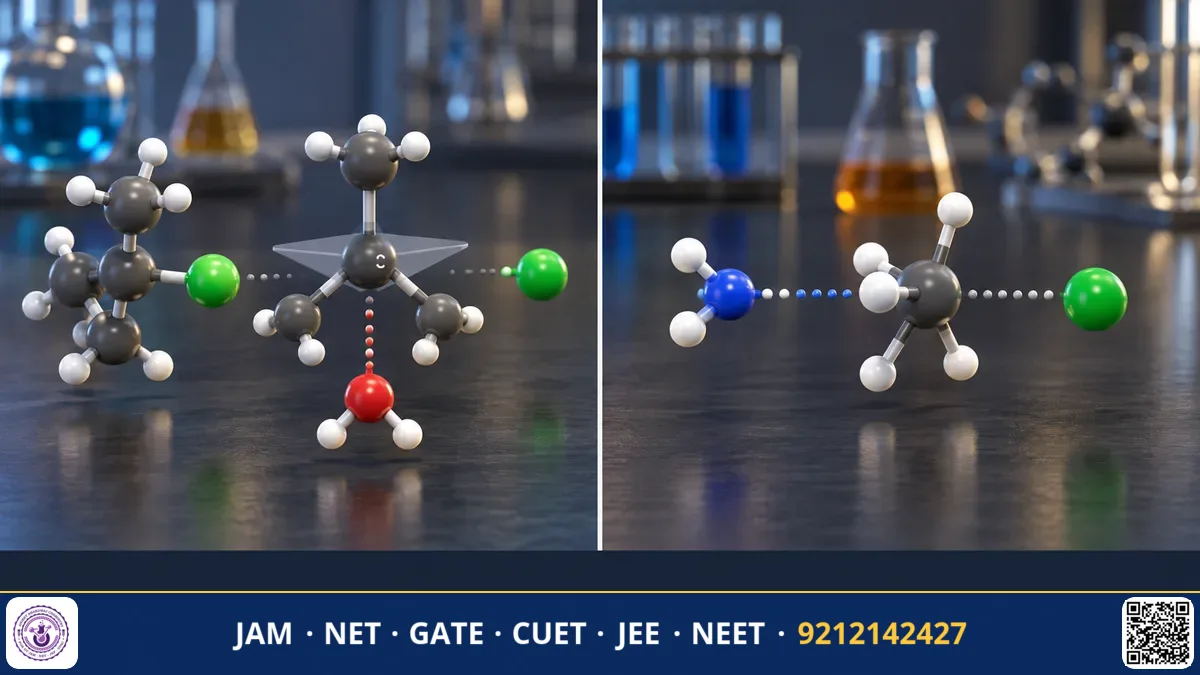
Haloalkanes and Haloarenes (Class 12): SN1 versus SN2 Explained Simply
What actually decides the mechanism, why haloarenes resist substitution, and the stereochemistry point that appears almost every year.
Class 12 · Organic Chemistry · Concept · Updated 24 August 2026
The comparison you must be able to write from memory
| SN1 | SN2 | |
|---|---|---|
| Slow step involves | Substrate only | Substrate and nucleophile |
| Rate law | Rate = k[RX] | Rate = k[RX][Nu] |
| Intermediate | Carbocation | None — one concerted step |
| Favoured by | 3° halides | 1° halides |
| Stereochemistry | Racemisation | Inversion of configuration |
| Solvent | Polar protic | Polar aprotic |
Why the order of reactivity reverses
SN1 runs through a carbocation, and carbocation stability rises 3° > 2° > 1°, so tertiary halides react fastest by SN1.
SN2 needs the nucleophile to attack the carbon from the side opposite the leaving group. Bulky groups block that approach, so the order reverses: primary halides react fastest by SN2. The same structural feature that stabilises the intermediate in one mechanism obstructs the transition state in the other.
That back-side attack is also why SN2 gives inversion of configuration — the Walden inversion, often compared to an umbrella turning inside out in the wind.
Why haloarenes are so unreactive
- The C—Cl bond has partial double-bond character from resonance with the ring, which shortens and strengthens it.
- The carbon is sp2 hybridised, so it is more electronegative and holds the shared pair more tightly than the sp3 carbon of a haloalkane.
- The electron-rich ring repels an approaching nucleophile.
- Forming a phenyl cation is very unfavourable, so the SN1 route is effectively closed too.
FAQs
Which halide is fastest by SN2?
Primary. Less steric crowding lets the nucleophile attack from the back side.
Why does SN1 give a racemic mixture?
The carbocation intermediate is planar, so the nucleophile can attack from either face with roughly equal probability.
Why are haloarenes less reactive than haloalkanes?
Resonance gives the C—X bond partial double-bond character, the sp² carbon binds more tightly, and the electron-rich ring repels nucleophiles.
What is the Walden inversion?
The reversal of configuration at the carbon centre during an SN2 reaction, caused by back-side attack.
Need help with this topic?
ABC Chemistry offers Home, Online, Group and One-to-One tuition for Class 11 & 12 Chemistry and Maths in Dwarka and Gurugram.
Call / WhatsApp: +91 92121 42427Related reading: Neighbouring Group Participation: When a Reaction Is Faster Than It Should Be