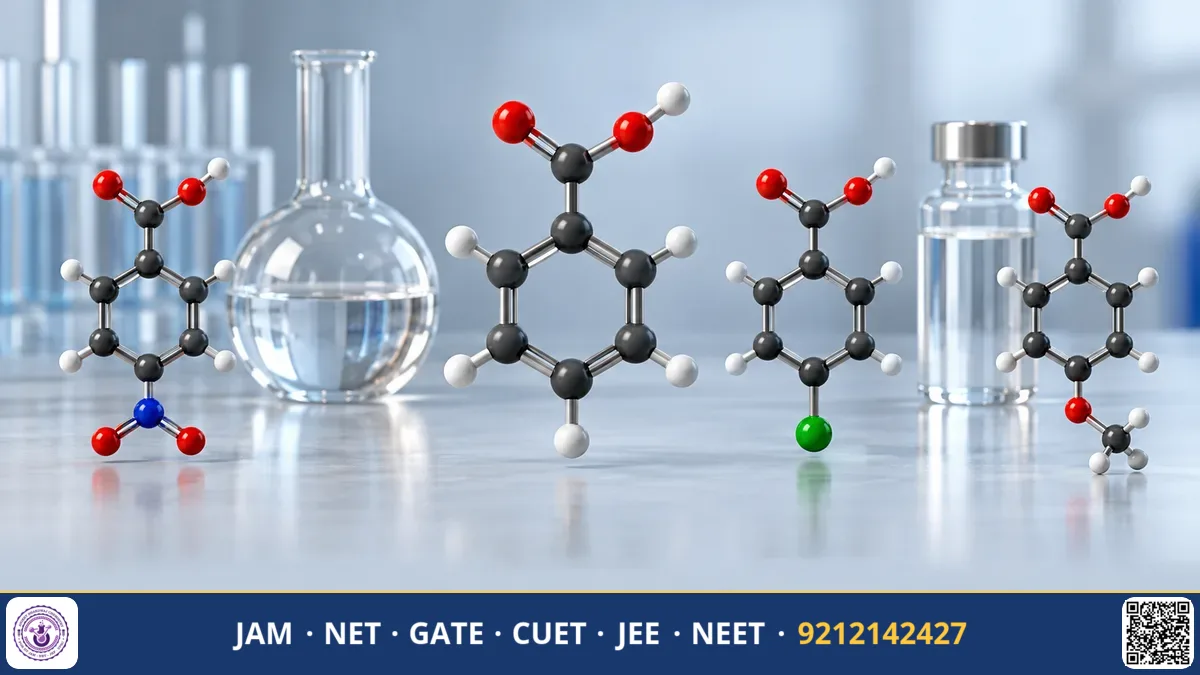

The Hammett Equation: Linear Free-Energy Relationships in Organic Chemistry
How substituent effects on reaction rate and equilibrium get reduced to a single number — and why CSIR-NET, GATE and IIT-JAM keep returning to it.
CSIR-NET · GATE Chemistry · IIT-JAM Chemistry · Physical Organic · Published 1 October 2026
What the equation actually says
For a series of meta- or para-substituted benzene derivatives undergoing the same reaction, the Hammett equation relates log(k/k₀) — or log(K/K₀) for an equilibrium — to σ, a substituent constant that measures how electron-withdrawing or electron-donating a group is relative to hydrogen, and ρ, a reaction constant that measures how sensitive that particular reaction is to electronic effects at all.
Reading the sign and size of ρ
| Observation | What it indicates |
|---|---|
| ρ > 0 | Rate or equilibrium increases with electron-withdrawing groups — negative charge is building up in the transition state or intermediate |
| ρ < 0 | Rate or equilibrium increases with electron-donating groups — positive (often cationic) charge is building up in the transition state or intermediate |
| ρ ≈ 0 | The reaction is barely sensitive to substituents — the bond-forming or bond-breaking step is far from the ring, or no significant charge develops there |
σ versus σ+
Ordinary σ values work well when the substituent acts mainly through induction. For reactions that generate a positive charge directly conjugated to the ring — the classic example is solvolysis of cumyl chlorides — electron-donating substituents can stabilise that charge through resonance far more than plain σ predicts. The modified constant σ+ accounts for this extra resonance donation, and using ordinary σ for such a reaction gives a poor, scattered correlation — itself a diagnostic clue about the mechanism.
Where the simple picture breaks down
How this fits a broader prep plan
The Hammett equation sits within the physical organic chemistry portion of CSIR-NET Part C and GATE Chemistry (CY), usually alongside kinetic isotope effects and reaction-mechanism questions that ask for similar reasoning about where charge builds up along a reaction coordinate.
FAQs
Is the Hammett equation examinable in GATE Chemistry, or mostly CSIR-NET?
Both. It appears in the physical organic sections of CSIR-NET Chemical Sciences and GATE Chemistry (CY), usually as a conceptual question about interpreting ρ rather than a long numerical derivation.
What is the practical difference between σ and σ+?
σ captures mostly inductive substituent effects; σ+ additionally accounts for resonance donation into a directly conjugated positive charge, and is used specifically for reactions where that kind of cationic intermediate forms.
Does ABC Chemistry cover this in GATE, CSIR-NET or IIT-JAM batches?
Yes, as part of the physical organic chemistry unit within these batches, alongside related topics like kinetic isotope effects and reaction mechanisms.
Preparing for IIT-JAM, CSIR-NET, GATE or CUET-PG Chemistry?
ABC Chemistry runs Chemical Science batches as live online classes for students anywhere in India. Taught in English with Hindi explanation wherever it helps a concept land.
Call / WhatsApp: 9212142427