Kinetic versus thermodynamic control in CSIR NET and GATE
Master kinetic versus thermodynamic reaction control, energy profiles, competitive mechanisms, worked practice questions, and study plans.
This guide explains kinetic and thermodynamic reaction control for post-graduate chemistry entrance examinations. You will learn to read reaction energy profiles accurately and solve competitive mechanism problems with confidence.
Understanding kinetic versus thermodynamic reaction control
When a reactant or intermediate follows competing pathways to yield different products, reaction conditions decide the outcome. You must distinguish between the rate of product formation and relative product stability.
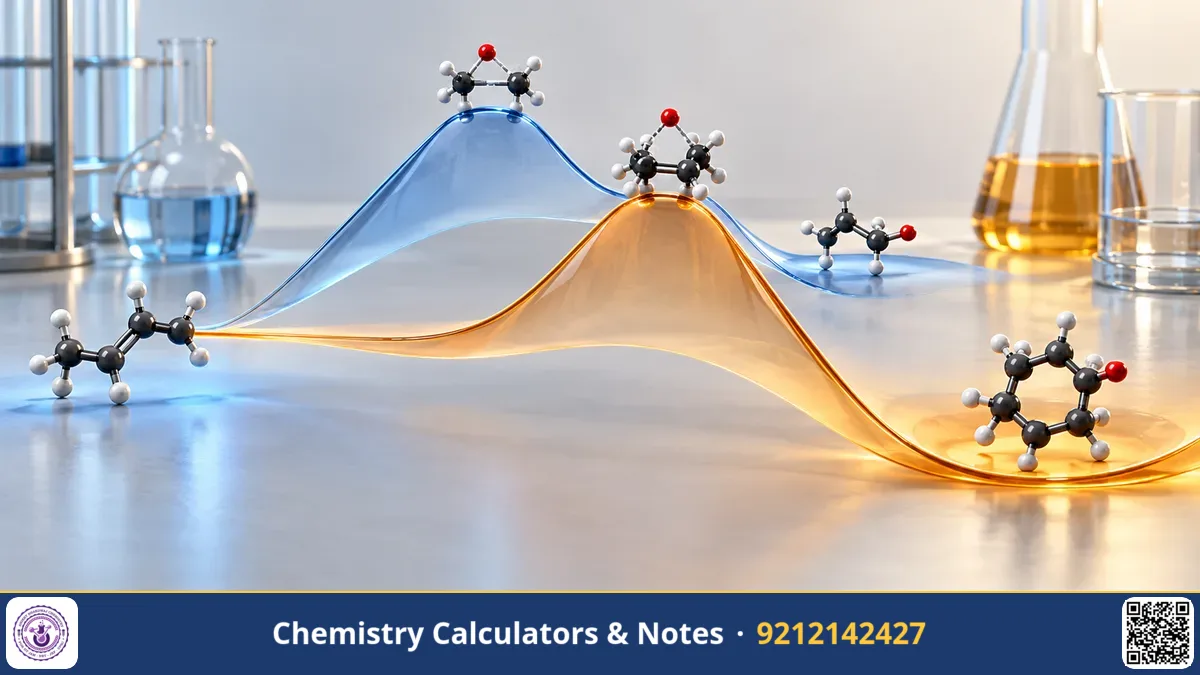
The term activation energy represents the energy barrier from starting material to the transition state. The pathway with the smaller activation energy proceeds faster. The product of this faster pathway is the kinetic product. At low temperatures, molecules clear this lower forward barrier, but lack energy to reverse once formed. The reaction is irreversible, so the product ratio depends strictly on forward rate constants.
The term free energy change describes the difference in stability between products and starting materials. The product in the deepest energy well has the lowest overall free energy and is the thermodynamic product. Higher temperatures supply thermal energy required for reversibility. When forward and reverse reactions equilibrate, the most stable product dominates according to the equilibrium constant.
Reading a reaction energy profile step by step
Reaction coordinate diagrams plot free energy against reaction progress. Follow this sequence to evaluate competitive pathways on examination diagrams:
- Reactant baseline: Start at the reactant ground state on the vertical axis to measure relative energy levels.
- Transition state peaks: Identify the highest point along each pathway. The lower peak corresponds to the smaller forward activation energy, marking the kinetic pathway.
- Product energy wells: Compare the valley depths of the products. The deepest valley indicates the lowest free energy, identifying the thermodynamic product.
- Reverse barriers: Measure the difference between each product valley and its transition state peak. This reverse barrier decides if a product reverts to starting material.
At low temperatures, molecules cannot clear the reverse barrier, trapping the kinetic product. At elevated temperatures, thermal energy allows molecules to cross the reverse barrier repeatedly, populating the deeper thermodynamic well.
Comparing kinetic and thermodynamic pathways
The operational differences between both regimes are summarized below:
| Parameter | Kinetic control | Thermodynamic control |
|---|---|---|
| Reaction temperature | Low temperature | Elevated temperature |
| Reaction duration | Short time; quenched early | Longer time to reach equilibrium |
| Governing factor | Rate of formation (lowest activation barrier) | Product stability (lowest free energy) |
| Critical barrier | Forward activation barrier | Reverse activation barrier |
| Reversibility | Irreversible forward steps | Reversible forward and reverse steps |
| Product ratio | Determined by forward rate constants | Determined by equilibrium constant |
How competitive exams frame these questions
Competitive examinations test this topic by assessing whether you can identify reversibility under specific conditions. Watch for three classic reaction models:
1. Addition of hydrogen halides to conjugated dienes: Protonation of 1,3-butadiene gives an allylic carbocation. Halide capture at the adjacent carbon gives the 1,2-adduct across a lower barrier. Capture at the terminal carbon yields the 1,4-adduct, a more substituted and more stable alkene. Low temperature yields the 1,2-adduct as the kinetic product, while higher temperature gives the 1,4-adduct as the thermodynamic product.
2. Regioselective enolate generation: Treating an unsymmetrical ketone with a strong, sterically hindered base like lithium diisopropylamide at low temperature deprotonates the less hindered carbon rapidly, generating the kinetic enolate. Using a smaller base at higher temperatures allows proton exchange, producing the more substituted thermodynamic enolate.
3. Sulfonation of naphthalene: At lower temperatures, 1-naphthalenesulfonic acid forms faster due to lower activation energy at the alpha position. At higher temperatures, steric crowding with the adjacent ring hydrogen causes desulfonation, driving reversible equilibrium toward the more stable 2-naphthalenesulfonic acid.
Do not assume the kinetic product is always less stable. When the lowest barrier leads directly to the deepest well, that single product dominates under all conditions.
Worked practice questions from the question bank
Work through two practice questions from the question bank:
Practice question 1 (from the question bank):
An energy profile for converting reactant R into products P1 and P2 shows that the forward activation barrier for P1 is lower than for P2. Meanwhile, P2 has lower free energy than P1, placing P2 in a deeper well. Which statement is correct?
- (A) P1 is the thermodynamic product and dominates after equilibration at elevated temperature.
- (B) P2 is the kinetic product and dominates at low temperature.
- (C) P1 is the kinetic product and dominates at low temperature; P2 is the thermodynamic product and dominates at elevated temperature.
- (D) Both products form at identical rates because both pathways are exothermic.
Solution:
- Compare barriers: The forward activation barrier for P1 is lower than for P2, so P1 forms faster as the kinetic product.
- Compare stability: The free energy of P2 is lower than P1, placing P2 in the deeper well as the thermodynamic product.
- At low temperature, the reverse reaction is negligible, trapping kinetic product P1.
- At elevated temperature, molecules overcome the reverse barrier, equilibrating to thermodynamic product P2.
Correct Answer: (C)
Practice question 2 (from the question bank):
Consider the reaction of 2-methylcyclohexanone under two distinct conditions, each followed by addition of iodomethane:
- Condition 1: Lithium diisopropylamide in tetrahydrofuran at low temperature.
- Condition 2: Sodium ethoxide in ethanol at an elevated temperature.
What are the major alkylated products formed under Condition 1 and Condition 2, respectively?
- (A) Condition 1 gives 2,6-dimethylcyclohexanone; Condition 2 gives 2,2-dimethylcyclohexanone.
- (B) Condition 1 gives 2,2-dimethylcyclohexanone; Condition 2 gives 2,6-dimethylcyclohexanone.
- (C) Both conditions give 2,6-dimethylcyclohexanone.
- (D) Both conditions give 2,2-dimethylcyclohexanone.
Solution:
- In Condition 1, lithium diisopropylamide is bulky and strong. At low temperature, deprotonation is irreversible at the less hindered position across a lower barrier. Alkylation yields 2,6-dimethylcyclohexanone.
- In Condition 2, ethoxide in ethanol allows reversible proton transfer at elevated temperature. Equilibrium favors the more substituted enolate. Alkylation yields 2,2-dimethylcyclohexanone.
Correct Answer: (A)
A four-week study plan for chemical science aspirants
Follow this four-week schedule to master reaction control:
- Week 1 (Coordinates and theory): Review transition state concepts, free energy diagrams, and activation parameters. Practice sketching profiles and identifying reverse barriers.
- Week 2 (Core reaction models): Work through additions to conjugated dienes, regioselective enolates, and reversible aromatic substitutions. Map mechanisms under kinetic and thermodynamic conditions.
- Week 3 (Question-bank practice): Solve chapter-wise problems from the question bank. Train yourself to spot keywords indicating kinetic control versus thermodynamic control.
- Week 4 (Timed sets and error analysis): Attempt timed question sets and log mistakes. Check whether errors arose from misreading profiles or overlooking reversibility.
Key takeaways
- The kinetic product forms faster via the lower transition state and dominates at low temperatures with short reaction times.
- The thermodynamic product has the lowest free energy and dominates at higher temperatures when reactions become reversible.
- On reaction profiles, compare peak heights for kinetic control and product well depths for thermodynamic control.
- Reversible reaction conditions allow the system to escape shallow kinetic wells and populate the deepest thermodynamic well.
Frequently asked questions
Can the kinetic product and thermodynamic product be identical?
Yes. When the pathway with the lowest activation barrier also leads to the product with the lowest free energy, one compound is both the kinetic and thermodynamic product across all temperatures.
Why does low temperature prevent thermodynamic control?
Thermodynamic control requires reversible steps so molecules can equilibrate. At low temperatures, the system lacks sufficient thermal energy to climb the reverse activation barrier, trapping the faster-forming kinetic product.
What are the primary indicators of kinetic control in exam questions?
Key indicators include low reaction temperatures, short reaction times, bulky bases, and explicit mentions of irreversible conditions.