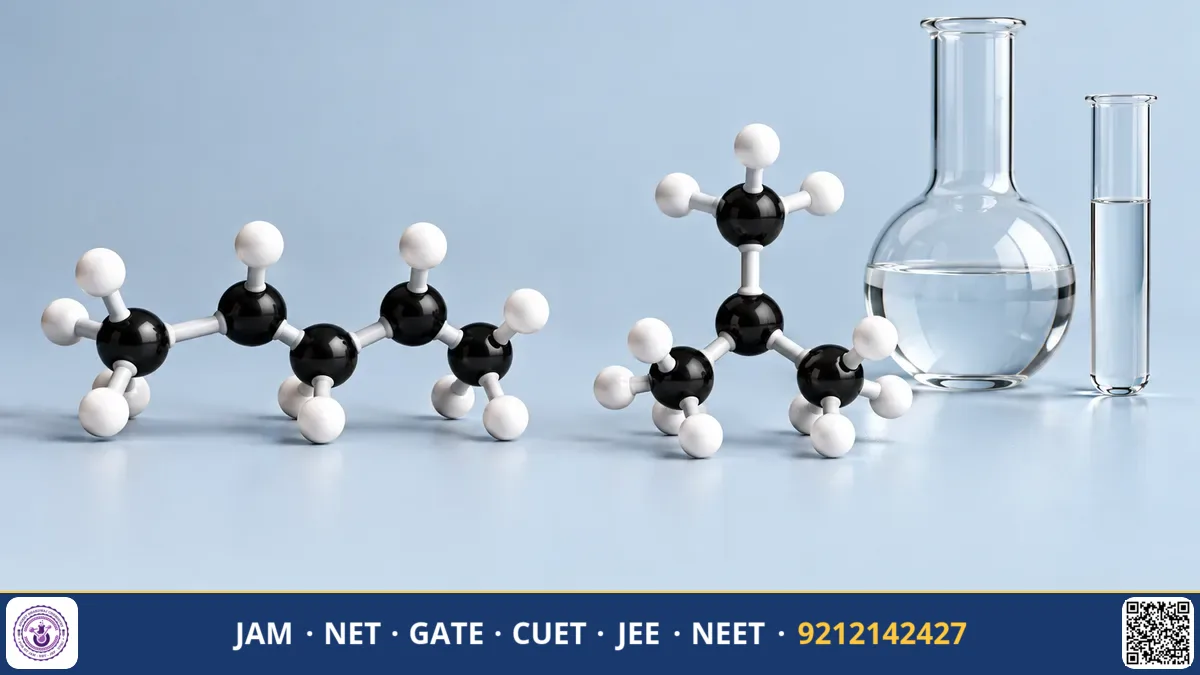

Organic Chemistry Basics (Class 11): IUPAC Naming and Isomerism
Naming is a procedure with a fixed order of steps. Follow the order and long names become routine; guess at it and even short ones go wrong.
Class 11 · CBSE & ISC · Concept and method
IUPAC naming, in the order the steps must be done
- Identify the principal functional group. This decides the suffix and takes priority over chain length.
- Find the longest continuous chain that contains that group. Not simply the longest chain in the molecule — it must include the principal group.
- Number the chain so the principal functional group receives the lowest possible locant.
- Identify substituents and their positions.
- Assemble: substituents in alphabetical order with locants, then the parent chain, then the suffix.
Functional group priority, highest first
| Group | Suffix when principal | Prefix when not |
|---|---|---|
| Carboxylic acid | -oic acid | carboxy- |
| Ester | -oate | alkoxycarbonyl- |
| Amide | -amide | carbamoyl- |
| Nitrile | -nitrile | cyano- |
| Aldehyde | -al | oxo- |
| Ketone | -one | oxo- |
| Alcohol | -ol | hydroxy- |
| Amine | -amine | amino- |
Only the highest-priority group present becomes the suffix. Every other functional group in the molecule is named as a prefix, alongside the alkyl substituents.
Alphabetical order, with its two traps
Substituents are cited alphabetically. Multiplying prefixes such as di, tri and tetra are not counted when alphabetising, so "diethyl" alphabetises under e. But complex substituent names in brackets are counted from their first letter. Both points are tested regularly.
Isomerism
Isomers share a molecular formula but differ in some other respect. The first division is between different connectivity and different spatial arrangement.
| Type | What differs | Example situation |
|---|---|---|
| Chain | Carbon skeleton branching | Straight chain versus branched with the same formula |
| Position | Location of a group on the same skeleton | An OH on carbon 1 versus carbon 2 |
| Functional | The functional group itself | An alcohol versus an ether of the same formula |
| Metamerism | Distribution of carbons either side of a divalent group | Different alkyl groups flanking an ether oxygen |
| Tautomerism | Rapid interconversion by proton shift | Keto and enol forms in equilibrium |
| Geometrical | Arrangement about a restricted bond | Cis and trans across a C=C |
| Optical | Handedness about a stereocentre | Non-superimposable mirror images |
The first five are structural isomerism; the last two are stereoisomerism. Tautomers are worth distinguishing carefully, because they interconvert rapidly and exist in equilibrium — unlike other structural isomers, which are distinct isolable compounds.
Electronic effects, which explain the reactions later
Inductive effect
Permanent polarisation transmitted through sigma bonds, weakening rapidly with distance — usually negligible beyond three bonds. Alkyl groups are electron-releasing; halogens and nitro groups are electron-withdrawing.
Resonance
Delocalisation of π electrons or lone pairs over more than two atoms. Resonance structures are not real separate species that interconvert; the actual molecule is a single hybrid. Stating this correctly is worth a mark, and describing resonance as "the molecule flipping between forms" loses it.
Hyperconjugation
Delocalisation involving sigma electrons of a C–H bond adjacent to a π system or an empty orbital. It explains why more substituted carbocations and alkenes are more stable — more adjacent C–H bonds means more hyperconjugative stabilisation.
These three effects, taken together, account for most of the stability arguments used across the rest of organic chemistry, which is why they belong at the start rather than being treated as an appendix.
Frequently asked questions
What if two chains of the same length both contain the functional group?
Choose the one with more substituents. If that still ties, apply the lowest-locants rule to the set of substituents.
Do multiplying prefixes count in alphabetical order?
No for simple prefixes such as di and tri. Yes for the full name of a complex substituent written in brackets. This distinction is tested often.
How is a tautomer different from a resonance structure?
Tautomers are genuinely different compounds in equilibrium, differing in the position of an atom — usually a proton. Resonance structures differ only in electron distribution and describe one single compound. They are conceptually unrelated, despite often being confused.
How many isomers should I be able to draw?
Enough to be systematic rather than to recall a number. Work through skeletons first, then positions on each skeleton, then functional group alternatives — a fixed order prevents both omissions and duplicates.
Students From These Gurugram Societies Learn With ABC Chemistry Online
Families in societies including Godrej Vrikshya, Whiteland The Urban Resorts, Indiabulls Centrum Park and Signature Global Grand IVA in Sector 103, Gurugram, learn with ABC Chemistry through live online classes; the registered office is at D-101 Capital Gateway, Sector 111. Small-group Class 11–12 batches run live online, for every part of Gurugram, Delhi and beyond.
Need help with Class 11–12 Chemistry?
ABC Chemistry runs small-group Class 11 and 12 Chemistry batches as live online classes for students across India.
Call / WhatsApp: +91 92121 42427Related reading: Purification and Analysis of Organic Compounds (Class 11)