Organic chemistry: GOC basics every chemistry student needs
Master inductive, resonance, and hyperconjugation effects in organic chemistry with solved practice questions and a revision plan for entrance exams.
This guide covers three core electron displacement effects in general organic chemistry: inductive effect, resonance, and hyperconjugation. You will learn how these factors govern intermediate stability, work through two practice questions from our question bank, and follow a revision plan for post-graduate chemical science examinations.
Core electronic displacements in general organic chemistry
Reaction mechanisms depend on electron density shifts within a molecular framework. Three permanent displacement effects govern these shifts:
- Inductive effect: A permanent polarization along sigma bonds caused by electronegativity differences. Electronegativity is an atom's ability to attract shared electrons. Electron-withdrawing (-I) groups like nitro, cyano, and halogens pull electron density through the sigma framework. Electron-donating (+I) groups like alkyl substituents push electron density. The effect diminishes rapidly with distance and becomes negligible beyond three sigma bonds.
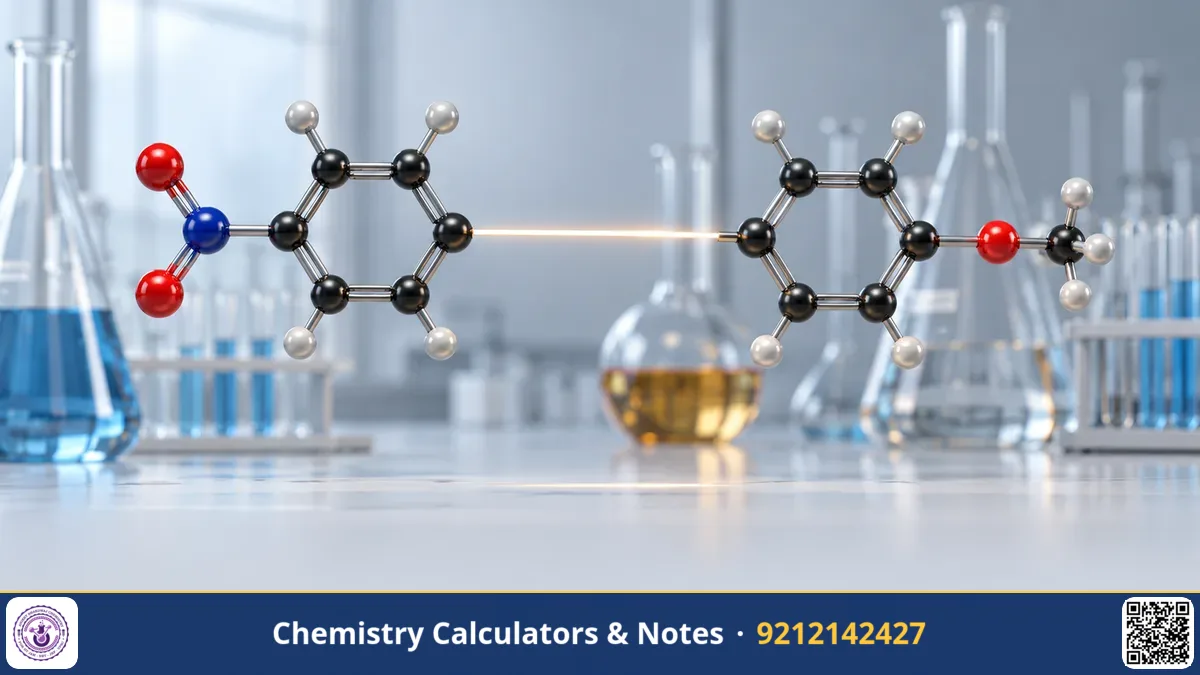
- Resonance effect: The delocalisation of pi electrons and unshared pairs across conjugated p-orbitals. Conjugation requires alternating single and multiple bonds or parallel p-orbitals. Substituents with unshared pairs, such as hydroxyl or amino groups, exert an electron-donating (+M) mesomeric effect. Groups with electronegative multiple bonds, such as nitro or carbonyl groups, exert an electron-withdrawing (-M) mesomeric effect. Contributors with complete octets and minimal formal charges provide greatest stability.
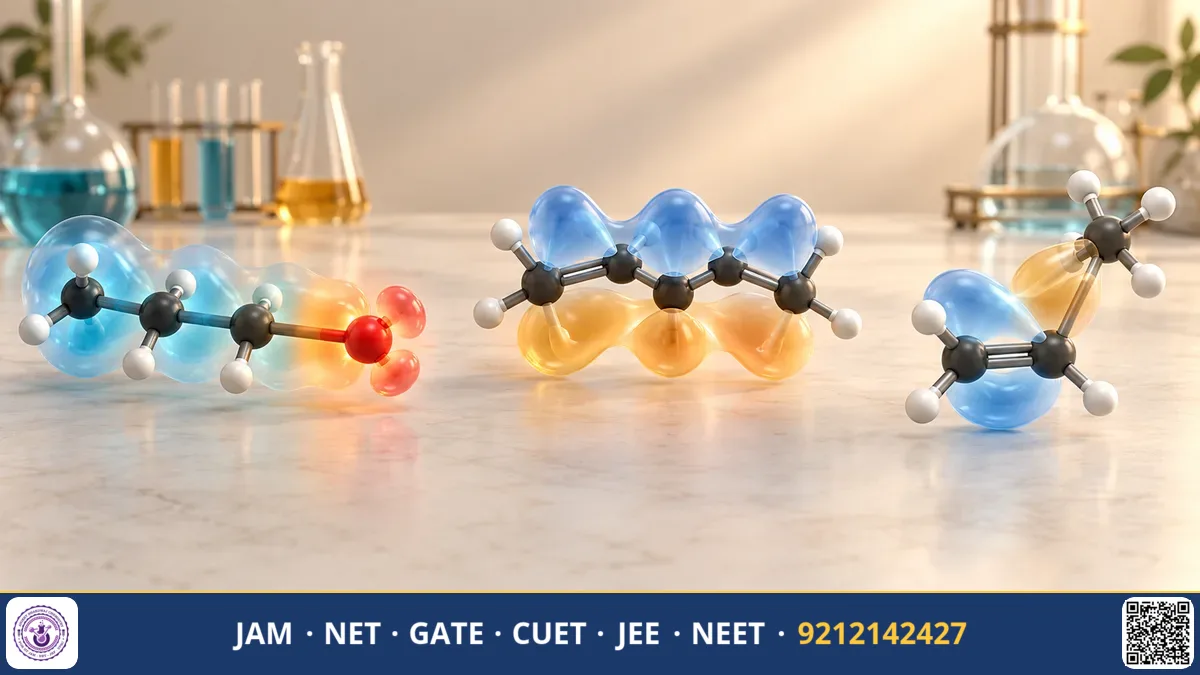
- Hyperconjugation: The stabilizing overlap of electrons in an adjacent sigma bond (typically carbon-hydrogen) with an empty or partially filled p-orbital. Often termed no-bond resonance, its stabilizing effect depends on the number of alpha hydrogens—hydrogen atoms attached to the carbon directly adjacent to the reactive centre. More alpha hydrogens provide greater charge dispersion.
| Electronic effect | Bonds involved | Operating range | Relative influence |
|---|---|---|---|
| Inductive effect | Sigma bonds | Fades rapidly past three bonds | Weakest permanent displacement effect |
| Hyperconjugation | Sigma carbon-hydrogen or carbon-carbon bonds | Restricted to adjacent alpha positions | Stronger than inductive effect |
| Resonance effect | Pi bonds and unshared p-orbitals | Operates across the conjugated system | Dominates over hyperconjugation and inductive effects |
As a rule, resonance stabilization dominates over hyperconjugation, which outweighs inductive effects. A key exception occurs with halogens on an aromatic ring: high electronegativity causes inductive withdrawal to outweigh resonance donation in overall reactivity, even though resonance directs electrophiles to ortho and para positions.
The examination angle for chemical science papers
National post-graduate entrance examinations—such as IIT-JAM Chemistry, CSIR NET Chemical Science, GATE Chemistry, and CUET-PG Chemistry—test general organic chemistry through conceptual ranking and mechanistic deduction rather than direct recall.
Examiners assess your understanding across four recurring formats:
- Intermediate stability: Ranking carbocations, carbanions, and radicals to determine addition, rearrangement, and elimination pathways.
- Acidity and basicity: Ordering substituted phenols, carboxylic acids, and amines by evaluating conjugate base or conjugate acid stabilization.
- Aromaticity: Classifying cyclic conjugated systems as aromatic, anti-aromatic, or non-aromatic based on ring planarity, continuous p-orbital overlap, and the total count of delocalised pi electrons.
- Directing groups: Analyzing competition between mesomeric and inductive influences to predict aromatic substitution sites.
When solving ranking problems, write out the conjugate species. To determine relative acidity, draw the conjugate base and inspect how resonance, hyperconjugation, and inductive withdrawal disperse negative charge. The molecule forming the most stabilized conjugate base is the strongest acid.
Worked practice questions from the question bank
Apply these electronic principles to two original practice questions from our chemistry question bank.
Practice question 1 (qid: goc-101)
Arrange the following three carbocations in order of decreasing stability: (1) 4-methoxybenzyl cation, (2) 4-methylbenzyl cation, and (3) 4-nitrobenzyl cation.
Step-by-step solution:
All three ions are benzylic carbocations where the vacant p-orbital conjugates with the aromatic ring:
In cation 1, the para methoxy substituent donates electron density through resonance (+M effect) using an oxygen unshared electron pair. This delocalises positive charge directly onto oxygen, yielding an octet-complete contributor. This resonance donation completely dominates over inductive electron withdrawal at the para position.
In cation 2, the para methyl substituent donates electron density through hyperconjugation via three alpha carbon-hydrogen bonds and a weak +I effect. This stabilizes the cation, but hyperconjugation is weaker than the +M resonance stabilization of methoxy.
In cation 3, the para nitro substituent withdraws electron density through strong -M resonance and -I inductive effects. This draws electron density away from the benzylic carbon, concentrating positive charge and destabilising the ion.
Answer: Decreasing stability order is 1 > 2 > 3.
Practice question 2 (qid: goc-102)
Arrange the following three compounds in order of decreasing acidity: (1) 4-nitrophenol, (2) 3-nitrophenol, and (3) 4-methylphenol.
Step-by-step solution:
To evaluate relative acidity, assess the stability of the phenoxide conjugate base formed upon deprotonation:
In compound 1 (4-nitrophenol), the nitro substituent is para to the phenoxide oxygen. Negative charge delocalises via resonance (-M effect) directly onto electronegative nitro oxygens, reinforced by the -I effect. This dual stabilization makes the phenoxide anion exceptionally stable and 4-nitrophenol the strongest acid.
In compound 2 (3-nitrophenol), the nitro substituent is meta to the phenoxide oxygen. Mesomeric interaction cannot occur because resonance contributors never place negative charge on the meta ring carbon. The nitro group acts solely through its electron-withdrawing inductive (-I) effect. This stabilizes the conjugate base, but far less effectively than resonance stabilization in the para isomer.
In compound 3 (4-methylphenol), the para methyl substituent donates electron density through hyperconjugation and a +I effect. This destabilises the phenoxide oxygen, making 4-methylphenol the weakest acid.
Answer: Decreasing acidity order is 1 > 2 > 3.
Four-week revision plan for organic reaction principles
Follow this structured four-week schedule to prepare for post-graduate chemical science examinations:
- Week 1: Electronic displacement fundamentals: Practice drawing canonical resonance structures for conjugated carbonyls, polyenes, and aromatic derivatives. Label +M, -M, +I, and -I substituents, and verify formal charges.
- Week 2: Intermediates and aromatic systems: Examine the geometry and stability of carbocations, carbanions, and carbon radicals. Master aromatic stability by classifying conjugated cyclic rings as aromatic, anti-aromatic, or non-aromatic based on continuous conjugation and pi electron counting.
- Week 3: Acidity and basicity ranking: Practice ranking substituted phenols, benzoic acids, pyridines, and anilines. Study the ortho effect in substituted benzoic acids and steric inhibition of resonance.
- Week 4: Timed question-bank problem solving: Solve mixed sets of ranking and mechanism problems from the chemistry question bank under timed conditions. Review every incorrect answer to confirm whether you misidentified the governing electronic effect.
Key takeaways
- The inductive effect transmits polarization along sigma bonds and drops off sharply beyond three bonds.
- Resonance delocalisation involves pi electrons across conjugated p-orbitals, providing greater stabilization energy than inductive shifts.
- Hyperconjugation stabilises carbocations, radicals, and alkenes through overlap of adjacent carbon-hydrogen sigma bonds with vacant or partially filled p-orbitals.
- Prioritize resonance over hyperconjugation, and hyperconjugation over inductive effects, noting the halogen exception.
- Acidity and basicity problems must always be solved by evaluating the electronic stabilization of the conjugate base or conjugate acid.
Frequently asked questions
What distinguishes the inductive effect from hyperconjugation?
The inductive effect involves shifting electron density along sigma bonds due to electronegativity differences between bonded atoms. Hyperconjugation involves direct overlap of an adjacent carbon-hydrogen sigma bonding orbital with an empty or partially filled p-orbital, acting as no-bond resonance.
Why does resonance delocalisation take precedence over the inductive effect?
Pi electrons in conjugated systems are held less tightly by atomic nuclei than sigma electrons. Consequently, pi electrons delocalise extensively across p-orbitals, creating substantial resonance stabilization energy that outweighs localized sigma bond polarization.
Why are halogens unique in aromatic electrophilic substitution?
Halogens possess high electronegativity that produces a strong electron-withdrawing inductive (-I) effect, alongside lone pairs that provide electron-donating resonance (+M). Inductive withdrawal deactivates the ring toward electrophiles, while resonance directs incoming attack to ortho and para positions.
How does hyperconjugation explain alkyl carbocation stability?
An alkyl carbocation is stabilized when adjacent carbon-hydrogen sigma bonds overlap with its empty p-orbital. A tertiary carbocation possesses nine alpha hydrogens, providing nine hyperconjugative interactions that disperse positive charge far more effectively than in secondary or primary carbocations.