
ABC Chemistry – Best Chemistry Coaching in Dwarka, Delhi

🔥 ALL COURSES SPECIAL OFFER 2026 CSIR NET • GATE • IIT-JAM • CUET PG 📞 92121-42427 Apply Now 🔥 ALL COURSES SPECIAL OFFER 2026 CSIR NET • GATE • IIT-JAM • CUET PG 📞 92121-42427 Apply Now 🔥 ALL COURSES SPECIAL OFFER 2026 CSIR NET • GATE • IIT-JAM • CUET PG 📞 92121-42427 Apply Now

The 18-Electron Rule and Hapticity: Counting Without Errors

Inorganic Chemistry · Organometallics The 18-Electron Rule and Hapticity: Counting Without Errors Electron counting is one of the few entrance-exam skills that is purely mechanical. Getting it wrong is almost always a bookkeeping slip, not a gap in understanding. BSc & MSc · Inorganic Chemistry · Method The short answer: Count the metal d electrons and add the electrons donated by each ligand. Eighteen corresponds to a filled valence shell and is the stable configuration for most low-oxidation-state transition metal complexes. Two counting conventions exist — ionic and neutral — and they give the same total provided you do not…
Read More

Crystal Field Theory: Splitting, CFSE and the Spectrochemical Series

Inorganic Chemistry · Coordination Crystal Field Theory: Splitting, CFSE and the Spectrochemical Series Coordination chemistry carries more entrance-exam weight than any other inorganic topic, and crystal field theory is the engine underneath most of it. BSc & MSc · Inorganic Chemistry · Concept The short answer: An octahedral field raises the two eg orbitals and lowers the three t2g orbitals, splitting them by Δo. Whether electrons pair up or occupy the upper set depends on whether Δo exceeds the pairing energy — which is what decides high-spin versus low-spin, and therefore colour, magnetism and stability. The model in one paragraph…

Read More

CIP Rules and R/S Assignment Without Mistakes

Organic Chemistry · Stereochemistry CIP Rules and R/S Assignment Without Mistakes Almost every stereochemistry error at entrance level comes from three specific places. Fix those and the assignments become mechanical. BSc & MSc · Organic Chemistry · Method The short answer: Rank the four groups on a stereocentre by atomic number at the first point of difference, put the lowest priority away from you, and read 1→2→3. Clockwise is R, anticlockwise is S. The rules are short; the errors come from exploring branches in the wrong order and from mishandling the case where the lowest group points toward the viewer….

Read More

Haemoglobin and Myoglobin: Coordination Chemistry Doing a Job

Inorganic Chemistry · Bioinorganic Haemoglobin and Myoglobin: Coordination Chemistry Doing a Job Bioinorganic questions are coordination chemistry questions wearing biological clothing. The reasoning is the same — geometry, spin state and ligand field. BSc & MSc · Inorganic Chemistry · Concept The short answer: Both proteins carry iron in a porphyrin ring. Myoglobin has one such site and binds oxygen with a simple hyperbolic curve; haemoglobin has four and binds cooperatively, giving a sigmoidal curve. The cooperativity is a structural consequence of a spin-state change moving the iron into the porphyrin plane. The haem group Both proteins are built around…

Read More

Molecular Symmetry and Point Groups: The Topic That Pays for Itself

Inorganic Chemistry · Symmetry Molecular Symmetry and Point Groups: The Topic That Pays for Itself Symmetry is taught as an abstract unit and then quietly assumed by spectroscopy, bonding and coordination chemistry. Learning it early makes three later topics cheaper. BSc & MSc · Inorganic Chemistry · Concept The short answer: Identify the symmetry elements a molecule possesses, assign it to a point group using a fixed decision sequence, and the character table then tells you which vibrations are infrared or Raman active, whether a molecule can be polar, and whether it can be chiral. It is one of the…

Read More

Steady-State Approximation: Three Solved Kinetics Problems

Physical Chemistry · Solved Problems Steady-State Approximation: Three Solved Kinetics Problems The approximation itself is one line. Knowing which intermediate to apply it to, and being able to defend that choice, is the part that is actually examined. BSc & MSc · Chemical Kinetics · Worked problems The short answer: Set d[intermediate]/dt ≈ 0, solve for the intermediate concentration, and substitute it into the rate expression for a product. The approximation is valid when the intermediate is highly reactive, so its concentration stays small and nearly constant — which is why it is applied to radicals and reactive complexes, never…

Read More

Particle in a Box: The Derivation IIT-JAM and CSIR-NET Actually Ask

Physical Chemistry · Quantum Particle in a Box: The Derivation IIT-JAM and CSIR-NET Actually Ask Almost every quantum question at entrance level is this one model wearing a different hat. Learn the derivation properly once and a whole unit becomes routine. BSc & MSc · Physical Chemistry · Concept · IIT-JAM, CSIR-NET, GATE The short answer: A particle confined to a one-dimensional box of length L has quantised energy En = n²h²/8mL², with n = 1, 2, 3… The quantisation is not assumed — it falls out of forcing the wavefunction to vanish at both walls. Understanding why that boundary…

Read More

IIT-JAM Chemistry: How to Study Physical Chemistry Without Drowning in Formulas

IIT-JAM · Chemistry IIT-JAM Chemistry: How to Study Physical Chemistry Without Drowning in Formulas For BSc students across India preparing for IIT-JAM — why physical chemistry feels heaviest, and the method that turns it into the most reliable section. IIT-JAM · Physical Chemistry · Graduate entrance · Published 28 August 2026 In short: Physical chemistry is the section most JAM aspirants fear and the one that rewards method most. The problem is almost never the formulas — it is that candidates memorise results instead of learning which quantity is being conserved, held constant or measured. Fix that and the same…

Read More

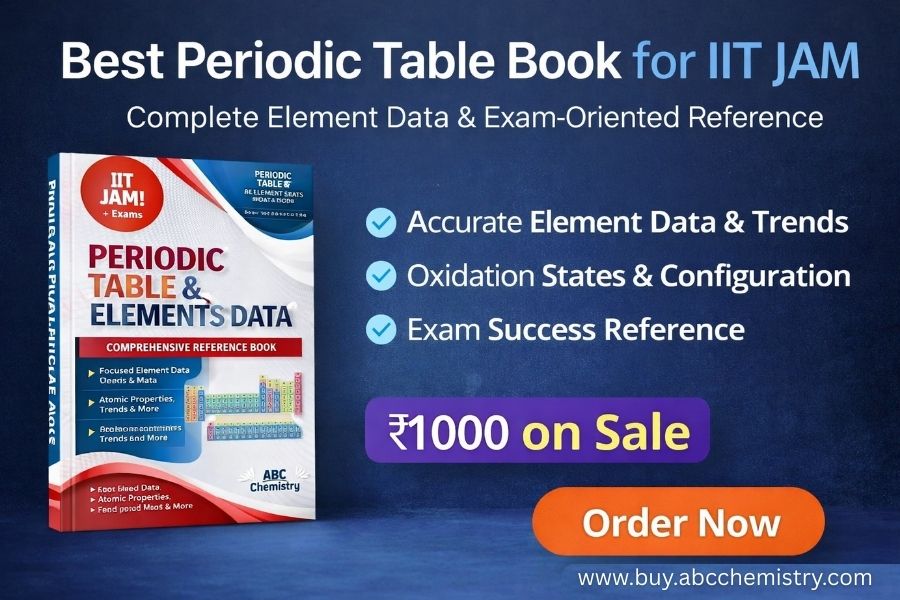
Best Periodic Table Book for IIT JAM 2026

Best Periodic Table Book for IIT JAM 2026

Best Periodic Table Book for IIT JAM – Complete Element Data & Exam-Oriented Reference Buy Now – Limited Stock Available If you are preparing for IIT JAM Chemistry, choosing the right study material can significantly impact your performance. One of the most important resources every aspirant needs is a reliable Periodic Table Book for IIT JAM that provides accurate element data, trends and exam-focused reference material in one place. In competitive exams like IIT JAM, direct and indirect questions from periodic properties, atomic data, oxidation states and inorganic trends are frequently asked. That is why investing in a structured and…

Read More

ABC Chemistry · 4th Floor, Part 2, M3M 113 Market, SCO No. 98, Dwarka Expressway, Sector 113, Bajghera, Gurugram, Haryana 122017 · +91 92121 42427 · Map