


Class 11 or Class 12 first? Plan for the March 2027 batch
Where a post-12th student should begin chemistry revision, with two worked practice questions, a simple study plan and the planned March 2027 online group bat
This post tells you where a post-12th chemistry student should start: Class 11 topics or Class 12 topics.
You also get two worked practice questions and a simple study plan for the planned March 2027 batch.
What "group batch" means here
ABC Chemistry teaches online only at present. The physical group classroom is not running now. The live online batch is the group class. It follows one syllabus map and includes a weekly test and a doubt hour. Classes are recorded, so a missed class can be watched later.
The chemical-science tier covers IIT-JAM, CSIR NET, GATE and CUET-PG. These are 6-month live online batches taught by Aniket Bhardwaj, who has taught chemistry since 2006.
The March 2027 batch is at the planning stage. This post does not give a start date, timetable or seat count, because none is final. It explains how to prepare so that you are ready whenever the batch opens.
Why Class 11 and Class 12 still matter after graduation
Entrance papers for MSc and research do not stop at the school syllabus. But their questions are built on it. A question on the Nernst equation assumes you know redox. A question on molecular orbitals assumes you know atomic orbitals. If the school-level idea is weak, the advanced question cannot be solved, however many formulas you memorise.
So treat Class 11 and Class 12 chemistry as a foundation layer. Use the NCERT textbooks for this layer. They are enough for the foundation. The CBSE academic site publishes the senior secondary chemistry syllabus, so you can check which chapters belong to which class.
Class 11 and Class 12: what each feeds into
| Foundation topic | Class | Where it grows later |
|---|---|---|
| Atomic structure, periodic trends | 11 | Quantum chemistry, spectroscopy, inorganic periodicity |
| Chemical bonding and shapes | 11 | Molecular orbital theory, symmetry, structure of inorganic compounds |
| Thermodynamics and equilibrium | 11 | Chemical thermodynamics, phase equilibria, Ellingham-type reasoning |
| Basic organic chemistry, electronic effects | 11 | Reaction mechanisms, stereochemistry |
| Electrochemistry | 12 | Cell potentials, Nernst equation, free energy link |
| Chemical kinetics | 12 | Rate laws, complex reaction schemes |
| d- and f-block, coordination compounds | 12 | Crystal field theory, magnetic and spectral properties |
| Organic reaction families | 12 | Named reactions, synthesis planning, spectra-based problems |
Read the table from left to right. A weak entry in the first column will show up as trouble in the third column. This is why the plan below starts with Class 11.
The exam angle
IIT-JAM, CSIR NET, GATE (Chemistry) and CUET-PG test different depths, and each has its own pattern and syllabus. Check the official notice of each exam for the current syllabus and format. This post does not quote marks, weightage or paper statistics.
What stays common across them is the style of thinking. Questions reward three habits:
- Units and signs. Many wrong answers come from a lost minus sign or a kJ and J mix-up.
- Reasoning over recall. You must explain why a bond is longer or why a reaction is spontaneous, not only state it.
- Speed on basics. A Class 11 or Class 12 level question should take you seconds, so the time goes to the harder ones.
Practise by topic, then by timed sets. The ABC Chemistry site has a previous-year question section for CSIR NET Chemistry, organised by chapter. Use it after you finish a topic, not before.
Two worked practice questions
These are practice questions written for this post. They are not past-paper questions. Try each one on paper first, then read the solution.
Practice question 1 (Class 11 base: thermodynamics). A reaction has ΔH = +40 kJ mol-1 and ΔS = +100 J K-1 mol-1. Above what temperature does it become spontaneous? Assume ΔH and ΔS do not change with temperature.
Step 1. A reaction is spontaneous when ΔG is negative. Here ΔG = ΔH − TΔS.
Step 2. Make the units match. ΔS = 100 J K-1 mol-1 = 0.100 kJ K-1 mol-1.
Step 3. At the changeover point, ΔG = 0. So T = ΔH / ΔS = 40 / 0.100 = 400 K.
Step 4. ΔH is positive, so the reaction is unfavourable by energy. ΔS is positive, so higher temperature helps. The TΔS term wins only when T is greater than 400 K.
Answer: the reaction is spontaneous above 400 K. The usual mistake is to divide 40 by 100 and get 0.4 K. That error comes from skipping Step 2.
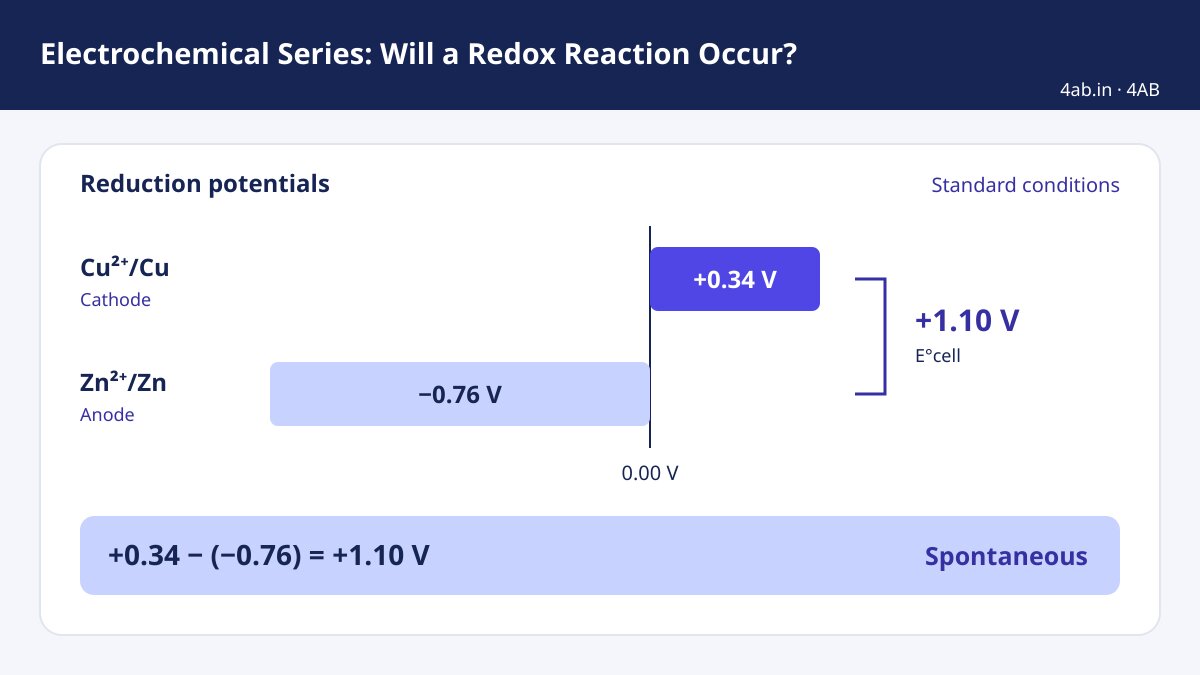
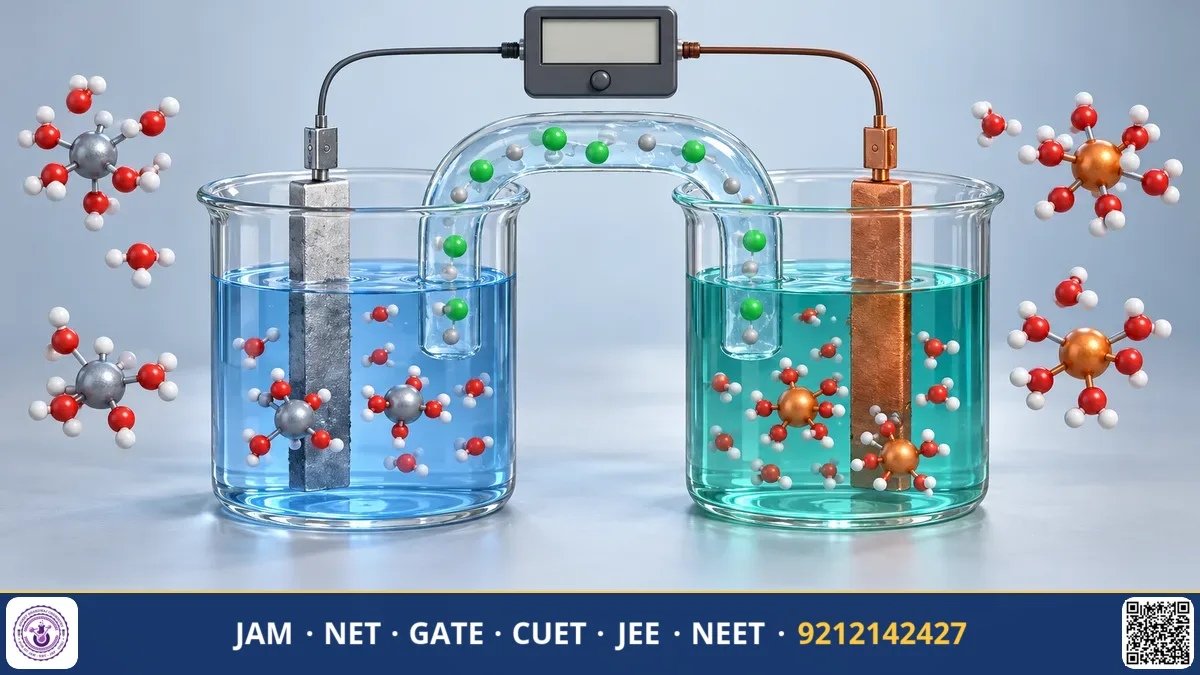
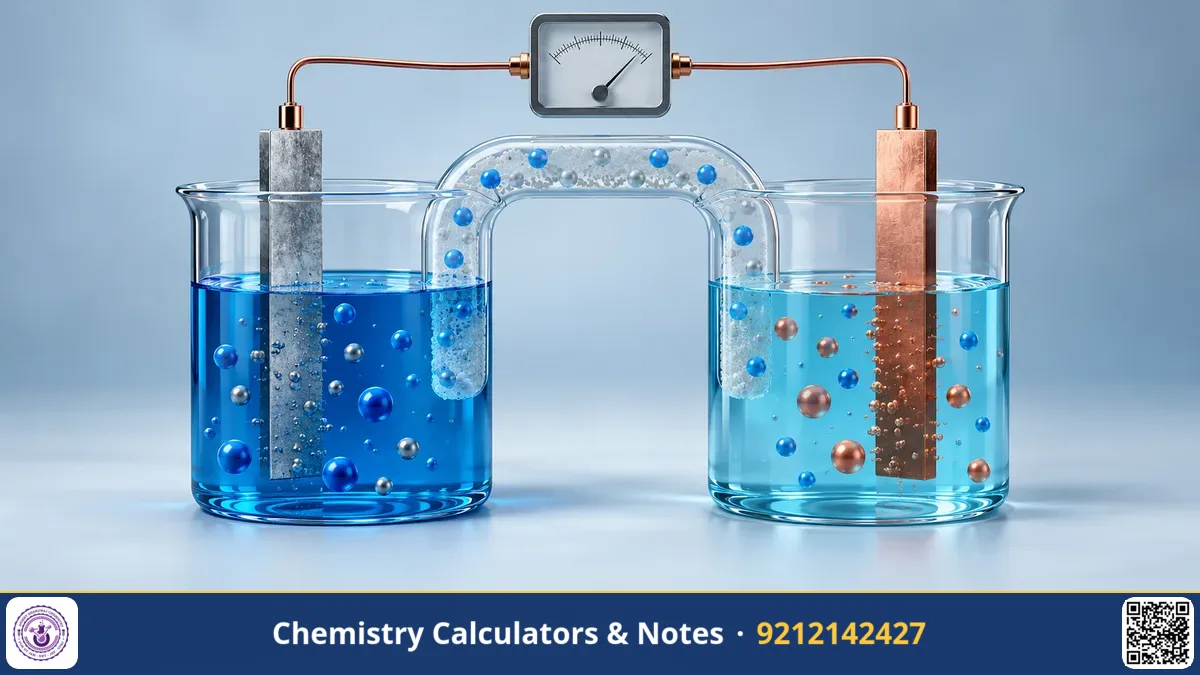
Practice question 2 (Class 12 base: electrochemistry). A cell is made of a zinc electrode in 0.01 M Zn2+ solution and a copper electrode in 1 M Cu2+ solution. The standard cell potential E° is 1.10 V at 298 K. Find the cell potential. Use 0.059 V as the Nernst constant at this temperature.
Step 1. Write the cell reaction: Zn + Cu2+ → Zn2+ + Cu. Two electrons are transferred, so n = 2.
Step 2. The reaction quotient is Q = [Zn2+] / [Cu2+] = 0.01 / 1 = 0.01. Solids do not appear in Q.
Step 3. Nernst equation: E = E° − (0.059 / n) log Q = 1.10 − (0.059 / 2) × log 0.01.
Step 4. log 0.01 = −2. So E = 1.10 − (0.0295 × −2) = 1.10 + 0.059 = 1.159 V.
Answer: about 1.16 V. Check the direction: the product concentration is low, so the cell pushes harder toward products. The potential should rise above E°, and it does.
Notice how question 2 uses the equilibrium and redox ideas from Class 11. The two classes are one chain, not two separate subjects.
A study plan before the batch opens
You do not need to wait for the batch to begin. Use the weeks before it for a short, honest self-check.
- Weeks 1 to 2: Class 11 core. Read the NCERT chapters on structure of atom, bonding, thermodynamics and equilibrium. Solve every in-text and end-of-chapter numerical. Keep a one-page note of formulas with units.
- Weeks 3 to 4: Class 11 organic. Revise inductive effect, resonance and hyperconjugation. Draw the stability order of carbocations and radicals from memory.
- Weeks 5 to 6: Class 12 physical. Do solutions, electrochemistry and kinetics. Redo question 2 above with different concentrations.
- Weeks 7 to 8: Class 12 inorganic and organic. Cover coordination compounds, d- and f-block elements, and the reaction families. Make a reaction map: one line per reagent and product.
- Every week: take one short timed test of 20 questions. Write down every error and tag it as concept, calculation or reading mistake.
The eight-week split is a suggestion. If your Class 11 base is strong, shorten the first block and spend the time on organic mechanisms.
How to decide where you start
Take a blank page and write the main Class 11 topics from the table without opening a book. Then do the same for the Class 12 topics. The side where you struggle is your starting point.
Most students find that Class 11 gaps cause more trouble, because those ideas are used in every later chapter. If you are unsure, begin with Class 11. It costs little time and removes a common cause of errors.
The batch is planned, not announced. Do not plan your year around a date that is not confirmed. Use the waitlist to be told when details are final, and keep preparing meanwhile. No batch can promise a result, but a strong base makes your effort count for more.
Key takeaways
- The March 2027 online group batch is planned; the waitlist is how you will hear confirmed details.
- Class 11 topics are the base for most advanced chemistry. Revise them first.
- Class 12 electrochemistry, kinetics, coordination compounds and organic families come next.
- Always check units and signs; many marks are lost there.
- Do a weekly timed test and classify each error as concept, calculation or reading.
Frequently asked questions
Is the March 2027 batch confirmed?
No. It is planned. Dates, timings and other details are not final, so treat anything you hear outside the official announcement as unconfirmed.
Is the group batch held in a classroom?
No. The group classroom is not running now. The live online batch is the group class, with a weekly test and a doubt hour, and recordings for missed classes.
Which exams does this tier cover?
The chemical-science tier covers IIT-JAM, CSIR NET, GATE and CUET-PG, as 6-month live online batches.
Which book should I use for Class 11 and 12 revision?
Use the NCERT textbooks. They are enough for the foundation layer. Check the current syllabus of your target exam on its official page.
Can I start with Class 12 topics if I am short of time?
You can, but test your Class 11 base first. Weak thermodynamics or equilibrium will slow you down in electrochemistry and kinetics.