






Trans Effect in Square Planar Platinum Complexes
Master the trans effect and trans influence in square planar platinum complexes. Learn substitution mechanisms, isomer synthesis, and key exam strategies.
Predicting substitution stereochemistry in square planar platinum complexes requires a firm grasp of the trans effect. Here you will learn to separate kinetic effects from ground-state influence, apply the trans-effect series, and solve exam practice questions.
Distinguishing kinetic trans effect from trans influence
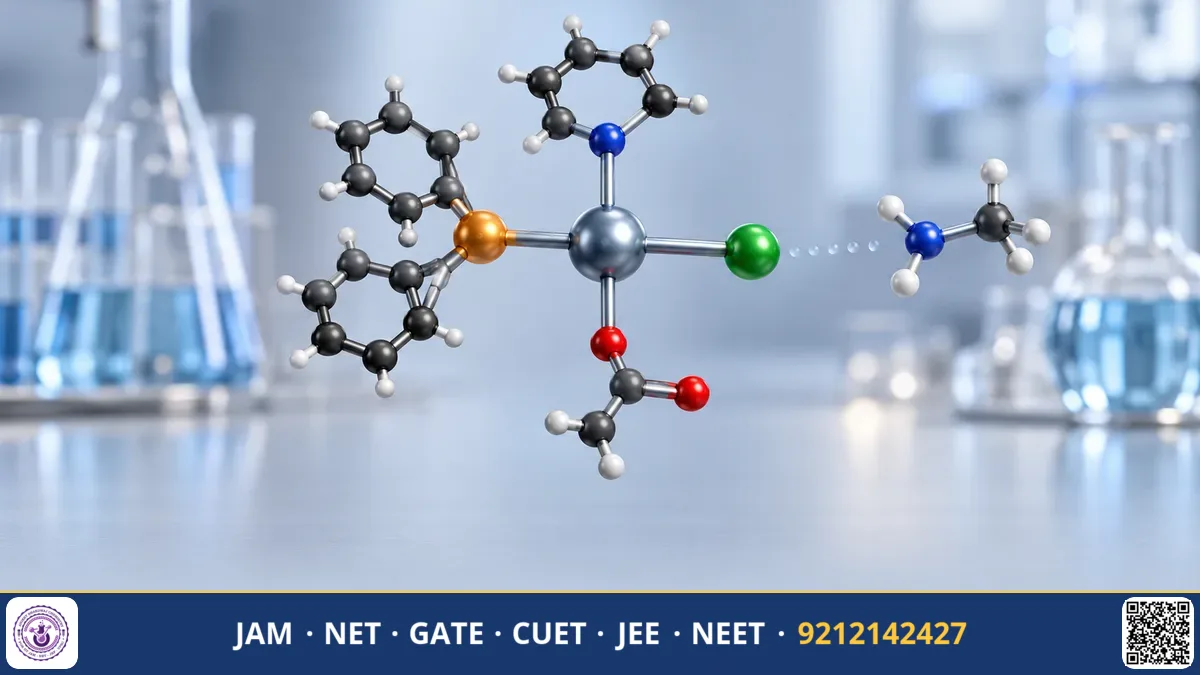
Square planar geometry is typical of d8 platinum(II) complexes. When an incoming nucleophile replaces a ligand, substitution is directed by the group trans to the leaving site. You must separate the kinetic trans effect from thermodynamic trans influence.
The trans effect is strictly a rate phenomenon. It describes how strongly a ligand accelerates substitution trans to itself. This kinetic labilisation dictates synthetic pathways and determines whether a reaction forms a cis or trans isomer.
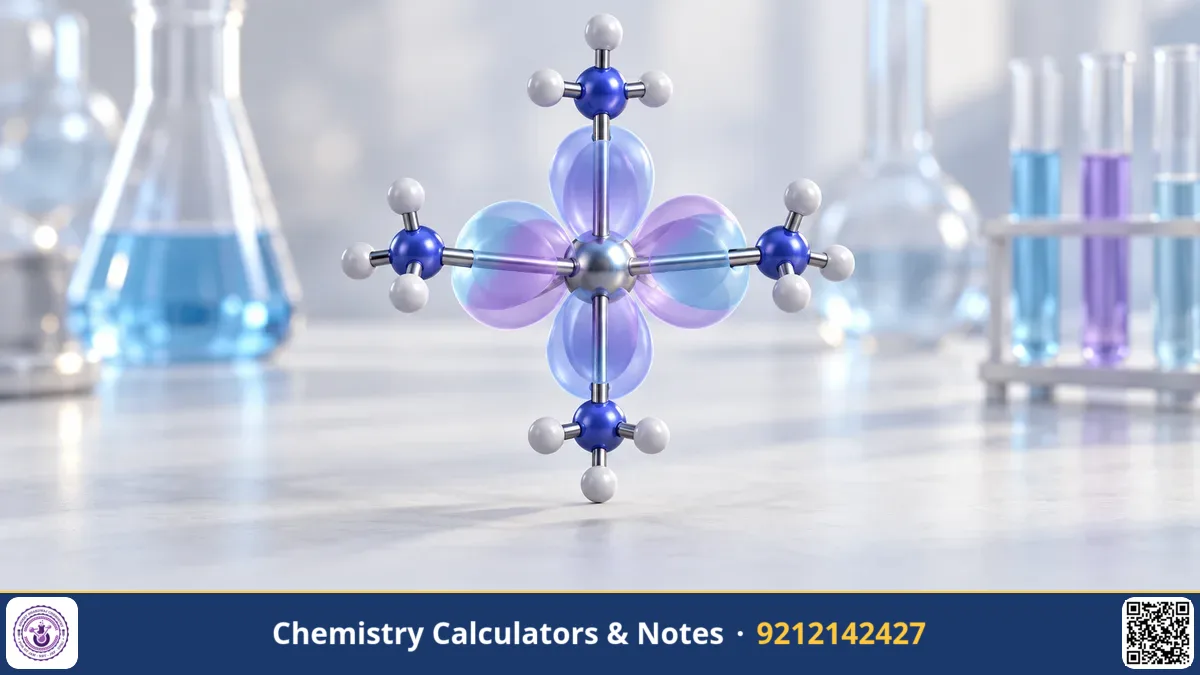
Trans influence is a ground-state thermodynamic property. It reflects how strongly a ligand weakens the metal-ligand bond trans to itself in the resting molecule. Trans ligands compete for shared metal σ-orbitals, so a strong σ-donor weakens the opposite bond. This weakening appears as bond lengthening in X-ray crystallography and lower stretching frequencies in infrared spectra.
| Property | Trans influence | Trans effect |
|---|---|---|
| Nature | Thermodynamic ground-state effect | Kinetic rate phenomenon |
| Observable | Bond lengths and stretching frequencies | Substitution rates and isomer outcomes |
| Origin | Competition for metal σ-orbitals | σ-labilisation and π-acceptor stabilisation |
| Measurement | X-ray crystallography and IR spectra | Reaction kinetics and stereochemistry |
Electronic mechanisms and the trans-effect series
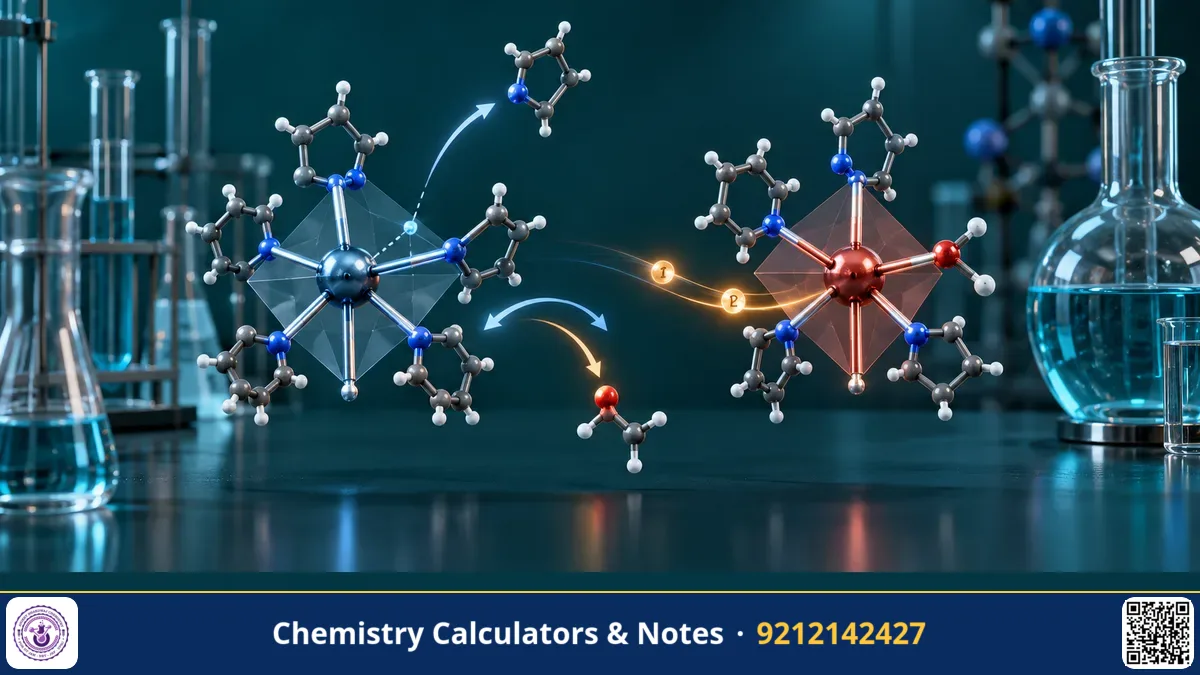
Ligand substitution in platinum(II) complexes follows an associative pathway. An incoming nucleophile attacks to form a five-coordinate trigonal bipyramidal intermediate. Under microscopic reversibility, the entering nucleophile arrives at an equatorial site, and the departing ligand exits from an equatorial site.
The trans-directing ligand occupies the third equatorial site. Two electronic factors govern the trans effect:
- The σ-factor (ground-state weakening): Strong σ-donors like hydride (H-), methyl (CH3-), and phosphines (PR3) donate electron density into platinum 6p orbitals. Sharing this orbital weakens the trans bond, labilising the leaving group.
- The π-factor (transition-state stabilisation): Strong π-acceptors like ethylene (C2H4), carbon monoxide (CO), and cyanide (CN-) possess empty π or π* orbitals. These ligands withdraw d-electron density from the equatorial plane in the intermediate, lowering activation energy and accelerating substitution.
Combining both factors gives the kinetic trans-effect series:
F-, H2O, OH- < NH3 < py < Cl- < Br- < I-, SCN-, NO2-, SC(NH2)2, Ph- < SO32- < PR3, AsR3, SR2, CH3- < H-, NO, CO, CN-, C2H4
Weak σ-donors lie at the low end, halides follow polarisability, and strong π-acids occupy the highest positions.
Exam angle for chemical-science papers
Examinations like CSIR NET, GATE, IIT-JAM, and CUET-PG evaluate square planar stereochemistry through three core problem types:
- Targeted isomer synthesis: Designing sequential substitution steps to prepare pure cis or trans isomers.
- Structural trends: Predicting relative bond lengths or stretching frequencies using ground-state trans influence.
- Rate comparisons: Ordering complexes by substitution reactivity based on the trans-directing ligand.
Do not confuse the trans-effect series with the spectrochemical series. The spectrochemical series ranks crystal field splitting, while the trans-effect series ranks substitution kinetics. In our 6-month live online batches for chemical science, students practice these distinctions through chapter question modules, weekly tests, and live doubt hours.
Solved practice questions
Work through these two practice problems to apply trans-directing principles systematically.
Practice question 1: Selective synthesis of cisplatin and transplatin
Explain how cis-[PtCl2(NH3)2] and trans-[PtCl2(NH3)2] are synthesised starting from [PtCl4]2- and [Pt(NH3)4]2+, respectively.
Solution:
From the series, chloride directs substitution more strongly than ammonia: Cl- > NH3.
Path A: From [PtCl4]2-
- Reaction with one NH3 yields [PtCl3(NH3)]-. All four positions are equivalent.
- In [PtCl3(NH3)]-, two chlorides are mutually trans and one is trans to NH3. Because Cl- > NH3, mutually trans chlorides are labilised faster.
- The second NH3 replaces a chloride trans to Cl-, forming cis-[PtCl2(NH3)2] (cisplatin).
Path B: From [Pt(NH3)4]2+
- Reaction with one Cl- yields [PtCl(NH3)3]+.
- Because Cl- exerts a stronger trans effect than NH3, ammonia trans to chloride is labilised.
- The second Cl- displaces ammonia trans to Cl-, yielding trans-[PtCl2(NH3)2] (transplatin).
Practice question 2: Structural and kinetic outcomes in [PtCl3(C2H4)]-
For [PtCl3(C2H4)]-: (a) identify which Pt-Cl bond is longest, and (b) predict the product upon reaction with pyridine.
Solution:
(a) Bond length (trans influence): Ethylene shares platinum 6p orbitals with the trans ligand, weakening the opposite bond in the ground state. Therefore, the Pt-Cl bond trans to ethylene is the longest, as confirmed by X-ray crystallography.
(b) Substitution product (trans effect): Ethylene lies near the top of the series (C2H4 >> Cl-). In the intermediate, ethylene occupies an equatorial site and stabilises the transition state via π-backbonding. This labilises the chloride trans to ethylene. Pyridine displaces this trans chloride, yielding trans-[PtCl2(py)(C2H4)].
A four-week structured study plan
Follow this weekly plan to master substitution mechanisms for chemical-science examinations:
- Week 1: Ground-state structures and trans influence. Study d8 square planar orbital configurations. Practice comparing bond lengths using σ-competition models. Solve foundational questions from your question bank.
- Week 2: Associative mechanisms and series hierarchy. Map the five-coordinate intermediate. Trace how σ-donation and π-backbonding lower activation energy. Review recorded classes to solidify orbital concepts.
- Week 3: Targeted isomer synthesis. Predict substitution pathways for mixed-ligand complexes. Practice designing multi-step syntheses targeting specific cis or trans products.
- Week 4: Timed drills and doubt resolution. Work through timed problem sets. Complete the weekly chapter test, analyse errors, and resolve mechanism questions during the live doubt hour.
Following this plan alongside our 6-month live online batches builds reliable problem-solving accuracy.
Key takeaways
- The trans effect is kinetic, accelerating substitution rates trans to a directing ligand.
- Trans influence is thermodynamic, causing ground-state bond lengthening and lower stretching frequencies.
- Substitution proceeds through an associative five-coordinate trigonal bipyramidal intermediate.
- Strong π-acceptors like C2H4 and CO accelerate substitution by stabilising the equatorial transition state.
- Selective synthesis of cisplatin versus transplatin relies on the trans-directing hierarchy of Cl- over NH3.
Frequently asked questions
What is the difference between trans effect and trans influence?
The trans effect is a kinetic rate phenomenon where a ligand accelerates substitution trans to itself. Trans influence is a thermodynamic property where a ligand weakens and lengthens the trans metal-ligand bond in the resting state.
Why does ethylene exhibit a high trans effect?
Ethylene has vacant π* orbitals that accept metal d-electron density. In the five-coordinate intermediate, ethylene occupies an equatorial site and stabilises the transition state through π-backbonding, lowering activation energy.
Can the trans effect occur in octahedral complexes?
Yes. While most prominent in square planar d8 complexes, the trans effect also occurs in octahedral complexes, alongside the related cis effect.
Why does [PtCl4]2- yield cisplatin while [Pt(NH3)4]2+ yields transplatin?
Chloride has a stronger trans effect than ammonia. In [PtCl3(NH3)]-, mutually trans chlorides activate each other, directing ammonia to form cis-[PtCl2(NH3)2]. In [PtCl(NH3)3]+, chloride activates ammonia trans to itself, producing trans-[PtCl2(NH3)2].