Q1 · 2020-2020 · 2 marks
The correct order of magnitude of 'A values' for the given substituents in cyclohexane derivatives is 

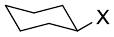 \mathbf{X}=\mathbf{C H}_{\mathbf{3}}, \mathbf{C N}, \mathbf{P h}
- (a) Ph > CN > Me
- (b) \mathrm{Me}>\mathrm{Ph}>\mathrm{CN}
- (c) \mathbf{C N}>\mathbf{M e}>\mathbf{P h}
- (d) Ph > Me > CN
Show answer
Answer: (d)
Report an error in ABC26OR0040
Q2 · June 2019 · 2 marks
In the following equilibrium, conformer B is more stable than A when R is 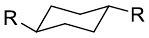

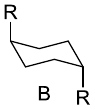
- (a) Me
- (b) F
- (c) CI
- (d) OMe
Show answer
Answer: (b)
Report an error in ABC26OR0061
Q3 · Dec 2019 · 2 marks
The correct order for the rate of thermal decarboxylation of the following compounds is 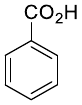
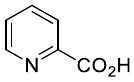
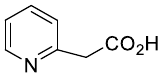 A B C
- (a) \mathrm{C}>\mathrm{B}>\mathrm{A}
- (b) C > A > B
- (c) A > C > B
- (d) \mathbf{B}>\mathbf{C}>\mathbf{A}
Show answer
Answer: (a)
Report an error in ABC26OR0064
Q4 · Dec 2019 · 2 marks
The number of geometrical isomers of the complex \left[\mathrm{RhH}(\mathrm{C} \equiv \mathrm{CR})_{2}\left(\mathrm{PMe}_{3}\right)_{3}\right]
Show answer
Answer: (b)
Report an error in ABC26OR0071
Q5 · June 2018 · 2 marks
For the following compounds, the correct order of reactivity towards nucleophilic acyl substitution is
- (a) acetyl chloride < methyl acetate < acetic anhydride < acetamide
- (b) acetamide < methyl acetate < acetic anhydride < acetyl chloride
- (c) acetamide < acetic anhydride < acetyl chloride < methyl acetate
- (d) methyl acetate < acetamide < acetic anhydride < acetyl chloride
Show answer
Answer: (b)
Report an error in ABC26OR0054
Q6 · June 2018 · 2 marks
IUPAC nomenclature of the following propellane is 2.4
- (a) Tricyclo[1.1.1.0 ]pentane 1.3
- (b) Tricyclo[1.1.0.1 ]pentane 1.3 1.5
- (c) Tricyclo[1.1.1 .0 ]pentane 1.3
- (d) Tricyclo[1.1.1.0 ]pentane
Show answer
Answer: (d)
Report an error in ABC26OR0056
Q7 · Dec 2018 · 2 marks
Oxidation of A with \mathrm{HNO}_{3} / \mathrm{H}_{2} \mathrm{O} provides the product (s), which is (are) 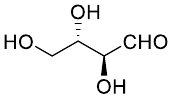 A
- (a) Optically active as it is racemic mixture
- (b) Optically inactive as it is meso
- (c) Optically active as it is a single diastereomer
- (d) Optically active as it is a single enantiomer
Show answer
Answer: (b)
Report an error in ABC26OR0059
Q8 · Dec 2018 · 2 marks
Among the following, the optically active compound is
Show answer
Answer: (d)
Report an error in ABC26OR0060
Q9 · June 2017 · 2 marks
The IUPAC name of the following compound is 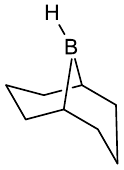
- (a) 9-borabicyclo[3.3.1]nonane
- (b) 1-borabicyclo[3.3.1]nonane
- (c) 9-borabicyclo[3.3.0]octane
- (d) 1-borabicyclo[3.3.0]octane
Show answer
Answer: (a)
Report an error in ABC26OR0048
Q10 · June 2015 · 2 marks
The correct statements about conformations X and Y of 2-butanone are 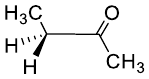
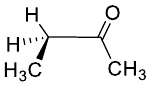 (X) (Y)
- (a) X is more stable than Y A and D
- (b) Y is more stable than X A and C
- (c) Methyl groups in X are anti B and C
- (d) Methyl groups in Y are gauche A, C and D
Show answer
Answer: (d)
Report an error in ABC26OR0039
Q11 · Dec 2016 · 2 marks
The correct statement about the following compound is 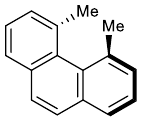
- (a) compound is chiral and has P configuration
- (b) compound is chiral and has M configuration
- (c) compound is achiral as it possess \mathbf{C}_{\mathbf{2}}-axis of symmetry
- (d) compound is achiral as it possess plane of symmetry
Show answer
Answer: (a)
Report an error in ABC26OR0044
Q12 · Dec 2016 · 2 marks
Methyl groups in the following compound are 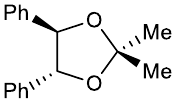
- (a) Homotopic
- (b) Diasterotopic
- (c) Enantiotopic
- (d) Constitutionally heterotopic
Show answer
Answer: (a)
Report an error in ABC26OR0045
Q13 · June 2015 · 2 marks
The correct relation between the following compounds is 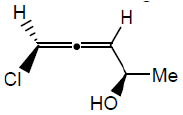
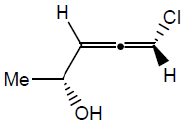
- (a) enantiomers
- (b) diastereomers
- (c) homomers (identical)
- (d) constitutional isomers
Show answer
Answer: (c)
Report an error in ABC26OR0034
Q14 · Dec 2014 · 2 marks
The compound that is antiaromatic is 


 (I) (II) (III) (IV)
- (a) I
- (b) II
- (c) III
- (d) IV
Show answer
Answer: (a)
Report an error in ABC26OR0030
Q15 · Dec 2014 · 2 marks
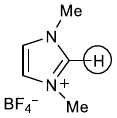
The increasing order of pKa values of the circled hydrogens in the following compounds is 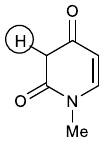
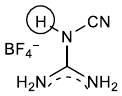
 (I) (II) (III)
- (a) I < II < III
- (b) I < III < II
- (c) II < I < III
- (d) II < III < I
Show answer
Answer: (c)
Report an error in ABC26OR0031
Q16 · June 2013 · 2 marks
The IUPAC name for the compound given below is 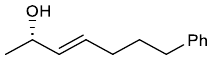
- (a) (2R, 3Z)-7-phenylhept-3-en-2-ol
- (b) (2S, 3Z)-7-phenylhept-3-en-2-ol
- (c) (2R, 3E)-7-phenylhept-3-en-2-ol
- (d) (2S, 3E)-7-phenylhept-3-en-2-ol
Show answer
Answer: (d)
Report an error in ABC26OR0018
Q17 · June 2013 · 2 marks
In the compound given below, the hydrogens marked A and B are 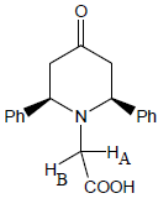
- (a) Homotopic
- (b) Isotopic
- (c) Enantiotopic
- (d) Diastereotopic
Show answer
Answer: (c)
Report an error in ABC26OR0019
Q18 · Dec 2013 · 2 marks
The IUPAC name of the compound given below is 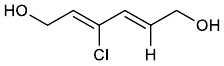
- (a) (2E, 4E)-3-chlorohexa-2, 4-diene-1, 6-diol
- (b) (2Z, 4E)-3-chlorohexa-2, 4-diene-1, 6-diol
- (c) (2Z, 4Z)-4-chlorohexa-2, 4-diene-1, 6-diol
- (d) (2E, 4Z)-4-chlorohexa-2, 4-diene-1, 6-diol
Show answer
Answer: (b)
Report an error in ABC26OR0023
Q19 · Dec 2013 · 2 marks
The two benzylic hydrogens \mathrm{H}_{\mathrm{A}} and \mathrm{H}_{\mathrm{B}} in the compounds I and II, are 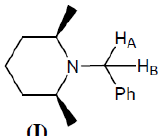
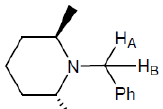 (I) (II)
- (a) diastereotopic in I and enantiotopic in II
- (b) diastereotopic in II and enantiotopic in I
- (c) diastereotopic in both I and II
- (d) enantiotopic in both I and II
Show answer
Answer: (b)
Report an error in ABC26OR0024
Q20 · Dec 2013 · 2 marks
The absolute configuration of the two stereogenic (chiral) centres in the following molecule is 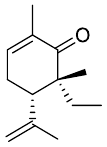
- (a) 5R, 6R
- (b) 5R, 6S
- (c) 5S 6R
- (d) 5S, 6S
Show answer
Answer: (c)
Report an error in ABC26OR0026
Q21 · Dec 2013 · 2 marks
The correct statement about the following molecule is 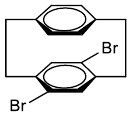
- (a) Molecular is chiral and possesses a chiral plane
- (b) Molecule is chiral and possesses a chiral axis.
- (c) Molecule is achiral as it possesses a plane of symmetry.
- (d) Molecule is achiral as it possesses a centre of symmetry.
Show answer
Answer: (a)
Report an error in ABC26OR0027
Q22 · Dec 2013 · 2 marks
Consider the following statements about cis- and trans-decalins (A) cis-isomer is more stable than trans-isomer (B) trans-isomer is more stable than cis-isomer (C) trans-isomer undergoes ring-flip (D) cis-isomer undergoes ring-flip The correct statements among the above are
- (a) B and D
- (b) A and C
- (c) A and D
- (d) B and C
Show answer
Answer: (a)
Report an error in ABC26OR0028
Q23 · Dec 2013 · 2 marks
The correct order for the rates of electrophilic aromatic substitution of the following compound is 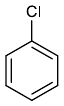
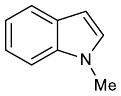
 (I) (II) (III)
- (a) I > II > III
- (b) II > I > III
- (c) III > II > I
- (d) I > III > II
Show answer
Answer: (d)
Report an error in ABC26OR0029
Q24 · June 2012 · 2 marks
The IUPAC name of the compound given below is: 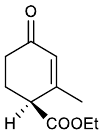
- (a) ethyl (R)-2-methyl-4-oxocyclohex-2-enecarboxylate
- (b) ethyl (S)-2-methyl-4-oxocyclohex-2-enecarboxylate
- (c) (R)-4-ethoxycarbonyl-3-methylcyclo-hex-2-enone
- (d) (S)-4-ethoxycarbonyl-3-methylcyclo-hex-2-enone
Show answer
Answer: (b)
Report an error in ABC26OR0012
Q25 · June 2012 · 2 marks
Epoxidation of (R)-cyclohex-2-enol with peracetic acid yields a 95: 5 mixture of compounds A and B. Compounds A and B are
- (a) Enantiomers
- (b) Diastereomers
- (c) Constitutional isomers
- (d) Homomers
Show answer
Answer: (b)
Report an error in ABC26OR0013
Q26 · Dec 2012 · 2 marks
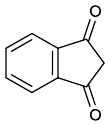
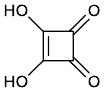
The correct order of acidity of the compounds A-C is: 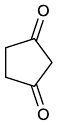
 A B C
- (a) A > B > C
- (b) B > C > A
- (c) C > A > B
- (d) B > A > C
Show answer
Answer: (c)
Report an error in ABC26OR0014
Q27 · Dec 2012 · 2 marks
The absolute configuration at the two chiral centres of (-)-camphore is: 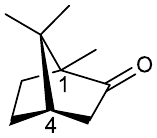
- (a) 1R, 4R
- (b) 1R, 4S
- (c) 1S, 4R
- (d) 1S, 4S
Show answer
Answer: (d)
Report an error in ABC26OR0015
Q28 · June 2011 · 2 marks
In the most stable conformation of trans-1-t-butyl-3-methylcyclohexane, the substituents at C–1 and C–3, respectively, are
- (a) Axial and equatorial
- (b) Equatorial and equatorial
- (c) Equatorial and axial
- (d) Axial and axial.
Show answer
Answer: (c)
Report an error in ABC26OR0003
Q29 · June 2011 · 2 marks
The relative rates of solvolysis of iodides A-C are 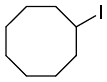
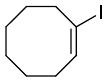
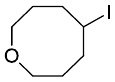
- (a) C > A > B
- (b) C > B > A
- (c) B > C > A
- (d) B > A > C
Show answer
Answer: (a)
Report an error in ABC26OR0005
Q30 · June 2011 · 2 marks
The correct order of acidity of the following compound A-C is: 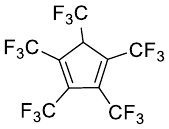

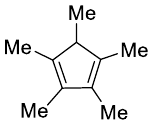
- (a) B > C > A
- (b) \mathrm{C}>\mathrm{B}>\mathrm{A}
- (c) A > C > B
- (d) A > B > C
Show answer
Answer: (c)
Report an error in ABC26OR0006
Q31 · June 2011 · 2 marks
The IUPAC name of the following compound is 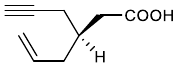
- (a) (R)-3- (prop-2-enyl) hex-5-ynoic acid
- (b) (S)-3- (prop-2-enyl) hex-5-ynoic acid
- (c) (R)-3- (prop-2-enyl) hex-5-enoic acid
- (d) (S)-3- (prop-2-ynyl) hex-5- enoic acid
Show answer
Answer: (d)
Report an error in ABC26OR0008
Q32 · June 2011 · 2 marks
With respect to electrophilic aromatic substitution, reactivity order of pyrrole, pyridine and indole is
- (a) indole > pyrrole > pyridine
- (b) pyrrole > pyridine > indole
- (c) pyrrole > indole > pyridine
- (d) indole > pyridine > pyrrole
Show answer
Answer: (c)
Report an error in ABC26OR0010
Q33 · June 2011 · 2 marks
An optically active compound enriched with \mathbf{R}-enantiomer ( \mathbf{6 0 \%} \mathbf{~ e e} ) exhibited [\alpha]_{\mathbf{D}}+\mathbf{9 0 ^ { \circ }}. If the [\alpha]_{\mathrm{D}} value of the sample is -\mathbf{1 3 5}^{\boldsymbol{\circ}}, the ratio of R and S enantiomers would be
- (a) \mathrm{R}: \mathrm{S}=1: 19
- (b) \mathrm{R}: \mathrm{S}=19: 1
- (c) \mathrm{R}: \mathrm{S}=1: 9
- (d) \mathrm{R}: \mathrm{S}=9: 1
Show answer
Answer: (a)
Report an error in ABC26OR0011