Q1 · June 2021 · 2 marks
The correct order of the electron affinity for one-electron gain of the elements is
- (a) \mathrm{F}>\mathrm{Cl}>\mathrm{Br}
- (b) P > N > As
- (c) \mathrm{S}>\mathrm{Se}>\mathrm{O}
- (d) \mathrm{K}>\mathrm{Li}>\mathrm{Na}
Show answer
Answer: (c)
Report an error in ABC26IN1324
Q2 · June 2021 · 2 marks
Which of the statements (A-D) given below are correct for \mathrm{B}_{2} \mathrm{H}_{6} molecule:
- (a) Addition of \mathrm{Et}_{2} \mathrm{O} . \mathrm{BF}_{3} to \mathrm{NaBH}_{4} in a polyether solvent produces \mathrm{B}_{2} \mathrm{H}_{6}. A, B and C
- (b) It has \mathrm{D}_{2 \mathrm{~d}} symmetry. A, C and D
- (c) Reaction of \mathrm{B}_{2} \mathrm{H}_{6} with \mathrm{NMe}_{3} give \mathrm{Me}_{3} \mathrm{~N} . \mathrm{BH}_{3}. A and B only
- (d) It is diamagnetic. B and D only
Show answer
Answer: (b)
Report an error in ABC26IN1325
Q3 · June 2021 · 2 marks
Which of the following reaction (s) do(es) NOT occur (i) \left[\mathrm{NPCl}_{2}\right]_{3}+6 \mathrm{NaF} \xrightarrow[\text { Reflux }]{\mathrm{MeCN}}\left[\mathrm{NPF}_{2}\right]_{3}+6 \mathrm{NaCl} (ii) \mathrm{n} \mathrm{PCl}_{5}+\mathrm{nNH}_{4} \mathrm{Cl} \xrightarrow[\text { Reflux }]{\mathrm{C}_{6} \mathrm{H}_{5} \mathrm{Cl}}\left[\mathrm{NPCl}_{2}\right]_{\mathrm{a}}+4 \mathrm{nHCl} \quad[\mathrm{n}=3,4,5 ] (iii) \mathrm{nPF}_{5}+\mathrm{nNH}_{4} \mathrm{~F} \xrightarrow[\text { Reflux }]{\mathrm{C}_{6} \mathrm{H}_{5} \mathrm{Cl}}\left[\mathrm{NPF}_{2}\right]_{\mathrm{n}}+4 \mathrm{nHF} \quad[\mathrm{n}=3,4,5 ]
- (a) (i) and (iii)
- (b) (i) and (ii)
- (c) (i) only
- (d) (iii) only MAIN GROUPS ELEMENTS
Show answer
Answer: (d)
Report an error in ABC26IN1326
Q4 · 2020 · 2 marks
Correct statement/s among the following with respect to ionization energy (IE) is/are (i) (\mathrm{IE_1 + IE_2 + IE_3}) for indium is more than that of aluminium (ii) \mathrm{IE_1} of scandium is higher than that of cobalt (iii) \mathrm{IE_1} of gallium is lower than that of selenium (iv) \mathrm{IE_1} of nitrogen is greater than that of oxygen
- (a) (ii) and (iv)
- (b) (iii) and (iv)
- (c) (i) and (iv)
- (d) (ii) and (iii)
Show answer
Answer: (b)
Report an error in ABC26IN0211
Q5 · 2020 · 2 marks
Choose the correct statements for the Group 15 halides: (i)AsCl3 can form complexes of type \left[\mathrm{AsCl}_{4}\right]^{-}in the presence of a chloride source (ii) \mathbf{P F}_{3} acts as a strong a-donor ligand towards d-metals (iii) In the solid state, \mathbf{S b F}_{\mathbf{5}} has a trigonal bipyramidal structure (iv) The reaction of \mathrm{SbF}_{5} with anhydrous HF generates \left[\mathrm{H}_{2} \mathrm{~F}\right]^{+}ions a(i) and (iv) b(ii) , (iii) and (iv) c(i) , (iii) and (iv) d(ii) and (iii)
- (a) (i) and (iv)
- (b) (ii) , (iii) and (iv)
- (c) (i) , (iii) and (iv)
- (d) (ii) and (iii)
Show answer
Answer: (a)
Report an error in ABC26IN0213
Q6 · 2020 · 2 marks
The reaction of \mathrm{XeF_6} with a limited amount of quartz gives compound A. Then on reaction with an equivalent amount of \mathrm{XeO_3}. A gives B. The products A and B are, respectively
- (a) \mathrm{XeOF_2} and \mathrm{XeO_2F_2}
- (b) \mathrm{XeOF_4} and \mathrm{XeO_2F_2}
- (c) \mathrm{XeOF_2} and \mathrm{XeOF_4}
- (d) \mathrm{XeO_2F_2} and \mathrm{XeOF_4}
Show answer
Answer: (b)
Report an error in ABC26IN0214
Q7 · 2020 · 2 marks
The energies of interaction for (i) ion pair, (ii) ion-dipole, and (iii) dipole-dipole interactions are inversely proportional to
- (a) r, r^{2} and r^{3} respectively
- (b) r^{2}, r and r^{3} respectively
- (c) \mathrm{r}, \mathrm{r}^{2} and \mathrm{r}^{6} respectively
- (d) r^{2}, r and r^{6} Respectively
Show answer
Answer: (a)
Report an error in ABC26IN1323
Q8 · 2019 · 2 marks
The correct statements regarding Boron among the following (1) Nuclear spin of { }^{\mathbf{1 1}} \mathbf{B} is greater than that of { }^{\mathbf{1 0}} \mathbf{B} (II) The polarities of B-H bond and C-H bonds are opposite (III) Cross-section of neutron absorption for { }^{\mathbf{1 0}} \mathbf{B} is much more than that of { }^{\mathbf{1 1}} \mathbf{B} (IV) \mathbf{B} reacts with boiling aq. \mathbf{N a O H} solution to form \mathbf{N a B}(\mathbf{O H})_{4} Are
- (a) II and III
- (b) I and II
- (c) III and IV
- (d) II and IV
Show answer
Answer: (a)
Report an error in ABC26IN0208
Q9 · 2019 · 2 marks
Choose the correct statement(s) among the following (I) LiF is more soluble than \mathrm{LiClO_4} in water. (II) The standard reduction potential [E^\circ] of Li is more negative than that of Na (III) The heat of hydration of \mathrm{Li^+(g)} is greater than that of \mathrm{Na^+(g)}
- (a) I and II
- (b) I and III
- (c) II and III
- (d) III Only
Show answer
Answer: (c)
Report an error in ABC26IN0209
Q10 · 2019 · 2 marks
The oxidation state of sulphur in the dithionous and dithionic acids, respectively, are
- (a) +4, +6
- (b) - 4,+5
- (c) +3, +5
- (d) +3,+6
Show answer
Answer: (c)
Report an error in ABC26IN1310
Q11 · 2019 · 2 marks
In the synthesis of polydimethylsiloxane, the chain forming, branching and terminating agents respectively, are
- (a) \mathrm{Me}_{2} \mathrm{SiCl}_{2}, \mathrm{Me}_{3} \mathrm{SiCl} and \mathrm{MeSiCl}_{3}
- (b) \mathrm{Me}_{2} \mathrm{SiCl}_{2}, \mathrm{MeSiCl}_{3} and \mathrm{Me}_{3} \mathrm{SiCl}
- (c) \mathrm{MeSiCl}_{3}, \mathrm{Me}_{2} \mathrm{SiCl}_{2} and \mathrm{Me}_{3} \mathrm{SiCl}
- (d) \mathrm{Me}_{2} \mathrm{SiCl}_{2}, \mathrm{MeSiCl}_{3} and \mathrm{Me}_{4} \mathrm{Si}
Show answer
Answer: (b)
Report an error in ABC26IN1311
Q12 · June 2019 · 2 marks
The correct statements regarding Boron among the following (1) Nuclear spin of { }^{11} \mathrm{~B} is greater than that of { }^{10} \mathrm{~B} (II) The polarities of B-H bond and C-H bonds are opposite (III) Cross-section of neutron absorption for { }^{10} \mathrm{~B} is much more than that of { }^{11} \mathrm{~B} (IV) B reacts with boiling aq. NaOH solution to form \mathrm{NaB}(\mathrm{OH})_{4}
- (a) II and III
- (b) I and II
- (c) III and IV
- (d) II and IV
Show answer
Answer: (a)
Report an error in ABC26IN1312
Q13 · June 2019 · 2 marks
Choose the correct statement(s) among the following (I) LiF is more soluble than \mathrm{LiClO}_{4} in water. (II) The standard reduction potential [E { }^{0} ] of Li is more negative than that of Na (III) The heat of hydration of \mathrm{Li}^{+}(\mathrm{g}) is greater than that of \mathrm{Na}^{+}(\mathrm{g})
- (a) I and II
- (b) I and III
- (c) II and III
- (d) III Only
Show answer
Answer: (c)
Report an error in ABC26IN1313
Q14 · 2019 · 2 marks
Choose the correct statement(s) among the following (1) The dihedral angle in \mathrm{O}_{2} \mathrm{~F}_{2} is 0^{0}. (II) \mathrm{OF}_{2} is generally prepared by reacting fluorine gas with dilute (2\%) aq. NaOH solution (III) \mathrm{O}_{2} \mathrm{~F}_{2} can be readily reduced by \mathrm{H}_{2} \mathrm{~S}.
- (a) I and II only
- (b) I, II and III
- (c) II and III only
- (d) II only
Show answer
Answer: (c)
Report an error in ABC26IN1314
Q15 · 2019 · 2 marks
The correct statements for dithionite and dithionate anions from the following are
- (a) both have S-S bond
- (b) both are dianionic
- (c) oxidation state of sulphur is +3 and +5 , respectively
- (d) sulphur in dithionate has lone pair of electrons (1)A, B and C (2)A, B and D (3)B, C and D (4)A and B only
Show answer
Answer: (a)
Report an error in ABC26IN1318
Q16 · Dec 2019 · 2 marks
Choose the correct statements for the Group 15 halides: (i) \mathrm{AsCl}_{3} can form complexes of type \left[\mathrm{AsCl}_{4}\right]^{-}in the presence of a chloride source (ii) \mathrm{PF}_{3} acts as a strong a-donor ligand towards d-metals (iii) In the solid state, \mathrm{SbF}_{5} has a trigonal bipyramidal structure (iv) The reaction of \mathrm{SbF}_{5} with anhydrous HF generates \left[\mathrm{H}_{2} \mathrm{~F}\right]^{+}Ion
- (a) (i) and (iv)
- (b) (ii), (iii) and (iv)
- (c) (i) , (iii) and (iv)
- (d) (ii) and (iii)
Show answer
Answer: (a)
Report an error in ABC26IN1321
Q17 · Dec 2019 · 2 marks
The reaction of \mathrm{XeF}_{6} with a limited amount of quartz gives compound A . Then on reaction with an equivalent amount of \mathrm{XeO}_{3}. A gives B. The products A and B are, respectively
- (a) \mathrm{XeOF}_{2} and \mathrm{XeO}_{2} \mathrm{~F}_{2}
- (b) \mathrm{XeOF}_{4} and \mathrm{XeO}_{2} \mathrm{~F}_{2}
- (c) \mathrm{XeOF}_{2} and \mathrm{XeOF}_{4}
- (d) \mathrm{XeO}_{2} \mathrm{~F}_{2} and \mathrm{XeOF}_{4}
Show answer
Answer: (b)
Report an error in ABC26IN1322
Q18 · 2018 · 2 marks
The reaction of decaborane \mathrm{B_{10}H_{14}}, with acetylene in the presence of \mathrm{Et_2S} gives
- (a) \mathrm{C_2B_{10}H_{12}}
- (b) \mathrm{C_2B_8H_{10}}
- (c) \mathrm{C_2B_{10}H_{14}}
- (d) \mathrm{C_2B_9H_{11}}
Show answer
Answer: (a)
Report an error in ABC26IN0206
Q19 · June 2018 · 2 marks
The structure of \mathrm{CaB}_{6} is close to that of
- (a) Cesium chloride
- (b) Nickel arsenide
- (c) Rock salt
- (d) Zinc blende
Show answer
Answer: (a)
Report an error in ABC26IN1299
Q20 · 2018 · 2 marks
Consider the following statements for \mathrm{Be}_{2} \mathrm{Cl}_{4} (I), \mathrm{B}_{2} \mathrm{Cl}_{4} (II) and \mathrm{Ga}_{2} \mathrm{Cl}_{4} (III):
- (a) There is an \mathbf{M}-\mathbf{M}(\mathbf{M}=\mathbf{B e}, \mathbf{B}, \mathbf{G a}) bond in all.
- (b) The oxidation state of \mathrm{Be}, \mathrm{B} and Ga is +2 .
- (c) The geometry around the central atom is planar for all.
- (d) The geometry around the central atom is planar in I and II only.
Show answer
Answer: (c)
Report an error in ABC26IN1303
Q21 · Dec 2018 · 2 marks
The reaction of decaborane \mathrm{B}_{10} \mathrm{H}_{14}, with acetylene in the presence of \mathrm{Et}_{2} \mathrm{~S} gives
- (a) \mathrm{C}_{2} \mathrm{~B}_{10} \mathrm{H}_{12}
- (b) \mathrm{C}_{2} \mathrm{~B}_{8} \mathrm{H}_{10}
- (c) \mathrm{C}_{2} \mathrm{~B}_{10} \mathrm{H}_{14}
- (d) \mathrm{C}_{2} \mathrm{~B}_{9} \mathrm{H}_{11}
Show answer
Answer: (a)
Report an error in ABC26IN1304
Q22 · 2018 · 2 marks
In compound \mathrm{N}_{3} \mathrm{P}_{3} \mathrm{~F}_{6}, the geometry around nitrogen and phosphorus, respectively, are
- (a) pyramidal and tetrahedral
- (b) planar and tetrahedral
- (c) pyramidal and planar
- (d) planar and trigonal bipyramidal
Show answer
Answer: (b)
Report an error in ABC26IN1305
Q23 · 2017 · 2 marks
Both potassium and sulfuric acid form intercalation compounds with graphite. The graphite layers are
- (a) reduced in both the cases
- (b) oxidized in both the cases
- (c) oxidized in the case of potassium and reduced in the case of sulphuric acid
- (d) reduced in the case of potassium and oxidized in the case of sulphuric acid
Show answer
Answer: (d)
Report an error in ABC26IN1294
Q24 · 2017 · 2 marks
Addition of two electrons to the bismuth cluster \mathrm{Bi}_{5}{ }^{+3} results in a change of structure type from
- (a) closo to nido
- (b) nido to arachno
- (c) closo to arachno
- (d) arachno to hypho
Show answer
Answer: (a)
Report an error in ABC26IN1295
Q25 · 2017 · 2 marks
The compound \mathrm{N}_{2} \mathrm{~F}_{2} has two isomers. Choose the correct option from the following:
- (a) both isomers possess a \sigma_{\mathrm{v}} plane
- (b) both isomers possess \sigma_{h} plane
- (c) one isomer has a \sigma_{h} plane while the other has a \sigma_{v} plane
- (d) none of them have a \sigma_{b} plane
Show answer
Answer: (c)
Report an error in ABC26IN1296
Q26 · 2017 · 2 marks
The first ionization energy is the lowest for
- (a) Br
- (b) Se
- (c) P
- (d) As
Show answer
Answer: (b)
Report an error in ABC26IN1297
Q27 · 2017 · 2 marks
Choose the incorrect statement for the phosphomolybdate anion \left[\mathrm{PMO}_{12} \mathrm{O}_{40}\right]^{-3}
- (a) It has a Keggin structure.
- (b) Phosphorus is in +5 oxidation state.
- (c) It is extremely basic.
- (d) It forms crystalline precipitates with \left[\mathrm{R}_{4} \mathrm{~N}\right]^{+}( \mathrm{R}= bulky alkyl or aryl group)
Show answer
Answer: (c)
Report an error in ABC26IN1298
Q28 · 2016 · 2 marks
The metal iodide with metallic lustre and high electrical conductivity is
- (b) \mathrm{CdI_2}
- (c) \mathrm{LaI_2}
- (d) \mathrm{BiI_3}
Show answer
Answer: (c)
Report an error in ABC26IN0201
Q29 · 2016 · 2 marks
The numbers of P-S and P-P bonds in the compound \mathrm{P}_{4} \mathrm{~S}_{3} are, respectively
- (a) 6 and 3
- (b) 4 and 3
- (c) 3 and 6
- (d) 6 and 2
Show answer
Answer: (a)
Report an error in ABC26IN1288
Q30 · Dec 2016 · 2 marks
The metal iodide with metallic lustre and high electrical conductivity is
- (a) NaI
- (b) \mathrm{CdI}_{2}
- (c) \mathrm{LaI}_{2}
- (d) \mathrm{BiI}_{3}
Show answer
Answer: (c)
Report an error in ABC26IN1290
Q31 · 2016 · 2 marks
Among the following, choose the correct products that are formed in the reaction of \mathrm{S}_{2} \mathrm{Cl}_{2} with ammonia in \mathrm{CCl}_{4} \mathrm{NH}_{4} \mathrm{Cl}(\mathrm{A}), \mathrm{S}_{4} \mathrm{~N}_{4}(\mathrm{~B}), \mathrm{S}_{8}(\mathrm{C}), and \mathrm{S}_{3} \mathrm{~N}_{3} \mathrm{Cl}_{3}(\mathrm{D}).
- (a) A, B and C
- (b) A, B and D
- (c) B, C and D
- (d) A, C and D
Show answer
Answer: (a)
Report an error in ABC26IN1292
Q32 · 2016 · 2 marks
The final product(s) of the reaction of arachno borane, \mathrm{B}_{4} \mathrm{H}_{10} with \mathrm{NMe}_{3} is/are
- (a) \left[\mathrm{BH}_{3} . \mathrm{NMe},\right] and \left[\mathrm{B}_{3} \mathrm{H}_{7} . \mathrm{NMe}_{3}\right]
- (b) \left[\mathrm{BH}_{2}\left(\mathrm{NMe}_{3}\right)_{2}\right]^{+}\left[\mathrm{B}_{3} \mathrm{H}_{8}\right]^{-}
- (c) \left[\mathrm{B}_{4} \mathrm{H}_{10} . \mathrm{NMe}_{3}\right]
- (d) \left[\mathrm{B}_{4} \mathrm{H}_{10} . \mathrm{NMe}_{3}\right] and \left[\mathrm{BH}_{2}\left(\mathrm{NMe}_{3}\right)_{2}\right]^{+}\left[\mathrm{B}_{3} \mathrm{H}_{8}\right]^{-}
Show answer
Answer: (a)
Report an error in ABC26IN1293
Q33 · 2015 · 2 marks
Consider the following reaction : \mathrm{N_3P_3Cl_6 + 6HNMe_2 \rightarrow \underset{[A]}{N_3P_3Cl_3(NMe_2)_3} + 3\,Me_2NH \cdot HCl}
The number of possible isomers for [A] is Show answer
Answer: (b)
Report an error in ABC26IN0199
Q34 · June 2015 · 2 marks
The correct set of pseudo halide anions is
- (a) \mathrm{CN}^{-}, \mathrm{ClO}_{4}{ }^{-}, \mathrm{BF}_{4}{ }^{-}, \mathrm{PF}_{6}{ }^{-}
- (b) \mathrm{SCN}^{-}, \mathrm{PO}_{4}^{-3}, \mathrm{H}_{2} \mathrm{PO}_{4}^{-}, \mathrm{N}_{3}^{-}
- (c) \mathrm{N}^{-}{ }_{3}, \mathrm{NO}_{3}^{-}, \mathrm{HSO}_{4} \mathrm{AsF}_{6}^{-}
- (d) \mathrm{CN}^{-}, \mathrm{N}_{3}{ }^{-}, \mathrm{SCN}^{-}, \mathrm{NCN}^{2-}
Show answer
Answer: (d)
Report an error in ABC26IN1280
Q35 · 2014 · 2 marks
The oxoacid of phosphorus having P atoms in +4,+3, and +4 oxidation states respectively, is
- (a) \mathrm{H}_{5} \mathrm{P}_{3} \mathrm{O}_{10}
- (b) \mathrm{H}_{5} \mathrm{P}_{3} \mathrm{O}_{7}
- (c) \mathrm{H}_{5} \mathrm{P}_{3} \mathrm{O}_{8}
- (d) \mathrm{H}_{5} \mathrm{P}_{3} \mathrm{O}_{9}
Show answer
Answer: (c)
Report an error in ABC26IN1281
Q36 · Dec 2015 · 2 marks
Consider the following reaction : \mathrm{N_3P_3Cl_6 + 6HNMe_2 \rightarrow N_3P_3Cl_3(NMe_2)_3 + 3\,Me_2NH.HCl}\quad [A]
The number of possible isomers for [A] is Show answer
Answer: (b)
Report an error in ABC26IN1285
Q37 · 2015 · 2 marks
The reaction of \mathrm{BCl}_{3}, with \mathrm{NH}_{4} \mathrm{Cl} gives product A which upon reduction by \mathrm{NaBH}_{4} gives product B . Product B upon reacting with HCI affords compound C , which is
- (a) \mathrm{Cl}_{3} \mathrm{~B}_{3} \mathrm{~N}_{3} \mathrm{H}_{9}
- (b) [\mathrm{ClBNH}]_{3}
- (c) [\mathrm{HBNH}]_{3}
- (d) (\mathrm{ClH})_{3} \mathrm{~B}_{3} \mathrm{~N}_{3}(\mathrm{ClH})_{3}
Show answer
Answer: (a)
Report an error in ABC26IN1286
Q38 · 2015 · 2 marks
Protonated form of ZSM-5 catalyzes the reaction of ethene with benzene to produce ethylbenzene. The correct statement for this catalytic process is
- (a) alkyl carbocation is formed
- (b) carbanion is formed
- (c) benzene converted to \left(\mathrm{C}_{6} \mathrm{H}_{5}\right)^{+}group
- (d) vinyl radical is formed
Show answer
Answer: (a)
Report an error in ABC26IN1287
Q39 · 2014 · 2 marks
Chromite ore on fusion with sodium carbonate gives
- (a) \mathrm{Na_2CrO_4} and \mathrm{Fe_2O_3}
- (b) \mathrm{Na_2Cr_2O_7} and \mathrm{Fe_2O_3}
- (c) \mathrm{Cr_2(CO_3)_3} and \mathrm{Fe(OH)_3}
- (d) \mathrm{Na_2CrO_4} and \mathrm{Fe_2(CO_3)_3}
Show answer
Answer: (a)
Report an error in ABC26IN0193
Q40 · 2014 · 2 marks
The correct set of pseudo halide anions is
- (a) \mathrm{CN^-, ClO_4^-, BF_4^-, PF_6^-}
- (c) \mathrm{SCN^-, PO_4^{-3}, H_2PO_4^-, N_3^-}
- (b) \mathrm{N_3^-, NO_3^-, HSO_4^{-}, AsF_6^-}
- (d) \mathrm{CN^-, N_3^-, SCN^-, NCN^{2-}}
Show answer
Answer: (d)
Report an error in ABC26IN0196
Q41 · June 2014 · 2 marks
Reactions of elemental as with hot and conc. \mathrm{HNO}_{3}, and \mathrm{H}_{2} \mathrm{SO}_{4} respectively, give
- (a) \mathrm{As}_{4} \mathrm{O}_{6} and \mathrm{As}_{2}\left(\mathrm{SO}_{4}\right)_{3}
- (b) \mathrm{As}\left(\mathrm{NO}_{3}\right)_{5} and \mathrm{As}_{2}(\mathrm{SO})_{3}
- (c) \mathrm{As}_{4} \mathrm{O}_{6} and \mathrm{H}_{3} \mathrm{AsO}_{4}
- (d) \mathrm{H}_{3} \mathrm{AsO}_{4} and \mathrm{As}_{4} \mathrm{O}_{6}
Show answer
Answer: (d)
Report an error in ABC26IN1269
Q42 · June 2014 · 2 marks
Chromite ore on fusion with sodium carbonate gives
- (a) \mathrm{Na}_{2} \mathrm{CrO}_{4} and \mathrm{Fe}_{2} \mathrm{O}_{3}
- (b) \mathrm{Na}_{2} \mathrm{Cr}_{2} \mathrm{O}_{7} and \mathrm{Fe}_{2} \mathrm{O}_{3}
- (c) \mathrm{Cr}_{2}\left(\mathrm{CO}_{3}\right) 3 and \mathrm{Fe}(\mathrm{OH})_{3}
- (d) \mathrm{Na}_{2} \mathrm{CrO}_{4} and \mathrm{Fe}_{2}\left(\mathrm{CO}_{3}\right)_{3}
Show answer
Answer: (a)
Report an error in ABC26IN1270
Q43 · 2014 · 2 marks
The correct order of decreasing electronegativity of the following atoms is,
- (a) \mathrm{As}>\mathrm{Al}>\mathrm{Ca}>\mathrm{S}
- (b) \mathrm{S}> As >\mathrm{Al}>\mathrm{Ca}
- (c) \mathrm{Al}>\mathrm{Ca}>\mathrm{S}>\mathrm{As}
- (d) \mathrm{S}>\mathrm{Ca}>\mathrm{As}>\mathrm{Al}
Show answer
Answer: (b)
Report an error in ABC26IN1271
Q44 · 2014 · 2 marks
The correct order of the size of \mathrm{S}, \mathrm{S}^{2-}, \mathrm{S}^{2+} and \mathrm{S}^{4+} species is,
- (a) \mathrm{S}>\mathrm{S}^{2+}>\mathrm{S}^{4+}>\mathrm{S}^{2-}
- (b) \mathrm{S}^{2+}>\mathrm{S}^{4+}>\mathrm{S}^{2-}>\mathrm{S}
- (c) \mathrm{S}^{2-}>\mathrm{S}>\mathrm{S}^{2+}>\mathrm{S}^{4+}
- (d) \mathrm{S}^{4+}>\mathrm{S}^{2-}>\mathrm{S}>\mathrm{S}^{2+}
Show answer
Answer: (c)
Report an error in ABC26IN1272
Q45 · 2014 · 2 marks
The reaction between \mathrm{SbF}_{5} and two equivalents of HF leads to the formation of
- (a) \mathrm{H}_{2} \mathrm{SbF}_{3}+2 \mathrm{~F}_{2}
- (b) \mathrm{HSbF}_{2}+3 \mathrm{~F}_{2}
- (c) \mathrm{SbF}_{3}+\mathrm{H}_{2}+2 \mathrm{~F}_{2}
- (d) \left[\mathrm{SbF}_{6}\right]^{-}\left[\mathrm{H}_{2} \mathrm{~F}\right]^{+}
Show answer
Answer: (d)
Report an error in ABC26IN1273
Q46 · 2014 · 2 marks
Among \mathrm{F}-, \mathrm{Na}^{+}, \mathrm{O}^{2-} and \mathrm{Mg}^{2+} ions, those having the highest and the lowest ionic radii respectively are
- (a) \mathrm{O}^{2-} and \mathrm{Na}^{+}
- (b) \mathrm{F}^{-}and \mathrm{Mg}^{2+}
- (c) \mathrm{O}^{2-} and \mathrm{Mg}^{2+}
- (d) \mathrm{Mg}^{2+} and \mathrm{O}^{2-}
Show answer
Answer: (c)
Report an error in ABC26IN1274
Q47 · 2014 · 2 marks
A borane (X) is reacted with ammonia to give a salt of borohydride (Y). The { }^{11} \mathrm{~B} NMR spectrum of Y consists of a triplet and a quintet. The borane X is
- (a) \mathrm{B}_{2} \mathrm{H}_{6}
- (b) \mathrm{B}_{3} \mathrm{H}_{9}
- (c) \mathrm{B}_{4} \mathrm{H}_{8}
- (d) \mathrm{B}_{5} \mathrm{H}_{9}
Show answer
Answer: (a)
Report an error in ABC26IN1276
Q48 · 2014 · 2 marks
The main products of the reaction of equimolar quantities of \mathrm{XeF}_{6} with \mathrm{NaNO}_{3} are
- (a) \mathrm{XeOF}_{4}, \mathrm{NaF} and \mathrm{NO}_{2} \mathrm{~F}
- (b) \mathrm{XeO}_{2} \mathrm{~F}_{2}, \mathrm{NaF}, \mathrm{NOF} and \mathrm{F}_{2}
- (c) \mathrm{XeOF}_{4}, \mathrm{NaNO}_{2} and \mathrm{F}_{2}
- (d) \mathrm{XeF}_{4}, \mathrm{NaNO}_{2}, and \mathrm{F}_{2} \mathrm{O}
Show answer
Answer: (a)
Report an error in ABC26IN1278
Q49 · 2013 · 2 marks
The reaction of \mathrm{FeCl_3 \cdot 6H_2O} with \mathrm{SOCl_2} yields.
- (a) \mathrm{FeCl_2} (s), \mathrm{SO_2} (g) and HCl (g)
- (b) \mathrm{FeCl_3}(s), \mathrm{SO_2}(g) and HCl(l)
- (c) \mathrm{FeCl_2} (S), \mathrm{SO_2}(s) and HCl (g)
- (d) \mathrm{FeCl_3}(s), \mathrm{SO_2}(g) and HCl(g)
Show answer
Answer: (d)
Report an error in ABC26IN0184
Q50 · 2013 · 2 marks
Commonly used scintillator for measuring radiation is
- (a) NaI(Al)
- (b) NaI(Tl)
- (c) CsI(Tl)
- (d) CsI(Al)
Show answer
Answer: (b)
Report an error in ABC26IN0186
Q51 · 2013 · 2 marks
Number of isomeric derivatives possible for the neutral closo-carborane, \mathrm{C_2B_{10}H_{12}} is
- (a) three
- (b) two
- (c) four
- (d) six
Show answer
Answer: (a)
Report an error in ABC26IN0191
Q52 · June 2013 · 2 marks
Which of the following pairs has the highest difference in their first ionization energy?
- (a) Xe, Cs
- (b) Kr, Rb
- (c) Ar, K
- (d) Ne, Na
Show answer
Answer: (d)
Report an error in ABC26IN1251
Q53 · June 2013 · 2 marks
Which of the following is used as propellant for whipping creams?
- (a) \mathrm{N}_{2} \mathrm{O}
- (b) NO
- (c) \mathrm{N}_{2} \mathrm{O}_{3}
- (d) \mathrm{N}_{2} \mathrm{O}_{5}
Show answer
Answer: (a)
Report an error in ABC26IN1252
Q54 · June 2013 · 2 marks
Flame proof fabrices contain
- (a) \mathrm{H}_{2} \mathrm{NC}(\mathrm{O}) \mathrm{NH}_{2} . \mathrm{Na}_{2} \mathrm{SO}_{4}
- (b) \mathrm{H}_{2} \mathrm{NC}(\mathrm{S}) \mathrm{NH}_{2} \cdot \mathrm{Na}_{2} \mathrm{SO}_{4}
- (c) \mathrm{H}_{2} \mathrm{NC}(\mathrm{O}) \mathrm{NH}_{2} . \mathrm{H}_{3} \mathrm{PO}_{4}
- (d) \mathrm{H}_{2} \mathrm{NC}(\mathrm{S}) \mathrm{NH}_{2} \cdot \mathrm{H}_{3} \mathrm{PO}_{4}
Show answer
Answer: (c)
Report an error in ABC26IN1253
Q55 · June 2013 · 2 marks
Among the oxides of nitrogen, \mathrm{N}_{2} \mathrm{O}_{3}, \mathrm{~N}_{2} \mathrm{O}_{4}, and \mathrm{N}_{2} \mathrm{O}_{5} the compound(s) having N - N bond is/are
- (a) \mathbf{N}_{\mathbf{2}} \mathbf{O}_{\mathbf{4}} and \mathbf{N}_{\mathbf{2}} \mathbf{O}_{\mathbf{5}}
- (b) \mathrm{N}_{2} \mathrm{O}_{3} and \mathrm{N}_{2} \mathrm{O}_{5}
- (c) \mathrm{N}_{2} \mathrm{O}_{3} and \mathrm{N}_{2} \mathrm{O}_{4}
- (d) \mathrm{N}_{2} \mathrm{O}_{5} only
Show answer
Answer: (c)
Report an error in ABC26IN1254
Q56 · June 2013 · 2 marks
Identify the pairs in which the covalent radii of elements are almost similar
- (a) Nb, Ta A and B only
- (b) Mo, W A and C only
- (c) La, Lu B and C only
- (d) Sc, Y A, B and C only
Show answer
Answer: (a)
Report an error in ABC26IN1255
Q57 · June 2013 · 2 marks
The correct equilibrium order for the interconversion of different forms of \mathrm{SiO}_{2} is
- (a) Tridymite ↔ quartz ↔cristobalite ↔ liquid \mathrm{SiO}_{2}
- (b) quartz ↔Tridymite \leftrightarrow cristobalite \leftrightarrow liquid \mathrm{SiO}_{2}
- (c) quartz ↔ cristobalite ⟷ tridymite ⟷liquid \mathrm{SiO}_{2}
- (d) cristobalite ↔ tridymite ↔ quartz ⇆liquid \mathrm{SiO}_{2}
Show answer
Answer: (b)
Report an error in ABC26IN1256
Q58 · 2013 · 2 marks
Treatment of \mathrm{ClF}_{3} with \mathrm{SbF}_{5} leads to the formation of a/an
- (a) polymeric material
- (b) covalent cluster
- (c) ionic compound
- (d) lewis acid-base adduct
Show answer
Answer: (c)
Report an error in ABC26IN1259
Q59 · 2013 · 2 marks
The reason for the chemical inertness of gaseous nitrogen at room temperature is best given
- (a) high bonding energy only
- (b) electronic configuration
- (c) HOMO-LUMO gap only
- (d) high bond energy and HOMO-LUMO gap.
Show answer
Answer: (d)
Report an error in ABC26IN1260
Q60 · Dec 2013 · 2 marks
Commonly used scintillator for measuring radiation is
- (a) \mathrm{Nal}(\mathrm{AI})
- (b) \mathrm{NaI}(\mathrm{TI})
- (c) CsI(TI)
- (d) Csl(AI)
Show answer
Answer: (b)
Report an error in ABC26IN1261
Q61 · Dec 2013 · 2 marks
In a specific reaction, hexachlorocyclotriphosphazene, \mathrm{N_3P_3Cl_6} was reacted with a metal fluoride to obtain mixed halo derivatives namely \mathrm{N_3P_3Cl_3F} (A), \mathrm{N_3P_3Cl_4F} (B), \mathrm{N_3P_3Cl_3F_3} (C), \mathrm{N_3P_3Cl_2F_4} (D), \mathrm{N_3P_3ClF_5} (E). Compositions among these which can give isomeric products are
- (d) E, A and B
- (a) A, B and C
- (b) B, C and D
- (c) C, D and E
Show answer
Answer: (c)
Report an error in ABC26IN1265
Q62 · Dec 2013 · 2 marks
Number of isomeric derivatives possible for the neutral closo-carborane, \mathrm{C}_{2} \mathrm{~B}_{10} \mathrm{H}_{12} is
- (a) three
- (b) two
- (c) four
- (d) six
Show answer
Answer: (a)
Report an error in ABC26IN1267
Q63 · 2013 · 2 marks
For higher boranes 3c-2e 'BBB' bond may be a part of their structures. In \mathrm{B}_{5} \mathrm{H}_{9}, the number of such electron deficient bond(s) present is/are
- (a) four
- (b) two
- (c) zero
- (d) one
Show answer
Answer: (d)
Report an error in ABC26IN1268
Q64 · 2012 · 2 marks
Structure of a carborane with formula, \mathrm{C_2B_4H_8}, is formally derived from
- (a) Closo-borane
- (b) Nido-borane
- (c) Arachno-borane
- (d) Conjuncto-borane
Show answer
Answer: (b)
Report an error in ABC26IN0181
Q65 · 2012 · 2 marks
Boric acid is a weak acid in aqueous solution. But its acidity increases significantly in the presence of ethylene glycol, because
- (a) ethylene glycol releases additional \mathrm{H^+}
- (b) \mathrm{B(OH)_4^-} is consumed in forming a compound with ethylene glycol.
- (c) ethylene glycol neutralizes \mathrm{H^+} released by boric acid.
- (d) Boric acid dissociates better in the mixed-solvent.
Show answer
Answer: (b)
Report an error in ABC26IN0182
Q66 · 2012 · 2 marks
Among the halides, \mathrm{NCl}_{3}(\mathrm{~A}), \mathrm{PCl}_{3}(\mathrm{~B}) and \mathrm{AsCl}_{3}(\mathrm{C}), those which produce two different acids.
- (a) A and B
- (b) A and C
- (c) B and C
- (d) A, B and C
Show answer
Answer: (c)
Report an error in ABC26IN1242
Q67 · 2012 · 2 marks
The most used acid catalyst in oil industry and the relevant process are respectively
- (a) Alumino phosphate and reforming
- (b) Alumino silicate and cracking
- (c) Alumino silicate and reforming
- (d) Alumino phosphate and cracking.
Show answer
Answer: (b)
Report an error in ABC26IN1243
Q68 · 2012 · 2 marks
For the deposition of Pb by electroplating, the best suited compound among the following is
- (a) \mathrm{PbCl}_{2}
- (b) \mathrm{PbSO}_{4}
- (c) \mathrm{Pb}(\mathrm{Et})_{4}
- (d) \mathrm{Pb}\left(\mathrm{BF}_{4}\right)_{2}
Show answer
Answer: (d)
Report an error in ABC26IN1246
Q69 · 2012 · 2 marks
The electronegativity differences is the highest for the pair
- (a) Li, Cl
- (b) K, F
- (c) Na, Cl
- (d) Li, F
Show answer
Answer: (b)
Report an error in ABC26IN1247
Q70 · Dec 2012 · 2 marks
Structure of a carborane with formula, \mathrm{C}_{2} \mathrm{~B}_{4} \mathrm{H}_{8}, is formally derived from
- (a) Closo-borane ethylene glycol releases additional \mathrm{H}^{+}
- (b) Nido-borane \mathrm{B}(\mathrm{OH})_{4}^{-}is consumed in forming a compound with ethylene glycol.
- (c) Arachno-borane ethylene glycol neutralizes \mathrm{H}^{+}released by boric acid.
- (d) Conjuncto-borane 3 ethylene glycol, because Boric acid dissociates better in the mixed-solvent.
Show answer
Answer: (b)
Report an error in ABC26IN1248
Q71 · Dec 2012 · 2 marks
Boric acid is a weak acid in aqueous solution. But its acidity increases significantly in the presence of ethylene glycol, because
- (a) ethylene glycol releases additional \mathrm{H}^{+}
- (b) \mathrm{B}(\mathrm{OH})_{4}^{-} is consumed in forming a compound with ethylene glycol.
- (c) ethylene glycol neutralizes \mathrm{H}^{+} released by boric acid.
- (d) Boric acid dissociates better in the mixed-solvent.
Show answer
Answer: (b)
Report an error in ABC26IN1249
Q72 · 2012 · 2 marks
Silicates with continuous 3D frame work are
- (a) Neso-silicates
- (b) Soro-silicates
- (c) Phyllo-silicates
- (d) Tecto-silicates
Show answer
Answer: (d)
Report an error in ABC26IN1250
Q73 · 2011 · 2 marks
Lewis acidity of \mathrm{BCl_3}, \mathrm{BPh_3} and \mathrm{BMe_3} with respect to pyridine follows the order
- (a) \mathrm{BCl_3} > \mathrm{BPh_3} > \mathrm{BMe_3}
- (b) \mathrm{BMe_3} > \mathrm{BPh_3} > \mathrm{BCl_3}
- (c) \mathrm{BPh_3} > \mathrm{BMe_3} > \mathrm{BCl_3}
- (d) \mathrm{BCl_3} > \mathrm{BMe_3} > \mathrm{BPh_3}
Show answer
Answer: (a)
Report an error in ABC26IN0179
Q74 · 2011 · 2 marks
Bayer's process involves.
- (a) Synthesis of \mathrm{B_2H_6} from \mathrm{NaBH_4}
- (b) Synthesis of \mathrm{NaBH_4} from borax
- (c) Synthesis of \mathrm{NaBH_4} from \mathrm{B_2H_6}
- (d) Synthesis of \mathrm{B_3N_3H_6} from \mathrm{B_2H_6}
Show answer
Answer: (b)
Report an error in ABC26IN0180
Q75 · 2011 · 2 marks
Alkali metal superoxides are obtained by the reaction of
- (a) Oxygen with alkali metals in liquid ammonia.
- (b) Water with alkali metals in liquid ammonia
- (c) \mathrm{H}_{2} \mathrm{O}_{2} with alkali metals.
- (d) \mathrm{H}_{2} \mathrm{O}_{2} with alkali metals in liquid ammonia.
Show answer
Answer: (a)
Report an error in ABC26IN1230
Q76 · 2011 · 2 marks
The correct statement regarding closo- \{\mathrm{BnHn}\} species is:
- (a) it always has-2 charge
- (b) it always has +2 charge.
- (c) it is a neutral species
- (d) it is more reactive than nido, arachno, and hypo-boranes
Show answer
Answer: (a)
Report an error in ABC26IN1233
Q77 · Dec 2011 · 2 marks
Lewis acidity of \mathrm{BCl}_{3}, \mathrm{BPh}_{3} and \mathrm{BMe}_{3} with respect to pyridine follows the order
- (a) \mathrm{BCl}_{3}>\mathrm{BPh}_{3}>\mathrm{BMe}_{3}
- (b) \mathrm{BMe}_{3}>\mathrm{BPh}_{3}>\mathrm{BCl}_{3}
- (c) \mathrm{BPh}_{3}>\mathrm{BMe} 3>\mathrm{BCl}_{3}
- (d) \mathrm{BCl}_{3}>\mathrm{BMe}_{3}>\mathrm{BPh}_{3}
Show answer
Answer: (a)
Report an error in ABC26IN1234
Q78 · 2011 · 2 marks
Among the following pairs (1) oxygen-sulfur (2) nitrogen -phosphorus (3) phosphorus arsenic (4) chlorine- iodine Those in which the first ionization energies differ by more than 300 kJ mole are:
- (a) (1) and (3) only
- (b) (1) and (2) only
- (c) (2) and (3) only
- (d) (3) and (4) only
Show answer
Answer: (b)
Report an error in ABC26IN1235
Q79 · 2011 · 2 marks
The reaction between \mathrm{NH}_{4} \mathrm{Br} and Na metal in liquid ammonia (solvent) results in the products
- (a) NaBr, HBr
- (b) \mathrm{NaBr}, \mathrm{H}_{2}
- (c) \mathrm{H}_{2}, \mathrm{HBr}
- (d) \mathrm{HBr}, \mathrm{H}_{2}
Show answer
Answer: (b)
Report an error in ABC26IN1236
Q80 · 2011 · 2 marks
The material that exhibits the highest electrical conductivity among the following sulfur - nitrogen compounds is
- (a) \mathrm{S}_{4} \mathrm{~N}_{4}
- (b) \mathrm{S}_{7} \mathrm{NH}
- (c) \mathrm{S}_{2} \mathrm{~N}_{2}
- (d) (\mathrm{SN})_{\mathrm{x}}
Show answer
Answer: (d)
Report an error in ABC26IN1237
Q81 · 2011 · 2 marks
The final product (s) of the reaction \mathrm{P}(\mathrm{OR})_{3}+\mathrm{R}^{\prime} \mathrm{X} is/are
- (a) \mathrm{R}^{\prime} \mathrm{PO}(\mathrm{OR})_{2} and RX
- (b) \left[\mathrm{R}^{\prime} \mathrm{PO}(\mathrm{OR})_{2}\right] \mathrm{X}
- (c) \left[\mathrm{R}^{\prime} \mathrm{RPO}_{2}(\mathrm{OR})\right] \mathrm{X}
- (d) ROR'and \mathrm{P}(\mathrm{OR})_{2} \mathrm{X}
Show answer
Answer: (a)
Report an error in ABC26IN1238
Q82 · 2011 · 2 marks
A Sodalite cage in zeolites is
- (a) a truncated tetrahedron
- (b) an icosahedron
- (c) a truncated octahedron
- (d) a dodecahedron
Show answer
Answer: (c)
Report an error in ABC26IN1239
Q83 · 2011 · 2 marks
The styx code of \mathrm{B}_{4} \mathrm{H}_{10} is:
- (a) 4120
- (b) 4220
- (c) 4012
- (d) 3203
Show answer
Answer: (c)
Report an error in ABC26IN1240
Q84 · Dec 2011 · 2 marks
Bayer's process involves.
- (a) Synthesis of \mathrm{B}_{2} \mathrm{H}_{6} from \mathrm{NaBH}_{4}
- (b) Synthesis of NaBH4 from borax
- (c) Synthesis of \mathrm{NaBH}_{4} from \mathrm{B}_{2} \mathrm{H}_{6}
- (d) Synthesis of \mathrm{B}_{3} \mathrm{~N}_{3} \mathrm{H}_{6} from \mathrm{B}_{2} \mathrm{H}_{6} 2 14 The correct structure of beryllium nitrate is :
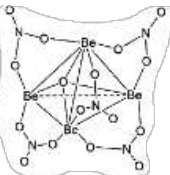
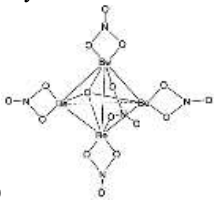
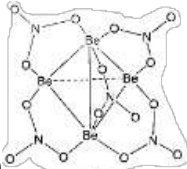
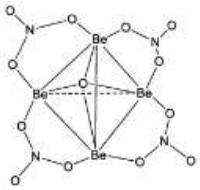
Show answer
Answer: (b)
Report an error in ABC26IN1241