Q1 · June 2021 · 2 marks
A compound shows [M]^{+}at \mathrm{m} / \mathrm{z} 84 and has base peak at 56 . It exhibits only one peak in 1 H NMR at \delta 1.4 \mathrm{ppm} and one signal in 13 \mathrm{C} \mathbf{~ N M R} at \delta 35 \mathrm{ppm}. The compound is
- (a) cyclobutane-1,3-dione
- (b) dichloromethane
- (c) cyclohexane
- (d) 1,2,3-trimethylcyclopropane
Show answer
Answer: (c)
Report an error in ABC26OR1012
Q2 · Dec 2019 · 2 marks
The frequency of O-H stretch occurs at 3600\ \mathrm{cm^{-1}}. The O-D stretch frequency (in \mathrm{cm^{-1}}) would be closest to
- (a) 3000
- (b) 2600
- (c) 1800
- (d) 900
Show answer
Answer: (b)
Report an error in ABC26OR0138
Q3 · Dec 2019 · 2 marks
In IR spectrum, recorded neat, a compound shows a strong and broad band at 3300 \mathrm{~cm}^{-1}. The band becomes sharp and shifts to \mathbf{3 6 0 0} \mathbf{~ c m}^{-\mathbf{1}} when the spectrum is recorded in \mathbf{C C l}_{\mathbf{4}} at high dilution. This proves that the compound has
- (a) OH group, which is involved in intra-molecular H-bonding
- (b) OH group, which is involved in inter-molecular H-bonding
- (c) A terminal alkyne group
- (d) OH group, present in severely sterically hindered environment
Show answer
Answer: (b)
Report an error in ABC26OR1002
Q4 · Dec 2019 · 2 marks
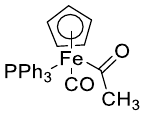
The correct match of {}^{13}C NMR chemical shift values (\delta ppm) for pyridine is 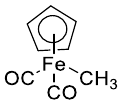
- (a) \mathrm{C_2} : 136, \mathrm{C_3} : 124; \mathrm{C_4} : 150
- (b) \mathrm{C_2} : 124, \mathrm{C_3} : 150; \mathrm{C_4} : 136
- (c) \mathrm{C_2} : 150, \mathrm{C_3} : 124; \mathrm{C_4} : 136
- (d) \mathrm{C_2} : 150; \mathrm{C_3} : 136; \mathrm{C_4} : 124
Show answer
Answer: (c)
Report an error in ABC26OR1003
Q5 · Dec 2019 · 2 marks
The frequency of O-H stretch occurs at 3600 \mathrm{cm^{-1}}. The O-D stretch frequency (in \mathrm{cm^{-1}}) would be closest to
- (a) 3000
- (b) 2600
- (c) 1800
- (d) 900
Show answer
Answer: (b)
Report an error in ABC26OR1004
Q6 · Dec 2019 · 2 marks
The natural product that gives a signal at 218 ppm in its {}^{13}\mathrm{C} NMR spectrum is
- (a) \alpha-pinene
- (b) camphor
- (c) geraniol
- (d) carvones
Show answer
Answer: (d)
Report an error in ABC26OR1007
Q7 · June 2018 · 2 marks
Using a double beam UV-visible spectrophotometer, Beer's law fails for \mathbf{K}_{\mathbf{2}} \mathbf{C r}_{\mathbf{2}} \mathbf{O}_{7} solution when
- (a) Intensity of light source is changed
- (b) Detector is not a photomultiplier tube
- (c) Cuvette of 2cm size is used
- (d) pH is not kept same in all measurements
Show answer
Answer: (d)
Report an error in ABC26OR0990
Q8 · Dec 2016 · 2 marks
{ }^{\mathbf{1}} \mathbf{H ~ N M R} spectrum of a mixture of benzene and acetonitrile shows two singlets of equal integration. The molar ratio of benzene: acetonitrile is
- (a) 1:1
- (b) 2: 1
- (c) 1:2
- (d) 6: 1
Show answer
Answer: (c)
Report an error in ABC26OR0984
Q9 · June 2015 · 2 marks
The {}^{1}\mathrm{H} NMR spectrum of a dilute solution of a mixture of acetone and dichloromethane in \mathrm{CDCl_3} exhibits two singlet of 1:1 intensity. Molar ratio of acetone to dichloromethane in the solution is
- (a) 3 : 1
- (b) 1 : 3
- (c) 1 : 1
- (d) 1 : 2
Show answer
Answer: (b)
Report an error in ABC26OR0972
Q10 · June 2015 · 2 marks
Intense band generally observed for a carbonyl group in the IR spectrum is due to
- (a) The force constant of CO bond is large
- (b) The force constant of CO bond is small
- (c) There is no change in dipole moment for CO bond stretching
Show answer
Answer: (d)
Report an error in ABC26OR0973
Q11 · June 2015 · 2 marks
Number of signals in the { }^{13} \mathrm{C}\left\{^{1} \mathrm{H}\right\} \mathrm{NMR} spectrum of (R)-4-methylpentan-2-ol are
Show answer
Answer: (d)
Report an error in ABC26OR0974
Q12 · Dec 2015 · 2 marks
The number of chemical shift non-equivalent protons expected in \mathbf{1 H ~ N M R} spectrum of \boldsymbol{\alpha} pinene is 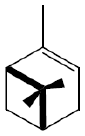 \alpha-pinene
Show answer
Answer: (b)
Report an error in ABC26OR0978
Q13 · Dec 2015 · 2 marks
In the mass spectrum of 1,2-dichloroethane, approximate ratio of peaks at m / z values 98, 100, 102 will be
- (a) 3: 1: 1
- (b) 9: 6: 1
- (c) 1: 1: 2
- (d) 1: 2: 1
Show answer
Answer: (b)
Report an error in ABC26OR0979
Q14 · Dec 2014 · 2 marks
The mass of metastable ion produced due to decomposition of \mathrm{F_1^+} in the following mass fragmentation sequence is Diethyl-phthalate (M + 222) \rightarrow \mathrm{F_1^+} \rightarrow \mathrm{F_2^+} + \mathrm{CO}
(177) - (a) 141.2
- (b) 125.4
- (c) 45.0
- (d) 210.2
Show answer
Answer: (b)
Report an error in ABC26OR0128
Q15 · Dec 2014 · 2 marks
In the IR spectrum, the absorption band due to carbonyl group in phenyl acetate appears at
- (a) \mathbf{1 8 0 0 ~ c m}^{-\mathbf{1}}
- (b) \mathbf{1 7 6 0 ~ c m}^{-1}
- (c) \mathbf{1 7 1 0 ~ c m}^{-\mathbf{1}}
- (d) \mathbf{1 6 6 0 ~ c m}^{-1}
Show answer
Answer: (b)
Report an error in ABC26OR0957
Q16 · Dec 2014 · 2 marks
The mass of metastable ion produced due to decomposition of { }_{1}{ }^{+}Fin the following mass fragmentation sequence is \begin{array}{cl} \text { Diethyl-phthalate } \rightarrow & \mathrm{F}_{1}{ }^{+} \rightarrow \mathrm{F}_{2}{ }^{+}+\mathrm{CO} (\mathrm{M}+222) & (177) \end{array}
(177) - (a) 141.2
- (b) 125.4
- (c) 45.0
- (d) 210.2
Show answer
Answer: (b)
Report an error in ABC26OR0968
Q17 · Dec 2014 · 2 marks
The ratio of the relative intensities of the carbon signals in the first order { }^{13} \mathrm{C} \mathrm{NMR} spectrum of \mathrm{CD}_{3} \mathrm{Cl} is
- (a) 1:4:6:4:1
- (b) 1: 3: 3: 1
- (c) 1: 6: 15: 20: 15: 6: 1
- (d) 1: 3: 6: 7: 6: 3: 1
Show answer
Answer: (d)
Report an error in ABC26OR0969
Q18 · Dec 2013 · 2 marks
Methyl 4-oxopentanoate exhibited signals at \delta 208,172,51,37,32 and 27 \mathrm{ppm} \mathrm{in}^{13} \mathrm{ifs} NMR spectrum. The signals due to the methoxy, \mathrm{C}_{1}, \mathrm{C}_{4} and \mathrm{C}_{5} carbons are
- (a) OMe -32; \mathrm{C}_{\mathrm{I}}-208 ; \mathrm{C}_{4}-172 ; \mathrm{C}_{5}-51
- (b) OMe-51; Cl-208; C4-172; C5-32
- (c) OMe-32; Cl-172; C4-208; C5-51
- (d) OMe-51; \mathrm{C}_{\mathrm{l}}-172, \mathrm{C}_{4}-208 ; \mathrm{C}_{5}-32
Show answer
Answer: (d)
Report an error in ABC26OR0963
Q19 · June 2012 · 2 marks
The number of signals that appear in the broadband decoupled { }^{13} \mathrm{C} \mathrm{NMR} spectrum of phenanthrene and anthracene, respectively are
- (a) ten and four
- (b) ten and ten
- (c) seven and four
- (d) seven and seven.
Show answer
Answer: (c)
Report an error in ABC26OR0950
Q20 · June 2012 · 2 marks
In the 400 \mathrm{MHz}^{1} \mathrm{H} \mathrm{NMR} spectrum, of organic compound exhibited a doublet. The two lines of the doublet are at 82.35 and 2.38 ppm . The coupling constant (\mathrm{J}) value is
- (a) 3 Hz
- (b) 6 Hz
- (c) 9 Hz
- (d) 12 Hz
Show answer
Answer: (d)
Report an error in ABC26OR0951
Q21 · June 2011 · 2 marks
The absorption at \lambda_{\max }=279 \mathrm{~nm}(\varepsilon=15) in the UV spectrum of acetone is due to
- (a) \pi \rightarrow \pi^{*} transition
- (b) \boldsymbol{n} \rightarrow \boldsymbol{\pi}^{*} transition
- (c) \sigma \rightarrow \sigma^{*} transition
- (d) \pi \rightarrow \sigma^{*} transition
Show answer
Answer: (b)
Report an error in ABC26OR0940
Q22 · June 2011 · 2 marks
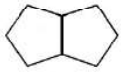
In the broad band decoupled { }^{13} \mathrm{C} \mathrm{NMR} spectrum, the numbers of signals apperating for the bicyclooctane A-C , respectively are
- (a)
 Five, four and eight
- (b)
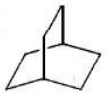 Three, two and five
- (c)
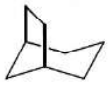 Five, four and five
- (d) Three, two and eight
Show answer
Answer: (b)
Report an error in ABC26OR0941
Q23 · June 2011 · 2 marks
In the mass spectrum of dichlorobenzene the ratio of the peaks at m / z 146, 148 and 150 , is:
- (a) 1:1:1
- (b) 3: 3: 1
- (c) 1: 2: 1
- (d) 9: 6: 1
Show answer
Answer: (d)
Report an error in ABC26OR0942
Q24 · Dec 2011 · 2 marks
In the mass spectrum of dodecahedron \left(\mathbf{C}_{\mathbf{2 0}} \mathbf{H}_{\mathbf{2 0}}\right), approximate ratio of the peaks at m / z=260 and 261 is
- (a) 1: 1
- (b) 5: 1
- (c) 10: 1
- (d) 20: 1
Show answer
Answer: (b)
Report an error in ABC26OR0946
Q25 · Dec 2011 · 2 marks
An organic compound \left(\mathrm{MF}=\mathrm{C}_{8} \mathrm{H}_{10} \mathrm{O}\right) exhibited the following { }^{1} \mathrm{H} \mathrm{NMR} spectral data: \delta 2.5 (3 \mathrm{H}, \mathrm{s}), 3.8(3 \mathrm{H}, \mathrm{s}), 6.8(2 \mathrm{H}, \mathrm{d}, J=8 \mathrm{~Hz}), 7.2(2 \mathrm{H}, \mathrm{d}, J=8 \mathrm{~Hz}) \mathrm{ppm}. The compound among the choices, is
- (a) 4-ethylphenol
- (b) 2-ethylphenol
- (c) 4-methylanisole
- (d) 4-methylbenzyl alcohol
Show answer
Answer: (c)
Report an error in ABC26OR0947