Q1 · June 2019 · 2 marks
A certain system of non interacting particles has the single-particle partition function f = A\frac{T^m}{V} where A is some constant. The average energy per particle will be
- (a) mkT
- (b) AkT
- (c) kT/m
- (d) kT/A
Show answer
Answer: (a)
Report an error in ABC26PH1368
Q2 · June 2013 · 2 marks
The allowed transition among the following is
- (a) {}^3\mathrm{F}_4 \rightarrow {}^3\mathrm{D}_3
- (b) {}^3\mathrm{F}_4 \rightarrow {}^1\mathrm{D}_3
- (c) {}^3\mathrm{F}_4 \rightarrow {}^3\mathrm{P}_4
- (d) {}^3\mathrm{F}_4 \rightarrow {}^3\mathrm{D}_2
Show answer
Answer: (a)
Report an error in ABC26PH1380
Q3 · June 2019 · 2 marks
The rotational partition function is expected to be the smallest for the molecule, among the following
- (a) \mathrm{H_2}
- (b) \mathrm{Li_2}
- (c) \mathrm{N_2}
- (d) \mathrm{F_2}
Show answer
Answer: (a)
Report an error in ABC26PH1404
Q4 · June 2019 · 2 marks
The difference between standard molar entropies of two mono-atomic gases (A) and (B) \left(S_{\mathrm{m},\mathrm{A}}^{0}-S_{\mathrm{m},\mathrm{B}}^{0}\right) at a given temperature is (given that the molar mass of (A) is twice the molar mass of (B)
- (a) \frac{3}{2}R\ln 2
- (b) R\ln 2
- (c) \frac{5}{2}R\ln 2
- (d) \frac{7}{2}R\ln 2
Show answer
Answer: (a)
Report an error in ABC26PH1407
Q5 · Dec 2019 · 2 marks
Consider a two-level system in which the excited state, separated from the ground state by energy \epsilon, is doubly degenerate. The fraction of the molecules in the excited state, as T \rightarrow \infty is
- (a) \frac{1}{2}
- (b) -\frac{1}{2}
- (c) \frac{2}{3}
- (d) 1
Show answer
Answer: (c)
Report an error in ABC26PH1408
Q6 · Dec 2019 · 2 marks
The molar residual entropy (in \mathrm{J\,K^{-1}}) of solid OCS would be closest to
- (a) 0
- (b) 2.9
- (c) 5.8
- (d) 8.7
Show answer
Answer: (c)
Report an error in ABC26PH1409
Q7 · Dec 2018 · 2 marks
The translational partition function for Ar confined to a volume of 1L at 300K, having thermal wavelength of 1.60 \times 10^{11}\ \mathrm{m}, is closest to :
- (a) 24.4 \times 10^{29}
- (b) 2.44 \times 10^{29}
- (c) 0.244 \times 10^{29}
- (d) 244 \times 10^{29}
Show answer
Answer: (b)
Report an error in ABC26PH0208
Q8 · Dec 2017 · 2 marks
Four distinguishable molecules are distributed in energy level E1 and E2 with degeneracy of 2 & 3 respectively. Number of microstates with 3 molecules in in energy level E1 and E2 is
- (a) 4
- (b) 12
- (c) 96
- (d) 192
Show answer
Answer: (c)
Report an error in ABC26PH0207
Q9 · June 2017 · 2 marks
The first excited state ({}^{2}\mathrm{P}_{1/2}) of fluorine lies at an energy of 400\ \mathrm{cm^{-1}} above the ground state ({}^{2}\mathrm{P}_{3/2}). The fraction of Fluorine atoms in the first excited state at k_BT = 420\ \mathrm{cm^{-1}} is close to
- (a) \frac{1}{1+e}
- (b) \frac{1}{2+e}
- (c) \frac{1}{1+4e}
- (d) \frac{1}{1+2e}
Show answer
Answer: (d)
Report an error in ABC26PH1398
Q10 · Dec 2017 · 2 marks
The term symbol for the ground state of a metal ion is {}^{3}\mathrm{P}_{2}. The residual entropy of a crystal of a salt of this metal ion at 0 K is :
- (a) k_B \ln 1
- (b) k_B \ln 3
- (c) k_B \ln 5
- (d) k_B \ln 7
Show answer
Answer: (d)
Report an error in ABC26PH1399
Q11 · June 2016 · 2 marks
The single – partition translational partition function (f) for an ideal gas in a fixed volume V depends on the thermal Broglie wave function \lambda^{\mathrm{th}} as f\sim(\lambda^{\mathrm{th}})_n where :
- (a) n=3
- (b) n=1
- (c) n=-1
- (d) n=-3
Show answer
Answer: (d)
Report an error in ABC26PH1394
Q12 · Dec 2016 · 2 marks
The weight of configuration with two ups and three down spins in a system with five spin \frac{1}{2} particles is
- (a) 120
- (b) 60
- (c) 20
- (d) 10
Show answer
Answer: (d)
Report an error in ABC26PH1395
Q13 · Dec 2016 · 2 marks
Partition function of a one - dimensional oscillator having equispaced energy level with energy spacing equal to \boldsymbol{k}_{\boldsymbol{b}} \boldsymbol{T} and zero ground energy is
- (a) e
- (b) 1/(e-1)
- (c) \mathrm{e} /(\mathrm{e}-1)
- (d) 1 /(e+1)
Show answer
Answer: (c)
Report an error in ABC26PH1396
Q14 · Dec 2015 · 2 marks
Though a constant shift of energy levels of a system changes the partition function, the properties that do not change are
- (a) average energy, entropy and heat capacity
- (b) average energy and entropy
- (c) average energy and heat capacity
- (d) entropy and heat capacity
Show answer
Answer: (d)
Report an error in ABC26PH1392
Q15 · Dec 2014 · 2 marks
Identify the speed distribution functions of Ne, Ar and Kr with the curves in the figure above: 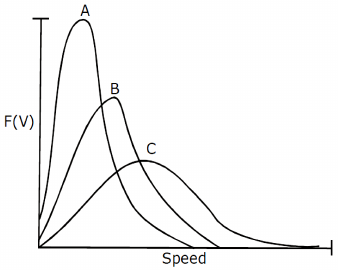
- (a) Ne-A, Ar-B, Kr-C
- (b) Ne-B, Ar-C, Kr-A
- (c) Ne-C, Ar-B, Kr-A
- (d) Ne-C, Ar-A, Kr-B
Show answer
Answer: (c)
Report an error in ABC26PH0205
Q16 · Dec 2014 · 2 marks
The number of microstates that are possible, when two particles are distributed in four states such that the resulting wave functions are antisymmetric with respect to exchange of the particles, is :
- (a) 16
- (b) 12
- (c) 8
- (d) 6
Show answer
Answer: (d)
Report an error in ABC26PH1386
Q17 · Dec 2014 · 2 marks
When T \rightarrow \infty, value of the single-particle partition function will be (given : degeneracy of level j = g_j) :
- (a) 1
- (b) g_0
- (c) \Sigma_j g_j
- (d) 1/\Sigma_j g_j
Show answer
Answer: (c)
Report an error in ABC26PH1387
Q18 · Dec 2014 · 2 marks
The probability of finding the harmonic oscillator in the energy level n = 1 is (neglect zero point energy and assume h\nu = k_BT)
- (a) e
- (b) e^2
- (c) 1 - e^2
- (d) e^{-2}(e-1)
Show answer
Answer: (d)
Report an error in ABC26PH1388
Q19 · Dec 2014 · 2 marks
Identify the speed distribution functions of \mathrm{Ne}, \mathrm{Ar} and Kr with the curves in the figure above:
- (a) Ne-A, Ar-B, Kr-C
- (b) Ne-B, Ar-C, Kr-A
- (c) Ne-C, Ar-B, Kr-A
- (d) Ne-C, Ar-A, Kr-B
Show answer
Answer: (c)
Report an error in ABC26PH1389
Q20 · Dec 2013 · 2 marks
The number of ways in which four molecules can be distributed in two different energy levels is :
Show answer
Answer: (c)
Report an error in ABC26PH0201
Q21 · June 2013 · 2 marks
A system has 100 degenerate energy levels and 100 bosons are kept in it. Find the entropy of the system at equilibrium
- (a) 10^{-2}\,k_b
- (b) 10^{2}\,k_b
- (c) 460.0\,k_b
- (d) 4.606\,k_b
Show answer
Answer: (b)
Report an error in ABC26PH1378
Q22 · Dec 2012 · 2 marks
Calculate the total number of microstates for 6 identical particles with their occupation numbers \{1, 2, and 3\} in three states is
- (a) 6
- (b) 12
- (c) 60
- (d) 720
Show answer
Answer: (c)
Report an error in ABC26PH1379
Q23 · June 2012 · 2 marks
The relative population in two states with energies E_1 and E_2 satisfying Boltzmann distribution is given by n_1/n_2 = (3/2)\exp[-(E_1 - E_2)/k_bT]. The relative degeneracy g_2/g_1 is:
- (a) 2
- (b) 2/3
- (c) 3/2
- (d) 3
Show answer
Answer: (b)
Report an error in ABC26PH0196
Q24 · Dec 2012 · 2 marks
The rotational partition function of \mathrm{H_2} is :
- (a) \sum_{J=0,1,2\ldots}(2J+1)e^{-\beta hcBJ(J+1)}
- (b) \sum_{J=1,3,5\ldots}(2J+1)e^{-\beta hcBJ(J+1)}
- (c) \sum_{J=0,2,4\ldots}(2J+1)e^{-\beta hcBJ(J+1)}
- (d) \frac{1}{4}\left[\sum_{J=0,2,4\ldots}(2J+1)e^{-\beta hcBJ(J+1)} + 3\sum_{J=1,3,5\ldots}(2J+1)e^{-\beta hcBJ(J+1)}\right]
Show answer
Answer: (d)
Report an error in ABC26PH0199
Q25 · June 2011 · 2 marks
The term symbol for the ground state of nitrogen atoms is
- (a) {}^{3}P_{0}
- (b) {}^{4}P_{3/2}
- (c) {}^{1}P_{1}
- (d) {}^{4}S_{3/2}
Show answer
Answer: (a)
Report an error in ABC26PH1370
Q26 · Dec 2011 · 2 marks
P_A and P_B denote the populations of two energy states E_A and E_B and E_A > E_B. The correct statement when the temperature T_1 > T_2 is
- (a) P_A(T_1) > P_B(T_1), P_A(T_2) < P_B(T_2) and (P_A/P_B)_{T_1} > (P_A/P_B)_{T_2}
- (b) P_A(T_1) < P_B(T_1), P_A(T_2) > P_B(T_2) and (P_A/P_B)_{T_1} > (P_A/P_B)_{T_2}
- (c) P_A(T_1) < P_B(T_1), P_A(T_2) < P_B(T_2) and (P_A/P_B)_{T_1} > (P_A/P_B)_{T_2}
- (d) P_A(T_1) < P_B(T_1), P_A(T_2) < P_B(T_2) and (P_A/P_B)_{T_1} < (P_A/P_B)_{T_2}
Show answer
Answer: (c)
Report an error in ABC26PH1371
Q27 · Dec 2011 · 2 marks
A system consisting of 4 identical and distinguishable particles, each possessing three available states of 1,2 and 3 units, has 10 units of energy. The number of ways, W, in which these conditions are satisfied is :
Show answer
Answer: (d)
Report an error in ABC26PH1372