Q1 · 2005-2021 · 2 marks
Which of the following statements is NOT correct for a catalyst?
- (a) It increases the rate of a reaction
- (b) It is not consumed in the course of a reaction
- (c) It provides an alternate pathway for the reaction
- (d) It increases the activation energy of the reaction
Show answer
Answer: (d)
Report an error in ABC26PH0338
Q2 · 2005-2021 · 2 marks
The value of the rate constant for the gas phase reaction \mathrm{2NO_2 + F_2 \rightarrow 2NO_2F} is 38\ \mathrm{dm^3\,mol^{-1}\,s^{-1}} at 300 K. The order of the reaction is
Show answer
Answer: (c)
Report an error in ABC26PH0339
Q3 · 2005-2021 · 2 marks
The rate constant of two reactions as temperature T are k_{1}(T) and k_{2}(T) and the corresponding activation energies are E_{1} and E_{2} with E_{2}>E_{1}. When temperature is raised from T_{1} and T_{2}, which one of the following relations is correct?
- (a) \frac{k_{1}(T_{2})}{k_{1}(T_{1})}=\frac{k_{2}(T_{2})}{k_{2}(T_{1})}
- (b) \frac{k_{1}(T_{2})}{k_{1}(T_{1})}>\frac{k_{2}(T_{2})}{k_{2}(T_{1})}
- (c) \frac{k_{1}(T_{2})}{k_{1}(T_{1})}\geq\frac{k_{2}(T_{2})}{k_{2}(T_{1})}
- (d) \frac{k_{1}(T_{2})}{k_{1}(T_{1})}<\frac{k_{2}(T_{2})}{k_{2}(T_{1})}
Show answer
Answer: (d)
Report an error in ABC26PH0343
Q4 · 2005-2021 · 2 marks
For the reaction \mathrm{2X_3 = 3X_2}, the rate of formation of \mathrm{X_2} is:
- (a) 3(-d[\mathrm{X_3}]/dt)
- (b) \frac{1}{2}(-d[\mathrm{X_3}]/dt)
- (c) \frac{1}{3}(-d[\mathrm{X_3}]/dt)
- (d) \frac{3}{2}(-d[\mathrm{X_3}]/dt)
Show answer
Answer: (d)
Report an error in ABC26PH0344
Q5 · 2005-2021 · 2 marks
In a homogeneous catalytic reaction, 1.0 M of a substrate and 1.0\,\mu\mathrm{M} of a catalyst yields 1.0 mM of a product in 10 seconds. The turnover frequency (TOF) of the reaction (\mathrm{s}^{-1}) is
- (a) 10^{-2}
- (b) 10^{2}
- (c) 10^{-3}
- (d) 10^{3}
Show answer
Answer: (b)
Report an error in ABC26PH0345
Q6 · 2005-2021 · 2 marks
For the reaction given below, the relaxation time is 10^{-6}\,\mathrm{s}. Given that 10% of A remains at equilibrium, the value of k_1\left(\mathrm{s}^{-1}\right) is A \underset{k_{-1}}{\stackrel{k_1}{\rightleftharpoons}} B
- (a) 9 \times 10^5
- (b) 10^{-5}
- (c) 10^5
- (d) 9 \times 10^{-5}
Show answer
Answer: (a)
Report an error in ABC26PH0346
Q7 · 2005-2021 · 2 marks
For the parallel first order reaction shown below 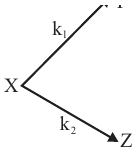 the value of k_1 is 1 \times 10^{-4}\ \mathrm{s^{-1}}. If the reaction starts from X, the ratio of the concentrations of Y and Z at any given time during the course of the reaction is found to be \frac{[\mathrm{Y}]}{[\mathrm{Z}]} = \frac{1}{4}. The value of k_2 is:
- (a) 1 \times 10^{-4}\ \mathrm{s^{-1}}
- (b) 2.5 \times 10^{-5}\ \mathrm{s^{-1}}
- (c) 4 \times 10^{-4}\ \mathrm{s^{-1}}
- (d) 4 \times 10^{4}\ \mathrm{s^{-1}}
Show answer
Answer: (c)
Report an error in ABC26PH0348
Q8 · 2005-2021 · 2 marks
The specific rate constant of decomposition of compound is represented by \text { Ink }=5.0-\frac{12000}{\mathrm{~T}}
The activation energy of decomposition for this compound at 300 K is - (a) 24 kcal/mole
- (b) 12 kcal/mole
- (c) 24 cal/mole
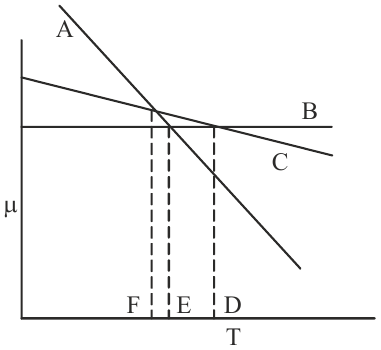
- (d) 12 cal/mole Statement for Linked Answer Q. 54 and Q. 55: In the m vs T diagram for different phases of the same substance at one atmospheric pressure, the lines \mathrm{A}, \mathrm{B} and C compound to
Show answer
Answer: (c)
Report an error in ABC26PH0353
Q9 · 2005-2021 · 2 marks
For a given first order reaction, the reactant reduces to 1/4^{\text{th}} its initial value in 10 minutes. The rate constant of the reaction is:
- (a) 0.1386\ \mathrm{min^{-1}}
- (b) 0.0693\ \mathrm{min^{-1}}
- (c) 0.1386\ \mathrm{mol\,L^{-1}\,min^{-1}}
- (d) 0.0693\ \mathrm{mol\,L^{-1}\,min^{-1}}


Show answer
Answer: (a)
Report an error in ABC26PH0356
Q10 · 2005-2021 · 2 marks
For a reaction involving two steps given below First step: \mathrm{G \rightleftharpoons 2H}
Second step: \mathrm{G + H \rightarrow P}
assume that the first step attains equilibrium rapidly. The rate of formation of P is proportional to - (a) [\mathrm{G}]^{1/2}
- (b) [\mathrm{G}]
- (c) [\mathrm{G}]^{2}
- (d) [\mathrm{G}]^{3/2}
Show answer
Answer: (d)
Report an error in ABC26PH0360
Q11 · 2005-2021 · 2 marks
Consider the reaction, 2\mathrm{C}(\mathrm{s})+\mathrm{O}_{2}(\mathrm{g})\rightleftharpoons 2\mathrm{CO}(\mathrm{g}) at equilibrium, The equilibrium can be shifted towards the forward direction by
- (a) Increasing the amount of carbon in the system
- (b) Decreasing the volume of the system
- (c) Decreasing the pressure of the system
- (d) Increasing the temperature of the system
Show answer
Answer: (c)
Report an error in ABC26PH0362
Q12 · 2005-2021 · 2 marks
The rate constant of a reaction is 1.25 \times 10^{-4}\ \mathrm{mol\,L^{-1}\,s^{-1}}. If the initial concentration of the reactant is 0.250 \mathrm{mol\,L^{-1}}, the total time (in second) required for complete conversion is ____
Show answer
Answer: 2000
Report an error in ABC26PH0370
Q13 · 2005-2021 · 2 marks
The dependence of rate constant k on a temperature T (in K) of a reaction is given by the expression \ln k = [(-5000\ \mathrm{K})/T] + 10
The activation energy of the reaction (in \mathrm{kJ\ mol^{-1}}) is ____ (up to two decimal places) Show answer
Answer: 41.57
Report an error in ABC26PH0371
Q14 · 2005-2021 · 2 marks
Under physiological conditions, the conversion of \mathrm{CO_2} to bicarbonate ion by carbonic anhydrase enzyme (MW = 30,000 \mathrm{g\,mol^{-1}}) has a turnover number of 4.00 \times 10^{5}\ \mathrm{s^{-1}}. The minimum amount of enzyme (in \mug) required to convert 0.44 g of \mathrm{CO_2} to bicarbonate ions in 100 seconds is ________ (up to two decimal places)
Show answer
Answer: 7.5
Report an error in ABC26PH0373
Q15 · 2005-2021 · 2 marks
According to Eyring state theory for a bimolecular reaction, the activated complex has
- (a) no vibrational degrees of freedom
- (b) vibrational degrees of freedom but they never participate in product formation
- (c) one high frequency vibration that leads to product formation
- (d) one low frequency vibration that leads to prodcut formation
Show answer
Answer: (c)
Report an error in ABC26PH0374
Q16 · 2005-2021 · 2 marks
Consider the following two parallel irreversible first order reactions at temperature T, 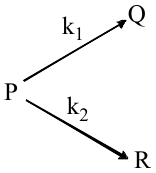 where k_1 and k_2 are the rate constants and their values are 5 \times 10^{-2} and 15 \times 10^{-2}\ \mathrm{min^{-1}} respectively, at temperature T. If the initial concentration of the reactant 'P' is 4\ \mathrm{mol\,L^{-1}}, then the concentration of product 'R' after 10 min of reaction is ____ \mathrm{mol\,L^{-1}}. (Round off to two decimal places) (Assume only P is present at the beginning of the reaction)
Show answer
Answer: 2.59
Report an error in ABC26PH0378
Q17 · 2005-2021 · 2 marks
In Freundlich isotherm, a linear relationship is obtained in the plot of (\theta = surface coverage and p = partial pressure of the gas)
- (a) \theta vs p
- (b) \ln(\theta) vs \ln(p)
- (c) \ln(\theta) vs p
- (d) \theta vs \ln(p)
Show answer
Answer: (b)
Report an error in ABC26PH0484