





Berry pseudorotation: mechanism in five-coordinate complexes
Learn how Berry pseudorotation swaps axial and equatorial atoms in PF5, with two solved practice questions and a short study plan for JAM, NET, GATE.
This post explains how the axial and equatorial atoms of a five-coordinate molecule swap places.
You will also get two solved practice questions and a short study plan.
The shapes involved
A trigonal bipyramid has five positions. Three are equatorial: they lie in one plane around the central atom. Two are axial: they lie above and below that plane, on a straight line through the central atom. A ligand is any atom or group attached to the central atom.
The two types of position are not the same. In a fixed picture of PF5, you would expect two kinds of fluorine: two axial and three equatorial. Yet experiments on PF5 point to only one kind. Berry pseudorotation explains this gap.
R. Stephen Berry described this mechanism in 1960. It is the most widely accepted mechanism for pseudorotation. Pseudorotation means the atoms exchange positions as if the molecule had rotated, but no bond is broken and the molecule does not actually spin. A molecule whose atoms keep swapping positions like this is called fluxional.
The mechanism, step by step
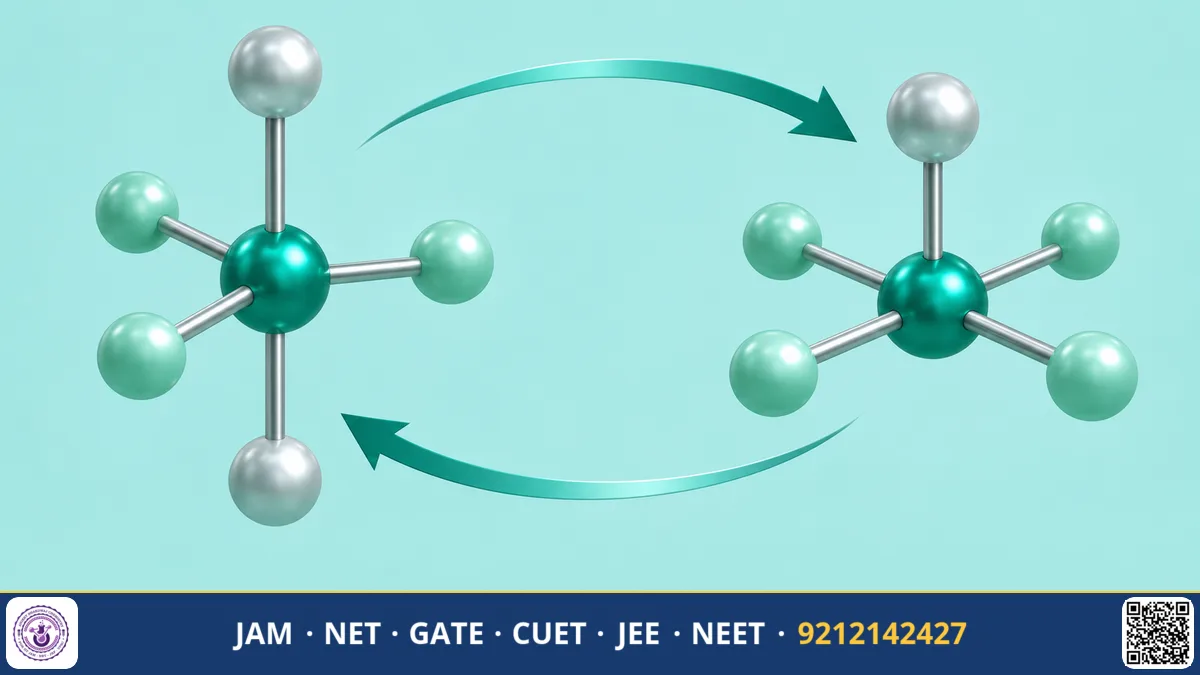
Label the ligands in PF5. Call the axial ones F1 and F2. Call the equatorial ones F3, F4 and F5. Take F3 as the pivot.
- Start: F1 and F2 are axial. F3, F4 and F5 are equatorial.
- Scissor motion: The two axial ligands close like a pair of scissors. They push in between the two equatorial ligands F4 and F5, which scissor out to make room. F3, the pivot, does not move.
- Transition state: The molecule passes through a square pyramid. F3 is at the tip. F1, F2, F4 and F5 form the square base.
- Finish: F4 and F5 open out until they are 180° apart. They are now axial. F1 and F2 have settled into the equatorial plane with F3.
The result is the same trigonal bipyramid, but the labels have moved. F4 and F5 are axial. F1, F2 and F3 are equatorial. The new axis is perpendicular to the old one.
In PF5 this step needs only about 3.6 kcal/mol. That is a small barrier, so the exchange is rapid.
What it means for the molecule
Because the exchange is fast, you must be careful when you read data on such molecules. Three consequences matter for exams.
- A fluorine spectrum shows an average. At ordinary temperature, PF5 gives one fluorine environment, not two. If the exchange is slowed enough, the two types can be seen separately.
- Isomers are hard to separate. A carbon with four different groups can be resolved into mirror-image forms. A five-coordinate complex cannot usually be resolved, because pseudorotation keeps interconverting the forms. Resolution becomes possible only at low temperatures, or when one or more ligands is bidentate or polydentate (binds through two or more atoms).
- Many arrangements are linked. For monodentate ligands, there are 20 unique arrangements, counting mirror-image forms. Successive pseudorotations can reach every one of them.
Trigonal bipyramid and square pyramid compared
| Point | Trigonal bipyramid (e.g. PF5) | Square pyramid |
|---|---|---|
| Role in the PF5 pathway | Starting and ending shape | Transition state |
| Positions | Two axial, three equatorial | One tip, four in the base |
| Pivot ligand | Stays equatorial throughout | Sits at the tip |
| Energy needed | About 3.6 kcal/mol in PF5 | About 26.7 kcal/mol when the molecule itself is square pyramidal, as in IF5 |
Do not mix up the two roles of the square pyramid. In PF5 it is a short-lived transition state. In IF5 it is the actual shape of the molecule, and the motion there is somewhat like the reverse of the bipyramidal case. It needs a much larger amount of energy.
How exam questions use this
For IIT-JAM, CSIR-NET, GATE and CUET-PG, this topic usually enters through a few routes. The exact mix changes from paper to paper, so prepare all of them.
- Fluxional behaviour, and what a spectrum shows at room temperature compared with low temperature.
- Which ligand acts as the pivot, and which positions are axial after one step.
- Why a five-coordinate complex with different ligands cannot easily be resolved into mirror-image forms.
- Comparing the Berry mechanism with the Bailar twist and the Ray–Dutt twist, which are related ideas.
Learn the motion as a picture first. Then answer questions from the picture, not from memory of words.
Practice question 1
Practice question (not a past-paper question). In PF5, fluorines F1 and F2 are axial. F3, F4 and F5 are equatorial. One Berry pseudorotation occurs with F3 as the pivot. Which fluorines are axial afterwards?
(a) F1 and F2 (b) F3 and F4 (c) F4 and F5 (d) F1 and F3
Solution.
- The pivot does not move. F3 stays equatorial. That removes (b) and (d), where F3 is axial.
- The two axial ligands close up and enter the equatorial plane. So F1 and F2 become equatorial. That removes (a).
- The two equatorial ligands other than the pivot open out to 180°. These are F4 and F5. They become axial.
Answer: (c). Check: the new equatorial set is F1, F2 and F3, which is still three ligands. The new axial set is F4 and F5, which is still two. The count is right.
Practice question 2
Practice question (not a past-paper question). PF3Cl2 has a trigonal bipyramidal structure with both chlorine atoms equatorial. The three fluorines are therefore one equatorial and two axial. (i) How many fluorine environments does a fixed structure have? (ii) What does the fluorine spectrum look like when pseudorotation is fast? (iii) Why does cooling help?
Solution.
- (i) The two axial fluorines are equivalent to each other. The one equatorial fluorine is different. So there are two fluorine environments, in the ratio 2 : 1.
- (ii) With fast pseudorotation, the fluorines keep swapping between axial and equatorial positions. The instrument sees an average, so the fluorines appear as one environment.
- (iii) Pseudorotation has an energy barrier. Lowering the temperature slows the exchange. When the exchange is slow enough, the two environments show up separately.
Note the pattern: count positions in the fixed structure first, then ask how fast the exchange is.
Study plan for this topic
- First sitting: Build a model from clay balls and sticks, or draw it on paper. Walk through the scissor motion again and again, choosing a different pivot each time.
- Second sitting: Revise the shapes of five-coordinate molecules from the electron-pair repulsion rules. Write down which positions are axial and which are equatorial.
- Third sitting: Link the idea to spectra. Write a one-line rule: fast exchange gives an average, slow exchange gives separate signals.
- Fourth sitting: Solve fresh questions on pivot and position labels. Do not look at the mechanism while solving.
- Fifth sitting: Compare with the Bailar twist and the Ray–Dutt twist. Note the coordination number each one belongs to.
- Every week: Re-solve the questions you got wrong.
For more practice by chapter, use the ABC Chemistry question bank. If you want guided preparation with a weekly test and a doubt hour, ABC Chemistry runs 6-month live online batches for IIT-JAM, CSIR NET, GATE and CUET-PG. Classes are recorded, so a missed class is never lost. Use the enquiry form on the ABC Chemistry site to ask about the batch for your exam.
Key takeaways
- Berry pseudorotation exchanges the two axial ligands with two equatorial ligands. One equatorial ligand stays fixed as the pivot.
- The transition state is a square pyramid, with the pivot at the tip.
- The barrier in PF5 is about 3.6 kcal/mol, so exchange is fast.
- Fast exchange makes ligands look equivalent and makes such complexes hard to resolve, except at low temperatures or with bidentate or polydentate ligands.
- For monodentate ligands there are 20 arrangements, all linked by successive pseudorotations.
Frequently asked questions
Does a bond break during Berry pseudorotation?
No. It is a type of vibration in which the angles change and the atoms exchange positions. The molecule keeps all five bonds.
Which ligand is the pivot?
The pivot is the equatorial ligand that does not move. It sits at the tip of the square pyramid in the transition state.
Why can a five-coordinate complex not be resolved easily?
The exchange of axial and equatorial ligands is rapid, so the forms interconvert. Resolution is possible only at low temperatures, or when one or more ligands is bidentate or polydentate.
Is the mechanism limited to PF5?
No. It most commonly occurs in trigonal bipyramidal molecules such as PF5. It can also occur in square pyramidal molecules such as IF5, but that needs about 26.7 kcal/mol.