






Chemical kinetics rate law numericals with step-by-step solutions
Learn to find reaction order, k and half-life from data. Two worked practice questions on rate law, plus a one-week kinetics study plan for PG entrance exams.
This post gives you a clear method to handle rate law numericals without guessing.
You will get the key ideas, the way exam questions are framed, two worked practice questions and a one-week study plan.
The rate law and what each symbol means
The rate of reaction is the change in concentration of a reactant or product per unit time. For a reactant it carries a minus sign, so the rate stays positive.
The rate law is an equation that expresses the rate in terms of concentrations. For a reaction A + B → products, it is written as:
rate = k[A]m[B]n
- k is the rate constant. It depends on temperature and on the catalyst, not on concentration.
- m and n are the orders with respect to A and B. The overall order is m + n.
Students often copy the stoichiometric coefficients as orders. Do not do this. The orders are fixed by the mechanism, which is the sequence of elementary steps, and you find them from data. They can be zero, a fraction or a whole number.
Do not mix up order with molecularity. Order is an experimental number for the whole rate law. Molecularity is the number of species colliding in a single elementary step, so it is always a whole number and is never zero.
Units of k and integrated equations at a glance
The unit of k tells you the order. This is the fastest check on any answer you write. For order n, the unit is (mol L-1)1-n s-1.
| Order | Rate law | Integrated form | Half-life | Unit of k | Straight-line plot |
|---|---|---|---|---|---|
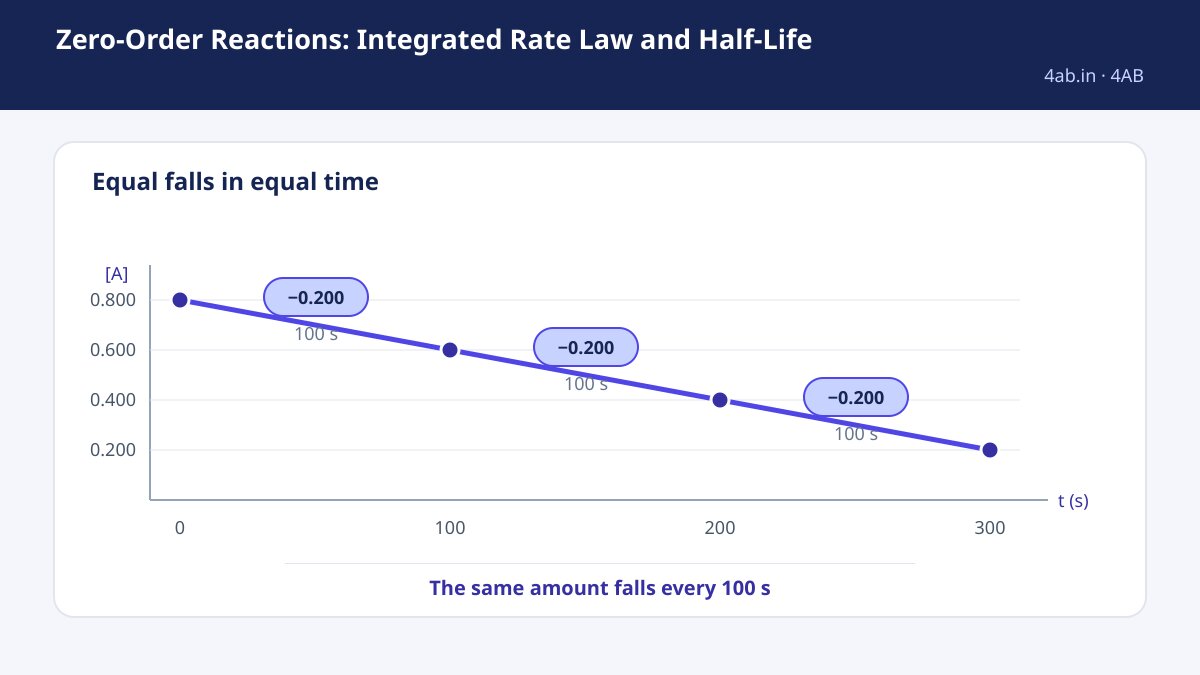
| Zero | rate = k | [A] = [A]0 − kt | [A]0/2k | mol L-1 s-1 | [A] against t |
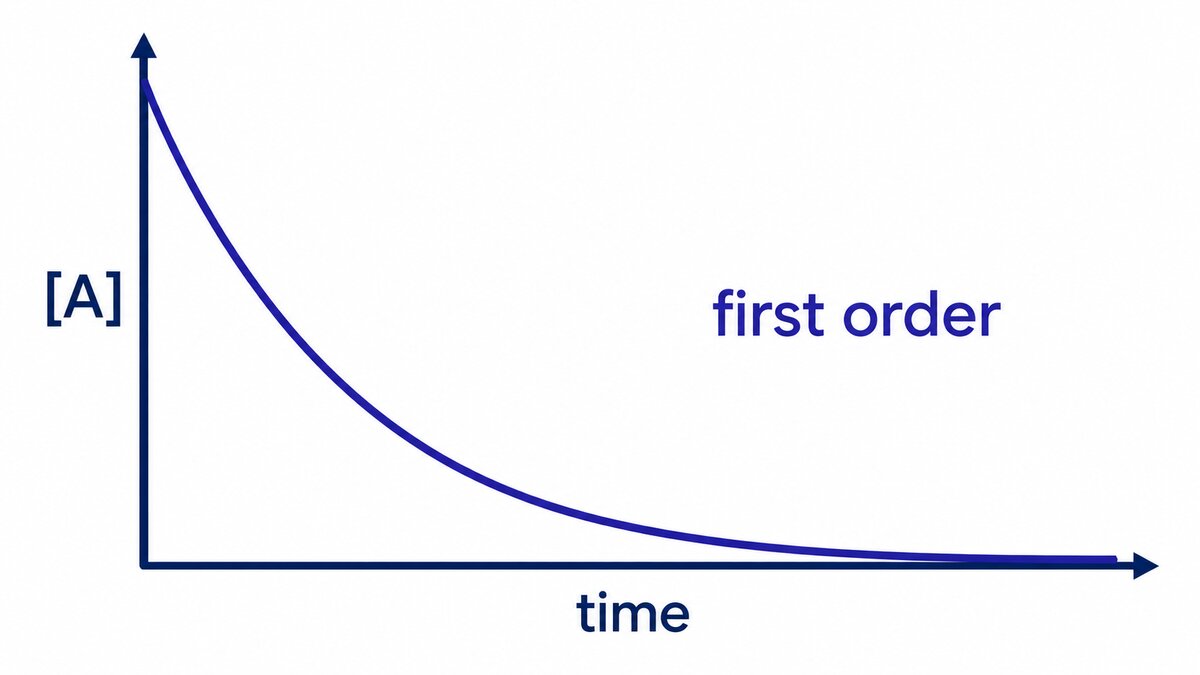
| First | rate = k[A] | ln[A] = ln[A]0 − kt | 0.693/k | s-1 | ln[A] against t |
| Second | rate = k[A]2 | 1/[A] = 1/[A]0 + kt | 1/(k[A]0) | L mol-1 s-1 | 1/[A] against t |
Learn one more fact about half-life. For a first-order reaction it does not depend on the starting concentration. For zero and second order it does. Many short-answer questions test only this point.
Also remember pseudo-first-order reactions. If one reactant is in large excess, its concentration hardly changes, so the reaction behaves as first order in the other reactant. Acid-catalysed hydrolysis of an ester in water is the standard example.
How these problems appear in entrance exams
At the post-graduate entrance level, the ideas are the same as in your school chapter. The questions are tighter and ask you to combine steps. Expect these patterns:
- Find the order and k from a table of initial rates.
- Use a half-life or a fraction completed to find k or time.
- Identify the order from the unit of k or from the shape of a plot.
- Compare rate constants at two temperatures. Reaction rates usually rise with temperature because more molecules can reach the activation energy, the minimum energy needed for reaction.
- Write the rate law from a proposed mechanism, where the slowest step controls the rate.
Most marks are lost through careless units, the wrong logarithm base, or mixing ln and log. Write the unit at every step. Check that your final unit matches the order you found.
The same toolkit serves both option-type papers and descriptive papers. In an option-type question, you may only need the order. In a descriptive answer, you must show the method, so write each line.
Practice question 1: order and k from initial rates
These are practice questions written for this post. They are not past-paper questions.
Question. For the reaction A + B → products, the initial rates were measured at the same temperature.
| Experiment | [A] (mol L-1) | [B] (mol L-1) | Initial rate (mol L-1 s-1) |
|---|---|---|---|
| 1 | 0.10 | 0.10 | 2.0 × 10⁻³ |
| 2 | 0.20 | 0.10 | 8.0 × 10⁻³ |
| 3 | 0.10 | 0.20 | 4.0 × 10⁻³ |
(a) Find the order with respect to A and B. (b) Find k with its unit. (c) Find the rate when [A] = 0.30 and [B] = 0.40 mol L-1.
Solution.
- Compare experiments 1 and 2. [B] is constant and [A] doubles. The rate becomes 8.0/2.0 = 4 times. So 2m = 4, and m = 2.
- Compare experiments 1 and 3. [A] is constant and [B] doubles. The rate becomes 2 times. So 2n = 2, and n = 1.
- The rate law is rate = k[A]2[B]. The overall order is 3.
- Use experiment 1: k = 2.0 × 10⁻³ / [(0.10)2 × 0.10] = 2.0 × 10⁻³ / 1.0 × 10-3 = 2.0.
- Unit: (mol L-1 s-1) / (mol L-1)3 = L2 mol-2 s-1. This matches a third-order reaction.
- Rate = 2.0 × (0.30)2 × 0.40 = 2.0 × 0.09 × 0.40 = 0.072 mol L-1 s-1.
Answer. Order 2 in A, order 1 in B, k = 2.0 L2 mol-2 s-1, and the rate is 0.072 mol L-1 s-1.
Why this works. Change one concentration at a time. Then the ratio of rates isolates one order. Check k from a second experiment. If it gives a different value, your orders are wrong.
Practice question 2: first-order decay and time
Question. A substance decomposes by a first-order reaction. Half of it is gone in 30 minutes. (a) Find k. (b) Find the time for 90% decomposition. (c) What fraction remains after 90 minutes?
Solution.
- For first order, t1/2 = 0.693/k. So k = 0.693/30 = 0.0231 min-1.
- For 90% decomposition, [A]0/[A] = 100/10 = 10.
- Use t = (2.303/k) log([A]0/[A]) = (2.303/0.0231) × log 10.
- Since log 10 = 1, t = 2.303/0.0231 ≈ 99.7 minutes, or about 100 minutes.
- 90 minutes is three half-lives (3 × 30). The fraction left is (1/2)3 = 1/8, which is 0.125.
Answer. k = 0.0231 min-1, about 100 minutes for 90% decomposition, and 1/8 remains after 90 minutes.
Why this works. Part (c) needs no logarithm. When the time is a whole number of half-lives, count halvings. This saves time in an exam. Part (b) gives a sense check: after three half-lives, 87.5% is gone. So 90% must take a little longer than 90 minutes, and it does.
A study plan for kinetics in one week
Follow this order. Do each day's work with a pen, not by reading.
- Day 1: Write the table above from memory. Derive the first-order integrated equation once.
- Day 2: Solve five initial-rate problems. Vary the style: some with a missing row, some with fractional orders.
- Day 3: Practise half-life and fraction-completed problems. Use both the log form and the halving shortcut.
- Day 4: Revise how k changes with temperature. Practise the two-temperature form and keep the units of the gas constant and the activation energy consistent.
- Day 5: Practise mechanisms. Write the rate law from the slow step. If the slow step contains an intermediate, replace it using a fast equilibrium step.
- Day 6: Attempt a timed set of mixed questions. Mark every unit error separately.
- Day 7: Redo only the questions you got wrong. Keep a one-page sheet of mistakes.
Read the NCERT chapter once before you begin. Its worked examples are a good base, and the exercises at the end are useful for the first two days.
Key takeaways
- Orders come from experiment. Never read them from the balanced equation.
- In initial-rate tables, change one concentration at a time and compare the ratios of rates.
- The unit of k identifies the order, so write units at every step.
- For first-order reactions, half-life is constant. When the time is a whole number of half-lives, count halvings instead of using logarithms.
- Keep one sheet of your own mistakes. Most kinetics errors repeat.
Frequently asked questions
Can the order of a reaction be a fraction or zero?
Yes. Order is found from experiment, so it can be zero, a fraction or a whole number. Molecularity cannot be zero or a fraction.
Why does the half-life stay constant only for first order?
For first order, t1/2 = 0.693/k, and the starting concentration does not appear. For zero order it is proportional to [A]0. For second order it is inversely proportional to [A]0.
Should I use ln or log in the integrated equation?
Both are correct if you are consistent. With natural logarithm, use ln. With base-10 logarithm, use the factor 2.303, as in t = (2.303/k) log([A]0/[A]).
What does a catalyst do to the rate law?
A catalyst provides a path with lower activation energy, which changes k. It is not consumed overall. It may also appear in the rate law, but it does not change the equilibrium position.
How do I find the rate-determining step from a mechanism?
It is the slowest elementary step. The rate law of the overall reaction follows from that step, after you remove any intermediate using the earlier fast steps.