






Stern-Volmer equation and fluorescence quenching
Learn the Stern-Volmer equation, how dynamic and static quenching differ, and how to read slopes, with two solved practice numericals for CSIR-NET, GATE and J
This post explains the Stern-Volmer equation and how fluorescence quenching is read from a straight-line plot.
You will also solve two practice numericals that separate dynamic quenching from static quenching.
What quenching means and where the equation comes from
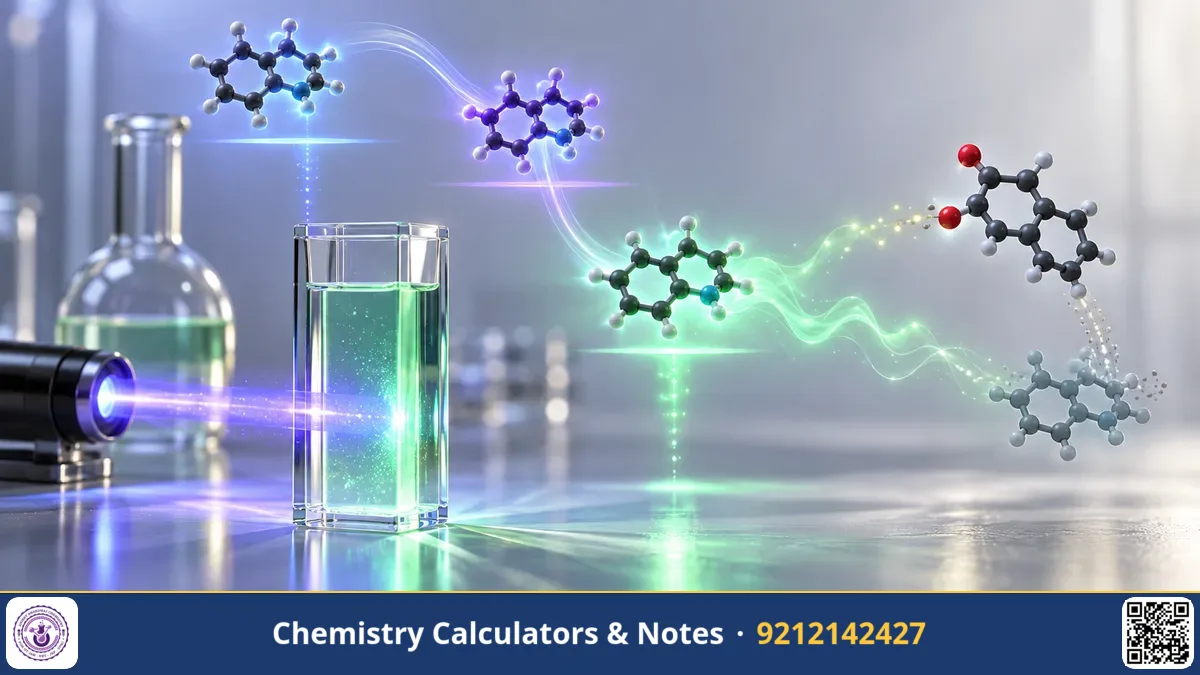
A fluorophore is a molecule that absorbs light, reaches an excited state and then emits light. We write the excited molecule as A*. Quenching is any process that lowers this emission.
In intermolecular quenching, another species Q (the quencher) takes energy from A*. The simple scheme is A* + Q → A + Q. In some cases the quencher itself ends up excited: A* + Q → A + Q*.
The Stern-Volmer relationship describes the kinetics of this process:
I0/I = 1 + kqτ0[Q]
- I0 is the fluorescence intensity without quencher.
- I is the intensity with quencher.
- kq is the bimolecular quenching rate constant, in M-1 s-1.
- τ0 is the lifetime of the excited state without quencher.
- [Q] is the quencher concentration.
The product kqτ0 is the slope of the plot. Its unit is M-1, so the term kqτ0[Q] is dimensionless. Always check this in a numerical. In this post we call the slope the Stern-Volmer constant and write it as K, to keep the symbols short.
The reason for the form is simple. Quenching adds one more way for A* to lose energy, so the excited state decays faster. Less of it is left to emit, and I falls.
Dynamic and static quenching: how to tell them apart
In dynamic quenching, the quencher collides with A* during its lifetime. The excited state is removed, so the lifetime becomes shorter. The plot is a straight line with intercept 1.
In static quenching, the quencher binds the ground-state fluorophore and forms a non-fluorescent complex. The complexed molecules never emit. The molecules that stay free emit with their normal lifetime, so τ0/τ stays equal to 1.
| Feature | Dynamic (collisional) | Static (complex) |
|---|---|---|
| What the quencher touches | Excited fluorophore | Ground-state fluorophore |
| Lifetime with quencher | Decreases: τ0/τ = I0/I | Unchanged: τ0/τ = 1 |
| Slope of I0/I vs [Q] | kqτ0 | Binding constant of the complex |
| Effect of higher temperature | Slope rises (faster diffusion) | Slope usually falls (complex weakens) |
| Absorption spectrum | Unchanged | May change on complex formation |
The lifetime test is the cleanest. Intensity alone cannot separate the two, because both lower I. If a question gives lifetimes, use them first.
When both processes act together, the plot of I0/I against [Q] curves upward. That is a standard clue in conceptual questions.
Reading kq and the diffusion limit
From the slope you get the product kqτ0. Divide by τ0 and you get kq. This is the step most students forget.
In diffusion-limited quenching, the time taken by the quencher to diffuse towards the excited molecule and collide with it is the limiting factor. Almost every such collision is effective. The rate coefficient is then kq = 8RT/3η. Here R is the gas constant, T is the temperature in kelvin and η is the viscosity of the solution.
The formula comes from the Stokes-Einstein relation. In this form it is useful only for two spherical particles of identical radius that react every time they come within a fixed distance.
Two uses follow. First, kq rises with temperature and falls with viscosity. Second, if your computed kq is far above the diffusion-limited value, collisional quenching alone cannot explain it. Suspect static quenching.
Exam angle
For CSIR-NET, GATE, IIT-JAM and CUET-PG, this topic sits inside photochemistry and spectroscopy. Questions are usually short numericals or statement-type items. They test a few habits:
- Writing the equation correctly and finding the slope from a graph or from one data point.
- Using τ0 to convert the slope into kq.
- Deciding dynamic or static from lifetime data or temperature behaviour.
- Spotting units and powers of ten.
The chemistry question bank, which you can use by chapter, is the place to practise more problems of this kind. The two problems below are practice questions written for this post. They are not past-paper questions.
Two solved practice questions
Practice question 1. The fluorescence intensity of a dye falls from 80 to 50 (arbitrary units) when [Q] = 0.020 M. The lifetime of the dye without quencher is 4.0 ns. Assuming purely dynamic quenching, find the slope K and kq.
Step 1. Find the ratio: I0/I = 80/50 = 1.6.
Step 2. Use I0/I = 1 + K[Q]. So 0.6 = K × 0.020 M.
Step 3. K = 0.6 / 0.020 = 30 M-1.
Step 4. kq = K/τ0 = 30 M-1 / (4.0 × 10⁻⁹ s) = 7.5 × 10⁹ M-1 s-1.
Check. The units come out as M-1 s-1, as expected for a bimolecular rate constant. Answer: K = 30 M-1, kq = 7.5 × 10⁹ M-1 s-1.
Practice question 2. A fluorophore is studied with quencher Q at 298 K. At [Q] = 0.010 M, I0/I = 2.0. The measured lifetime ratio at the same [Q] is τ0/τ = 1.0. At a higher temperature, I0/I at the same [Q] drops to 1.6. Identify the type of quenching and find the slope at both temperatures, assuming a straight line through the intercept 1.
Step 1. Compare the two ratios at 298 K. I0/I = 2.0 but τ0/τ = 1.0. In dynamic quenching these two ratios would be equal. They are not, so the quenching is not dynamic.
Step 2. The unchanged lifetime points to a ground-state complex. The temperature result agrees: a higher temperature weakens the complex, so quenching falls.
Step 3. Slope at 298 K: (2.0 − 1)/0.010 M = 100 M-1. Here the slope is the binding constant of the complex, not kqτ0.
Step 4. At the higher temperature the slope is (1.6 − 1)/0.010 = 60 M-1. It fell, which supports static quenching.
Answer: static quenching; slope = 100 M-1 at 298 K and 60 M-1 at the higher temperature.
Trap to avoid: do not compute kq = slope/τ0 here. That formula applies only to dynamic quenching.
Study plan
- Day 1: Write the equation, define every symbol and note the units of the slope and of kq. Rewrite the dynamic versus static table from memory.
- Day 2: Solve five numericals on finding the slope from one point and from a graph. Always state the powers of ten.
- Day 3: Practise decision questions: lifetime data, temperature trend and upward-curving plots.
- Day 4: Link the topic to the diffusion-limited formula kq = 8RT/3η and to excited-state decay in general.
- Day 5: Attempt a timed set of mixed photochemistry questions and review each mistake.
Keep a one-page sheet with the equation, the table and the trap from Practice question 2. Revise it before every mock test.
Key takeaways
- Stern-Volmer: I0/I = 1 + kqτ0[Q]; the slope is kqτ0 and the intercept is 1.
- Dynamic quenching shortens lifetime, so τ0/τ = I0/I. Static quenching leaves lifetime unchanged.
- Get kq by dividing the slope by τ0, and only for dynamic quenching.
- Higher temperature raises dynamic quenching and usually lowers static quenching.
- Check units and powers of ten in every numerical.
Frequently asked questions
What is the unit of the slope of the Stern-Volmer plot?
The slope is kqτ0, so its unit is M-1. This makes kqτ0[Q] dimensionless, which it must be since it is added to 1.
Can intensity data alone tell me if quenching is dynamic or static?
No. Both types lower the intensity. You need lifetime data, or a temperature study, to separate them.
What does an upward-curving Stern-Volmer plot mean?
It usually means both dynamic and static quenching act together on the same fluorophore.
What is diffusion-limited quenching?
It is quenching where the time for the quencher to diffuse towards and collide with the excited molecule is the limiting factor, and almost every collision is effective. Then kq = 8RT/3η.
Does the quencher always end up unchanged?
Not always. The quencher may stay in its ground state, or it may be left in an excited state after taking the energy.