






Crystal field splitting: CFSE calculations step by step
Learn d-orbital splitting, high-spin and low-spin states and CFSE with two solved practice questions, common exam traps and a one-week study plan.
This post shows you how d-orbitals split in a ligand field and how to find the CFSE without guessing.
You will also get two solved practice questions, the usual exam traps and a short study plan.
How d-orbitals split and what decides the spin state
In a free metal ion, the five d-orbitals have the same energy. We call this being degenerate. Crystal field theory treats ligands as point negative charges around the metal ion. It looks only at electrostatic repulsion between ligand electrons and d-electrons. It does not describe covalent bonding.
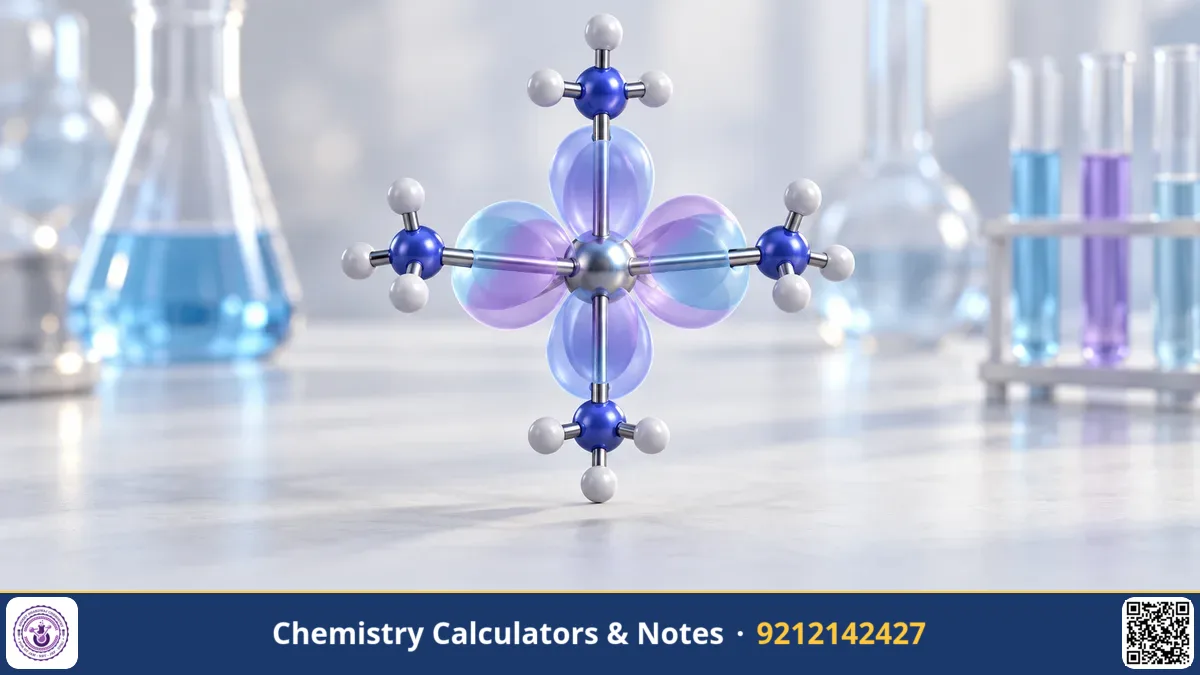
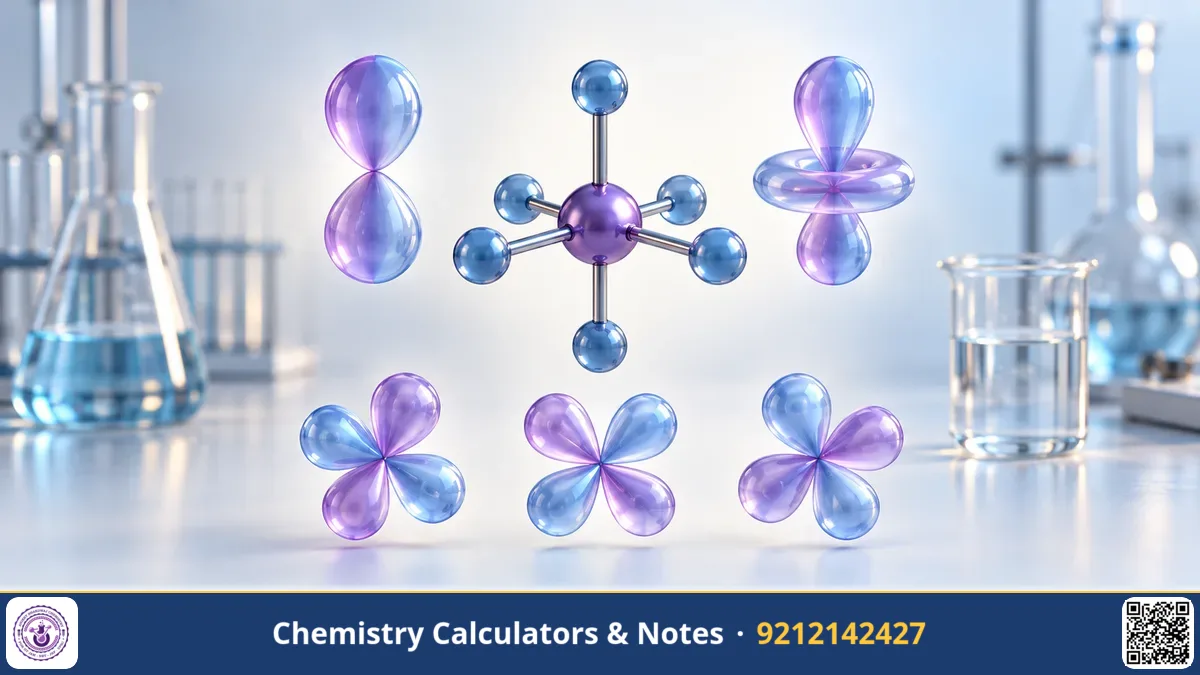
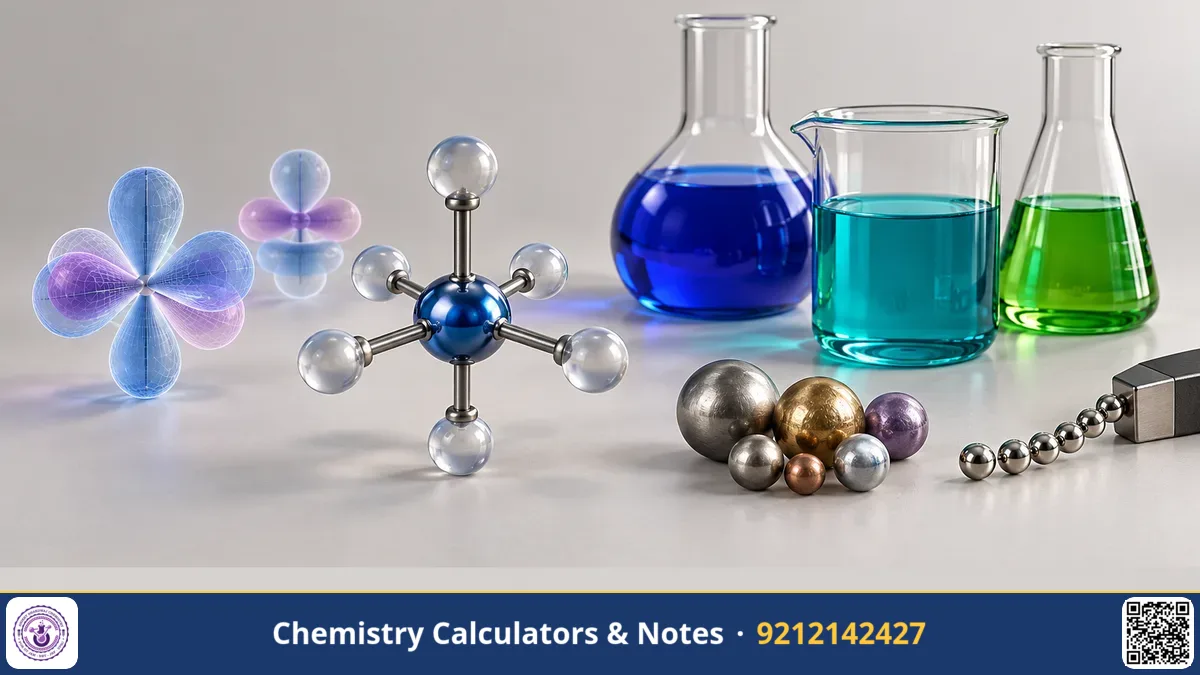
In an octahedral complex, six ligands sit on the x, y and z axes. The dz² and dx²−y² orbitals point straight at the ligands, so they feel more repulsion and rise in energy. These two are called eg. The dxy, dxz and dyz orbitals point between the axes, so they feel less repulsion. These three are called t2g. The gap between the two sets is Δo, also written 10Dq.
Energies are measured from the average of the five orbitals. This average stays fixed, so three orbitals going down by 2/5 each balances two orbitals going up by 3/5 each: 3 × (−2/5) + 2 × (3/5) = 0.
The size of the gap depends on these factors:
- The nature of the metal ion.
- The oxidation state of the metal. A higher oxidation state gives a larger splitting.
- The arrangement of the ligands and the coordination number.
- The nature of the ligands. Stronger-field ligands give a larger gap.
The spectrochemical series arranges ligands by the splitting they cause. A working version, weak to strong, is:
I− < Br− < Cl− < F− < OH− < H2O < NH3 < en < NO2− < CN− < CO
Learn this order by heart. Most spin-state questions are solved by it.
Now take d4 to d7 ions in an octahedral field. The next electron can go into the upper eg set, or it can pair up in t2g. Pairing costs energy, called the pairing energy P. The rule is:
- If Δo < P (weak-field ligand), electrons spread out first. The complex is high-spin.
- If Δo > P (strong-field ligand), electrons pair in t2g first. The complex is low-spin.
For d1 to d3 and d8 to d10, there is only one possible arrangement in an octahedral field. So there is no high-spin or low-spin choice.
CFSE step by step, octahedral and tetrahedral
CFSE means crystal field stabilisation energy. It is the total energy lowering of the d-electrons compared with the unsplit orbitals. Follow these steps every time:
- Find the oxidation state of the metal and write its d-electron count.
- Decide the geometry: octahedral or tetrahedral.
- Look at the ligand in the spectrochemical series. Decide strong field or weak field.
- Fill the orbitals using that spin state.
- Count nt2g and neg. Then CFSE = (−2/5 nt2g + 3/5 neg) Δo.
- State whether you include pairing energy. Say so clearly in the answer.
The table gives octahedral CFSE for the d-counts where spin state matters. Values are in units of Δo, and pairing energy is not included.
| d-count | High-spin configuration | High-spin CFSE | Low-spin configuration | Low-spin CFSE |
|---|---|---|---|---|
| d4 | t2g3 eg1 | −3/5 | t2g4 | −8/5 |
| d5 | t2g3 eg2 | 0 | t2g5 | −2 |
| d6 | t2g4 eg2 | −2/5 | t2g6 | −12/5 |
| d7 | t2g5 eg2 | −4/5 | t2g6 eg1 | −9/5 |
For the other counts, the octahedral CFSE is: d1 −2/5, d2 −4/5, d3 −6/5, d8 −6/5, d9 −3/5, d10 0.
In a tetrahedral complex, four ligands approach between the axes. The splitting is the reverse of the octahedral case. The lower set is e (dz² and dx²−y²). The upper set is t2 (dxy, dxz, dyz). Each e electron gives −3/5 Δt. Each t2 electron gives +2/5 Δt.
Two facts matter in exams. First, the ligand electrons do not point directly at any d-orbital, so Δt is smaller than Δo. For the same metal and ligand, the textbook relation is Δt = (4/9) Δo. Second, because Δt is small, tetrahedral complexes are almost always high-spin.
Two solved practice questions
These are practice questions written for this post. They are not past-paper questions.
Practice question 1. Calculate the CFSE (in Δo, without P) and the spin-only magnetic moment of [Fe(H2O)6]2+ and [Fe(CN)6]4−.
Solution.
- In both complexes the metal is Fe2+. Fe is 3d64s2, so Fe2+ is d6. The geometry is octahedral.
- H2O is a weak-field ligand, so [Fe(H2O)6]2+ is high-spin: t2g4 eg2. CFSE = 4 × (−2/5) + 2 × (3/5) = −8/5 + 6/5 = −2/5 Δo.
- Unpaired electrons = 4. Spin-only moment = √[n(n+2)] = √24 BM.
- CN− is a strong-field ligand, so [Fe(CN)6]4− is low-spin: t2g6. CFSE = 6 × (−2/5) = −12/5 Δo.
- Unpaired electrons = 0. The complex is diamagnetic, so the moment is zero.
Check. The low-spin complex has two more electron pairs than the free ion, so it pays extra pairing energy. It is still favoured because Δo is greater than P for CN−.
Practice question 2. Compare the CFSE of Ni2+ in an octahedral complex and in a tetrahedral complex such as [NiCl4]2−. Express both in Δo, taking Δt = (4/9) Δo. Give the spin-only magnetic moment of the tetrahedral complex.
Solution.
- Ni is 3d84s2, so Ni2+ is d8.
- Octahedral: t2g6 eg2. CFSE = 6 × (−2/5) + 2 × (3/5) = −12/5 + 6/5 = −6/5 Δo.
- Tetrahedral: e4 t24. CFSE = 4 × (−3/5) + 4 × (2/5) = −12/5 + 8/5 = −4/5 Δt.
- Convert: −4/5 × 4/9 = −16/45 Δo. The octahedral value, −6/5, is the same as −54/45.
- The octahedral field gives far greater stabilisation. This is one reason Ni2+ prefers octahedral geometry when the ligands allow it.
- In the tetrahedral case, e4 is fully paired and t24 has two unpaired electrons. Moment = √8 = 2√2 BM.
Exam traps to avoid
- Judging spin state by ligand charge. Use the spectrochemical series, not the charge.
- Inventing a choice where none exists. An octahedral d8 ion has only one arrangement. Do not write a low-spin d8.
- Mixing the tetrahedral order. Remember e is lower and t2 is higher. The coefficients are −3/5 and +2/5.
- Comparing Δo and Δt directly. Convert first, as in Practice question 2.
- Counting unpaired electrons from the free ion. Count from the filled split diagram.
- Ignoring the metal and its oxidation state. A higher oxidation state gives a larger gap. The same ligand can behave differently with a different metal ion.
- Forgetting geometry changes. Square planar and other geometries can also be described by crystal field theory. Check the geometry before you apply octahedral numbers.
- Reading colour wrongly. Colour comes from electrons moving between the split d-levels. A d0 or d10 ion has no such transition, so it is usually colourless.
- Using crystal field theory for bonding. It does not describe bonding. Questions on bonding need ligand field theory, which combines it with molecular orbital ideas.
A short study plan
- Day 1 and 2: concept. Draw the octahedral and tetrahedral splitting diagrams from memory. Write why each set rises or falls.
- Day 3: ligand series. Write the spectrochemical series until you can do it without looking. Mark strong-field and weak-field ligands.
- Day 4 and 5: CFSE drill. Fill a blank table for d1 to d10, high-spin and low-spin, and check it against the table above.
- Day 6: magnetism. For every complex you solve, also write the unpaired electrons and the spin-only moment.
- Day 7: mixed practice. Solve questions on geometry, colour and spin state together. Write every mistake in a separate notebook.
Repeat the blank table a week later. If you can complete it without errors, the topic is secure. For more practice on this chapter, use the chapter-wise question bank on this site.
Key takeaways
- Octahedral: t2g is lower (−2/5 Δo per electron) and eg is higher (+3/5 Δo per electron).
- Strong-field ligands (Δo > P) give low-spin. Weak-field ligands give high-spin. The choice exists only for octahedral d4 to d7.
- Tetrahedral splitting is inverted and smaller, with Δt = (4/9) Δo. These complexes are almost always high-spin.
- Always fill the diagram, count nt2g and neg, and state whether pairing energy is included.
Frequently asked questions
Does crystal field theory explain covalent bonding?
No. It treats ligands as point charges and looks only at electrostatic repulsion. Ligand field theory adds molecular orbital ideas to describe bonding. Crystal field theory still accounts for colour and some magnetic properties.
Why does a higher oxidation state give a larger splitting?
Crystal field theory states that a higher oxidation state leads to a larger splitting compared with a spherical field. The larger gap is what you use when judging spin state.
Why is the tetrahedral splitting smaller than the octahedral one?
In a tetrahedron, the ligand electrons are not oriented directly towards the d-orbitals. The repulsion is weaker, so the gap is smaller.
Is pairing energy included in CFSE?
Many questions give CFSE in terms of Δ only. Some ask you to add the pairing cost. Read the question, and write which convention you used.
What do t2g and eg stand for?
They are symmetry labels for the two sets of orbitals in an octahedral field. For CFSE questions, remember that t2g has three orbitals and eg has two.