






Schottky and Frenkel Defects, and Non-Stoichiometry in Solids
Schottky, Frenkel and non-stoichiometric defects explained with their effect on density, two worked practice questions and a short study plan for PG exams.
This post explains the main point defects in ionic crystals and how each one changes density.
You will also get two worked practice questions and a short study plan for IIT-JAM, GATE, CSIR-NET and CUET-PG.
What a point defect is
A real crystal is never perfect. Some lattice sites are empty, some ions sit in the wrong place, and some foreign atoms are present. A point defect is a fault at one site, or at a few neighbouring sites. It is different from a line fault or a plane fault.
For ionic solids, we group point defects into three families:
- Stoichiometric defects. The ratio of cations to anions stays exactly as in the formula. Schottky and Frenkel defects belong here.
- Non-stoichiometric defects. The ratio no longer matches the formula. These are metal excess and metal deficiency.
- Impurity defects. A foreign ion replaces a host ion. We keep these outside this post.
Remember the word stoichiometric. It means the atom ratio follows the chemical formula. Everything below depends on this idea.
Why do defects exist at all? Disorder raises the entropy of the crystal. At any temperature above absolute zero, a small number of defects lowers the free energy. So a perfect crystal is possible only at absolute zero, and the number of defects grows as temperature rises.
Schottky defect
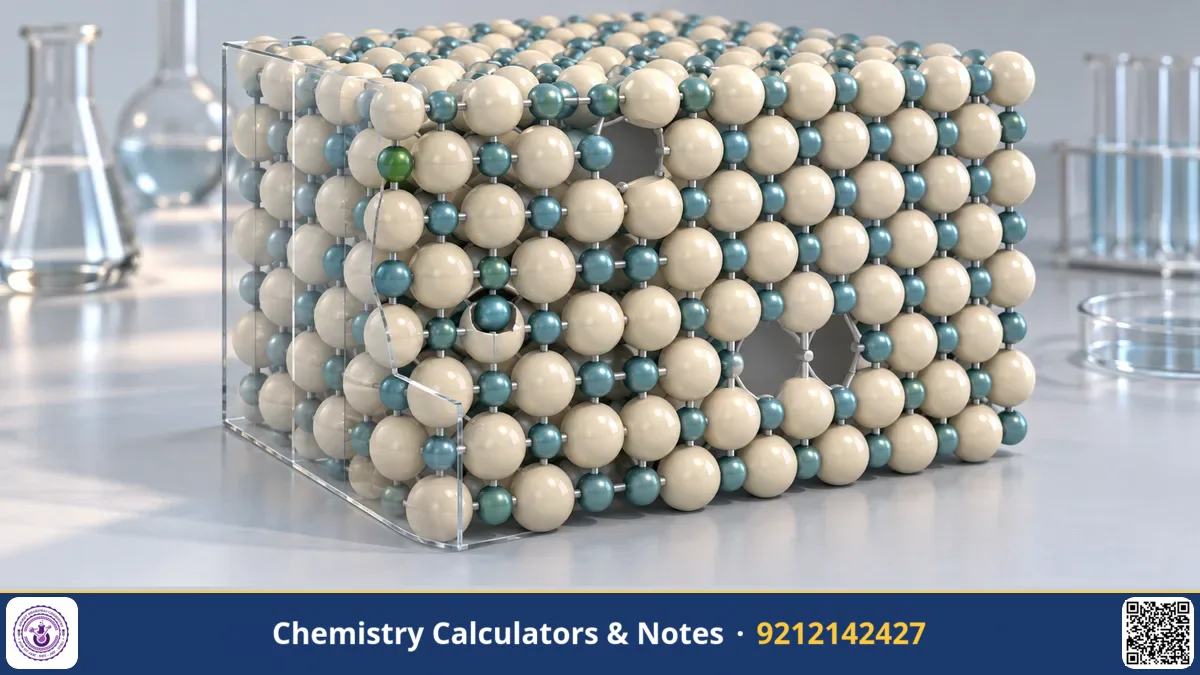
In a Schottky defect, one cation and one anion are both missing from their sites. They leave as a pair, so the crystal stays electrically neutral. The formula ratio is unchanged.
The mass of the crystal falls, but the volume of the unit cell stays almost the same. So density decreases.
This defect is common when:
- the cation and the anion are of similar size, and
- the coordination number is high. (Coordination number is the count of nearest neighbours around an ion.)
Many alkali halides, which are compounds of an alkali metal with a halogen, show this defect. Because ions can hop into the vacant sites, Schottky defects also give a small ionic conductivity.
A useful way to remember it: the ions go out of the crystal, to the surface, so the crystal loses mass.
Frenkel defect
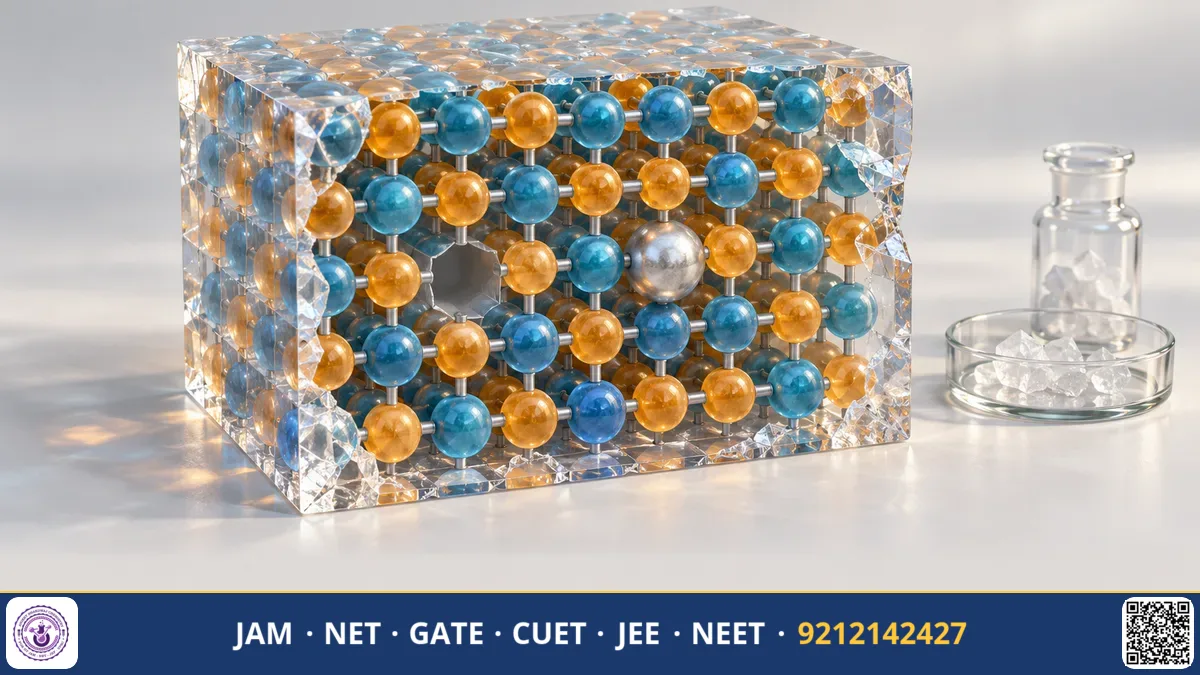
In a Frenkel defect, an ion leaves its normal site and goes into an interstitial position. That is a gap between the regular sites. The ion that moves is almost always the smaller one, which is the cation. It leaves a vacancy behind.
No ion leaves the crystal. Mass and volume are both unchanged, so density stays the same. A Frenkel defect is also called a dislocation defect.
It is common when:
- the cation is much smaller than the anion, and
- the coordination number is low.
Silver halides are the standard examples, because the silver ion is small. A solid can also show both defects together. Silver bromide is the usual example of this, and examiners like it.
Schottky and Frenkel compared
| Feature | Schottky | Frenkel |
|---|---|---|
| What happens | Cation and anion both missing | Smaller ion moves to an interstitial site |
| Ion ratio | Unchanged | Unchanged |
| Density | Decreases | Stays the same |
| Favoured by | Similar ion sizes, high coordination number | Large size difference, low coordination number |
| Vacancies per event | Two (one cation, one anion) | One (the cation site) |
| Typical solids | Alkali halides | Silver halides |
Non-stoichiometric defects
Here the ratio of ions differs from the ideal formula. There are two kinds.
Metal excess defect. It arises in two ways.
- Anion vacancy. An anion is missing, and an electron sits in its place to keep the crystal neutral. This trapped electron is called an F-centre (from the German word for colour). It absorbs visible light, so the crystal looks coloured. An alkali halide heated in the vapour of its own metal becomes coloured in this way.
- Extra cation in an interstitial site. An extra cation sits in a gap, and a free electron stays nearby to balance the charge. Zinc oxide behaves like this. It turns yellow on heating and becomes white again on cooling.
Metal deficiency defect. Some cations are missing, and a nearby metal ion takes a higher charge to balance it. Iron(II) oxide is the standard example. Its real formula is Fe1-xO. Some Fe2+ sites are empty, and some iron ions are present as Fe3+.
These defects matter because the free or hopping electrons make the solid a semiconductor or give it colour. The crystal as a whole is still neutral. Only the ratio of ions has changed.
Exam angle
At PG level, examiners rarely ask for a bare definition. They test whether you can link a defect to a property. Prepare these links:
- Defect to density. Schottky lowers it. Frenkel leaves it unchanged. Metal-excess and metal-deficiency questions usually ask about composition instead.
- Defect to ion size. A small cation and a low coordination number point to Frenkel. Similar sizes and a high coordination number point to Schottky.
- Defect to colour. An F-centre explains the colour of heated alkali halides.
- Defect to charge balance. Write the charge equation first. This solves most iron-oxide-type numericals.
Watch for two traps. First, a solid whose density is unchanged can still have defects, as a Frenkel solid does. Second, metal-deficiency compounds keep neutrality by changing the oxidation state of a metal, not by losing anions.
In multiple-select questions, check each statement against the table above. One wrong word, such as "anion" for "cation" in a Frenkel statement, makes the option false.
Practice question 1: density with Schottky defects
Question. An ionic solid MX has the rock-salt structure, with four formula units per unit cell. Two percent of its M+–X- ion pairs are missing because of Schottky defects. The cell edge stays the same. By what fraction does the density change compared with the perfect crystal?
Solution.
- Density = (Z × M) / (NA × a3). Here Z is the number of formula units per cell, M is the molar mass, NA is Avogadro's number and a is the cell edge.
- M, NA and a do not change. So density is proportional to Z.
- Perfect crystal: Z = 4.
- With 2% of ion pairs missing: Z = 4 × 0.98 = 3.92.
- Ratio of densities = 3.92 / 4 = 0.98.
Answer. The density falls by 2%, which is a decrease of 0.02 times the original value. If the same crystal had only Frenkel defects, the density change would be zero.
Practice question 2: charge balance in Fe0.92O
Question. A sample of iron(II) oxide has the composition Fe0.92O. Assume iron is present only as Fe2+ and Fe3+. Find the fraction of the iron present as Fe3+.
Solution.
- Take one O2-. The total positive charge must be +2.
- Let the amount of Fe2+ be a and of Fe3+ be b.
- Iron balance: a + b = 0.92.
- Charge balance: 2a + 3b = 2.
- Multiply the first equation by 2: 2a + 2b = 1.84.
- Subtract from the second: b = 2 − 1.84 = 0.16. Then a = 0.76.
- Fraction of iron as Fe3+ = 0.16 / 0.92 ≈ 0.174, which is about 17.4%.
Answer. About 17.4% of the iron is Fe3+. This is a metal-deficiency defect: iron sites are empty, and the charge is made up by Fe3+ ions.
Study plan
Four short sessions are enough to cover this topic. Keep each one to about an hour.
- Session 1. Draw a Schottky and a Frenkel defect on a square lattice by hand. Write the density effect and the conditions that favour each one beside the drawing.
- Session 2. Learn the two metal-excess types and the metal-deficiency type. For each one, write the cause, one example and the effect on colour or conductivity.
- Session 3. Solve five density and charge-balance numericals. Always begin with the density formula or the charge equation.
- Session 4. Attempt a timed set of mixed multiple-choice questions on this chapter. Note every question where you confused Schottky with Frenkel, and revise the table above.
Revise after a week. Redraw the comparison table from memory and check it against this post. Then go through the related solid-state topics, such as unit cells and packing, so that the density formula comes to you without effort.
Key takeaways
- Schottky defect: a cation–anion pair is missing, and density decreases.
- Frenkel defect: the smaller ion moves to an interstitial site, and density is unchanged.
- F-centres (electrons in anion vacancies) explain the colour of heated alkali halides.
- Metal-deficiency solids such as iron(II) oxide keep neutrality through higher-charged metal ions.
- Write the charge-balance equation before you solve any non-stoichiometry numerical.
Frequently asked questions
Why does a Schottky defect lower the density?
Ions leave the crystal, so the mass in each unit cell falls. The cell volume stays nearly the same. Less mass in the same volume means lower density.
Why does a Frenkel defect not change the density?
The displaced ion stays inside the crystal. Mass and volume are both unchanged, so the density is the same.
Can one crystal show both Schottky and Frenkel defects?
Yes. Silver bromide is the standard example. It shows both defects together.
What is an F-centre?
It is an electron trapped in an anion vacancy. The electron absorbs visible light, so the crystal appears coloured.
Is a non-stoichiometric compound electrically neutral?
Yes. The crystal as a whole stays neutral. In metal excess, trapped electrons balance the charge. In metal deficiency, some metal ions take a higher charge.