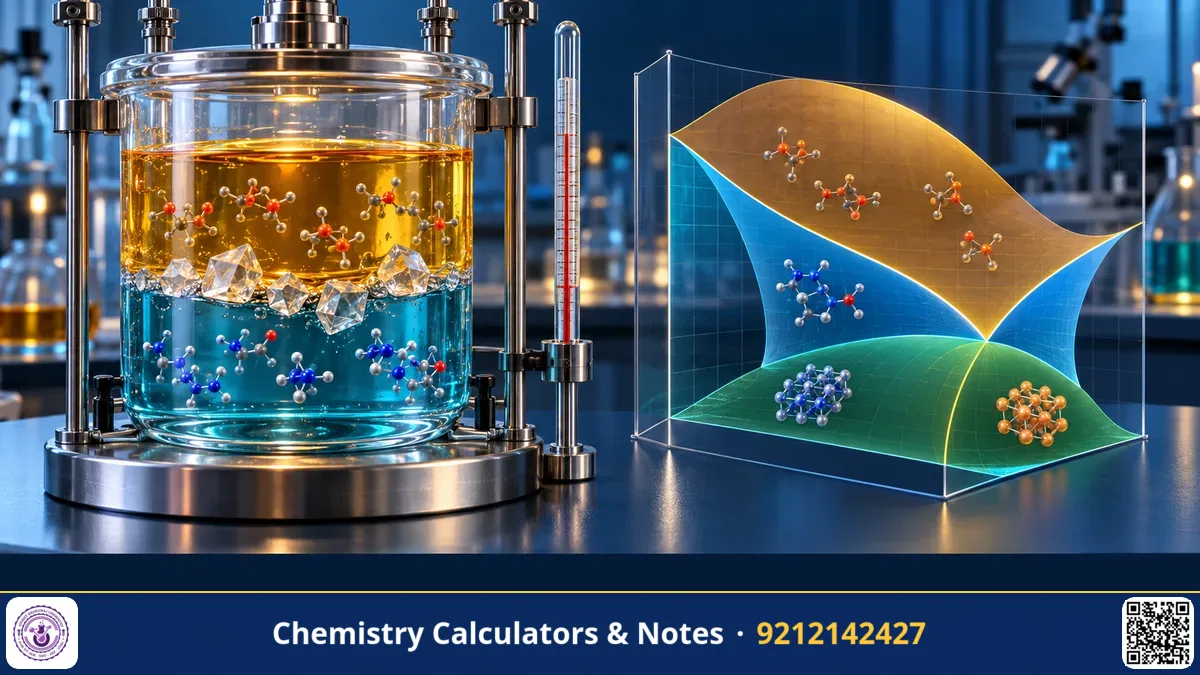







Gibbs Phase Rule: Degrees of Freedom in Two-Component Systems
Learn how to calculate degrees of freedom and read condensed eutectic phase diagrams for binary systems, with worked practice questions and study tips.
This guide explains how to calculate degrees of freedom in two-component systems and interpret condensed eutectic phase diagrams. You will examine the equations, solve two practice problems, and review an exam study plan.
Foundations of the Gibbs phase rule
Thermodynamic analysis of multi-phase equilibrium relies on three variables: phases, components, and degrees of freedom. Josiah Willard Gibbs formulated this relationship between 1875 and 1878.
A phase (P) is a homogeneous, physically distinct state of matter separated by boundaries. Gases mix completely to form one phase. Immiscible liquids or distinct crystalline solids form separate phases. For instance, an insoluble mixture of solid component A and solid component B forms two separate solid phases.
The number of components (C) is the smallest number of chemically independent constituents needed to specify the composition of every phase. In a non-reacting mixture of two pure substances, C = 2.
The degrees of freedom or variance (F) is the number of independent intensive variables—such as temperature, pressure, or mole fraction—that can change without altering the phases at equilibrium.
When temperature and pressure both vary, the rule is:
F = C - P + 2
Equilibrium requires the chemical potential of each component to match across all coexisting phases.
The condensed phase rule for two-component systems
In solid-liquid systems, pressure changes have negligible effects on equilibrium because condensed phases are nearly incompressible. Most experiments occur in open vessels at constant atmospheric pressure, where vapor is neglected.
Fixing pressure removes one degree of freedom, yielding the condensed phase rule:
F' = C - P + 1
Here, F' denotes the reduced degrees of freedom. For a binary system (C = 2), the equation becomes:
F' = 3 - P
Because variance cannot be negative, at most three phases can coexist at equilibrium in an isobaric binary system.
Interpreting simple eutectic phase diagrams
A simple eutectic system contains two components that mix completely in the liquid state but remain immiscible as solids. On an isobaric temperature-composition diagram, specific domains illustrate this behavior:
- Liquid region: Above liquidus lines, a single liquid exists (P = 1). Here, F' = 3 - 1 = 2 (bivariant). Temperature and composition vary independently.
- Liquidus lines: Where solid freezes from solution, two phases coexist (P = 2). Here, F' = 3 - 2 = 1 (univariant). Selecting a temperature fixes liquid composition.
- Eutectic point: Where liquidus curves intersect, three phases coexist: solid A, solid B, and liquid melt (P = 3). Here, F' = 3 - 3 = 0 (invariant). Temperature and composition are fixed.
- Sub-eutectic region: Below the eutectic line, the liquid freezes into solid A and solid B (P = 2). Thus, F' = 3 - 2 = 1 (univariant). Only temperature can vary.
The table below summarizes these equilibrium conditions across the diagram:
| Region or boundary | Phases (P) | Reduced variance (F') | Equilibrium state |
|---|---|---|---|
| Liquid solution | 1 | 2 | Bivariant (temperature and composition vary) |
| Liquidus curve | 2 | 1 | Univariant (temperature fixes composition) |
| Eutectic point | 3 | 0 | Invariant (fixed temperature and composition) |
| Sub-eutectic solids | 2 | 1 | Univariant (temperature can vary) |
The competitive exam perspective
Phase equilibria questions in CSIR NET Chemical Science, GATE Chemistry, IIT-JAM Chemistry, and CUET-PG Chemistry test your grasp of phase boundaries and variance. Examiners focus on three key areas:
- Selecting the proper equation: For isobaric systems, always use F' = C - P + 1. Using F = C - P + 2 introduces an extra degree of freedom.
- Counting solid phases: Insoluble solids never form a single phase. Pure crystals of separate substances represent separate phases (P = 2).
- Invariant points: At eutectic points, variance is zero. No intensive property can change while all three phases coexist.
Practice questions from the question bank
Work through two practice problems from our chemistry question bank to reinforce these principles.
Practice question 1 (qid 2041): A binary mixture of substance A and substance B is studied at 1 atmosphere. The components are miscible in the liquid phase and insoluble in the solid phase.
- Calculate the degrees of freedom along the liquidus line where pure substance A begins to crystallize.
- Calculate the degrees of freedom at the eutectic point where solid A, solid B, and liquid solution coexist.
Solution:
1. The system has two components, so C = 2. At constant atmospheric pressure, use the reduced phase rule: F' = C - P + 1 = 3 - P. Along the liquidus line, solid A coexists with the liquid melt (P = 2). Thus, F' = 3 - 2 = 1 (univariant).
2. At the eutectic point, solid A, solid B, and the liquid solution coexist (P = 3). Substituting gives F' = 3 - 3 = 0 (invariant).
Practice question 2 (qid 2042): A condensed binary system of components X and Y is cooled below its eutectic temperature at constant pressure. Determine the degrees of freedom of the solid mixture and identify which intensive variable can change.
Solution:
1. The system contains two components, so C = 2.
2. Below the eutectic line, the sample consists of separate crystals of pure X and pure Y. Because they do not form a solid solution, two solid phases exist (P = 2).
3. Apply the condensed phase rule: F' = 3 - P = 3 - 2 = 1.
The system is univariant. The only intensive variable that can be varied independently is temperature, provided it remains below the eutectic point.
A structured study plan for phase equilibria
A structured approach helps master phase equilibria for competitive examinations:
- Core principles: Master definitions of phases, components, and degrees of freedom. Review how chemical potentials dictate equilibrium.
- One-component systems: Study one-component diagrams to understand phase boundaries and triple points.
- Binary condensed systems: Apply F' = 3 - P to simple eutectic mixtures and congruent compounds.
- Problem practice: Work through timed questions from our chemistry question bank.
Students preparing for CSIR NET Chemical Science, GATE Chemistry, IIT-JAM Chemistry, or CUET-PG Chemistry can book a free demo class for our chemical-science tier 6-month live online batches with Mr. Aniket Bhardwaj to master physical chemistry concepts.
Key takeaways
- The general Gibbs phase rule is F = C - P + 2, relating variance to components and phases.
- In condensed systems at constant pressure, the reduced phase rule is F' = C - P + 1.
- For binary eutectic systems, variance is 2 in the liquid state, 1 along liquidus curves, and 0 at the eutectic point.
- Immiscible solids form separate phases and must always be counted individually.
Frequently asked questions
Why is pressure omitted in the condensed phase rule?
In solid-liquid systems, pressure changes have negligible effects on equilibrium and experiments are held at 1 atmosphere. Because pressure is fixed, one variable is removed, giving F' = C - P + 1.
What does an invariant eutectic point mean?
An invariant point has zero degrees of freedom (F' = 0). Three phases coexist only at one fixed temperature and composition. Altering either variable causes at least one phase to vanish.
How do you calculate components in a non-reacting mixture?
In non-reacting systems, the number of components equals the number of distinct chemical substances. A mixture of two distinct non-reacting chemicals has C = 2.
Do two immiscible solids count as one phase?
No. Each distinct solid has its own crystal boundary and composition. A mixture of two insoluble solids represents two phases (P = 2).