






Chemical Bonding: VSEPR and Hybridisation Question Types
Master VSEPR theory, steric numbers, and molecular geometries with a clear decision flow, worked practice questions, and a structured study plan.
Mastering chemical bonding requires a dependable method to deduce hybridisation, electron geometry, and molecular shape from electronic principles. This guide provides a clear decision flow, examines structural distortions, and works through two representative practice questions for chemical-science examinations.
A unified decision flow for hybridisation and shape
Candidates often lose marks by memorising molecular shapes rather than applying electronic principles. A reliable decision flow resolves hybridisation and geometry in three steps.
First, identify the central atom and count its valence electrons. For neutral species, use the periodic group valence. For polyatomic cations, subtract one electron per unit of positive charge; for anions, add one electron per unit of negative charge.
Second, calculate the steric number by accounting for sigma bonds and lone pairs. Monovalent atoms form one sigma bond using one electron. Divalent atoms like oxygen form one sigma bond and one pi bond, consuming two electrons. Pi bonds occupy unhybridised orbitals and do not alter steric numbers. Subtract bonding electrons from the valence pool, then divide remaining non-bonding electrons by two to find lone pairs. Steric number equals sigma bonds plus lone pairs.
Third, match the steric number directly to hybridisation: two corresponds to sp, three to sp2, four to sp3, five to sp3d, and six to sp3d2. Electron geometry describes all electron domains, while molecular shape traces only bonded nuclei.
Geometry versus shape across common steric numbers
Electron pairs arrange themselves to minimise electrostatic repulsion. Because lone pairs are held closer to the central nucleus, repulsion follows the order: lone pair–lone pair > lone pair–bond pair > bond pair–bond pair.
In trigonal bipyramidal systems, equatorial positions experience fewer perpendicular repulsions, so lone pairs occupy equatorial sites. In octahedral arrangements with two lone pairs, placing them trans to each other eliminates perpendicular lone pair–lone pair repulsion.
| Steric number | Hybridisation | Bond pairs | Lone pairs | Molecular shape | Electron geometry | Example |
|---|---|---|---|---|---|---|
| 2 | sp | 2 | 0 | Linear | Linear | BeCl2, CO2 |
| 3 | sp2 | 3 | 0 | Trigonal planar | Trigonal planar | BF3 |
| 3 | sp2 | 2 | 1 | Bent | Trigonal planar | SO2 |
| 4 | sp3 | 4 | 0 | Tetrahedral | Tetrahedral | CH4 |
| 4 | sp3 | 3 | 1 | Trigonal pyramidal | Tetrahedral | NH3 |
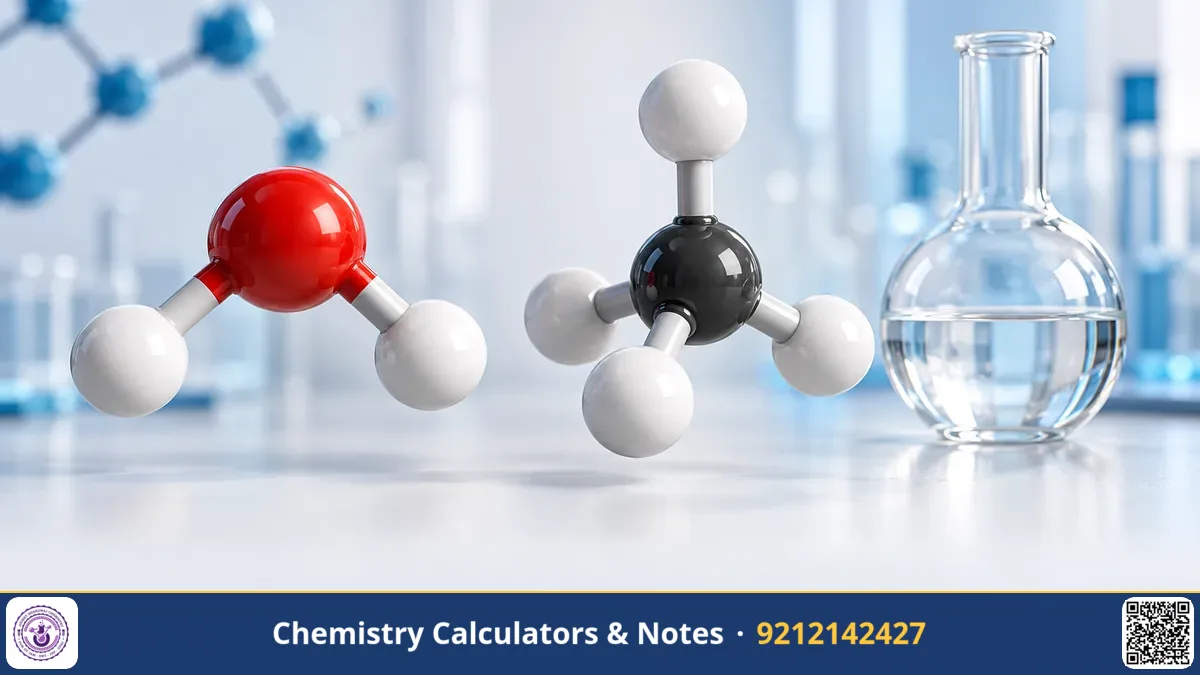
| 4 | sp3 | 2 | 2 | Bent | Tetrahedral | H2O |
| 5 | sp3d | 4 | 1 | See-saw | Trigonal bipyramidal | SF4 |
| 5 | sp3d | 3 | 2 | T-shaped | Trigonal bipyramidal | ClF3 |
| 5 | sp3d | 2 | 3 | Linear | Trigonal bipyramidal | XeF2 |
| 6 | sp3d2 | 6 | 0 | Octahedral | Octahedral | SF6 |
| 6 | sp3d2 | 4 | 2 | Square planar | Octahedral | XeF4 |
Evaluating bond angles and structural distortions
Evaluate bond angles across molecules using four factors in sequence:
- Baseline steric angle: Begin with the parent hybridisation angle. Systems derived from sp start linear, sp2 systems start trigonal planar, and sp3 systems start tetrahedral.
- Lone-pair compression: Non-bonding pairs exert stronger repulsion than bonding pairs, squeezing adjacent bond angles below standard values. In tetrahedral systems, adding lone pairs progressively contracts angles from methane to ammonia to water.
- Substituent electronegativity: Electronegative terminal atoms draw bonding electrons away from the central atom, reducing bond-pair repulsion near the central nucleus and closing angles. Thus, phosphorus trifluoride has a smaller angle than phosphorus trihydride, and oxygen difluoride contracts narrower than water.
- Steric crowding: Bulky terminal substituents repel each other. In dichlorine monoxide, non-bonded repulsion between chlorine atoms forces the bond angle open, exceeding that of water despite two lone pairs.
Exam perspective and solved practice questions
Entrance exams like CSIR NET, GATE, IIT-JAM, and CUET-PG test non-ideal geometries. Solve these two practice questions using our decision flow.
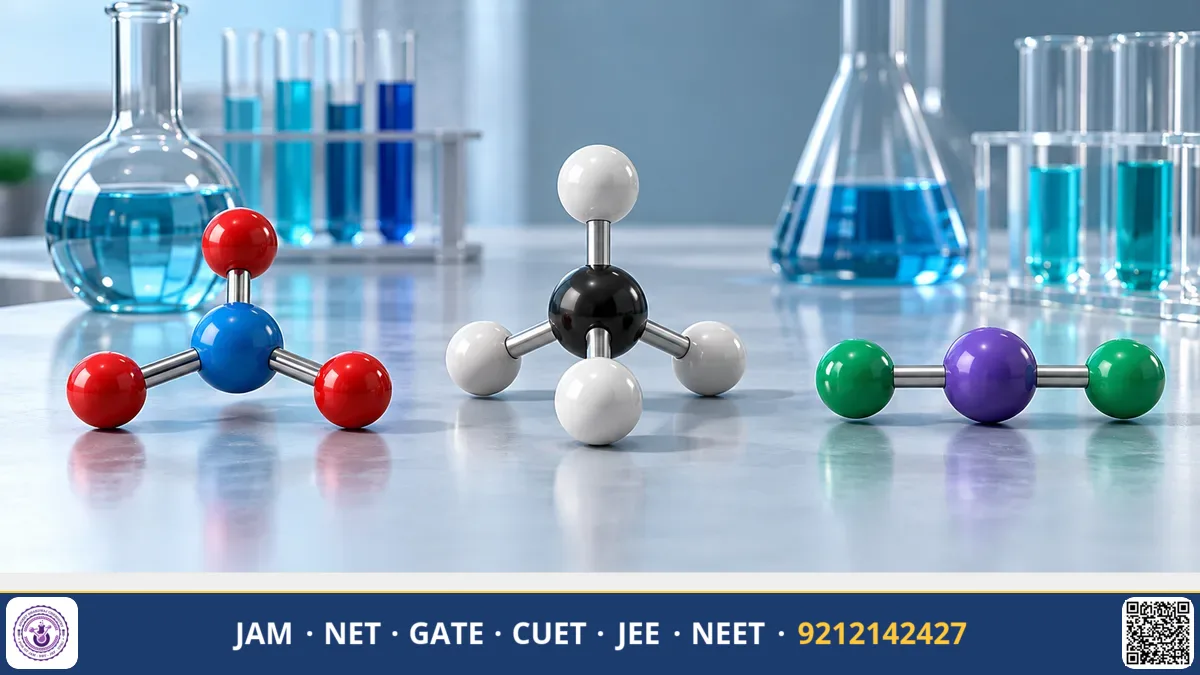
Practice question 1 (QID: CY-CB-204): Determine the shapes and decreasing bond angle order for NO2+, NO2, and NO2-.
Solution:
- NO2+: Valence electrons equal 5 minus 1, leaving 4. Nitrogen forms two double bonds with zero lone pairs. Steric number is 2, giving sp hybridisation, linear shape, and a straight bond angle.
- NO2: Nitrogen has 5 valence electrons. It forms two bonding domains with oxygen and holds one unpaired odd electron in a hybrid orbital. A single electron repels less than an electron pair, so the angle remains wide.
- NO2-: Valence electrons equal 5 plus 1, giving 6. Nitrogen forms two bonds and holds one full lone pair. Steric number is 3, giving sp2 hybridisation and a bent shape. Strong lone pair–bond pair repulsion contracts the angle below that of neutral nitrogen dioxide.
Decreasing bond angle order: NO2+ > NO2 > NO2-.
Practice question 2 (QID: CY-CB-318): Determine the hybridisation, lone-pair count, and molecular geometry of SF4 and XeF4. Explain why their molecular shapes differ despite both having four terminal fluorine atoms.
Solution:
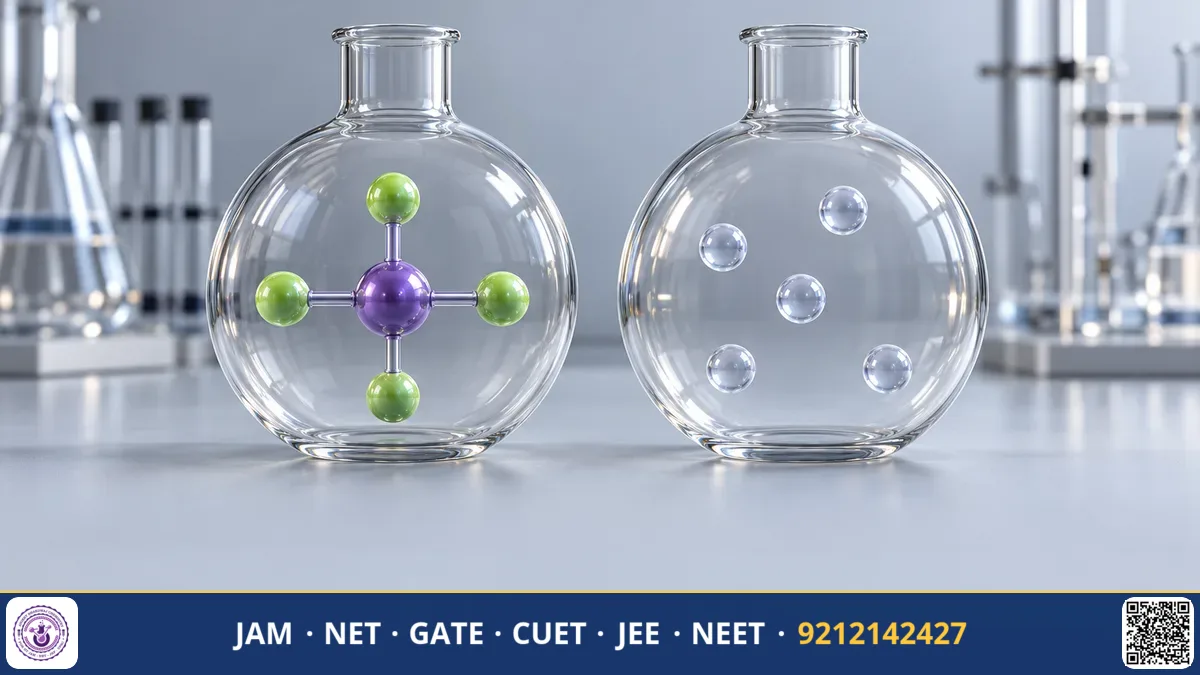
- SF4: Sulfur has 6 valence electrons. Four fluorine atoms form four sigma bonds, leaving 2 non-bonding electrons as one lone pair. Steric number is 4 plus 1, which equals 5, giving sp3d hybridisation and trigonal bipyramidal electron geometry. To minimise perpendicular repulsions, the lone pair occupies an equatorial position, producing a see-saw shape.
- XeF4: Xenon has 8 valence electrons. Four fluorine atoms form four sigma bonds, leaving 4 non-bonding electrons as two lone pairs. Steric number is 4 plus 2, which equals 6, giving sp3d2 hybridisation and octahedral electron geometry. Both lone pairs sit trans along the axial axis to eliminate perpendicular lone-pair repulsions, producing a square planar shape.
A five-day study plan for chemical bonding questions
Follow this five-day revision plan to prepare for entrance examinations:
- Day 1: Calculate steric numbers on neutral molecules and ions across steric numbers two to four. Confirm electron geometry versus molecular shape.
- Day 2: Master five- and six-coordinate geometries. Map lone pairs to equatorial sites in trigonal bipyramids and trans sites in octahedra.
- Day 3: Compare bond angles across isoelectronic series and apply electronegativity shifts in nitrogen-family and oxygen-family hydrides.
- Day 4: Solve mixed problems on xenon fluorides and odd-electron molecules.
- Day 5: Test recognition speed with timed question-bank sets to prevent counting mistakes.
Key takeaways
- Steric number equals the sum of sigma bonds and lone pairs on the central atom; pi bonds do not influence hybridisation.
- Electron geometry accounts for all electron domains, while molecular shape describes only the arrangement of bonded nuclei.
- In trigonal bipyramidal arrangements, lone pairs occupy equatorial sites; in octahedral systems with two lone pairs, they occupy trans axial sites.
- An unpaired electron exerts less electrostatic repulsion than an electron pair, causing smaller bond angle compression.
Frequently asked questions
Why does XeF2 adopt a linear shape instead of a bent structure?
Xenon in XeF2 has two bonding pairs and three lone pairs, giving steric number 5 and trigonal bipyramidal electron geometry. The three lone pairs occupy equatorial positions to minimise perpendicular repulsions, placing the two fluorine atoms axially to yield a linear shape.
How does Bent's rule explain substituent distribution in trigonal bipyramidal geometry?
Bent's rule indicates that s-character concentrates into orbitals directed toward electropositive substituents, while p-character concentrates toward electronegative substituents. In sp3d geometry, equatorial hybrid orbitals possess higher s-character, whereas axial hybrid orbitals lack s-character. Electronegative substituents therefore occupy axial sites, while lone pairs occupy equatorial sites.
Why is the bond angle in OF2 smaller than that in water?
Both OF2 and H2O possess two bonding pairs and two lone pairs with sp3 hybridisation. Because fluorine is more electronegative than oxygen, it draws bonding electron density away from the central atom. The reduced electron density near oxygen weakens bond-pair repulsion, allowing lone pairs to compress the angle in OF2 further than in water.