




Organic Photochemistry: Norrish Type I and Type II Reactions
Master Norrish Type I and II reaction mechanisms, radical pathways, regioselectivity, worked practice questions, and an entrance exam study plan.
This guide explains the photochemical pathways of ketones through Norrish Type I and Norrish Type II reactions. You will learn the bond-cleavage mechanisms, examine governing structural factors, solve two practice questions, and follow a focused study plan.
Photochemical excitation and Norrish type I alpha-cleavage
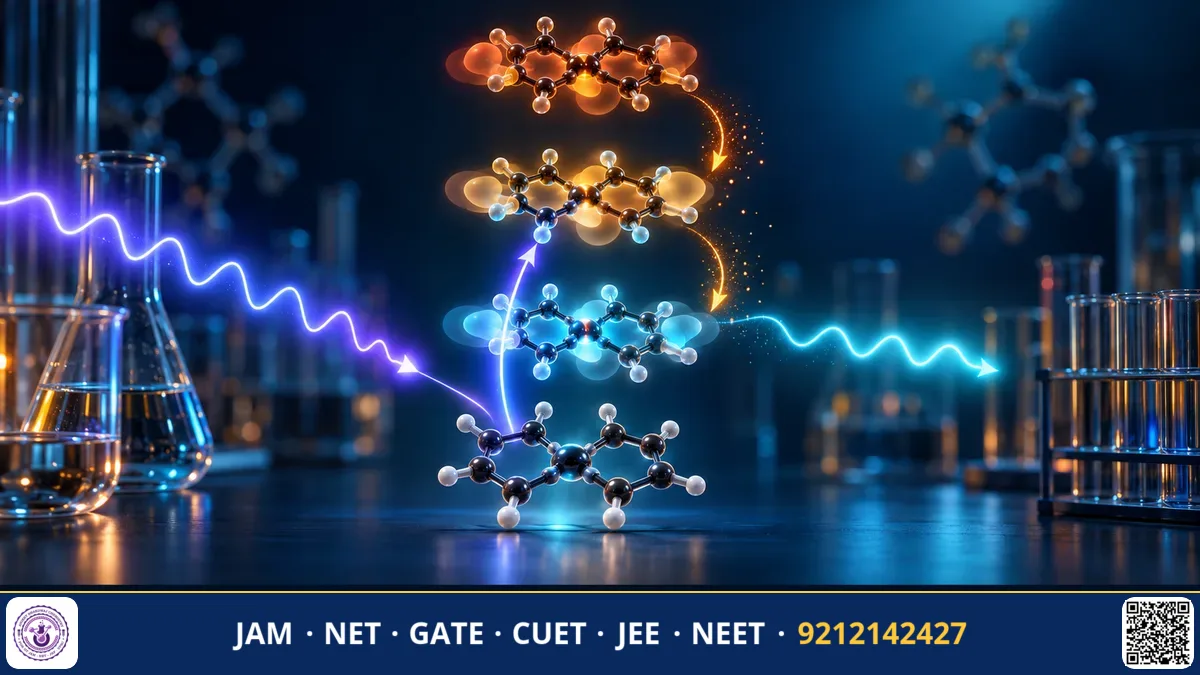
Photochemical excitation occurs when a ketone absorbs ultraviolet radiation. Non-bonding electrons on the carbonyl oxygen are promoted to the pi-antibonding orbital in an n to pi-star transition, producing the singlet excited state S1. Intersystem crossing can then invert an electron spin to yield the lower-energy triplet state T1. Aromatic ketones undergo rapid intersystem crossing and react almost exclusively from T1, whereas aliphatic ketones react from both S1 and T1.
The Norrish Type I reaction is an alpha-cleavage process where the bond between the carbonyl carbon and an alpha-carbon breaks homolytically. This cleavage produces an acyl radical and an alkyl radical. In unsymmetrical ketones, cleavage occurs regioselectively at the bond yielding the more stable alkyl radical, following the order tertiary greater than secondary greater than primary.
Once formed, the acyl-alkyl radical pair follows three common fates:
- Decarbonylation: The acyl radical expels carbon monoxide to generate an alkyl radical, favored in the gas phase or when tertiary or benzylic radicals form. The alkyl radicals then couple or disproportionate.
- Recombination: Solvent cage effects can cause the radical pair to recombine, reforming the starting ketone.
- Intramolecular disproportionation: In cyclic ketones, alpha-cleavage creates a 1,n-diradical that transfers a hydrogen internally to produce an unsaturated aldehyde or a ketene.
Norrish type II reaction: gamma-hydrogen abstraction and cyclization
The Norrish Type II reaction occurs when a carbonyl compound has at least one hydrogen atom at the gamma position. Upon excitation, the carbonyl oxygen acquires radical-like character. It abstracts a gamma-hydrogen atom through a strain-free six-membered cyclic transition state, generating a 1,4-diradical intermediate.
This 1,4-diradical resolves through two competing processes:
- Fragmentation: Homolytic cleavage of the alpha-beta bond splits the intermediate into an enol and an alkene. The enol tautomerizes rapidly into a ketone or aldehyde.
- Intramolecular cyclization: Direct bond formation between radical centers at the carbonyl carbon and gamma-carbon closes a four-membered ring, producing a substituted cyclobutanol.
Reverse hydrogen transfer can also return the hydrogen to the gamma-carbon, regenerating the starting ketone. In solution photolysis, flexible ketones with accessible gamma-hydrogens favor Type II over Type I because the activation barrier for six-membered hydrogen abstraction is lower than direct alpha-cleavage.
Comparison of Norrish type I and Norrish type II pathways
Reaction pathways depend on molecular structure and conditions. Norrish Type II dominates in solution when gamma-hydrogens are accessible. Norrish Type I takes over when gamma-hydrogens are absent, when ring strain promotes cleavage, or in the gas phase where decarbonylation is entropy-driven.
| Parameter | Norrish type I | Norrish type II |
|---|---|---|
| Primary event | Homolytic alpha-bond cleavage | Intramolecular gamma-hydrogen abstraction |
| Structural need | Carbonyl with alpha-substituent | Accessible gamma-hydrogen |
| Intermediate | Acyl-alkyl radical pair or 1,n-diradical | 1,4-hydroxy diradical |
| Transition state | Direct bond extension | Six-membered cyclic transition state |
| Major products | Aldehydes, ketenes, carbon monoxide, alkanes | Enol/ketone plus alkene, cyclobutanols |
| Favored phase | Gas phase, high temperature, strained rings | Solution phase at room temperature |
Exam strategy and structural patterns to watch
Postgraduate chemistry entrance examinations evaluate your ability to trace radical intermediates and predict major products. Apply this step-by-step method:
- Label the carbon chain: Number from the carbonyl group and locate alpha, beta, and gamma carbons.
- Screen for gamma-hydrogens: If absent, eliminate the Type II pathway immediately.
- Check conformational access: In rigid systems, confirm if the gamma-hydrogen can reach the carbonyl oxygen. If geometric constraints prevent the six-membered transition state, expect Type I cleavage.
- Select the weaker alpha-bond: In unsymmetrical ketones undergoing Type I cleavage, break the bond leading to the more stable alkyl radical.
- Track the cleavage site in Type II: In Norrish Type II fragmentation, break the alpha-beta bond, not the beta-gamma bond. Tautomerize the enol to its keto form.
Worked practice questions from our question bank
Practice question 1 (qid: ph-401): A sample of 5-methylhexan-2-one is irradiated with ultraviolet light in an inert solvent. Predict the major organic products formed and outline the mechanism.
Solution:
Write the carbon framework of 5-methylhexan-2-one: CH3–CO–CH2–CH2–CH(CH3)2. Relative to the C2 carbonyl, C3 is alpha, C4 is beta, and C5 is gamma. C5 carries one tertiary hydrogen.
Upon ultraviolet excitation, the carbonyl oxygen abstracts the tertiary gamma-hydrogen via a six-membered cyclic transition state to form a 1,4-diradical: CH3–C•(OH)–CH2–CH2–C•(CH3)2.
This 1,4-diradical partitions into two pathways:
- Fragmentation: Cleavage of the C3–C4 (alpha-beta) bond yields prop-1-en-2-ol and 2-methylpropene. Prop-1-en-2-ol tautomerizes rapidly to acetone.
- Intramolecular cyclization: Coupling between C2 and C5 radical centers forms 1,3,3-trimethylcyclobutanol.
The major products are acetone and 2-methylpropene, accompanied by 1,3,3-trimethylcyclobutanol.
Practice question 2 (qid: ph-402): Predict the major photochemical product when 2,2-dimethylcyclohexanone is photolyzed in an inert solvent without nucleophiles.
Solution:
In 2,2-dimethylcyclohexanone, chair geometry disfavors gamma-hydrogen abstraction from C4, directing the reaction along the Norrish Type I pathway.
Comparing alpha-cleavage sites:
- Cleavage of C1–C6 yields an acyl radical and a secondary alkyl radical.
- Cleavage of C1–C2 yields an acyl radical and a tertiary alkyl radical.
Because tertiary alkyl radicals are more stable than secondary radicals, cleavage occurs regioselectively at the C1–C2 bond, forming the 1,6-diradical: O=C•–(CH2)4–C•(CH3)2.
The acyl radical at C1 abstracts a hydrogen from C3. This hydrogen transfer generates an aldehyde at C1 and a double bond between C2 and C3. The resulting major product is 6-methylhept-5-en-1-al: (CH3)2C=CH–(CH2)3–CHO.
Focused revision plan for photochemical reactions
Follow this three-week schedule to master organic photochemistry for entrance tests:
- Week 1: Photoexcitation and photophysical states: Study the Jablonski diagram, singlet and triplet spin states, fluorescence, phosphorescence, and intersystem crossing.
- Week 2: Norrish Type I and Type II mechanisms: Master alpha-cleavage regioselectivity, six-membered transition states, and cyclobutanol ring formation. Solve chapter-wise sets from the question bank.
- Week 3: Advanced rearrangements and practice: Cover di-pi-methane and cyclohexadienone rearrangements. Practice mixed problems to sharpen pathway recognition.
Key takeaways
- Norrish Type I is an alpha-cleavage generating an acyl-alkyl radical pair, governed by alkyl radical stability.
- Norrish Type II requires an accessible gamma-hydrogen and proceeds through a six-membered cyclic transition state to form a 1,4-diradical.
- The 1,4-diradical partitions into enol plus alkene (fragmentation) or a cyclobutanol (intramolecular cyclization).
- Flexible ketones with gamma-hydrogens favor Type II over Type I in solution at room temperature.
- Always number from the carbonyl group to identify alpha, beta, and gamma positions before determining cleavage.
Frequently asked questions
Why does Norrish type II require a six-membered transition state?
A six-membered transition state provides optimal orbital overlap between the carbonyl oxygen and the gamma-hydrogen with minimal angle and torsional strain.
What governs regioselectivity in Norrish type I cleavage of unsymmetrical ketones?
Regioselectivity is governed by alkyl radical stability. Cleavage favors the bond that yields the more substituted or resonance-stabilized radical.
Why do cyclobutanones undergo facile Norrish type I reactions compared to cyclohexanones?
Cyclobutanones possess high ring strain. Homolytic alpha-cleavage relieves this ring strain, lowering the activation energy for the reaction.
What is the difference between Norrish type II fragmentation and cyclization?
Both pathways share the initial 1,4-diradical. Type II fragmentation breaks the alpha-beta bond to form an enol and an alkene, whereas cyclization couples radical centers to yield a cyclobutanol.