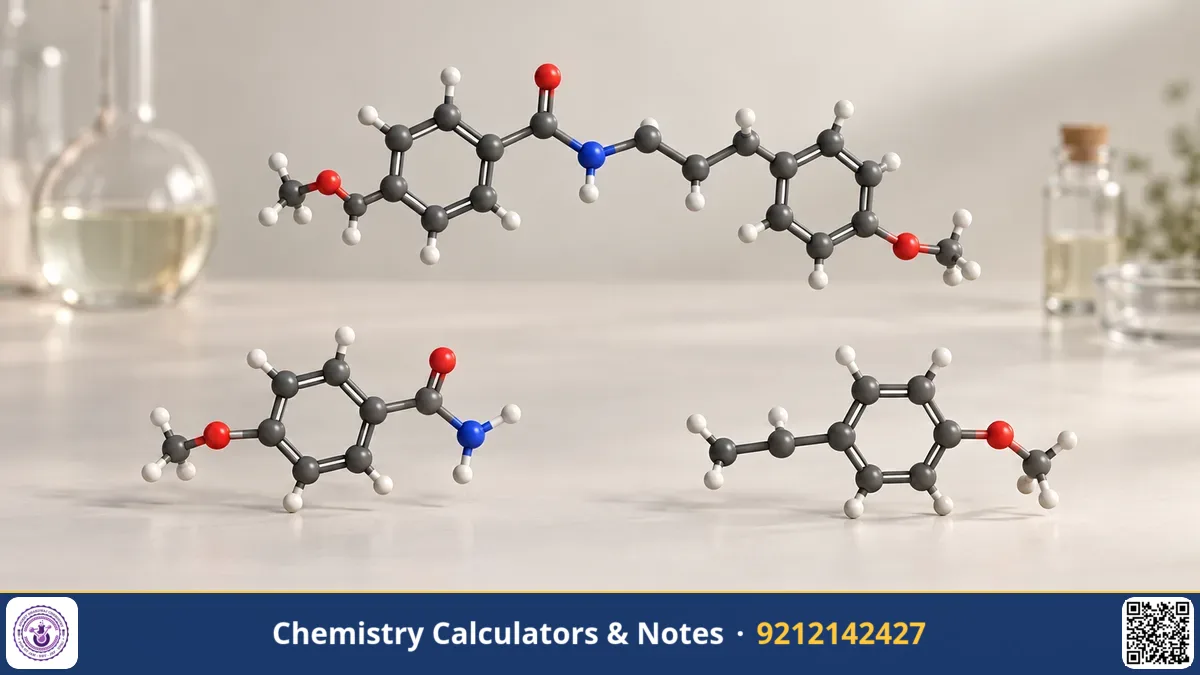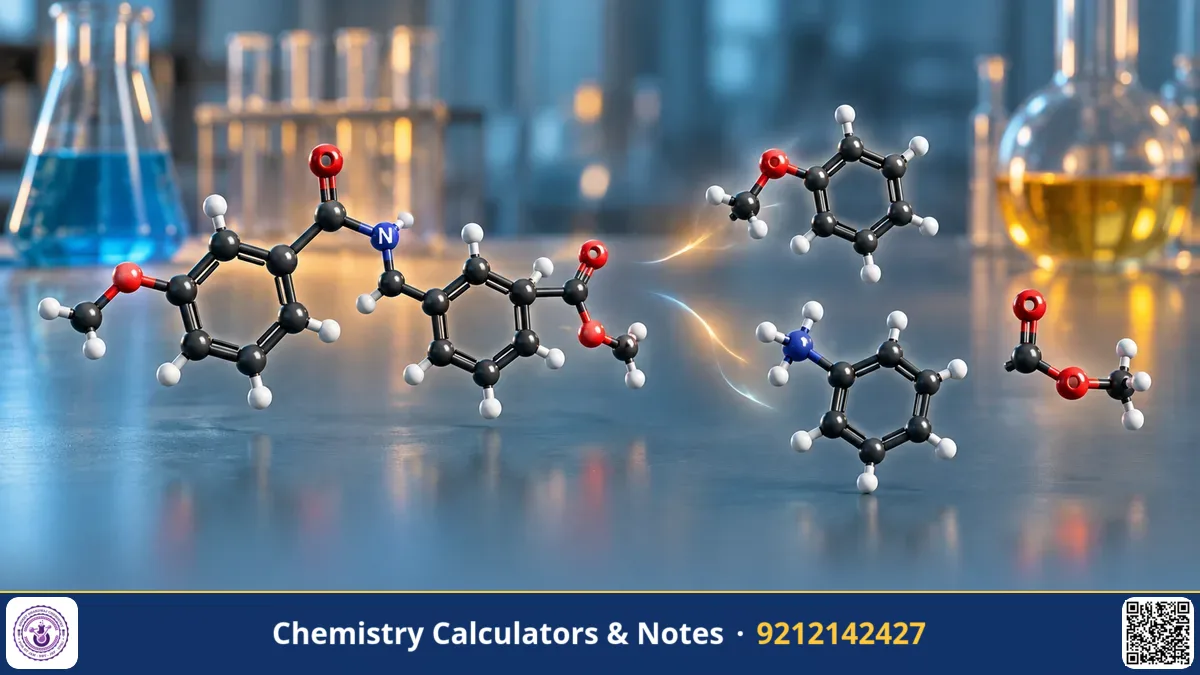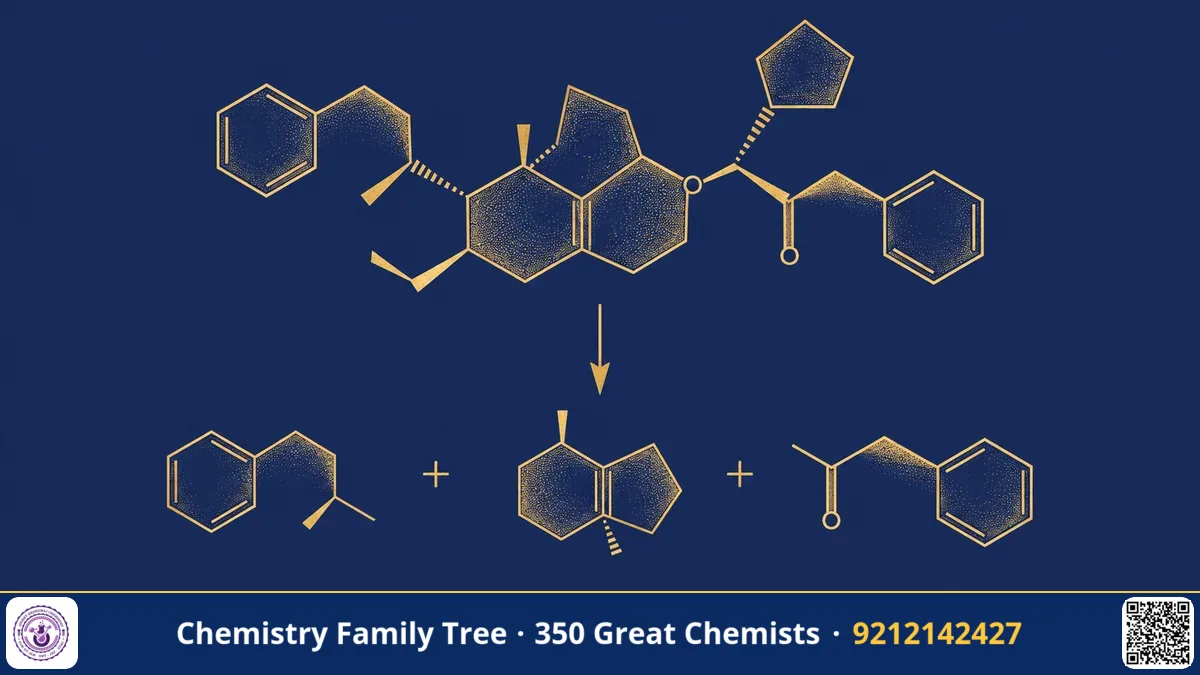






Retrosynthesis and Disconnection Approach: Starter Strategy for NET
Learn the disconnection approach for CSIR NET Chemical Science with key rules, synthon relationships, two solved practice problems, and a study plan.
This guide explains the disconnection approach and retrosynthetic logic for chemical science competitive examinations. You will learn fundamental synthon relationships, strategic disconnection rules, two worked practice problems, and a structured study plan.
Core principles of retrosynthetic analysis
Designing an organic synthesis by guessing forward from arbitrary starting materials leads to confusion. Retrosynthetic analysis reverses your perspective: you begin with the target molecule and systematically cleave selected bonds until reaching simple precursors.
Master these foundational definitions before attempting complex targets:
- Target molecule: The final compound you intend to assemble.
- Retrosynthetic arrow: An open, double-lined arrow pointing backward from target to precursors, indicating an analytical mental step rather than a forward reaction.
- Disconnection: An analytical operation where a bond is cleaved, splitting the structure into two or more fragments.
- Synthon: An idealized structural unit, usually an ion, representing the polarity required for bond formation.
- Synthetic equivalent: A stable, real chemical compound delivering the reactivity of an idealized synthon.
- Functional group interconversion: Converting one functional group into another to enable a favorable bond disconnection.
Synthons are classified as donors (designated by d, supplying electrons as nucleophiles) or acceptors (designated by a, accepting electrons as electrophiles). Numerical indices indicate carbon positions relative to the functional group.
| Synthon | Classification | Synthetic equivalent | Forward bond formation |
|---|---|---|---|
| Alkyl cation: R+ | Acceptor (a1) | Alkyl halide (R-Br, R-I) | Bimolecular nucleophilic substitution |
| Alkyl carbanion: R- | Donor (d1) | Alkylmagnesium halide | Nucleophilic addition or displacement |
| Acyl cation: R-CO+ | Acceptor (a1) | Acyl chloride or ester | Nucleophilic acyl substitution |
| Enolate carbon donor | Donor (d2) | Ketone or ester enolate | Aldol addition or alpha-alkylation |
| Enone beta-acceptor | Acceptor (a3) | alpha,beta-unsaturated carbonyl | Conjugate addition |
Strategic rules for choosing bond disconnections
Not every bond in a target should be cleaved. Random cuts produce unrealistic synthons lacking practical chemical equivalents. Follow these strategic rules:
- Disconnect carbon-heteroatom bonds first: Bonds between carbon and oxygen, nitrogen, or sulfur are straightforward to reconnect. Cleaving them early simplifies the core skeleton before tackling carbon-carbon bonds.
- Recognize functional group relationships: Relative spacing between groups signals standard reactions. A 1,3-dicarbonyl framework suggests an ester condensation. A beta-hydroxy carbonyl points to an aldol addition. An endocyclic alkene in a six-membered ring indicates a retro-[4+2] cycloaddition.
- Disconnect at branch points and symmetry axes: Cleaving at branch points or across symmetry axes divides the molecule into comparable fragments, reducing synthetic steps.
- Maintain chemoselectivity: Avoid disconnections placing mutually reactive groups on the same intermediate to prevent self-condensation.
- Use functional group interconversion when blocked: When a target lacks a direct disconnection route, convert an existing group into one enabling standard bond cleavage.
Retrosynthesis in chemical science examinations
Examinations such as CSIR NET Chemical Science, GATE Chemistry, IIT-JAM, and CUET-PG evaluate retrosynthetic reasoning through multi-step synthesis questions rather than isolated definitions.
Typical questions ask candidates to select the most efficient synthetic route among four choices. Incorrect options contain identifiable errors:
- Regiochemical errors: Proposed disconnections lead to reagents yielding isomeric mixtures rather than a single desired product.
- Polyalkylation side reactions: Direct alkylation of simple ketone enolates causes multiple alkylations. Examiners reward candidates selecting stabilized synthetic equivalents like beta-keto esters.
- Polarity reversal recognition: Examiners test polarity reversal, known as umpolung. Reagents like 1,3-dithiane anions reverse normal carbonyl electrophilicity to generate nucleophilic acyl donor synthons.
- Protecting group requirements: Polyfunctional targets require chemoselective protection before carrying out bond-forming reactions.
Always sketch retrosynthetic disconnections on your rough sheet before reading multiple-choice options to avoid deceptive choices.
Worked practice problems with question bank identifiers
The following two worked problems demonstrate how retrosynthetic planning translates into practical forward reactions.
Practice question 1 (QID: ABC-NET-CS-101)
Target compound: 4-phenylbutan-2-one.
Problem statement: Formulate a retrosynthetic analysis for 4-phenylbutan-2-one. Identify synthons, select synthetic equivalents, and outline an efficient forward route avoiding polyalkylation.
Retrosynthetic analysis:
Cleaving the bond between carbon-3 and carbon-4 yields two synthons:
- An electrophilic benzyl synthon (an a1 synthon).
- A nucleophilic acetone enolate synthon (a d2 synthon).
Evaluating synthetic equivalents:
The synthetic equivalent for the benzyl cation is benzyl bromide. Direct use of acetone enolate causes self-aldol condensation and polyalkylation. The superior synthetic equivalent is ethyl acetoacetate, permitting selective mono-alkylation under basic conditions.
Forward synthetic route:
- Deprotonate ethyl acetoacetate with sodium ethoxide to form the stabilized mono-enolate anion.
- React with benzyl bromide to achieve clean mono-alkylation via nucleophilic substitution.
- Hydrolyze the ester with dilute aqueous acid to produce the beta-keto acid.
- Heat gently to drive thermal decarboxylation, affording pure 4-phenylbutan-2-one.
Practice question 2 (QID: ABC-NET-CS-102)
Target compound: 4-methylcyclohex-3-enecarbaldehyde.
Problem statement: Perform a retrosynthetic analysis for 4-methylcyclohex-3-enecarbaldehyde. Identify starting materials and explain the regiochemical basis of the forward reaction.
Retrosynthetic analysis:
The target molecule contains a six-membered ring with an endocyclic double bond and a formyl substituent, indicating a retro-[4+2] cycloaddition. Cleaving two single bonds reveals two precursors:
- A conjugated diene: 2-methylbuta-1,3-diene (isoprene).
- An electron-deficient dienophile: prop-2-enal (acrolein).
Evaluating regioselectivity:
The diene has an electron-donating methyl group at carbon-2, making carbon-1 the most nucleophilic site with the largest coefficient in the highest occupied molecular orbital. The dienophile has an electron-withdrawing formyl group, making carbon-3 the most electrophilic site with the largest coefficient in the lowest unoccupied molecular orbital. Orbital overlap directs carbon-1 of 2-methylbuta-1,3-diene to bond with carbon-3 of prop-2-enal.
Forward synthetic route:
Heating 2-methylbuta-1,3-diene with prop-2-enal cleanly produces 4-methylcyclohex-3-enecarbaldehyde as the major 1,4-disubstituted regioisomer. This pericyclic reaction forms two carbon-carbon bonds with complete regiocontrol in one step.
Structured four-week study plan
Mastering retrosynthesis requires systematic problem solving. Follow this four-week revision plan:
- Week 1: Single-group disconnections. Master one-group disconnections for alcohols, ethers, and carbonyls. Practice writing synthons and synthetic equivalents. Solve chapter-wise problems from the question bank.
- Week 2: Two-group disconnections. Study 1,3-difunctional and 1,5-difunctional relationships. Work through ester condensations, aldol reactions, and conjugate additions. Focus on enolates and active methylene compounds.
- Week 3: Ring synthesis and pericyclic reactions. Practice retro-[4+2] cycloadditions on cyclohexenes. Review regiochemical outcomes. Practice intramolecular ring formations.
- Week 4: Multi-step synthesis and timed practice. Tackle targets requiring three to five forward steps. Practice recognizing umpolung synthons and selecting protecting groups. Work through timed question sets.
Students preparing through a 6-month live online batch should use weekly tests and doubt-clearing sessions to resolve tricky disconnections immediately.
Key takeaways
- Retrosynthesis plans organic synthesis by working backward from target molecules to starting materials using logical bond disconnections.
- Synthons are hypothetical charged fragments, whereas synthetic equivalents are actual reagents used in laboratory reactions.
- Disconnecting carbon-heteroatom bonds and locating molecular symmetry should precede difficult carbon-carbon disconnections.
- Advanced chemical science examinations test retrosynthesis through multi-step sequences, regioselectivity, and umpolung strategies.
Frequently asked questions
What is the difference between a synthon and a synthetic equivalent?
A synthon is an idealized, theoretical fragment representing the polarity needed to form a bond, often written with a formal charge. A synthetic equivalent is a stable, real chemical compound that performs the function of that synthon in the laboratory.
When should functional group interconversion be applied in retrosynthesis?
Functional group interconversion is used when a target molecule lacks a direct disconnection route. Converting an existing group into another functionality creates a recognized structural motif enabling standard bond cleavage.
Why is ethyl acetoacetate preferred over acetone for alkylation disconnections?
Direct deprotonation of acetone causes self-aldol condensation and polyalkylation. Ethyl acetoacetate contains an acidic methylene group between two carbonyls, allowing clean mono-alkylation, followed by ester hydrolysis and thermal decarboxylation to give the methyl ketone.
How does the disconnection approach assist in competitive chemical science tests?
In examinations like CSIR NET and GATE, questions feature complex products with multiple choices. Applying the disconnection approach allows you to identify key bond-forming reactions, verify regiochemical outcomes, and eliminate incorrect answer choices systematically.