





Raman spectroscopy: selection rules and mutual exclusion
Polarisability, the Raman selection rule, IR-Raman complementarity and the rule of mutual exclusion, with two worked practice questions and a short study plan
This post explains when a vibration shows up in a Raman spectrum and why that differs from infrared (IR).
You will also get two worked practice questions and a short plan to revise the topic.
What Raman scattering actually is
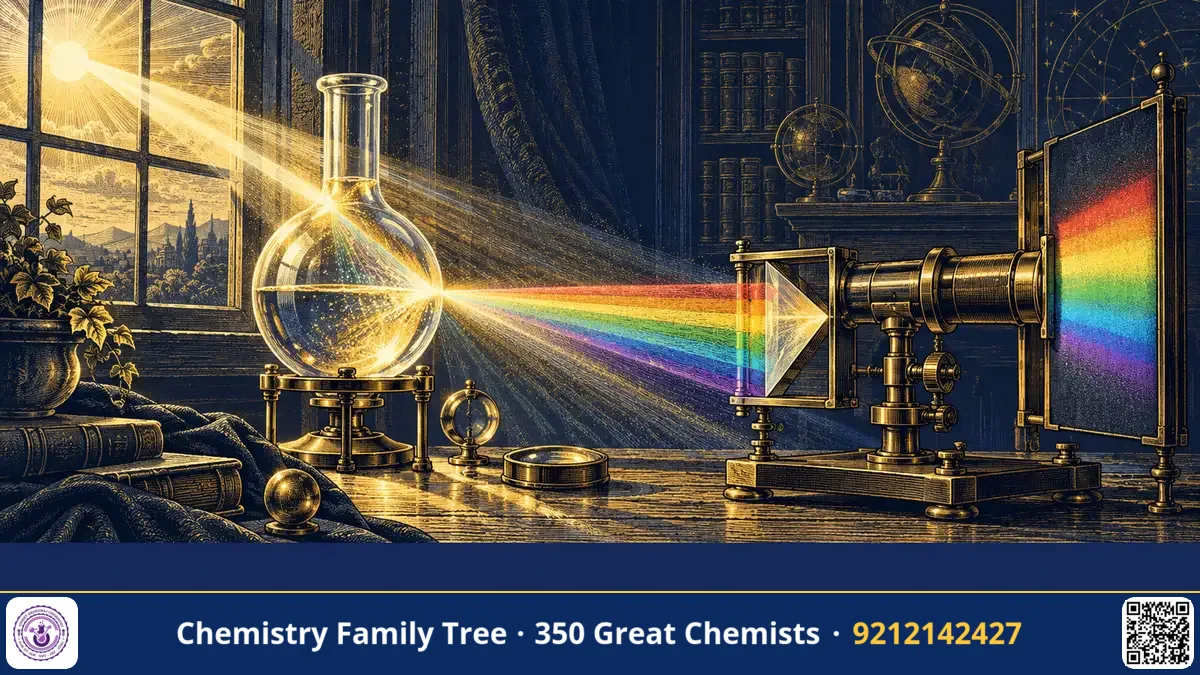
In Raman spectroscopy, a sample is lit with monochromatic light, which means light of one wavelength. Usually this is a laser. Most of the scattered light has the same wavelength as the laser. This is Rayleigh scattering, and it is elastic, so no energy is exchanged.
A very small part of the scattered light has a different energy. This is Raman scattering, and it is inelastic. The energy shift tells you the energy of a vibration in the molecule. Raman scattering is weak, so instruments filter out the strong Rayleigh light before detection.
Two lines appear on either side of the Rayleigh line:
- Stokes lines: the molecule takes energy from the photon. The scattered photon has lower energy.
- Anti-Stokes lines: the molecule gives energy to the photon. The scattered photon has higher energy. This needs molecules that are already in an excited vibrational level.
The Raman shift is the difference between the scattered and the incident energy, expressed in wavenumber. It depends on the molecule, not on the laser you choose. That is why the Raman spectrum works as a fingerprint of the molecule.
Keep one point clear: Raman is a scattering technique, not an absorption technique. The laser wavelength is chosen so that the sample does not absorb it. The light interacts through a short-lived virtual state, which is not a real energy level of the molecule.
Polarisability: the quantity that decides everything
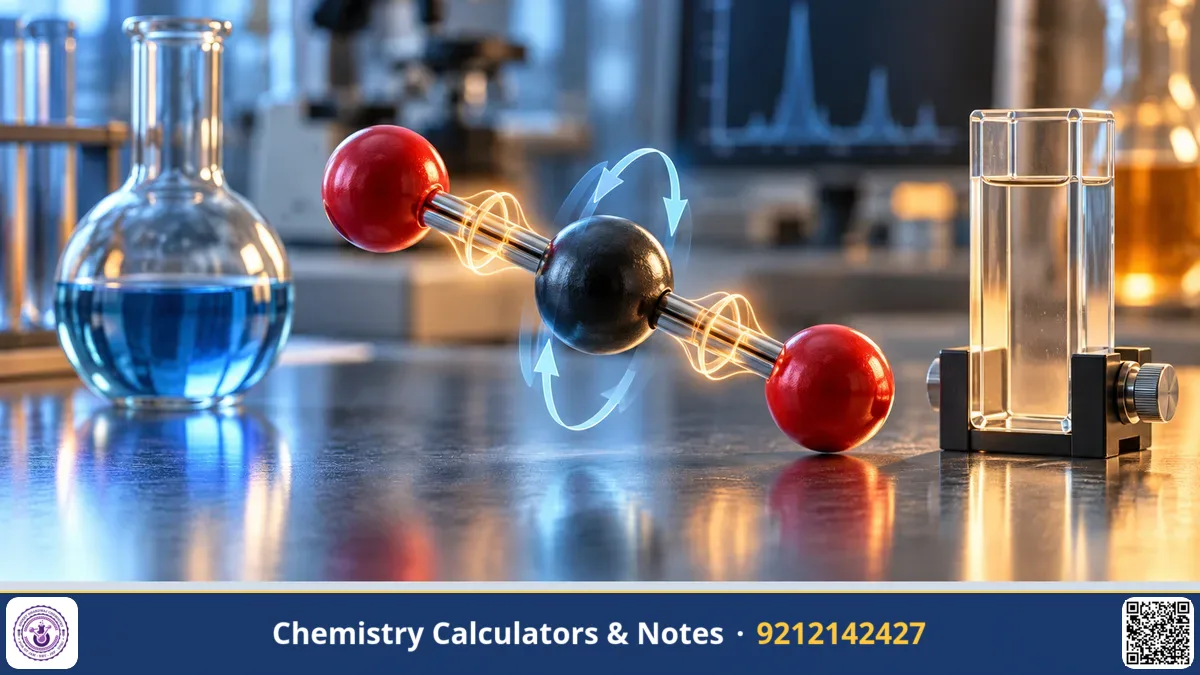
Polarisability (α) measures how easily the electron cloud of a molecule is distorted by an electric field. The light wave is an oscillating electric field. It induces a dipole moment in the molecule. The size of that induced dipole depends on α.
The gross selection rule for a vibrational Raman line is this: the polarisability must change as the molecule vibrates. Think of the electron cloud. If the vibration stretches bonds, the cloud becomes easier or harder to distort, and α changes.
Compare this with IR. For an IR line, the dipole moment must change during the vibration. These are two different conditions, so the two techniques pick out different vibrations.
Here are the standard cases to remember:
- Homonuclear diatomics such as H2, N2 and O2: the dipole moment stays zero, so there is no IR band. The stretch changes α, so it is Raman active.
- Heteronuclear diatomics such as HCl: the stretch changes both the dipole moment and α, so it is active in both.
- Symmetric stretches are usually strong in Raman. Asymmetric stretches are usually strong in IR.
For vibrational transitions, the rule for the quantum number is Δv = ±1. Pure rotational Raman needs an anisotropic polarisability, which means α depends on the direction. The rotational rule is ΔJ = 0, ±2. Linear molecules such as N2 and CO2 qualify. Molecules with perfectly spherical polarisability, such as CH4 and SF6, show no pure rotational Raman spectrum.
IR-Raman complementarity and mutual exclusion
The two techniques give related but different information. Together they give a fuller picture of the vibrations. The table sets the conditions side by side.
| Feature | IR spectroscopy | Raman spectroscopy |
|---|---|---|
| Process | Absorption of light | Inelastic scattering of light |
| Selection rule | Dipole moment changes | Polarisability changes |
| Homonuclear diatomic stretch | Inactive | Active |
| Typically strong for | Polar bonds, asymmetric stretches | Non-polar bonds, symmetric stretches |
| Light source | Infrared radiation | Monochromatic laser |
Now the rule of mutual exclusion. If a molecule has a centre of symmetry (a centre of inversion, i), then no vibration is active in both IR and Raman. A vibration that is symmetric with respect to inversion is labelled g (gerade). It changes α but not the dipole moment, so it is Raman active only. A vibration that is antisymmetric with respect to inversion is labelled u (ungerade). It changes the dipole moment but not α, so it is IR active only.
The rule works as a test in two directions:
- If the molecule has a centre of symmetry, the IR and Raman bands will not coincide.
- If one band appears in both spectra, the molecule cannot have a centre of symmetry. This helps you choose between structures, for example a linear and a bent triatomic.
The converse is not true. Missing coincidences do not prove a centre of symmetry. Many molecules without a centre, such as H2O, simply have every vibration active in both.
The exam angle
Questions on this topic in CSIR-NET, GATE, IIT-JAM and CUET-PG usually test the logic, not memory. Expect these patterns:
- Decide which vibrations of a given molecule are IR active, Raman active, both or neither.
- Count the normal modes using 3N − 6 for non-linear molecules and 3N − 5 for linear molecules.
- Use the mutual exclusion rule to pick the correct structure from IR and Raman data.
- Judge statements about Stokes and anti-Stokes lines, or about why Rayleigh scattering is filtered out.
Always begin by finding the point group, or at least by checking whether the molecule has a centre of symmetry. That one check settles half the question.
Two solved practice questions
These are practice questions written for this post. They are not past-paper questions.
Practice question 1. Which of the following has no vibrational mode that is active in both IR and Raman?
(a) H2O (b) CH4 (c) CO2 (d) SO2
Solution.
- The rule of mutual exclusion applies only to molecules with a centre of symmetry.
- H2O and SO2 are bent. They have no centre of symmetry. Their modes are active in both techniques.
- CH4 is tetrahedral. It has no centre of symmetry, so the rule does not apply. Some of its modes are active in both.
- CO2 is linear and symmetric (O=C=O). It has a centre of symmetry.
- CO2 has four modes, since 3N − 5 = 4. The symmetric stretch is g, so it is Raman active only. The asymmetric stretch and the doubly degenerate bend are u, so they are IR active only.
Answer: (c). Common mistake: choosing CH4 because it is "highly symmetric". High symmetry is not the same as having an inversion centre.
Practice question 2. Acetylene (HC≡CH) is linear and has a centre of symmetry. How many distinct fundamental vibrational frequencies does it have? How many are IR active and how many are Raman active?
Solution.
- N = 4 and the molecule is linear, so there are 3N − 5 = 7 normal modes.
- Two of the modes are bends that are doubly degenerate. Degenerate modes share one frequency. So the seven modes give five distinct frequencies.
- The five frequencies are: the symmetric C–H stretch, the C≡C stretch, the asymmetric C–H stretch, the trans bend and the cis bend.
- The symmetric C–H stretch, the C≡C stretch and the trans bend are g. These three are Raman active, and none of them is IR active.
- The asymmetric C–H stretch and the cis bend are u. These two are IR active, and neither is Raman active.
Answer: five distinct frequencies; two IR active; three Raman active; none active in both. This agrees with mutual exclusion. Check: 3 + 2 = 5, so every fundamental is accounted for.
Study plan
- Day 1: Learn the two selection rules and the Stokes, anti-Stokes and Rayleigh picture. Write the IR-Raman table from memory.
- Day 2: Practise the g and u labels on CO2, acetylene and a few other linear molecules. Check each answer with the 3N − 5 count.
- Day 3: Do the same for bent and tetrahedral molecules, where no centre of symmetry exists. See that many modes are active in both.
- Day 4: Attempt mixed questions. Write the point group first, then the mode count, then the activity.
- Day 5: Redo every mistake without looking at the solution. Then connect this topic to your combined spectroscopy practice, where IR and Raman data narrow down a structure.
Keep a one-page sheet with the two rules, the table and the CO2 and acetylene examples. Revise it before every mock test.
Key takeaways
- IR needs a change in dipole moment. Raman needs a change in polarisability.
- Stokes lines have lower photon energy after scattering. Anti-Stokes lines have higher.
- With a centre of symmetry, g modes are Raman only and u modes are IR only.
- A band seen in both spectra means the molecule has no centre of symmetry.
- Check for an inversion centre before anything else, then count modes with 3N − 5 or 3N − 6.
Frequently asked questions
Why is Raman scattering so weak?
Most photons scatter elastically as Rayleigh scattering. Only a very small share scatter inelastically. That is why instruments filter out the strong Rayleigh light before the detector.
Does the Raman shift change if I change the laser?
No. The shift is the energy difference between the scattered and the incident light, and it reflects the molecule's vibrations. The laser line moves, and the shifted lines move with it.
Can a molecule show a band in both IR and Raman?
Yes, if it has no centre of symmetry. H2O is an example. Mutual exclusion forbids this only for molecules that have an inversion centre.
Do I need Raman theory for rotational spectra too?
Yes, at a basic level. Pure rotational Raman needs an anisotropic polarisability and follows ΔJ = 0, ±2. Linear molecules such as N2 qualify even though they have no permanent dipole moment.