






Update, 2 October 2026: ABC Chemistry teaches online only at present — classroom batches are not running and there is no walk-in centre. D-101 Capital Gateway, Sector 111, Gurugram is the registered office. How the online classes work.
Rigid rotor and anharmonic oscillator: spectra and selection rules
Energy levels and selection rules for the rigid rotor and anharmonic oscillator, with two solved practice questions and a 5-day study plan for chemistry exams
This post gives you the energy formulas and selection rules for rotation and vibration of diatomic molecules.
You will also solve two practice questions and get a short plan to revise the topic.
Rotation: the rigid rotor
A molecule in the gas phase can rotate freely. In liquids and solids, intermolecular forces stop this free rotation, so sharp rotational lines are a gas-phase feature.
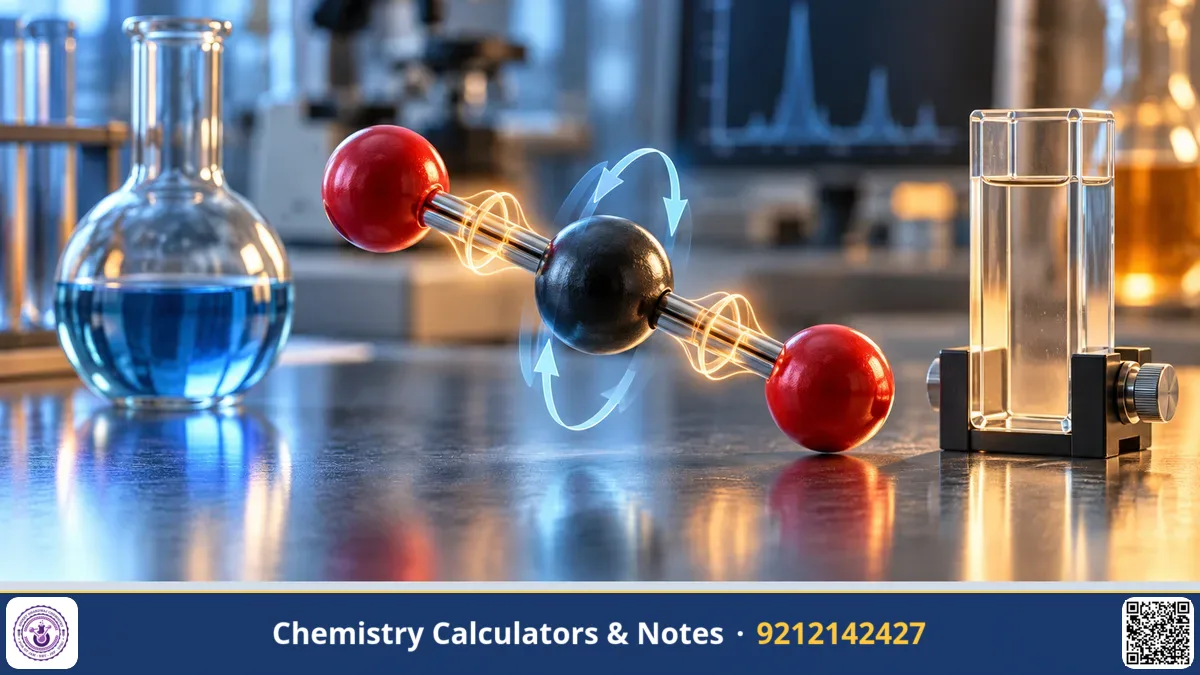
The rigid rotor model treats a diatomic molecule as two masses joined by a bond of fixed length. Its moment of inertia (a measure of how hard it is to spin the molecule) is I = μr2. Here μ is the reduced mass, μ = m1m2/(m1 + m2), and r is the bond length.
The energy levels are:
- EJ = BJ(J+1), with J = 0, 1, 2, ...
- B = h/(8π2cI) when B is written in cm-1.
- Each level J has a degeneracy (number of states at the same energy) of 2J + 1.
The selection rules for absorption are:
- The molecule must have a permanent dipole moment. HCl shows a pure rotational spectrum. H2 and N2 do not.
- ΔJ = ±1.
For the transition J → J+1, the line appears at 2B(J+1). So the lines fall at 2B, 4B, 6B and so on. Neighbouring lines are 2B apart. Measure that spacing, get B, then get I and r. This is the standard route to bond length.
Non-polar molecules are not lost entirely. Their rotational spectra can be seen by Raman spectroscopy. The Raman rule is ΔJ = 0, ±2. The lines are then 4B apart, and the first line sits at 6B from the exciting line.
Real molecules are not perfectly rigid. At high J the bond stretches a little. This is centrifugal distortion. It lowers the energy slightly: E = BJ(J+1) − DJ2(J+1)2, where D is a small positive constant. The lines then crowd slightly closer at high J.
Vibration: harmonic and anharmonic oscillator
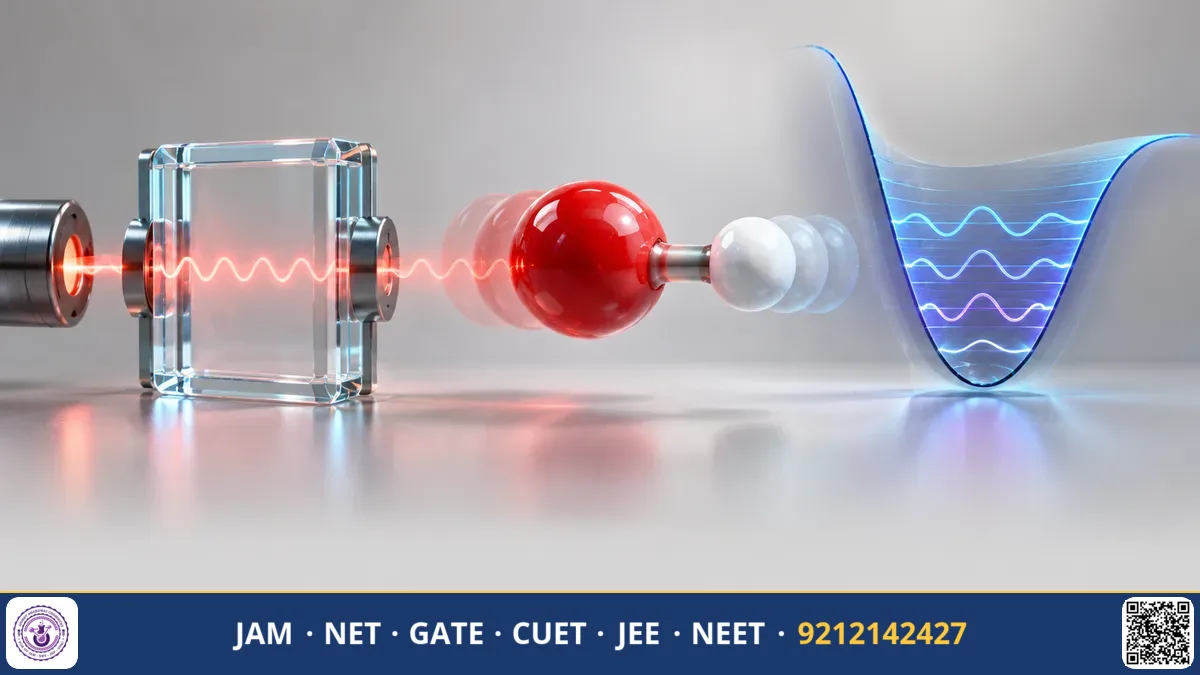
In the harmonic oscillator the bond behaves like a perfect spring. The levels are (v + ½)hν, with v = 0, 1, 2, ... The levels are equally spaced. The selection rules are Δv = ±1 and a change of dipole moment during the vibration. Because of this rule, a harmonic oscillator would show only one line, the fundamental.
A real bond is not a perfect spring. It stretches more easily than it compresses, and it breaks at large extension. The anharmonic oscillator describes this. In wavenumbers:
G(v) = (v + ½)ωe − (v + ½)2ωexe
Here ωe is the equilibrium vibrational wavenumber and xe is the small, positive anharmonicity constant. Three results follow:
- The levels get closer as v increases and finally converge at the dissociation limit.
- Overtones (Δv = ±2, ±3) become weakly allowed. The first overtone is v = 0 → 2.
- The fundamental (0 → 1) lies at ωe(1 − 2xe). The first overtone lies at 2ωe(1 − 3xe), a little less than twice the fundamental.
A useful estimate of the depth of the potential well (the dissociation energy measured from the bottom of the well) is De ≈ ωe2/(4ωexe). It comes from a straight-line extrapolation of level spacings, so treat it as approximate.
| Feature | Rigid rotor | Harmonic oscillator | Anharmonic oscillator |
|---|---|---|---|
| Levels | BJ(J+1) | (v + ½)hν | (v + ½)ωe − (v + ½)2ωexe |
| Spacing | Grows with J | Equal | Shrinks with v |
| Selection rule | ΔJ = ±1 | Δv = ±1 | Δv = ±1 strong; ±2, ±3 weak |
| Condition | Permanent dipole | Dipole changes on vibration | Dipole changes on vibration |
Rotation and vibration together
In the gas phase, the infrared spectrum of a diatomic shows the vibrational band split into rotational lines. The rotational changes are much smaller than the vibrational ones, so they appear as fine structure on the vibration. The lines of one band are grouped into branches:
- R-branch: ΔJ = +1, on the high-wavenumber side of the band centre.
- P-branch: ΔJ = −1, on the low-wavenumber side.
- Q-branch: ΔJ = 0, at the band centre. It is sometimes missing because ΔJ = 0 is forbidden for simple diatomics.
The R-branch looks much like the pure rotational spectrum shifted to higher wavenumber. The P-branch looks like a near mirror image of it. The gap at the centre, where the Q-branch would sit, is a quick way to recognise a diatomic spectrum.
Line intensity depends on how many molecules start in each J level, and this depends on temperature. The 2J + 1 degeneracy raises the population at first, and at higher J the population decays. So the lines grow stronger, reach a maximum and then fade. This gives the P and R branches their characteristic shape.
How the exam asks it
Questions on this topic are usually short and numerical. Expect these patterns:
- Which molecule is microwave-active, IR-active or Raman-active? Always check for a permanent dipole first.
- Given a line spacing, find B, I or r. Remember that the spacing is 2B in absorption and 4B in Raman.
- Given two vibrational lines, find ωe and xe. Write both equations and solve them together.
- Count or locate lines. For example, where does the J = 3 → 4 line fall?
- Compare isotopologues (molecules differing only in isotope). A heavier isotope has a larger μ, so a larger I and a smaller B. The rotational lines come closer together.
Units cause most lost marks. Keep B in cm-1 if h/(8π2cI) is used with c in cm s-1. Convert I to kg m2 before finding r.
Two solved practice questions
These are practice questions written for this post. They are not past-paper questions. The data are made up for teaching.
Practice question 1. The microwave spectrum of a heteronuclear diatomic molecule shows equally spaced lines, 4.0 cm-1 apart. Its reduced mass is 1.0 × 10⁻²⁶ kg. Find (a) B, (b) the J = 3 → 4 line position, (c) the moment of inertia and (d) the bond length. Use h = 6.626 × 10⁻³⁴ J s and c = 3.0 × 1010 cm s-1.
Solution.
- Line spacing = 2B = 4.0 cm-1, so B = 2.0 cm-1.
- The J → J+1 line is at 2B(J+1). For J = 3, the line is at 2 × 2.0 × 4 = 16 cm-1.
- I = h/(8π2cB) = 6.626 × 10⁻³⁴ / (8 × 9.87 × 3.0 × 1010 × 2.0) ≈ 1.4 × 10-46 kg m2.
- r = √(I/μ) = √(1.4 × 10-46 / 1.0 × 10⁻²⁶) = √(1.4 × 10⁻²⁰) ≈ 1.18 × 10⁻¹⁰ m, or about 118 pm.
Check: if this molecule were replaced by a heavier isotopologue, μ would rise, B would fall and the spacing would shrink below 4.0 cm-1.
Practice question 2. An anharmonic diatomic oscillator shows its fundamental at 2000 cm-1 and its first overtone at 3950 cm-1. Find ωe, ωexe and the approximate De.
Solution.
- Fundamental: ωe − 2ωexe = 2000.
- First overtone: 2ωe − 6ωexe = 3950.
- Multiply the first equation by 2: 2ωe − 4ωexe = 4000.
- Subtract the second equation: 2ωexe = 50, so ωexe = 25 cm-1.
- Then ωe = 2000 + 2(25) = 2050 cm-1. This gives xe ≈ 0.012.
- De ≈ ωe2/(4ωexe) = (2050)2/(4 × 25) ≈ 42,000 cm-1.
Check: the overtone (3950) is less than twice the fundamental (4000). That is the signature of anharmonicity. This De is measured from the bottom of the well, not from the v = 0 level.
A short study plan
- Day 1: Write the rigid rotor formulas from memory: EJ, B, I, selection rules and line positions. Solve three line-spacing problems.
- Day 2: Do the same for the anharmonic oscillator. Derive the fundamental and overtone positions yourself instead of memorising them.
- Day 3: Draw a P-Q-R spectrum and mark the missing Q-branch. Then sort a list of molecules into microwave-, IR- and Raman-active.
- Day 4: Solve mixed numericals with isotopes and unit conversions. Time yourself.
- Day 5: Revise the table in this post and redo the two practice questions without looking at the solutions.
Practise more problems of this type from the chemistry question bank, chapter by chapter. Do not move on until you can set up each problem in under two minutes.
Key takeaways
- Pure rotational lines need a permanent dipole, with ΔJ = ±1 and spacing 2B. Raman uses ΔJ = 0, ±2 and spacing 4B.
- Vibrational absorption needs a changing dipole. Anharmonicity allows weak overtones and makes levels converge.
- Fundamental = ωe(1 − 2xe). First overtone = 2ωe(1 − 3xe). Solve two equations to get both constants.
- In a ro-vibrational band, R is ΔJ = +1, P is ΔJ = −1, and Q (ΔJ = 0) is sometimes absent.
- Watch units: B in cm-1, I in kg m2.
Frequently asked questions
Why does H2 show no pure rotational microwave spectrum?
H2 has no permanent dipole moment. Rotation does not change any dipole, so it cannot absorb microwave radiation. Its rotational spectrum can be seen by Raman spectroscopy.
Why is the Q-branch missing in many diatomic spectra?
The Q-branch needs a vibrational transition with no change in J. Such transitions are forbidden for simple diatomic molecules, so only P and R branches appear, with a gap at the centre.
Why are overtones weaker than the fundamental?
Overtones (Δv = ±2, ±3) are forbidden for a perfectly harmonic oscillator. They become allowed only because of anharmonicity, so their intensity is much lower.
What happens to the rotational constant for a heavier isotope?
The reduced mass increases, so the moment of inertia increases. B is inversely proportional to I, so B decreases and the lines move closer together.
Can rotational spectra be measured for molecules in solids or liquids?
Not as sharp lines. Free rotation needs the gas phase, because intermolecular forces in liquids and solids prevent it.