





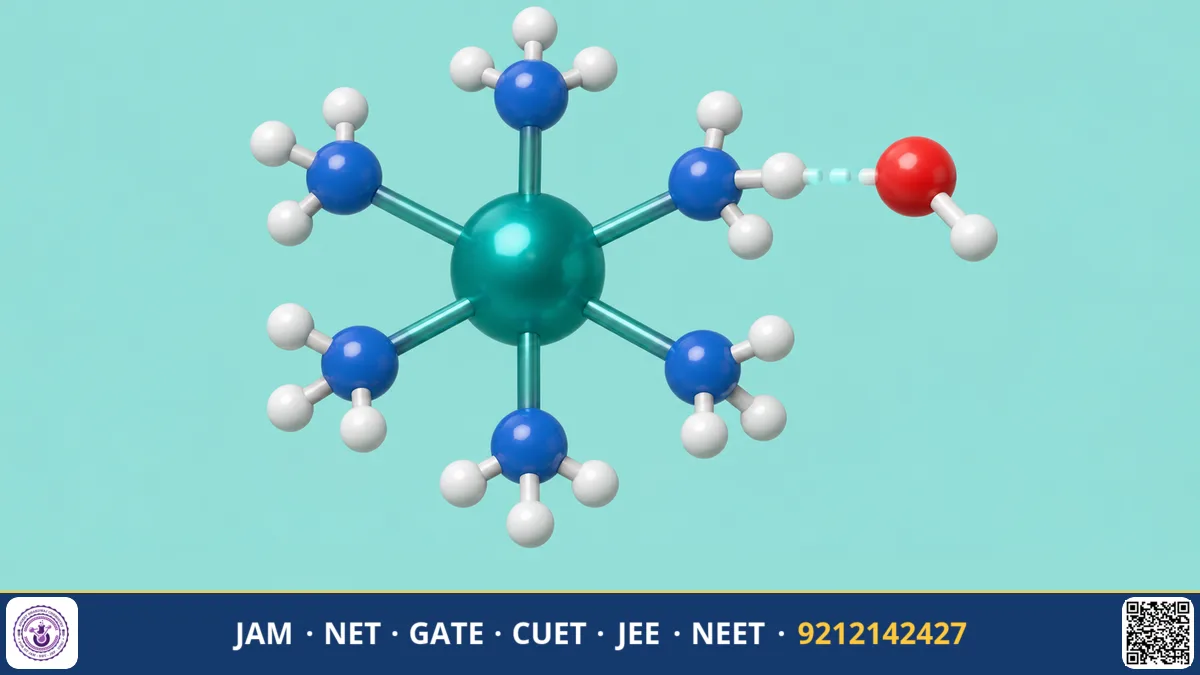
SN1CB mechanism: base hydrolysis in cobalt(III) ammines
Learn why hydroxide acts as a base, not a nucleophile, in SN1cB base hydrolysis of cobalt(III) ammines. Includes two worked practice questions and a study pla
This post explains the SN1cB mechanism step by step and shows why its rate law misleads many students.
You will also get two worked practice questions and a short plan to revise the topic.
What SN1cB stands for
SN1cB means substitution, nucleophilic, unimolecular, through the conjugate base. A conjugate base is what remains after a species loses a proton. Here the species is the complex itself.
The classic reaction converts a polyamine metal halide into the metal hydroxide complex in aqueous base:
[Co(NH3)5Cl]2+ + OH− → [Co(NH3)5OH]2+ + Cl−
Read as written, this looks like OH− replacing Cl− directly. The mechanism says otherwise. That gap between the equation and the mechanism is where exam questions are set.
The mechanism in three steps
Co(III) is a d6 ion. In an octahedral low-spin complex it is inert, which means ligand exchange is slow. The ammine ligands, however, carry N–H bonds. Those hydrogens become weakly acidic when nitrogen is bound to a highly charged metal ion.
- Deprotonation (fast, reversible). OH− acts as a base, not as a nucleophile. It pulls H+ from one coordinated NH3. This gives [Co(NH3)4(NH2)Cl]+, the conjugate base.
- Loss of chloride (slow, rate-determining). The amido group donates electron density to cobalt, which helps chloride leave. A five-coordinate intermediate, [Co(NH3)4(NH2)]2+, forms. This step is dissociative, so it earns the label "SN1".
- Water adds and a proton shifts (fast). Water from the solvent binds to the coordinatively unsaturated intermediate. A proton then moves from the bound water to the amido nitrogen. The product is the hydroxo complex.
The conjugate base is rarely observed. It forms in small amounts and reacts at once. Do not expect it to be an isolable species in a question.
Note where the oxygen in the product comes from. It comes from the solvent water that binds to the intermediate, not from the hydroxide that did the deprotonation. Examiners like to test this point.
Why the rate law is deceptive
The observed rate law is: rate = k[complex][OH−]. It is second order overall. A student who sees this may conclude that hydroxide attacks cobalt in a bimolecular step. That conclusion is wrong here.
The reason is the pre-equilibrium. Let K be the equilibrium constant for step 1, and k the rate constant for step 2.
- [conjugate base] = K[complex][OH−]
- rate = k[conjugate base] = kK[complex][OH−]
- So the observed constant is kobs = kK.
OH− appears in the rate law because it controls how much conjugate base exists. It does not take part in the slow step as a nucleophile. The same rate law can come from two very different mechanisms, so a rate law alone cannot prove a mechanism.
Evidence and conditions
Two ideas support the mechanism, and both turn up in exam options.
- An N–H bond is needed. A complex with no ionisable N–H bond cannot form a conjugate base, so it cannot follow this pathway. Coordinated pyridine, for example, has no N–H site.
- The amido ligand is a strong electron donor. It stabilises the five-coordinate intermediate by donating electron density to the metal. This is why deprotonation speeds up halide loss.
Base hydrolysis of such ammine complexes is generally far faster than their reaction with neutral water. The extra speed comes from the conjugate base, which loses its leaving group much more easily than the parent complex.
| Feature | Direct bimolecular attack | SN1cB |
|---|---|---|
| Role of OH− | Nucleophile bonding to metal | Base removing H+ from N–H |
| Rate law | First order in complex and OH− | First order in complex and OH− |
| Slow step | Bimolecular attack | Loss of leaving group from conjugate base |
| Intermediate | Seven-coordinate (associative) | Five-coordinate, with NH2− |
| Needs N–H on ligand? | No | Yes |
The exam angle
Questions on this topic in CSIR-NET, GATE, IIT-JAM and CUET-PG usually take one of a few forms. Prepare for each.
- Rate-law derivation. You are given the steps and asked for the rate expression or the observed constant.
- Mechanism identification. You are told the rate law is second order and asked what the mechanism is. Look for N–H ligands before you answer.
- Which complex reacts? You get a set of complexes and must pick the one that can undergo base hydrolysis by this route.
- Role of hydroxide. The options say nucleophile, base, catalyst or ligand. Only "base" is correct for the key step.
- Intermediate and product. You are asked for the coordination number of the intermediate or the origin of the oxygen in the product.
Read the question for what is being asked. Most errors come from answering with the equation rather than the mechanism.
Two worked practice questions
These are practice questions written for this post. They are not past-paper questions.
Practice question 1. Base hydrolysis of [Co(NH3)5Cl]2+ follows the SN1cB mechanism. The complex concentration is kept fixed and the pH is raised from 10 to 11. Assume the conjugate base stays a very small fraction of the complex. By what factor does the rate change? Name the species whose formation makes OH− appear in the rate law.
Solution.
- Write step 1 as a fast equilibrium with constant K. This gives [conjugate base] = K[complex][OH−].
- The slow step has rate = k[conjugate base]. So rate = kK[complex][OH−].
- With the complex concentration fixed, the rate is directly proportional to [OH−].
- A rise of one pH unit makes [OH−] ten times larger, because pOH falls by one unit.
Answer. The rate increases tenfold. OH− appears in the rate law because it generates the amido conjugate base, [Co(NH3)4(NH2)Cl]+, in the pre-equilibrium.
Practice question 2. Which one of the following is least likely to undergo base hydrolysis by the SN1cB route?
(a) [Co(NH3)5Cl]2+ (b) [Co(NH3)5Br]2+ (c) [Co(py)5Cl]2+ (d) [Co(NH3)4Cl2]+
Solution.
- SN1cB needs a ligand with an ionisable N–H bond, so that a conjugate base can form.
- Options (a), (b) and (d) all carry coordinated NH3. Each can lose a proton to give an amido complex.
- In option (c), pyridine (py) binds through a nitrogen that carries no hydrogen. The complex has no N–H site, so no conjugate base can form.
Answer. Option (c). Without an N–H group, hydroxide cannot act as a base on the ligand, and the SN1cB route is closed.
A short study plan
Four short sessions are enough to make this topic secure. Do them on separate days so the ideas settle.
- Session 1: redraw the mechanism from memory. Write the three steps with charges. Check that each step balances in charge and atoms.
- Session 2: derive the rate law twice. Do it once for the chloro complex and once with a different leaving group. The result should not change.
- Session 3: revise inertness of Co(III). Review why d6 low-spin complexes exchange ligands slowly. Then see why a conjugate base can bypass that barrier.
- Session 4: practise elimination. Take any set of complexes and mark those with N–H ligands. This is a quick filter for option-based questions.
Keep a one-page note with the equation, the three steps and the rate law. Read it before each mock test.
Key takeaways
- In SN1cB, hydroxide is a base. It deprotonates a coordinated NH3 and does not attack the metal.
- The slow step is the loss of the leaving group from the amido conjugate base, giving a five-coordinate intermediate.
- The rate law, rate = k[complex][OH−], is second order, but the mechanism is dissociative.
- A ligand with an ionisable N–H bond is a must. Without it, the route does not operate.
- Always trace the oxygen in the product back to water.
Frequently asked questions
Is SN1cB an SN1 or an SN2 reaction?
The slow step is dissociative, so it is SN1-like. The overall rate law looks second order, which is why students mistake it for a bimolecular substitution.
Why does the rate depend on OH− if it is not a nucleophile?
OH− sets how much conjugate base is present through the fast pre-equilibrium. More OH− means more conjugate base, so a faster rate.
Can the conjugate base be isolated?
Generally not. It is rarely observed, because it forms in small amounts and reacts rapidly.
Which ligands allow this mechanism?
Ligands with an N–H bond, such as coordinated ammonia and amines, allow it. Ligands without such a bond do not.
How should I answer a mechanism question that gives only a rate law?
Check the ligands first. If an N–H bond is present and the medium is basic, consider SN1cB before choosing a direct bimolecular attack.