Q1 · June 2021 · 2 marks
Which of the following statements regarding dissociative substitution in an octahedral transition metal complex, (1) High steric hindrance between ligands in the metal complex favours fast dissociation of ligand. (2) Increased charge on the metal atom/ion of the complex favours the acceptance of electron pair of the entering ligands. (3) A penta-coordinated intermediate is observed. (4) Nature of the entering ligand significantly influences the reaction. Which are correct?
- (a) 1 and 4
- (b) 1 and 3
- (c) 1, 3 and 4
- (d) 1, 2, 3 and 4 22
Show answer
Answer: (b)
Report an error in ABC26IN1146
Q2 · June 2021 · 2 marks
Consider an octahedral complex Ma2b2cd, where \mathrm{a}, \mathrm{b}, \mathrm{c}, and d are monodentate ligands. The number of enantiomeric pairs for the complex is
- (a) one
- (b) two
- (c) three
- (d) four
Show answer
Answer: (b)
Report an error in ABC26IN1147
Q3 · June 2021 · 2 marks
For the ligand-to-metal charge-transfer (LMCT) transitions in the oxo-anions given below, the wavelength of the transitions are in the order
- (a) \mathrm{VO}_{4}^{3-}<\mathrm{CrO}_{4}^{2-}<\mathrm{MnO}_{4}^{-}and \mathrm{WO}_{4}^{2-}<\mathrm{MoO}_{4}^{2-}<\mathrm{CrO}_{4}^{2-}
- (b) \mathrm{VO}_{4}^{3-}<\mathrm{CrO}_{4}^{2-}<\mathrm{MnO}_{4}^{-}and \mathrm{WO}_{4}^{2-}>\mathrm{MoO}_{4}^{2-}>\mathrm{CrO}_{4}^{2-}
- (c) \mathrm{VO}_{4}^{3-}>\mathrm{CrO}_{4}^{2-}>\mathrm{MnO}_{4}^{-}and \mathrm{WO}_{4}^{2-}<\mathrm{MoO}_{4}^{2-}<\mathrm{CrO}_{4}^{2-}
- (d) \mathrm{VO}_{4}^{3-}>\mathrm{CrO}_{4}^{2-}>\mathrm{MnO}_{4}^{-}and \mathrm{WO}_{4}^{2-}>\mathrm{MoO}_{4}^{2-}>\mathrm{CrO}_{4}^{2-}
Show answer
Answer: (a)
Report an error in ABC26IN1148
Q4 · June 2021 · 2 marks
Consider the following statements for the self-exchange electron transfer reaction in \left[\mathrm{Cr}\left(\mathrm{H}_{2} \mathrm{O}\right)_{6}\right]^{2+/ 3+}
- (a) \sigma^{*} orbitals are only involved in electron transfer
- (b) It involves large inner-sphere reorganization energy
- (c) It involves no change in M-L bond lengths
- (d) Rate of self-exchange electron transfer is fast
Show answer
Answer: (b)
Report an error in ABC26IN1149
Q5 · June 2021 · 2 marks
The number of CO bands for isomers from sets (i) and (ii) in their IR spectra Set (i): Trigonal bipyramidal isomers, axial- \mathrm{Fe}(\mathrm{CO})_{4} \mathrm{~L}(\mathrm{~A}) and equatorial- \mathrm{Fe}(\mathrm{CO})_{4} \mathrm{~L}(\mathrm{~B}) Set (ii): Octahedral isomers, fac- \mathrm{Mo}(\mathrm{CO})_{3} \mathrm{~L}_{3}(\mathrm{C}) and mer- \mathrm{Mo}(\mathrm{CO})_{3} \mathrm{~L}_{3}(\mathrm{D}) are
- (a) A, 4 and B, 3; C, 3 and D, 2
- (b) A, 4 and B, 3; C, 2 and D, 3
- (c) A, 3 and B, 4; C, 3 and D, 2
- (d) A, 3 and B, 4; C, 2 and D, 3
Show answer
Answer: (d)
Report an error in ABC26IN1150
Q6 · June 2021 · 2 marks
The absorption spectrum of \left[\mathrm{Cr}\left(\mathrm{NH}_{3}\right)_{6}\right]^{3+} in water shows two bands around 475 and 365 nm . The ground term and the spin-allowed transitions, respectively, are
- (a) { }^{4} \mathrm{~F} ;{ }^{4} \mathrm{~T}_{1 \mathrm{~g}}(\mathrm{~F}) \rightarrow{ }^{4} \mathrm{~T}_{2 \mathrm{~g}} and { }^{4} \mathrm{~T}_{1 \mathrm{~g}} \rightarrow{ }^{4} \mathrm{~A}_{2 \mathrm{~g}}
- (b) { }^{4} \mathrm{~F} ;{ }^{4} \mathrm{~A}_{2 \mathrm{~g}} \rightarrow{ }^{4} \mathrm{~T}_{2 \mathrm{~g}} and { }^{4} \mathrm{~A}_{2 \mathrm{~g}} \rightarrow{ }^{4} \mathrm{~T}_{1 \mathrm{~g}}(\mathrm{~F})
- (c) { }^{2} \mathrm{G} ;{ }^{2} \mathrm{Eg} \rightarrow{ }^{2} \mathrm{~T}_{1 \mathrm{~g}} and { }^{2} \mathrm{Eg}_{\mathrm{g}} \rightarrow{ }^{2} \mathrm{~T}_{1 \mathrm{~g}}
- (d) { }^{2} \mathrm{~F} ;{ }^{4} \mathrm{~A}_{2 \mathrm{~g}} \rightarrow{ }^{2} \mathrm{~T}_{2 \mathrm{~g}} and { }^{2} \mathrm{~A}_{2 \mathrm{~g}} \rightarrow{ }^{2} \mathrm{~T}_{1 \mathrm{~g}}(\mathrm{~F})
Show answer
Answer: (b)
Report an error in ABC26IN1151
Q7 · June 2021 · 2 marks
For trigonal bipyramidal coordination complex (ML5) the correct point group symmetry and the relative order of the energies of the 3d orbitals in that crystal field, respectively are
- (a) \mathrm{D}_{3 \mathrm{~h}} ; \mathrm{d}_{\mathrm{x} 2-\mathrm{y} 2}>\mathrm{d}_{\mathrm{z} 2},>\mathrm{d}_{\mathrm{xy}}>\mathrm{d}_{\mathrm{xz}}, \mathrm{d}_{\mathrm{yz}}
- (b) \mathrm{D}_{3 \mathrm{~d}} ; \mathrm{d}_{\mathrm{z}} 2,>\mathrm{d}_{\mathrm{xy}}, \mathrm{d}_{\mathrm{x} 2-\mathrm{y} 2}>\mathrm{d}_{\mathrm{xz}}, \mathrm{d}_{\mathrm{yz}}
- (c) \mathrm{D}_{3 \mathrm{~d}} ; \mathrm{d}_{\mathrm{x} 2-\mathrm{yz}}>\mathrm{d}_{\mathrm{zz}}, \mathrm{d}_{\mathrm{xy}}>\mathrm{d}_{\mathrm{xz}}, \mathrm{d}_{\mathrm{yz}}
- (d) \mathrm{D}_{3 \mathrm{~h}} ; \mathrm{d}_{\mathrm{z} 2},>\mathrm{d}_{\mathrm{x} 2-\mathrm{y} 2}, \mathrm{dxy}>\mathrm{d}_{\mathrm{xz}}, \mathrm{d}_{\mathrm{yz}} COORDINATION CHEMISTRY
Show answer
Answer: (d)
Report an error in ABC26IN1152
Q8 · 2020 · 2 marks
Consider the following statements:
- (a) \mathbf{C r}^{+2} is easier to oxidize than \mathbf{V}^{+2} in the gas phase
- (b) \mathbf{C r}^{+2} (aq) is a more powerful reducing agent than \mathbf{V}^{+2} (aq).
- (c) The rate of water exchange for \mathbf{C r}^{+2}(\mathbf{a q}) is much faster than for \mathbf{V}^{+2}(\mathbf{a q})
Show answer
Answer: (c)
Report an error in ABC26IN0136
Q9 · 2020 · 2 marks
\mathrm{I}_{2} is violet in the solid as well as in gas phase. However in acetone or ethanol, it turns brown. Choose the correct statement(s) for this colour change:
- (a) Dissociation of \mathbf{I}_{\mathbf{2}} in atomic state
- (b) Interaction of low-lying \sigma^{*}-orbital of iodine with lone pair of O (solvent)
- (c) Formation of a charge-transfer complex [CSIR-2020] 1(a) only 2(b) only 3(a) and (b) only 4(b) and (c) only
Show answer
Answer: (d)
Report an error in ABC26IN1137
Q10 · 2020 · 2 marks
The pair of compounds in which both members show LMCT band in their electronic spectra is [CSIR-2020]
- (a) \left[\mathrm{FeCl}_{4}\right]^{-2} and \left[\mathrm{Fe}(\mathrm{bpy})_{3}\right]^{+2}
- (b) \left[\mathrm{FeBr}_{4}\right]^{-2} and \left[\mathrm{TcO}_{4}\right]^{-}
- (c) \left[\mathrm{ReO}_{4}\right]^{-}and [\mathrm{Ru}(\mathrm{bpy})]^{+2}
- (d) \left[\mathrm{Fe}(\mathrm{phen})_{3}\right]^{+2} and \left[\mathrm{FeCl}_{4}\right]^{-2}
Show answer
Answer: (b)
Report an error in ABC26IN1138
Q11 · 2020 · 2 marks
For the \mathrm{d}^{3} electron configuration, the ground state term symbol is
- (a) { }^{4} \mathrm{~F}_{1 / 2}
- (b) { }^{4} \mathrm{~F}_{3 / 2}
- (c) { }^{4} \mathrm{~F}_{7 / 2}
- (d) { }^{4} \mathrm{~F}_{9 / 2}
Show answer
Answer: (b)
Report an error in ABC26IN1139
Q12 · 2020 · 2 marks
The value of magnetic moment will be independent of temperature for(acac = acetylacetonato; OAc = acetate; o-phen = o-phenathroline; Pz = pyrazolyl)
- (a) \left[\mathrm{Fe}(\mathrm{acac})_{3}\right]
- (b) \left[\mathrm{Cu}(\mathrm{OAc})_{4}\left(\mathrm{H}_{2} \mathrm{O}\right)_{2}\right]
- (c) \left[\mathrm{Fe}(\text { o-phen })_{2}(\mathrm{NCS})_{2}\right]
- (d) \left[\mathrm{Fe}\left\{\left(\mathrm{HC}\left(3,5-\mathrm{Me}_{2} \mathrm{Pz}\right)_{3}\right\}_{2}\right]_{+2}\right.
Show answer
Answer: (a)
Report an error in ABC26IN1142
Q13 · 2020 · 2 marks
In the following sequence of reactions the correct P, Q and R are respectively 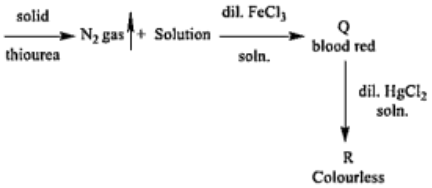

- (a) \mathrm{KNO}_{2}, \mathrm{CO}_{2},\left[\mathrm{Fe}\left(\mathrm{H}_{2} \mathrm{O}\right)_{5} \mathrm{~S}\right]^{+}, \mathrm{HgS}
- (b) \mathrm{KNO}_{2}, \mathrm{~N}_{2},\left[\mathrm{Fe}\left(\mathrm{H}_{2} \mathrm{O}\right)_{5}(\mathrm{SCN})\right]^{2+},\left[\mathrm{Hg}(\mathrm{SCN})_{4}\right]^{2-}
- (c) \mathrm{KNO}_{3}, \mathrm{~N}_{2},\left[\mathrm{Fe}\left(\mathrm{H}_{2} \mathrm{O}\right)_{5}(\mathrm{CN})\right]^{+2},\left[\mathrm{Hg}(\mathrm{OCN})_{4}\right]^{2-}
- (d) \mathrm{NaN}_{3}, \mathrm{~N}_{2},\left[\mathrm{Fe}\left(\mathrm{H}_{2} \mathrm{O}\right)_{5}(\mathrm{~N} 3)\right]^{+2},\left[\mathrm{Hg}\left(\mathrm{N}_{3}\right) 4\right]^{2-}
Show answer
Answer: (b)
Report an error in ABC26IN1143
Q14 · 2019 · 2 marks
Hydrolysis of trans-\mathrm{[CoLCl(en)_2]^+} (\mathrm{L = NO_2^-, NCS^-, OH^-, Cl^-}) results in a product (A). The tendency to form cis-isomer of the product (A) follows the order [CSIR-JUNE 2019]
- (a) \mathrm{L = NO_2^- < NCS^- < OH^- < Cl^-}
- (b) \mathrm{L = NO_2^- < Cl^- < NCS^- < OH^-}
- (d) \mathrm{L = OH^- < NCS^- < Cl^- < NO_2^-}
- (c) \mathrm{L = OH^- < Cl^- < NO_2^- < NCS^-}
Show answer
Answer: (b)
Report an error in ABC26IN0145
Q15 · 2019 · 2 marks
Donor mode of NO ligand depends on the metal. Now, consider the following complexes (in gaseous state). (A) \mathrm{[IrCl(CO)(PPh_3)_2(NO)]^+} (B) \mathrm{[RuCl(PPh_3)_2(NO)_2]^+} (C) \mathrm{[Co(NCS)(diars)_2(NO)]^+}, where diars \rightarrow o-\mathrm{(Me_2As)_2C_6H_4}. (D) \mathrm{[Cr(CN)_5(NO)]^{3-}} The complex(es) that do NOT exhibit bent NO coordination mode is/are [CSIR-JUNE 2019]
- (a) A and B
- (b) C and D
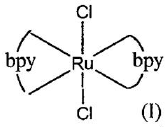
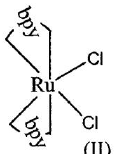
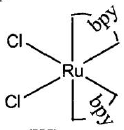
- (c) D only
- (d) B only
Show answer
Answer: (c)
Report an error in ABC26IN0146
Q16 · 2019 · 2 marks
\mathrm{FeCr_2O_4} and \mathrm{NiGa_2O_4} have normal and inverse spinel structures, respectively. The correct statement is [CSIR-DEC 2019]
- (a) Fe(II) and Ni(II) occupy octahedral sites
- (b) Fe(II) and Ni(II) occupy tetrahedral and octahedral sites, respectively
- (c) Cr(III) and Ga(III) occupy only octahedral sites
- (d) Cr(III) and Ga(III) occupy tetrahedral and octahedral sites, respectively
Show answer
Answer: (b)
Report an error in ABC26IN0149
Q17 · June 2019 · 2 marks
Self-exchange electron transfer is fastest in
- (a) \left[\mathrm{Ru}\left(\mathrm{NH}_{3}\right)_{6}\right]^{+2 /+3}
- (b) \left[\mathrm{Co}\left(\mathrm{NH}_{3}\right)_{6}\right]^{+2 /+3}
- (c) \left[\mathrm{Cr}(\mathrm{OH})_{6}\right]^{+2 /+3}
- (d) \left[\mathrm{Fe}\left(\mathrm{OH}_{2}\right)_{6}\right]^{+2 /+3}
Show answer
Answer: (a)
Report an error in ABC26IN1123
Q18 · June 2019 · 2 marks
Consider the following reaction: \mathrm{Hg}^{+2}(\mathrm{aq})+\mathrm{X}^{-}(\mathrm{aq})=[\mathrm{HgX}]^{+}(\mathrm{aq})
The stability constants for [\mathrm{HgX}]^{+}(\mathrm{aq}) for \mathrm{X}=\mathrm{F}, \mathrm{Cl} and Br follow the order - (a) \mathrm{F}<\mathrm{Cl}<\mathrm{Br}
- (b) \mathrm{Br}<\mathrm{Cl}<\mathrm{F}
- (c) \mathrm{Cl}<\mathrm{Br}<\mathrm{F}
- (d) \mathrm{Br}<\mathrm{F}<\mathrm{Cl}
Show answer
Answer: (a)
Report an error in ABC26IN1124
Q19 · June 2019 · 2 marks
Consider the following statements regarding electronic spectra of high spin complexes
- (a) \mathrm{Ti}^{+3} complexes exhibit one sharp band.
- (b) \mathrm{Co}^{+2} and \mathrm{Cr}+3 complexes exhibit two broad bands.
- (c) \mathrm{Mn}^{+2} complexes exhibit a series of very weak and sharp bands.
- (d) \mathrm{Ni}^{+2} complexes exhibit three broad bands .
Show answer
Answer: (c)
Report an error in ABC26IN1126
Q20 · June 2019 · 2 marks
Donor mode of NO ligand depends on the metal. Now, consider the following complexes (in gaseous state).
- (a) \left[\mathrm{IrCl}(\mathrm{CO})\left(\mathrm{PPh}_{3}\right)_{2}(\mathrm{NO})\right]^{+} A and B
- (b) \left[\mathrm{RuCl}\left(\mathrm{PPh}_{3}\right)_{2}(\mathrm{NO})_{2}\right]+ C and D
- (c) \left[\mathrm{Co}(\mathrm{NCS})(\text { diars })_{2}(\mathrm{NO})\right]^{+}, where diars \rightarrow \mathrm{o}-\left(\mathrm{Me}_{2} \mathrm{As}\right)_{2} \mathrm{C}_{6} \mathrm{H}_{4}. D only
- (d) \left[\mathrm{Cr}(\mathrm{CN})_{5}(\mathrm{NO})\right]^{3-} The complex (es) that do NOT exhibit bent NO coordination mode is/are B only
Show answer
Answer: (c)
Report an error in ABC26IN1128
Q21 · 2019 · 2 marks
An aqueous solution of metal ion (A) gives a blood-red colored product (B) upon reaction with KSCN. Upon dropwise addition of NaF, the complex turns to a colorless compound (C). Identify A,B and C [CSIR-JUNE 2019]
- (a) aq. \mathrm{Fe}(\mathrm{II}),\left[\mathrm{Fe}(\mathrm{SCN})\left(\mathrm{H}_{2} \mathrm{O}\right)_{5}\right]^{+}and \left[\mathrm{Fe}\left(\mathrm{H}_{2} \mathrm{O}\right)_{6}\right]^{+2}
- (b) aq. \mathrm{Fe}(\mathrm{III}),\left[\mathrm{Fe}(\mathrm{SCN})\left(\mathrm{H}_{2} \mathrm{O}\right)_{5}\right]^{+2} and \left[\mathrm{FeF}_{6}\right]^{+3}
- (c) aq. \mathrm{Fe}(\mathrm{II}),\left[\mathrm{Fe}(\mathrm{SCN})\left(\mathrm{H}_{2} \mathrm{O}\right)_{5}\right]^{+}and \mathrm{FeF}_{3}
- (d) aq. \mathrm{Fe}(\mathrm{III}),\left[\mathrm{Fe}(\mathrm{SCN})_{3}\left(\mathrm{H}_{2} \mathrm{O}\right)_{3}\right]^{+}and \mathrm{FeF}_{3}
Show answer
Answer: (b)
Report an error in ABC26IN1129
Q22 · June 2019 · 2 marks
Correct order of molar extinction coefficient values of the visible absorption bands for the following species is
- (a) \left[\mathrm{Cr}\left(\mathrm{H}_{2} \mathrm{O}\right)_{6}\right]^{+2}>\left[\mathrm{Mn}\left(\mathrm{H}_{2} \mathrm{O}\right)_{6}\right]^{+2}> Chlorophyll >\left[\mathrm{NiCl}_{4}\right]^{-2}
- (b) Chlorophyll >\left[\mathrm{NiCl}_{4}\right]^{-2}>\left[\mathrm{Cr}\left(\mathrm{H}_{2} \mathrm{O}\right)_{6}\right]^{+2}>\left[\mathrm{Mn}\left(\mathrm{H}_{2} \mathrm{O}\right)_{6}\right]^{+2}
- (c) \left[\mathrm{NiCl}_{4}\right]^{-2}> Chlorophyll >\left[\mathrm{Cr}\left(\mathrm{H}_{2} \mathrm{O}\right)_{6}\right]^{+2}>\left[\mathrm{Mn}\left(\mathrm{H}_{2} \mathrm{O}\right)_{6}\right]^{+2}
- (d) \mathrm{Chlorophyll}>\left[\mathrm{Cr}\left(\mathrm{H}_{2} \mathrm{O}\right)_{6}\right]^{+2}>[\mathrm{NiCl}]^{-2}>\left[\mathrm{Mn}\left(\mathrm{H}_{2} \mathrm{O}\right)_{6}\right]^{+2}
Show answer
Answer: (b)
Report an error in ABC26IN1130
Q23 · June 2019 · 2 marks
The correct statement about base hydrolysis of \left[\mathrm{Co}(\mathrm{py})_{4} \mathrm{Cl}_{2}\right]^{+}(py-pyridine) is
- (a) rate expression is, Rate- \mathrm{k}\left[\mathrm{Co}(\mathrm{py})_{4} \mathrm{Cl}_{2}\right]^{+}\left[\mathrm{OH}^{-}\right]
- (b) reaction does not depend on hydroxide ion concentration
- (c) reaction proceeds through \mathrm{S}_{\mathrm{N} 1} \mathrm{CB} mechanism
- (d) intermediate involved in this reaction is \left[\mathrm{Co}(\mathrm{py})_{4} \mathrm{Cl}_{2}(\mathrm{OH})\right]
Show answer
Answer: (b)
Report an error in ABC26IN1131
Q24 · June 2019 · 2 marks
\mathrm{FeCr}_{2} \mathrm{O}_{4} and \mathrm{NiGa}_{2} \mathrm{O}_{4} have normal and inverse spinel structures, respectively. The correct statement is
- (a) Fe(II) and Ni(II) occupy octahedral sites
- (b) Fe (II) and Ni(II) occupy tetrahedral and octahedral sites, respectively
- (c) Cr(III) and Ga(III) occupy only octahedral sites
- (d) Cr(III) and Ga(III) occupy tetrahedral and octahedral sites, respectively
Show answer
Answer: (b)
Report an error in ABC26IN1132
Q25 · June 2019 · 2 marks
The correct match of spin-only magnetic moment for the complexes cis- \left[\mathrm{Fe}(\mathrm{phen})_{2}(\mathrm{NCS}-\mathrm{N})_{2}\right]
- (a) and \left[\mathrm{Fe}(\text { phen })_{3}\right] \mathrm{Cl}_{2}(\mathrm{~B}) at 300 K is (phen =1,10-phenantholine) 4.89 BM for both A and B
- (b) 0 BM for both A and B
- (c) 4.89 BM for A and 0 BM for B
- (d) 0 BM for A and 4:59 BM for B 20
Show answer
Answer: (c)
Report an error in ABC26IN1133
Q26 · June 2019 · 2 marks
In the electronic spectrum of \left[\mathrm{IrBr}_{6}\right]^{2-}, the number of charge transfer band(s) and their origin are respectively
- (a) Two ligand \rightarrow metal \left(\sigma \rightarrow \mathrm{t}_{2 \mathrm{~g}}\right. and \left.\sigma \rightarrow \mathrm{a}_{1 \mathrm{~g}}{ }^{*}\right)
- (b) One ligand → metal \left(\sigma \rightarrow \mathrm{e}_{\mathrm{g}}\right)
- (c) Two ligand → metal \left(\sigma \rightarrow \mathrm{t}_{2 \mathrm{~g}}\right. and \left.\sigma \rightarrow \mathrm{e}_{\mathrm{g}}\right)
- (d) One ligand → metal \left(\sigma \rightarrow \mathrm{t}_{2 \mathrm{~g}}\right)
Show answer
Answer: (c)
Report an error in ABC26IN1134
Q27 · June 2019 · 2 marks
The number of geometrical isomers of the complex \left[\mathrm{RhH}(\mathrm{C} \equiv \mathrm{CR})_{2}\left(\mathrm{PMe}_{3}\right)_{3}\right] is
Show answer
Answer: (b)
Report an error in ABC26IN1136
Q28 · June 2019 · 2 marks
The calculated heat of formation \left(\Delta \mathrm{H}_{\mathrm{f}}\right) for \mathrm{NaCl}_{2} and CaF is
- (a) negative for both \mathrm{NaCl}_{2} and CaF
- (b) negative for \mathrm{NaCl}_{2} but positive for CaF
- (c) positive for \mathrm{NaCl}_{2} but negative for CaF
- (d) positive for both \mathrm{NaCl}_{2} and CaF
Show answer
Answer: (c)
Report an error in ABC26IN1145
Q29 · 2018 · 2 marks
Consider the following reaction: \mathrm{Hg^{+2}(aq) + X^{-}(aq) = [HgX]^{+}(aq)}
The stability constants for [\mathrm{HgX}]^{+}(\mathrm{aq}) for X = F, Cl and Br follow the order [CSIR-JUNE 2019] - (a) F < Cl < Br
- (b) Br < Cl < F
- (c) Cl < Br < F
- (d) Br < F < Cl
Show answer
Answer: (a)
Report an error in ABC26IN0142
Q30 · June 2018 · 2 marks
The total degeneracy of the ground term of \mathrm{Co^{II}} (high spin) in octahedral geometry is
- (a) 18
- (b) 12
- (c) 28
- (d) 9
Show answer
Answer: (c)
Report an error in ABC26IN1109
Q31 · June 2018 · 2 marks
The lowest energy state of a 1 \mathrm{~s}^{1} 2 \mathrm{~s}^{1} electronic configuration, according to hund's rule, is
- (a) { }^{3} \mathrm{~S}_{0}
- (b) { }^{1} \mathrm{~S}_{0}
- (c) { }^{3} \mathrm{~S}_{1}
- (d) { }^{1} \mathrm{~S}_{1}
Show answer
Answer: (c)
Report an error in ABC26IN1112
Q32 · June 2018 · 2 marks
Consider the following statements:
- (a) \mathrm{Cr}^{+2} is easier to oxidize than \mathrm{V}^{+2} in the gas phase
- (b) \mathrm{Cr}^{+2}(\mathrm{aq}) is a more powerful reducing agent than \mathrm{V}^{+2}(\mathrm{aq}).
- (c) The rate of water exchange for \mathrm{Cr}^{+2}(\mathrm{aq}) is much faster than for \mathrm{V}^{+2}(\mathrm{aq})
Show answer
Answer: (c)
Report an error in ABC26IN1113
Q33 · June 2018 · 2 marks
The allowed electronic transition in fluorine molecule is
- (a) \sum_{\mathrm{g}}^{+} \rightarrow \sum_{\mathrm{g}}^{+}
- (b) \sum_{\mathrm{g}}^{+} \rightarrow \sum_{\mathrm{g}}^{+}
- (c) \sum_{\mathrm{g}}^{+} \rightarrow \pi_{\mathrm{u}}
- (d) \sum_{\mathrm{g}}^{+} \rightarrow \Delta_{\mathrm{u}}
Show answer
Answer: (c)
Report an error in ABC26IN1115
Q34 · 2018 · 2 marks
Consider the species \mathrm{NO}, \mathrm{I}_{2}, \mathrm{I}_{2}^{-}, \mathrm{Cu}^{+2} and \mathrm{VO}^{+2}. The number of paramagnetic species among them and the EPR inactive species, respectively, are
- (a) 4 and \mathrm{I}_{2}{ }^{-}
- (b) 4 and \mathrm{I}_{2}
- (c) 3 and \mathrm{VO}^{+2}, \mathrm{Cu}^{+2}
- (d) 3 and \mathrm{NO}, \mathrm{Cu}^{+2}
Show answer
Answer: (b)
Report an error in ABC26IN1116
Q35 · 2018 · 2 marks
The correct set of electronic configurations for metal ions in octahedral coordination geometry for strong Jahn-Teller distortion is
- (a) \mathrm{t}^{6}{ }_{2 \mathrm{~g}} \mathrm{e}^{1}{ }_{\mathrm{g}}, \mathrm{t}^{3}{ }_{2 \mathrm{~g}} \mathrm{e}^{1}{ }_{\mathrm{g}}, \mathrm{t}^{6}{ }_{2 \mathrm{~g}} \mathrm{e}^{3}{ }_{\mathrm{g}}
- (b) \mathrm{t}^{1}{ }_{2 \mathrm{~g}}, \mathrm{t}^{3}{ }_{2 \mathrm{~g}} \mathrm{e}^{2}{ }_{\mathrm{g}}, \mathrm{t}^{6}{ }_{2 \mathrm{~g}} \mathrm{e}^{1}{ }_{\mathrm{g}}
- (c) \mathrm{t}^{3}{ }_{2 \mathrm{~g}}, \mathrm{t}^{3}{ }_{2 \mathrm{~g}} \mathrm{e}^{1}{ }_{\mathrm{g}}, \mathrm{t}^{3}{ }_{2 \mathrm{~g}} \mathrm{e}^{2}{ }_{\mathrm{g}}
- (d) \mathrm{t}^{3}{ }_{2 \mathrm{~g}} \mathrm{e}^{2}{ }_{\mathrm{g}}, \mathrm{t}^{6}{ }_{2 \mathrm{~g}} \mathrm{e}^{2}{ }_{\mathrm{g}}, \mathrm{t}^{6}{ }_{2 \mathrm{~g}} \mathrm{e}^{3}{ }_{\mathrm{g}}
Show answer
Answer: (a)
Report an error in ABC26IN1119
Q36 · 2018 · 2 marks
Consider the two sets of molecules. Set A: \left[\mathrm{AIF}_{6}\right]^{-3},\left[\mathrm{PF}_{6}\right]^{-},\left[\mathrm{SF}_{6}\right] and \left[\mathrm{SiF}_{6}\right]^{-2} Set \mathrm{B}:\left[\mathrm{Ba}\left(\mathrm{H}_{2} \mathrm{O}\right)_{6}\right]^{+2},\left[\mathrm{Ca}\left(\mathrm{H}_{2} \mathrm{O}\right)_{6}\right]^{+2},\left[\mathrm{Mg}\left(\mathrm{H}_{2} \mathrm{O}\right)_{6}\right]^{+2},\left[\mathrm{Sr}\left(\mathrm{H}_{2} \mathrm{O}\right)_{6}\right]^{+2} The slowest ligand exchange rate in Set A and Set B are, respectively [CSIR-DEC 2018]
- (a) \left[\mathrm{AIF}_{6}\right]^{-3} and \left[\mathrm{Sr}\left(\mathrm{H}_{2} \mathrm{O}\right)_{6}\right]^{+2}
- (c) \left[\mathrm{SiF}_{6}\right]^{-2} and \left[\mathrm{Ca}\left(\mathrm{H}_{2} \mathrm{O}\right)_{6}\right]^{+2}
- (b) \left[\mathrm{SF}_{6}\right] and \left[\mathrm{Mg}\left(\mathrm{H}_{2} \mathrm{O}\right)_{6}\right]^{+2}
- (d) \left[\mathrm{PF}_{6}\right]^{-}and \left[\mathrm{Ca}\left(\mathrm{H}_{2} \mathrm{O}\right)_{6}\right]^{+2}
Show answer
Answer: (b)
Report an error in ABC26IN1122
Q37 · 2017 · 2 marks
The geometry around Cu and its spin state for \mathrm{K_3CuF_6} and \mathrm{KCuL_2}, [\mathrm{H_2L = H_2NCONHCONH_2}], respectively are: [CSIR-DEC 2017]
- (a) (octahedral, high-spin) and (square planar, low-spin)
- (b) (octahedral, low-spin) and (square planar, low-spin)
- (c) (trigonal prismatic, high-spin) and (tetrahedral, high-spin)
- (d) (trigonal prismatic, low-spin) and (tetrahedral, high-spin)
Show answer
Answer: (a)
Report an error in ABC26IN0128
Q38 · 2017 · 2 marks
For high spin and low spin d^{6} octahedral complexes (\mathrm{ML_6}), the generally observed spin allowed transitions respectively, are [CSIR-DEC 2017]
- (a) two and one
- (b) one and two
- (c) zero and one
- (d) two and two
Show answer
Answer: (b)
Report an error in ABC26IN0130
Q39 · 2017 · 2 marks
\mathrm{Br_2} with propanone forms a charge transfer complex and \mathrm{I_2} forms triiodide anion with \mathrm{I^-}. This implies that [CSIR-DEC 2017]
- (a) both \mathrm{Br_2} and \mathrm{I_2} act as bases
- (b) both \mathrm{Br_2} and \mathrm{I_2} act as acids
- (c) \mathrm{Br_2} acts as an acid and \mathrm{I_2} acts as a base
- (d) \mathrm{Br_2} acts as a base and \mathrm{I_2} acts an an acid
Show answer
Answer: (b)
Report an error in ABC26IN0131
Q40 · 2016 · 2 marks
\mathrm{CdS}, \mathrm{HgS} and BiI 3 are coloured due to
- (a) L→M charge transfer transitions
- (b) d → d electronic transitions
- (c) M→L charge transfer transitions
- (d) combination of \mathrm{L} \rightarrow \mathrm{M} charge transfer and \mathrm{d} \rightarrow \mathrm{d} electronic transitions
Show answer
Answer: (a)
Report an error in ABC26IN1096
Q41 · June 2017 · 2 marks
The relative rates of water exchange for the hydrated complexes of (1) \mathrm{Ni}^{+2} (2) \mathrm{V}^{+2} and (3) \mathrm{Cr}^{3}+ ions follows the trend:
- (a) (1)>(2)>(3)
- (b) (1)<(2)<(3)
- (c) (1)>(2)<(3)
- (d) (1)<(2)>(3)
Show answer
Answer: (a)
Report an error in ABC26IN1097
Q42 · 2017 · 2 marks
For the following complexes, the increasing order of magnetic moment (spin only value) is
A. [\mathrm{TiF}_6]^{-3}
B. [\mathrm{CrF}_6]^{-3}
C. [\mathrm{MnF}_6]^{-3}
D. [\mathrm{CoF}_6]^{-3}
- (a) D < A < B < C
- (b) C < A < D < B
- (c) B \approx A < D < C
- (d) A < B < C \approx D
Show answer
Answer: (d)
Report an error in ABC26IN1102
Q43 · Dec 2017 · 2 marks
The geometry around Cu and its spin state for \mathrm{K}_{3} \mathrm{CuF}_{6} and \mathrm{KCuL}_{2}, \left[\mathrm{H}_{2} \mathrm{~L}=\mathrm{H}_{2} \mathrm{NCONHCONH}_{2}\right], respectively are:
- (a) (octahedral, high-spin) and (square planar, low-spin)
- (b) (octahedral, low-spin) and (square planar, low-spin)
- (c) (trigonal prismatic, high-spin) and (tetrahedral, high-spin)
- (d) (trigonal prismatic, low-spin) and (tetrahedral, high-spin)
Show answer
Answer: (a)
Report an error in ABC26IN1103
Q44 · 2017 · 2 marks
Consider the following statements with respect to the base hydrolysis of \left[\mathrm{CoCl}\left(\mathrm{NH}_{3}\right)_{5}\right] to \left[\mathrm{Co}\left(\mathrm{NH}_{3}\right)_{5}(\mathrm{OH})\right]^{+2}
- (a) One of the ammonia ligands acts as a Bronsted acid.
- (b) The entering group is water.
- (c) A heptacoordinated \mathrm{Co}^{+3} species is an intermediate.
Show answer
Answer: (a)
Report an error in ABC26IN1104
Q45 · 2016 · 2 marks
The number of microstates present in ^{3}\mathrm{F}-term is [CSIR-JUNE 2016]
- (a) 3
- (b) 21
- (c) 9
- (d) 28
Show answer
Answer: (b)
Report an error in ABC26IN0117
Q46 · 2016 · 2 marks
The lowest energy term for the d^{6} configuration is [CSIR-JUNE 2016]
- (a) {}^{2}\mathrm{D}
- (b) {}^{5}\mathrm{D}
- (c) {}^{1}\mathrm{P}
- (d) {}^{1}\mathrm{D}
Show answer
Answer: (b)
Report an error in ABC26IN0118
Q47 · 2016 · 2 marks
The first excited state of hydrogen molecule is [CSIR-JUNE 2016]
- (a) {}^1\Sigma_g^+
- (b) {}^1\Sigma_u^+
- (c) {}^3\Sigma_g^-
- (d) {}^3\Sigma_u^+
Show answer
Answer: (d)
Report an error in ABC26IN0119
Q48 · 2016 · 2 marks
Complex [\mathrm{Cr}(\mathrm{bipyridyl})_3]^{+3}, shows red phosphorescence due to transition [CSIR-JUNE 2016]
- (a) ^{4}\mathrm{T}_{2\mathrm{g}} \leftarrow {}^{4}\mathrm{A}_{2\mathrm{g}}
- (b) ^{4}\mathrm{T}_{1\mathrm{g}} \leftarrow {}^{4}\mathrm{A}_{2\mathrm{g}}
- (c) ^{4}\mathrm{A}_{2\mathrm{g}} \leftarrow {}^{2}\mathrm{E}_{\mathrm{g}}
- (d) ^{2}\mathrm{E}_{\mathrm{g}} \leftarrow {}^{4}\mathrm{A}_{2\mathrm{g}}
Show answer
Answer: (c)
Report an error in ABC26IN0120
Q49 · 2016 · 2 marks
Paramagnetic susceptibility of the order of 10^{-6}\ \mathrm{cm^3\,mol^{-1}} observed for \mathrm{KMnO_4} is due to- [CSIR-JUNE 2016]
- (a) random spin alignment
- (c) paramagnetic impurity
- (b) antiferromagnetic exchange interaction
- (d) temperature independent paramagnetism
Show answer
Answer: (d)
Report an error in ABC26IN0121
Q50 · 2016 · 2 marks
The nephelauxetic parameter \beta is highest for [CSIR-DEC 2016]
- (a) \mathrm{Br}^{-}
- (b) \mathrm{Cl}^{-}
- (c) \mathrm{CN}^{-}
- (d) \mathrm{F}^{-}
Show answer
Answer: (d)
Report an error in ABC26IN0122
Q51 · 2016 · 2 marks
The {}^{2}\mathrm{E}_{g} \leftarrow {}^{4}\mathrm{A}_{2g} transition in the electronic spectrum of \mathrm{[Cr(NH_3)_6]^{+3}} occurs nearly at [CSIR-DEC 2016]
- (a) 650 nm
- (b) 450 nm
- (c) 350 nm
- (d) 200 nm
Show answer
Answer: (a)
Report an error in ABC26IN0123
Q52 · 2016 · 2 marks
The correct statement for a Fischer carbene complex is [CSIR-DEC 2016]
- (a) the carbene carbon is electrophilic in nature
- (b) metal exists in high oxidation state
- (c) metal fragment and carbene are in the triplet states
- (d) CO ligands destabilize the complex
Show answer
Answer: (a)
Report an error in ABC26IN0124
Q53 · 2016 · 2 marks
The highest molecular orbitals for an excited electronic configuration of the oxygen molecule are [1\pi_g]^1\,[3\sigma_u]^1. A possible molecular term symbol for oxygen with this electronic configuration is [CSIR-DEC 2016]
- (a) {}^{1}\pi
- (b) {}^{3}\Sigma
- (c) {}^{1}\Delta
- (d) {}^{1}\Sigma
Show answer
Answer: (a)
Report an error in ABC26IN0125
Q54 · 2016 · 2 marks
The relative rates of water exchange for the hydrated complexes of (1) \mathrm{Ni}^{+2} (2) \mathrm{V}^{+2} and (3) \mathrm{Cr}^{3+} ions follows the trend: [CSIR-JUNE 2017]
- (a) (1) > (2) > (3)
- (b) (1) < (2) < (3)
- (c) (1) > (2) < (3)
- (d) (1) < (2) > (3)
Show answer
Answer: (a)
Report an error in ABC26IN0126
Q55 · June 2016 · 2 marks
The number of microstates present in { }^{3} \mathrm{~F}-term is
- (a) 3
- (b) 21
- (c) 9
- (d) 28
Show answer
Answer: (b)
Report an error in ABC26IN1077
Q56 · 2016 · 2 marks
Chelate effect is [CSIR-JUNE 2016]
- (a) predominantly due to enthalpy change
- (b) predominantly due to entropy change
- (c) independent of ring size
- (d) due to equal contribution of entropy and enthalpy change
Show answer
Answer: (b)
Report an error in ABC26IN1078
Q57 · June 2016 · 2 marks
The lowest energy term for the \mathrm{d}^{6} configuration is
- (a) { }^{2} \mathrm{D}
- (b) { }^{5} \mathrm{D}
- (c) { }^{1} \mathrm{P}
- (d) { }^{1} \mathrm{D}
Show answer
Answer: (b)
Report an error in ABC26IN1079
Q58 · June 2016 · 2 marks
The first excited state of hydrogen molecule is
- (a) { }^{1} \sum_{\mathrm{g}}^{+}
- (b) { }^{1} \sum_{u}^{+}
- (c) { }^{3} \sum_{\mathrm{g}}^{-}
- (d) { }^{3} \sum_{u}^{+}
Show answer
Answer: (d)
Report an error in ABC26IN1080
Q59 · June 2016 · 2 marks
Complex \left[\mathrm{Cr}(\text { bipyridyl })_{3}\right]^{+3}, shows red phosphorescence due to transition
- (a) { }^{4} \mathrm{~T}_{2 \mathrm{~g}} \leftarrow{ }^{4} \mathrm{~A}_{2 \mathrm{~g}}
- (b) { }^{4} \mathrm{~T}_{1 \mathrm{~g}} \leftarrow{ }^{4} \mathrm{~A}_{2 \mathrm{~g}}
- (c) { }^{4} \mathrm{~A}_{2 \mathrm{~g}} \leftarrow{ }^{2} \mathrm{Eg}
- (d) { }^{2} \mathrm{Eg} \leftarrow{ }^{4} \mathrm{~A} 2 \mathrm{~g}
Show answer
Answer: (c)
Report an error in ABC26IN1081
Q60 · 2016 · 2 marks
The complex that shows orbital contribution to the magnetic moment, is
- (a) \left[\mathrm{Cu}\left(\mathrm{H}_{2} \mathrm{O}\right)_{6}\right]^{+2}
- (b) \left[\mathrm{Ni}\left(\mathrm{H}_{2} \mathrm{O}\right)_{6}\right]^{+2}
- (c) \left[\mathrm{Co}\left(\mathrm{H}_{2} \mathrm{O}\right)_{6}\right]^{+2}
- (d) \left[\mathrm{Cr}\left(\mathrm{H}_{2} \mathrm{O}\right)_{6}\right]^{+2}
Show answer
Answer: (c)
Report an error in ABC26IN1082
Q61 · 2016 · 2 marks
The room temperature magnetic moment ( in BM) for a monomeric Cu(II) complex is greater than 1.73 . This may be explained using the expression: [CSIR-JUNE 2016]
- (a) \boldsymbol{\mu}_{\text {eff }}=\boldsymbol{\mu}_{\mathrm{s}}\left(\mathbf{1}-\frac{\lambda \alpha}{\Delta}\right)
- (b) \mu_{\text {eff }}=\sqrt{n(n+2)}
- (c) \mu_{\text {eff }}=\sqrt{4 s(s+1)+L(L+1)}
- (d) \mu_{\mathrm{eff}}=\mathrm{g} \sqrt{J(J+1)}
Show answer
Answer: (a)
Report an error in ABC26IN1084
Q62 · 2016 · 2 marks
The HOMO (highest occupied molecular orbital) to LUMO (lowest unoccupied molecular orbital) electronic transition responsible for the observed colours of halogen molecules (gas) is
- (a) \pi^{*} \rightarrow \sigma^{*} \mathrm{NO}_{2}^{-}
- (b) \pi^{*} \rightarrow \pi^{*} \mathrm{NCS}^{-}
- (c) \sigma \rightarrow \sigma^{*} \mathrm{Cl}^{-}
- (d) \pi \rightarrow \sigma^{*} 13 product is the least, when A is \mathrm{OH}^{-}
Show answer
Answer: (a)
Report an error in ABC26IN1085
Q63 · 2016 · 2 marks
In the hydrolysis of trans-[\mathrm{Co}(\mathrm{en})_{2}\mathrm{Cl}(\mathrm{A})]^{+} if the leaving group is chloride, the formation of cis product is the least, when A is
- (a) \mathrm{NO}_{2}^{-}
- (b) \mathrm{NCS}^{-}
- (c) \mathrm{Cl}^{-}
- (d) \mathrm{OH}^{-}
Show answer
Answer: (a)
Report an error in ABC26IN1086
Q64 · Dec 2016 · 2 marks
The nephelauxetic parameter \beta is highest for
- (a) \mathrm{Br}^{-}
- (b) \mathrm{Cl}^{-}
- (c) \mathrm{CN}^{-}
- (d) \mathrm{F}^{-}
Show answer
Answer: (d)
Report an error in ABC26IN1087
Q65 · Dec 2016 · 2 marks
The { }^{2} \mathrm{Eg}_{\mathrm{g}} \leftarrow^{4} \mathrm{~A}_{2 \mathrm{~g}} transition in the electronic spectrum of \left[\mathrm{Cr}\left(\mathrm{NH}_{3}\right)_{6}\right]^{+3} occurs nearly at
- (a) 650 nm
- (b) 450 nm
- (c) 350 nm
- (d) 200 nm
Show answer
Answer: (a)
Report an error in ABC26IN1088
Q66 · 2016 · 2 marks
For \left[\mathrm{Ce}\left(\mathrm{NO}_{3}\right)_{4}\left(\mathrm{OPPh}_{3}\right)_{2}\right] from the following
- (a) Its aqueous solution yellow-orange in
- (b) Coordination number of Ce is ten
- (c) It shows metal to ligand charge transfer
- (d) It is diamagnetic in nature
Show answer
Answer: (c)
Report an error in ABC26IN1089
Q67 · 2016 · 2 marks
Consider the following statements for \left[\mathrm{FeO}_{4}\right]^{-4}
- (a) It is paramagnetic
- (b) It has \mathrm{T}_{\mathrm{d}} symmetry
- (c) Adopts distorted square planar geometry
- (d) Shows approximately \mathrm{D}_{2 \mathrm{~d}} symmetry
Show answer
Answer: (c)
Report an error in ABC26IN1090
Q68 · 2016 · 2 marks
The spectroscopic ground state term symbols for the octahedral aqua complexes of \mathrm{Mn}(\mathrm{II}), Cr(III) and Cu(II), respectively, are
- (a) { }^{2} \mathrm{H},{ }^{4} \mathrm{~F} and { }^{2} \mathrm{D}
- (b) { }^{6} \mathrm{~S},{ }^{4} \mathrm{~F} and { }^{2} \mathrm{D}
- (c) { }^{2} \mathrm{H},{ }^{2} \mathrm{H} and { }^{2} \mathrm{D}
- (d) { }^{6} \mathrm{~S},{ }^{4} \mathrm{~F} and { }^{2} \mathrm{P}
Show answer
Answer: (b)
Report an error in ABC26IN1091
Q69 · 2016 · 2 marks
In the following redox reaction with an equilibrium constant \mathrm{K}=2.0 \times 10^{8} \left[\mathrm{Ru}\left(\mathrm{NH}_{3}\right)_{6}\right]^{+2}+\left[\mathrm{Fe}\left(\mathrm{H}_{2} \mathrm{O}_{6}\right)\right]^{+3} \rightarrow\left[\mathrm{Ru}\left(\mathrm{NH}_{3}\right)_{6}\right]^{+3}+\left[\mathrm{Fe}\left(\mathrm{H}_{2} \mathrm{O}\right)_{6}\right]^{+2} the self exchange rates for oxidant and reductant are 5.0 \mathrm{M}^{-1} \mathrm{~s}^{-1} and 4.0 \times 10^{3} \mathrm{M}^{-1} \mathrm{~s}^{-1} respectively. The approximate rate constant \left(\mathrm{M}^{-1} \mathrm{~s}^{-1}\right) for the reaction is
- (a) 3.16 \times 10^{6}
- (b) 2.0 \times 10^{6}
- (c) 6.32 \times 10^{6}
- (d) 3.16 \times 10^{6}
Show answer
Answer: (b)
Report an error in ABC26IN1093
Q70 · Dec 2016 · 2 marks
The correct statement for a Fischer carbene complex is
- (a) the carbene carbon is electrophilic in nature
- (b) metal exists in high oxidation state
- (c) metal fragment and carbene are in the triplet states
- (d) CO ligands destabilize the complex 14
Show answer
Answer: (a)
Report an error in ABC26IN1094
Q71 · Dec 2016 · 2 marks
The highest molecular orbitals for an excited electronic configuration of the oxygen molecule are [1 \pi \mathrm{~g}]^{1}[3 \sigma \mathrm{u}]^{1}. A possible molecular term symbol for oxygen with this electronic configuration is
- (a) { }^{1} \pi
- (b) { }^{3} \Sigma
- (c) { }^{1} \Delta
- (d) { }^{1} \Sigma
Show answer
Answer: (a)
Report an error in ABC26IN1095
Q72 · 2015 · 2 marks
The formation constant for the complexation of \mathrm{M}^{+} (M = Li, Na, K and Cs) with cryptand, C222 follows the order [CSIR-DEC 2015]
- (a) \mathrm{Li^+ < Cs^+ < Na^+ < K^+}
- (b) \mathrm{Li^+ < Na^+ < K^+ < Cs^+}
- (c) \mathrm{K^+ < Cs^+ < Li^+ < Na^+}
- (d) \mathrm{Cs^+ < K^+ < Li^+ < Na^+}
Show answer
Answer: (a)
Report an error in ABC26IN0113
Q73 · June 2015 · 2 marks
In transition metal phosphine \left(\mathrm{M}-\mathrm{PR}_{3}\right) complexes, the back-bonding involves donation of electrons from
- (a) \mathrm{M}\left(\mathrm{t}_{2 \mathrm{~g}}\right) \rightarrow \mathrm{PR}_{3}\left(\sigma^{*}\right)
- (b) \mathrm{M}\left(\mathrm{t}_{2 \mathrm{~g}}\right) \rightarrow \mathrm{PR}_{3}\left(\pi^{*}\right)
- (c) \mathrm{M}\left(\mathrm{e}_{\mathrm{g}}\right) \rightarrow \mathrm{P}(\mathrm{d})
- (d) \mathrm{PR}_{3}(\pi) \rightarrow \mathrm{M}\left(\mathrm{t}_{2 \mathrm{~g}}\right)
Show answer
Answer: (a)
Report an error in ABC26IN1057
Q74 · 2015 · 2 marks
Among the complexes, (\mathrm{A}) \mathrm{K}_{4}\left[\mathrm{Cr}(\mathrm{CN})_{6}\right], \mathrm{K}_{4}\left[\mathrm{Fe}(\mathrm{CN})_{6}\right], (\mathrm{C}) \mathrm{K}_{3}\left[\mathrm{Co}(\mathrm{CN})_{6}\right], (\mathrm{D}) \mathrm{K}_{4}\left[\mathrm{Mn}(\mathrm{CN})_{6}\right], and \mathrm{Jahn}- Teller distortion is expected in
- (a) A, B and C
- (b) B, C and D
- (c) A and D
- (d) B and C
Show answer
Answer: (c)
Report an error in ABC26IN1061
Q75 · June 2015 · 2 marks
The complex \left[\mathrm{Fe}(\text { phen })_{2}(\mathrm{NCS})_{2}\right] (phen 1,10-phenanthroline) shows spin cross-over behaviour CFSE and at \mu_{\text {eff }} 250 and 150 K , respectively are
- (a) 0.4 \Delta_{0}, 4.90 \mathrm{BM} and 2.4 \Delta, 0.00 \mathrm{BM}
- (b) 2.4 \Delta_{0}, 2.90 \mathrm{BM} and 0.4 \Delta, 1.77 \mathrm{BM}
- (c) 2.4 \Delta_{0}, 0.00 \mathrm{BM} and 0.4 \Delta, 4.90 \mathrm{BM}
- (d) 1.2 \Delta_{0}, 4.90 \mathrm{BM} and 2.4 \Delta .0 .00 \mathrm{BM}
Show answer
Answer: (a)
Report an error in ABC26IN1062
Q76 · 2015 · 2 marks
The oxidizing power of \left[\mathrm{CrO}_{4}\right]^{2-},\left[\mathrm{MnO}_{4}\right]^{2-} and \left[\mathrm{FeO}_{4}\right]^{2-} follows the order
- (a) \left[\mathrm{CrO}_{4}\right]^{2-}<\left[\mathrm{MnO}_{4}\right]^{2-}<\left[\mathrm{FeO}_{4}\right]^{2-}
- (b) \left[\mathrm{FeO}_{4}\right]^{2-}<\left[\mathrm{MnO}_{4}\right]^{2-}<\left[\mathrm{CrO}_{4}\right]^{2-}
- (c) \left[\mathrm{MnO}_{4}\right]^{2-}<\left[\mathrm{FeO}_{4}\right]^{2-}<\left[\mathrm{CrO}_{4}\right]^{2-}
- (d) \left[\mathrm{CrO}_{4}\right]^{2-}<\left[\mathrm{FeO}_{4}\right]^{2-}<\left[\mathrm{MnO}_{4}\right]^{2-}
Show answer
Answer: (a)
Report an error in ABC26IN1064
Q77 · 2015 · 2 marks
Using crystal field theory, identify from the following complex ions that shows same \mu_{\text {eff }} (spin only) values
- (a) \left[\mathrm{CoF}_{6}\right]^{3-} A and B
- (b) \left[\mathrm{IrCl}_{6}\right]^{3-} B and C
- (c) \left[\mathrm{Fe}\left(\mathrm{H}_{2} \mathrm{O}\right)_{6}\right]^{2+} [CSIR-DEC 2015] A and C
- (d) A, B and C
Show answer
Answer: (c)
Report an error in ABC26IN1065
Q78 · 2015 · 2 marks
The correct statement for \mathrm{Mn}-\mathrm{O} bond lengths in \left[\mathrm{Mn}\left(\mathrm{H}_{2} \mathrm{O}\right)_{6}\right]^{2+}, is [CSIR-DEC 2015]
- (a) all bonds are equal
- (b) four bonds are longer than two others
- (c) two bonds are longer than four others
- (d) they are shorter than the \mathrm{Mn}-\mathrm{O} bond in \left[\mathrm{MnO}_{4}\right]^{-}
Show answer
Answer: (a)
Report an error in ABC26IN1066
Q79 · 2015 · 2 marks
Identify the complex ions in sequential order when ferroin is used as an indicator in the titration of iron(II) with potassium dichromate, (phen = 1, 10-phenathroline)
- (a) \left[\mathrm{Fe}(\text { phen })_{3}\right]^{2+} and \left[\mathrm{Fe}(\text { phen })_{3}\right]^{3+}
- (b) \left[\mathrm{Fe}(\mathrm{phen})_{3}\right]^{3+} and \left[\mathrm{Fe}(\mathrm{phen})_{3}\right]^{2+}
- (c) \left[\mathrm{Fe}(\mathrm{CN})_{6}\right]^{4-} and \left[\mathrm{Fe}(\mathrm{CN})_{6}\right]^{3-}
- (d) \left[\mathrm{Fe}(\mathrm{CN})_{6}\right]^{3-} and \left[\mathrm{Fe}(\mathrm{CN})_{6}\right]^{4-}
Show answer
Answer: (a)
Report an error in ABC26IN1067
Q80 · 2015 · 2 marks
The correct statement about the substitution reaction of \left[\mathrm{Co}(\mathrm{CN}){ }_{5} \mathrm{Cl}\right]^{3-} with OH - to give \left[\mathrm{Co}(\mathrm{CN})_{5}(\mathrm{OH})\right]^{3-} is,
- (a) it obeys first order kinetics
- (b) its rate is proportional to the concentration of both the reactants
- (c) it follows the \mathrm{SN}^{1}{ }_{\mathrm{CB}} mechanism
- (d) its rate is dependent only on the concentration of [\mathrm{OH}]^{-}
Show answer
Answer: (a)
Report an error in ABC26IN1070
Q81 · 2015 · 2 marks
Aqueous \mathrm{Cr}^{+2} effects one electron reduction of \left[\mathrm{Co}\left(\mathrm{NH}_{3}\right)_{5} \mathrm{Cl}\right]^{+2} giving compound Y . Compound Y undergoes rapid hydrolysis. Y is,
- (a) \left[\mathrm{Co}\left(\mathrm{NH}_{3}\right)_{5}\right]^{+2}
- (b) \left[\mathrm{Co}\left(\mathrm{NH}_{3}\right)_{5}(\mathrm{OH})\right]^{+}
- (c) \left[\mathrm{Co}\left(\mathrm{NH}_{3}\right)_{4}(\mathrm{OH})_{2}\right]
- (d) \left[\mathrm{Cr}\left(\mathrm{H}_{2} \mathrm{O}\right)_{5} \mathrm{Cl}\right]^{+2}
Show answer
Answer: (a)
Report an error in ABC26IN1071
Q82 · 2015 · 2 marks
Three electronic transitions at 14900,22700 and 34400 \mathrm{~cm}^{-1} are observed in the absorption spectrum of \left[\mathrm{CrF}_{6}\right]^{-3}, The \Delta 0 value (in \mathrm{cm}^{-1} ) and the corresponding transition are
- (a) 7800 and { }^{4} \mathrm{~A}_{2 \mathrm{~g}} \rightarrow{ }^{4} \mathrm{~T}_{2} \mathrm{~g}
- (b) 14900 and { }^{4} \mathrm{~A}_{2 \mathrm{~g}} \rightarrow{ }^{4} \mathrm{~T}_{2} \mathrm{~g}
- (c) 14900 and { }^{4} \mathrm{~T}_{1} \mathrm{~g} \rightarrow{ }^{4} \mathrm{~T}_{1} \mathrm{~g}(\mathrm{~F})
- (d) 7800 and { }^{4} \mathrm{~T}_{2 \mathrm{~g}} \rightarrow{ }^{3} \mathrm{~T}_{1 \mathrm{~g}}(\mathrm{~F})
Show answer
Answer: (b)
Report an error in ABC26IN1073
Q83 · 2014 · 2 marks
Reaction of nitrosyl tetrafluoroborate to Vaska's complex gives complex A with angle \mathrm{M-N-O}=124^{\circ}. The complex A and its \mathrm{N-O} stretching frequency are, respectively [CSIR-JUNE 2014]
- (a) [\mathrm{IrCl(CO)(NO)(PPh_3)_2}]\mathrm{BF_4},\ 1620\ \mathrm{cm}^{-1}
- (b) [\mathrm{IrCl(CO)(NO)_2(PPh_3)}](\mathrm{BF_4})_2,\ 1730\ \mathrm{cm}^{-1}
- (c) [\mathrm{IrCl(CO)(NO)_2(PPh_3)}](\mathrm{BF_4})_2\ 1520\ \mathrm{cm}^{-1}
- (d) [\mathrm{IrCl(CO)(NO)(PPh_3)_2}],\ 1820\ \mathrm{cm}^{-1}
Show answer
Answer: (a)
Report an error in ABC26IN0103
Q84 · 2014 · 2 marks
An aqueous solution of \mathrm{[Mn(H_2O)_6]^{+2}} complex is pale pink in colour. The probable reasons for it are [CSIR-DEC 2014] (A) Presence of {}^{6}\mathrm{A_{1}g} ground state (B) Disallowed transition by spin selection rule (C) Presence of {}^{2}\mathrm{T_{2}g} ground state (D) Charge transfer transition. The correct answer is
- (a) A and B
- (b) A and C
- (c) B and C
- (d) C and D
Show answer
Answer: (a)
Report an error in ABC26IN0105
Q85 · 2014 · 2 marks
In transition metal phosphine (\mathrm{M{-}PR_3}) complexes, the back-bonding involves donation of electrons from [CSIR-JUNE 2015]
- (a) \mathrm{M}(t_{2g}) \rightarrow \mathrm{PR_3}(\sigma^*)
- (b) \mathrm{M}(t_{2g}) \rightarrow \mathrm{PR_3}(\pi^*)
- (c) \mathrm{M}(e_g) \rightarrow \mathrm{P}(d)
- (d) \mathrm{PR_3}(\pi) \rightarrow \mathrm{M}(t_{2g})
Show answer
Answer: (a)
Report an error in ABC26IN0107
Q86 · 2013 · 2 marks
In bis(dimethylglyoximato)nickel(II), the number of Ni-N, Ni-O and intramolecular hydrogen bond(s)respectively are [CSIR-JUNE 2014]
- (a) 4,0 and 2
- (b) 2, 2 and 2
- (c) 2, 2 and 0
- (d) 4, 0 and 1
Show answer
Answer: (a)
Report an error in ABC26IN1037
Q87 · 2014 · 2 marks
\mathrm{NiBr}_{2} reacts with (\mathrm{Et})\left(\mathrm{Ph}_{2}\right) \mathrm{P} at -78^{\circ} \mathrm{C} in \mathrm{CS}_{2} to give red compound ' A ', which upon standing at room temperature turns green to give compound, 'B' of the same formula. The measured magnetic moments of ' A ' and ' B ' are 0.0 and 3.2 BM, respectively. The geometries of ' A ' and ' B ' are
- (a) square planar and tetrahedral
- (b) tetrahedral and square planar
- (c) square planar and octahedral
- (d) tetrahedral and octahedral
Show answer
Answer: (a)
Report an error in ABC26IN1038
Q88 · 2014 · 2 marks
If L is a neutral mono-dentate ligand, the species, \left[\mathrm{AgL}_{4}\right]^{2+},\left[\mathrm{AgL}_{6}\right]^{2+} and \left[\mathrm{AgL}_{4}\right]^{3+} respectively are
- (a) Paramagnetic, paramagnetic and diamagnetic
- (b) Paramagnetic, diamagnetic and paramagnetic
- (c) Diamagnetic, paramagnetic and diamagnetic
- (d) Paramagnetic, diamagnetic and diamagnetic
Show answer
Answer: (a)
Report an error in ABC26IN1039
Q89 · 2014 · 2 marks
\left[\mathrm{CoL}_{6}\right]^{3+} is red in colour whereas \left[\mathrm{CoL}_{6}^{\prime}\right]^{3+} is green. L. and \mathrm{L}^{\prime} respectively corresponds to,
- (a) \mathrm{NH}_{3} and \mathrm{H}_{2} \mathrm{O}
- (b) \mathrm{NH}_{3} and 1, 10-phenanthroline
- (c) \mathrm{H}_{2} \mathrm{O} and 1, 10-phenanthroline
- (d) \mathrm{H}_{2} \mathrm{O} and \mathrm{NH}_{3}
Show answer
Answer: (a)
Report an error in ABC26IN1040
Q90 · 2014 · 2 marks
The term symbol that is NOT allowed for the n p^{2} configuration is
- (a) { }^{1} \mathrm{D}
- (b) { }^{3} \mathrm{P}
- (c) { }^{1} \mathrm{~S}
- (d) { }^{3} \mathrm{D}
Show answer
Answer: (d)
Report an error in ABC26IN1042
Q91 · 2014 · 2 marks
Identify the correct statement about \left[\mathrm{Ni}\left(\mathrm{H}_{2} \mathrm{O}\right)_{6}\right]^{+2} and \left[\mathrm{Cu}\left(\mathrm{H}_{2} \mathrm{O}\right)_{6}\right]^{+2} [CSIR-JUNE 2014]
- (a) All Ni-O and Cu-O bond lengths of individual species are equal
- (b) Ni-O(equatorial) and Cu-O(equatorial)
- (c) All Ni-O bond lengths are equal whereas Cu-O (equatorial) bonds are shorter than Cu O(axial) bonds
- (d) All Cu-O bond lengths are equal whereas Ni-O(equatorial) bonds are shorter than Ni O(axial)bonds
Show answer
Answer: (c)
Report an error in ABC26IN1046
Q92 · June 2014 · 2 marks
Reaction of nitrosyltetrafluoroborate to Vaska's complex gives complex A with angle \mathrm{M}-\mathrm{NO}=124^{\circ}. The complex A and its N-O stretching frequency are, respectively
- (a) \left[\mathrm{IrCl}(\mathrm{CO})(\mathrm{NO})\left(\mathrm{PPh}_{3}\right)_{2}\right] \mathrm{BF}_{4}, 1620 \mathrm{~cm}^{-1}
- (b) \left[\operatorname{IrCl}(\mathrm{CO})(\mathrm{NO})_{2}\left(\mathrm{PPh}_{3}\right)\right]\left(\mathrm{BF}_{4}\right)_{2}, 1730 \mathrm{~cm}^{-1}
- (c) \left[\mathrm{IrCl}(\mathrm{CO})(\mathrm{NO})_{2}\left(\mathrm{PPh}_{3}\right)\right]\left(\mathrm{BF}_{4}\right)_{2} 1520 \mathrm{~cm}^{-1}
- (d) \left[\operatorname{IrCl}(\mathrm{CO})(\mathrm{NO})\left(\mathrm{PPh}_{3}\right)_{2}\right], 1820 \mathrm{~cm}^{-1}
Show answer
Answer: (a)
Report an error in ABC26IN1047
Q93 · 2014 · 2 marks
The S and L values for { }^{15} \mathrm{~N} atom respectively, are
- (a) 1/2 and 1
- (b) 1/2 and 0
- (c) 1 and 0
- (d) 3 / 2 and 0
Show answer
Answer: (d)
Report an error in ABC26IN1048
Q94 · 2014 · 2 marks
In the following reaction \left[\mathrm{PtCl}_{4}\right]^{-2}+\mathrm{NO}_{2}^{-}, is \rightarrow \mathrm{A}+\mathrm{NH}_{3} \rightarrow \mathrm{~B}, compound B is [CSIR-DEC 2014]
- (a) trans- \left[\mathrm{PtCl}_{2}\left(\mathrm{NO}_{2}\right)\left(\mathrm{NH}_{3}\right)\right]^{-}
- (b) cis- \left[\mathrm{PtCl}\left(\mathrm{NO}_{2}\right)\left(\mathrm{NH}_{3}\right)\right]^{-}
- (c) trans- \left[\mathrm{PtCl}_{2}\left(\mathrm{NH}_{3}\right)_{2}\right]
- (d) cis- \left[\mathrm{PtCl}_{3}\left(\mathrm{NO}_{2}\right)_{2}\right]^{-2}
Show answer
Answer: (a)
Report an error in ABC26IN1049
Q95 · Dec 2014 · 2 marks
An aqueous solution of \left[\mathrm{Mn}\left(\mathrm{H}_{2} \mathrm{O}\right)_{6}\right]^{+2} complex is pale pink in colour. The probable reasons for it are
- (a) Presence of { }^{6} \mathrm{~A}_{1 \mathrm{~g}} ground state
- (b) Disallowed transition by spin selection rule
- (c) Presence of { }^{2} \mathrm{~T}_{2 \mathrm{~g}} ground state
- (d) Charge transfer transition
Show answer
Answer: (a)
Report an error in ABC26IN1051
Q96 · Dec 2014 · 2 marks
Base hydrolysis of \left[\mathrm{CoCl}\left(\mathrm{NH}_{3}\right)_{5}\right]^{+2} is an overall second order reaction, whereas that of [\mathrm{Co}(\mathrm{CN})]^{-3} is of first order. The rates depend in both cases solely on the concentrations of the cobalt complex. This may be due to
- (a) Presence of ionizable proton in \left[\mathrm{CoCl}\left(\mathrm{NH}_{3}\right)_{5}\right]^{+2} but not in \left[\mathrm{Co}(\mathrm{CN})_{6}\right]^{-3}, A and B
- (b) \mathrm{SN}^{1}{ }_{\mathrm{CB}} mechanism in the case of \left[\mathrm{CoCl}\left(\mathrm{NH}_{3}\right)_{5}\right]^{+2} only A and C
- (c) \mathrm{SN}^{1}{ }_{\mathrm{CB}} mechanism in the case of \left[\mathrm{Co}(\mathrm{CN})_{6}\right]^{-3}, only B only
- (d) \mathrm{SN}^{1}{ }_{\mathrm{CB}} mechanism in both the complexes Correct explanation(s) is/are A and D
Show answer
Answer: (a)
Report an error in ABC26IN1052
Q97 · 2014 · 2 marks
The configuration [\mathrm{Ne}] 2 p^{1} 3 p^{1} has a { }^{3} \mathrm{D} term. Its levels are
- (a) { }^{3} \mathrm{D}_{3 / 2},{ }^{3} \mathrm{D}_{1 / 2}
- (b) { }^{3} \mathrm{D}_{5 / 2},{ }^{3} \mathrm{D}_{3 / 2},{ }^{3} \mathrm{D}_{1 / 2}
- (c) { }^{3} \mathrm{D}_{3},{ }^{3} \mathrm{D}_{2},{ }^{3} \mathrm{D}_{1}
- (d) { }^{3} \mathrm{D}_{3},{ }^{3} \mathrm{D}_{2},{ }^{3} \mathrm{D}_{1},{ }^{3} \mathrm{D}_{0}
Show answer
Answer: (c)
Report an error in ABC26IN1053
Q98 · 2014 · 2 marks
The spin-only magnetic moment and the spectroscopic ground state term symbol of manganese center in \left[\mathrm{MnF}_{6}\right]^{-3} ion respectively, are
- (a) 4.9 BM and { }^{5} \mathrm{D}
- (b) 4.9 BM and { }^{4} \mathrm{~F}
- (c) 3.9 BM and { }^{3} \mathrm{D}
- (d) 4.9 BM and { }^{3} \mathrm{~F}
Show answer
Answer: (a)
Report an error in ABC26IN1054
Q99 · 2014 · 2 marks
The three dimensional structure of compound \left[\mathrm{Co}\left(\mathrm{Co}\left(\mathrm{NH}_{3}\right)_{4}(\mathrm{OH})_{2}\right)_{3}\right] \mathrm{Br}_{6}, has [CSIR-DEC 2014]
- (a) Twelve \mathrm{Co}-\mathrm{O} and twelve \mathrm{Co}-\mathrm{N} bonds
- (b) Ten Co-O and ten Co-N bonds
- (c) Fourteen Co-O and ten Co-N bonds
- (d) Twelve Co-O and ten Co-N bonds
Show answer
Answer: (a)
Report an error in ABC26IN1055
Q100 · 2014 · 2 marks
The spin-only and spin plus orbital magnetic moments of \left[\mathrm{CrCl}_{6}\right]^{-3} are [CSIR-DEC 2014]
- (a) 3.87 BM and 5.20 BM
- (b) 2.84 BM and 5.20 BM
- (c) 3.87 BM and 6.34 BM
- (d) 2.84 BM and 6.34 BM
Show answer
Answer: (a)
Report an error in ABC26IN1056
Q101 · 2013 · 2 marks
The species with highest magnetic moment (spin only value) is [CSIR-JUNE 2013]
- (a) \mathrm{VCl_6^{4-}}
- (b) (\eta^5\text{-}\mathrm{C_5H_5})_2\mathrm{Cr}
- (c) \mathrm{[Co(NO_2)_6]^{3-}}
- (d) \mathrm{[Ni(EDTA)]^{2-}}
Show answer
Answer: (a)
Report an error in ABC26IN0097
Q102 · 2013 · 2 marks
An octahedral metal ion \mathrm{M^{+2}} has magnetic moment of 4.0 B.M. The correct combination of metal ion and d-electron configuration is given by [CSIR-DEC 2013]
- (a) \mathrm{Co^{2+}},\ t_{2g}^{5}e_{g}^{2}
- (b) \mathrm{Cr^{2+}},\ t_{2g}^{4}e_{g}^{2}
- (c) \mathrm{Mn^{2+}},\ t_{2g}^{3}e_{g}^{1}
- (d) \mathrm{Fe^{2+}},\ t_{2g}^{4}e_{g}^{2}
Show answer
Answer: (a)
Report an error in ABC26IN0100
Q103 · 2013 · 2 marks
\mathrm{MnCr_2O_4} is likely to have a normal spinel structure because [CSIR-DEC 2013]
- (a) \mathrm{Mn^{2+}} will have a LFSE in the octahedral site whereas the Cr will not
- (b) Mn is +2 oxidation state and both the Cr are in +3 oxidation state.
- (c) Mn is +3 oxidation state and 1 Cr is in +2 and the other is in +3 state.
- (d) \mathrm{Cr^{3+}} will have a LFSE in the octahedral site whereas the \mathrm{Mn^{2+}} ion will not.
Show answer
Answer: (d)
Report an error in ABC26IN0101
Q104 · 2013 · 2 marks
Compounds \mathrm{K_2Ba[Cu(NO_2)_6]} (A) and \mathrm{Cs_2Ba[Cu(NO_2)_6]} (B) exhibit tetragonal elongation and tetragonal compression, respectively. The unpaired electron in A and B are found respectively, in orbitals [CSIR-DEC 2013]
- (a) d_{z^2} and d_{x^2-y^2},
- (b) d_{x^2-y^2} and d_{z^2}
- (c) d_{z^2} and d_{z^2}
- (d) d_{x^2-y^2} and d_{x^2-y^2}
Show answer
Answer: (b)
Report an error in ABC26IN0102
Q105 · 2012 · 2 marks
The reaction of \mathrm{Pt}\left(\mathrm{NH}_{3}\right)_{4}{ }^{2-} with two equivalents of \mathrm{NH}_{3} produces
- (a) cis- \left[\mathrm{Pt}\left(\mathrm{NH}_{3}\right)_{2} \mathrm{Cl}_{2}\right]
- (b) trans -\left[\mathrm{Pt}\left(\mathrm{NH}_{3}\right)_{2} \mathrm{Cl}_{2}\right]
- (c) both cis- \left[\mathrm{Pt}\left(\mathrm{NH}_{3}\right)_{2} \mathrm{Cl}_{2}\right] and trans -\left[\mathrm{Pt}\left(\mathrm{NH}_{3}\right)_{2} \mathrm{Cl}_{2}\right]
- (d) cis -\left[\mathrm{Pt}\left(\mathrm{NH}_{3}\right)_{2} \mathrm{Cl}_{4}\right]^{2-}
Show answer
Answer: (a)
Report an error in ABC26IN1021
Q106 · 2013 · 2 marks
The electronic transition responsible for the colour of the transition metal ions is
- (a) \mathrm{d}_{\pi} \rightarrow \mathrm{d}_{\sigma}
- (b) \mathrm{d}_{\pi} \rightarrow \mathrm{d}_{\sigma} *
- (c) \mathrm{d}_{\pi} \rightarrow \mathrm{d}_{\pi}{ }^{*}
- (d) \mathrm{d}_{\sigma} \rightarrow \mathrm{d}_{\pi}{ }^{*}
Show answer
Answer: (b)
Report an error in ABC26IN1022
Q107 · 2013 · 2 marks
The Mulliken symbols for the spectroscopic states arising from the free-ion term F are
- (a) \mathrm{T}_{2 \mathrm{~g}}+\mathrm{E}_{\mathrm{g}}
- (b) \mathrm{T}_{1 \mathrm{~g}}+\mathrm{T}_{2 \mathrm{~g}}+\mathrm{T}_{1 \mathrm{u}}
- (c) \mathrm{T}_{1 \mathrm{~g}}+\mathrm{T}_{2 \mathrm{~g}}+\mathrm{A}_{2 \mathrm{~g}}(\mathrm{~d}) \mathrm{A}_{1 \mathrm{~g}}+\mathrm{T}_{2 \mathrm{~g}}+\mathrm{T}_{1 \mathrm{~g}}
Show answer
Answer: (c)
Report an error in ABC26IN1023
Q108 · 2013 · 2 marks
Intense band at 15000 cm-1 in the UV-visible spectrum of \left[\mathrm{Bu}_{4} \mathrm{~N}\right]_{2} \mathrm{Re}_{2} \mathrm{Cl}_{8} is due to the transition [CSIR-JUNE 2013]
- (a) \pi \rightarrow \pi^{*}
- (b) \boldsymbol{\delta} \rightarrow \boldsymbol{\delta}^{*}
- (c) \boldsymbol{\delta} \rightarrow \boldsymbol{\pi}^{*}
Show answer
Answer: (b)
Report an error in ABC26IN1026
Q109 · 2013 · 2 marks
Identify the order representing increasing \pi-acidity of the following ligands \mathrm{C}_2\mathrm{F}_4, \mathrm{NEt}_3, \mathrm{CO} and \mathrm{C}_2\mathrm{H}_4
- (a) \mathrm{CO}<\mathrm{C}_2\mathrm{F}_4<\mathrm{C}_2\mathrm{H}_4<\mathrm{NEt}_3
- (b) \mathrm{C}_2\mathrm{F}_4<\mathrm{C}_2\mathrm{H}_4<\mathrm{NEt}_3<\mathrm{CO}
- (c) \mathrm{C}_2\mathrm{H}_4<\mathrm{NEt}_3<\mathrm{CO}<\mathrm{C}_2\mathrm{F}_4
- (d) \mathrm{NEt}_3<\mathrm{C}_2\mathrm{H}_4<\mathrm{C}_2\mathrm{F}_4<\mathrm{CO}
Show answer
Answer: (d)
Report an error in ABC26IN1027
Q110 · June 2013 · 2 marks
The species with highest magnetic moment (spin only value) is
- (a) \mathrm{VCI}_{6}{ }^{4-}
- (b) \left(\eta^{5} \mathrm{C}_{5} \mathrm{H}_{5}\right)_{2} \mathrm{Cr}
- (c) \left[\mathrm{Co}\left(\mathrm{NO}_{2}\right)_{6}\right]^{3-}
- (d) [Ni(EDTA)] { }^{2-}
Show answer
Answer: (a)
Report an error in ABC26IN1028
Q111 · Dec 2013 · 2 marks
An octahedral metal ion \mathrm{M}^{+2} has magnetic moment of 4.0 B.M. The correct combination of metal ion and d-electron configuration is given by
- (a) \mathrm{Co}^{2+},\ t_{2g}^{5}\ e_g^{2}
- (b) \mathrm{Cr}^{2+},\ t_{2g}^{4}\ e_g^{2}
- (c) \mathrm{Mn}^{2+},\ t_{2g}^{3}\ e_g^{1}
- (d) \mathrm{Fe}^{2+},\ t_{2g}^{4}\ e_g^{2}
Show answer
Answer: (a)
Report an error in ABC26IN1031
Q112 · 2013 · 2 marks
For an electronic configuration of two non-equivalent \pi electronics \left[\pi^{1}, \pi^{1}\right] which of the Following terms is not possible?
- (a) { }^{1} \Sigma
- (b) { }^{3} \Sigma
- (c) { }^{3} \Delta
- (d) { }^{3} \phi
Show answer
Answer: (d)
Report an error in ABC26IN1032
Q113 · 2013 · 2 marks
Among the following, the correct combination of complex and its color is [CSIR-DEC 2013] Show answer
Answer: (c)
Report an error in ABC26IN1033
Q114 · Dec 2013 · 2 marks
\mathrm{MnCr}_{2} \mathrm{O}_{4} is likely to have a normal spinel structure because
- (a) \mathrm{Mn}^{2+} will have a LFSE in the octahedral site whereas the Cr will not
- (b) Mn is { }^{+2} oxidation state and both the Cr are in { }^{+3} oxidation state.
- (c) Mn is { }^{+3} oxidation state and I Cr is \mathrm{in}^{+2} and the other is in { }^{+3} state.
- (d) \mathrm{Cr}^{3+} will have a LFSE in the octahedral site whereas the \mathrm{Mn}^{2+} ion will not.
Show answer
Answer: (d)
Report an error in ABC26IN1034
Q115 · Dec 2013 · 2 marks
Compounds \mathrm{K}_{2} \mathrm{Ba}\left[\mathrm{Cu}\left(\mathrm{NO}_{2}\right)_{6}\right] (A) and \mathrm{Cs}_{2} \mathrm{Ba}\left[\mathrm{Cu}\left(\mathrm{NO}_{2}\right)_{6}\right] (B) exhibit tetragonal elongation and tetragonal compression, respectively. The unpaired electron in A and B are found respectively, in orbitals
- (a) \mathrm{d}_{\mathrm{z}^{2}} and \mathrm{dx}^{2}-\mathrm{y}^{2},
- (b) \mathrm{dx}^{2}-\mathrm{y}_{2} and \mathrm{d}_{\mathrm{z}^{2}}
- (c) \mathrm{d}_{\mathrm{z}^{2}} and \mathrm{d}_{\mathrm{z}^{2}}
- (d) \mathrm{dx}^{2}-\mathrm{y}^{2} and \mathrm{dx}^{2}-\mathrm{y}^{2}
Show answer
Answer: (b)
Report an error in ABC26IN1035
Q116 · 2012 · 2 marks
The correct spinel structure of \mathrm{Co}_{3}\mathrm{O}_{4} is: [CSIR-DEC 2012]
- (a) \left(\mathrm{Co}^{+2}\right)_{\mathrm{t}}\left(2\mathrm{CO}^{+3}\right)_{\mathrm{o}}\mathrm{O}_{4}
- (b) \left(\mathrm{Co}^{+2}\right)_{\mathrm{t}}\left(2\mathrm{Co}^{+3}\mathrm{Co}^{+3}\right)_{\mathrm{o}}\mathrm{O}_{4}
- (c) \left(\mathrm{Co}^{+2}\mathrm{Co}^{+3}\right)_{\mathrm{t}}\left(\mathrm{Co}^{+3}\right)_{\mathrm{o}}\mathrm{O}_{4}
- (d) \left(2\mathrm{Co}^{+3}\right)_{\mathrm{t}}\left(\mathrm{Co}^{+2}\right)_{\mathrm{o}}\mathrm{O}_{4}
Show answer
Answer: (a)
Report an error in ABC26IN0094
Q117 · 2011 · 2 marks
As a ligand Cl - is:
- (a) Only a \sigma-donor
- (b) Only \pi donor
- (c) Both a \sigma-donor and \pi-donor
- (d) A \sigma-donor and a \sigma-acceptor
Show answer
Answer: (c)
Report an error in ABC26IN1004
Q118 · 2012 · 2 marks
The nucleophilic attack on olefins under mild conditions: [CSIR-JUNE 2012]
- (a) Is always facile
- (b) Is more facile than electrophilic attack on olefins
- (c) Is facile for electron-rich olefins
- (d) Requires activation by coordination to metal.
Show answer
Answer: (c)
Report an error in ABC26IN1006
Q119 · 2012 · 2 marks
The number of spin-allowed ligand field transitions for octahedral Ni(II) complexes with { }^{3} \mathbf{A}_{\mathbf{2 g}}, ground state is: [CSIR-JUNE 2012]
- (a) Two
- (b) Three
- (c) One
- (d) Four
Show answer
Answer: (b)
Report an error in ABC26IN1007
Q120 · Dec 2012 · 2 marks
The total number of Cu-O bonds present in the crystalline copper(II) acetate monohydrate is:
Show answer
Answer: (a)
Report an error in ABC26IN1013
Q121 · 2012 · 2 marks
The electric dipole allowed transition in a \mathrm{d}^{2} atomic system is
- (a) { }^{3} \mathrm{~F} \rightarrow{ }^{1} \mathrm{D}
- (b) { }^{3} \mathrm{~F} \rightarrow{ }^{1} \mathrm{P}
- (c) { }^{3} \mathrm{~F} \rightarrow{ }^{3} \mathrm{D}
- (d) { }^{3} \mathrm{~F} \rightarrow{ }^{3} \mathrm{P}
Show answer
Answer: (c)
Report an error in ABC26IN1014
Q122 · Dec 2012 · 2 marks
The correct spinel structure of \mathrm{Co}_{3} \mathrm{O}_{4} is:
- (a) \left(\mathrm{Co}^{+2}\right) \mathrm{t}\left(2 \mathrm{CO}^{+3}\right) o \mathrm{O}_{4}
- (b) \left(\mathrm{Co}^{+2}\right) \mathrm{t}\left(2 \mathrm{Co}^{+3} \mathrm{Co}^{+3}\right) o \mathrm{O}_{4}
- (c) \left(\mathrm{Co}^{+2} \mathrm{Co}^{+3}\right) \mathrm{t}\left(\mathrm{Co}^{+3}\right) o \mathrm{O}_{4}
- (d) \left(2 \mathrm{Co}^{+3}\right) \mathrm{t}\left(\mathrm{Co}^{+2}\right) o \mathrm{O}_{4}
Show answer
Answer: (a)
Report an error in ABC26IN1017
Q123 · 2012 · 2 marks
The platinum complex of \mathbf{N H}_{3} and \mathbf{C l}^{-}ligands is an anti-tumour agent. The correct isomeric formula of the complex and its precursor are: [CSIR-DEC 2012]
- (a) cis- \mathbf{P t}\left(\mathbf{N H}_{\mathbf{3}}\right)_{\mathbf{2}} \mathbf{C l}_{\mathbf{2}} and \mathbf{P t C l}_{\mathbf{4}}{ }^{\mathbf{2 -}}
- (b) trans- \mathrm{Pt}\left(\mathrm{NH}_{3}\right)_{2} \mathrm{Cl}_{2} and \mathrm{PtCl}_{4}{ }^{2-}
- (c) cis- \mathrm{Pt}\left(\mathrm{NH}_{3}\right)_{2} \mathrm{Cl}_{2} and \mathrm{Pt}\left(\mathrm{NH}_{3}\right)_{4}{ }^{2-}
- (d) trans- \mathrm{Pt}\left(\mathrm{NH}_{3}\right)_{2} \mathrm{Cl}_{2} and \mathrm{Pt}\left(\mathrm{NH}_{3}\right)_{4}{ }^{2-}
Show answer
Answer: (a)
Report an error in ABC26IN1018
Q124 · 2012 · 2 marks
One of the excited states of Ti has the electric configuration [\mathrm{Ar}] 4 \mathrm{~s}^{2} 3 \mathrm{~d}^{1} 4 \mathrm{p}^{1}. The number of microstates with zero total spin (S) for this configuration is
- (a) 9
- (b) 15
- (c) 27
- (d) 60
Show answer
Answer: (b)
Report an error in ABC26IN1019
Q125 · 2011 · 2 marks
According To Crystal Field Theory, \mathrm{Ni^{2+}} can two have unpaired electrons in [CSIR-JUNE 2011]
- (a) Octahedral geometry only
- (b) Square planar geometry only
- (c) Tetrahedral geometry only
- (d) Both octahedral and tetrahedral geometry
Show answer
Answer: (c)
Report an error in ABC26IN0075
Q126 · 2011 · 2 marks
The term symbol of a molecule with electronic configuration: (1\sigma_g)^2(1\sigma_u)^2(2\sigma_g)^2(2\sigma_u)^2(1\pi_u)^1(1\pi_u)^1 is: [CSIR-JUNE 2011]
- (a) {}^{1}\Sigma_g^{+}
- (b) {}^{3}\Sigma_g^{-}
- (c) {}^{1}\Sigma_g^{-}
- (d) {}^{3}\Sigma_g^{+}
Show answer
Answer: (b)
Report an error in ABC26IN0076
Q127 · 2011 · 2 marks
The complex \mathrm{[Mn(H_2O)_6]^{+2}} has very light pink colour. The best reason for it is [CSIR-JUNE 2011]
- (a) the complex does not have a charge transfer transition.
- (b) d-d transitions here are orbital forbidden but spin allowed.
- (c) d-d transitions here are orbital allowed but spin forbidden.
- (d) d-d transitions here are both orbital forbidden and spin forbidden.
Show answer
Answer: (d)
Report an error in ABC26IN0078
Q128 · 2011 · 2 marks
The number of possible isomers for [\mathrm{Ru(bpy)_2Cl_2}] is (bpy = 2,2′- bipyridine) [CSIR-JUNE 2011]
- (a) 2
- (b) 3
- (c) 4
- (d) 5
 (I) trans-form (Optically inactive) (II) d-cis-form (III) l-cis-form
Show answer
Answer: (b)
Report an error in ABC26IN0083
Q129 · 2011 · 2 marks
The term symbol for the ground state of nitrogen atoms is [CSIR-DEC 2011]
- (a) {}^{3}\mathrm{P}_{0}
- (b) {}^{4}\mathrm{P}_{3/2}
- (c) {}^{1}\mathrm{P}_{1}
- (d) {}^{4}\mathrm{S}_{3/2}
Show answer
Answer: (d)
Report an error in ABC26IN0084
Q130 · 2011 · 2 marks
The complex that absorbs light of shortest wavelength is [CSIR-DEC 2011]
- (a) [\mathrm{CoF}_{6}]^{3-}
- (b) [\mathrm{Co}(\mathrm{H}_{2}\mathrm{O})_{6}]^{3+}
- (c) [\mathrm{Co}(\mathrm{NH}_{3})_{6}]^{3+}
- (d) [\mathrm{Co}(\mathrm{ox})_{3}]^{3-}\ (\mathrm{ox}=\mathrm{C}_{2}\mathrm{O}_{4}^{2-})
Show answer
Answer: (c)
Report an error in ABC26IN0085
Q131 · 2011 · 2 marks
Observe the following electronic transition of a diatomic molecule. (A) {}^{1}\Sigma^{+}_{g} \rightarrow {}^{3}\Sigma^{+}_{g} (B) {}^{1}\Sigma^{+}_{u} \rightarrow {}^{1}\Sigma^{+}_{g} (C) {}^{1}\Delta_{u} \rightarrow {}^{1}\Sigma^{+}_{g} (D) {}^{1}\Pi_{g} \rightarrow {}^{1}\Sigma^{+}_{u} The allowed transitions are [CSIR-DEC 2011]
- (a) (A) and (C) only
- (b) (B) and (D) only
- (c) (A), (B) and (C) only
- (d) (A), (C) and (D) only
Show answer
Answer: (b)
Report an error in ABC26IN0086
Q132 · 2011 · 2 marks
The electronic spectrum of [\mathrm{CrF}_{6}]^{3-} shows three bands at 14,900\ \mathrm{cm}^{-1}, 22400\ \mathrm{cm}^{-1} and 34,800\ \mathrm{cm}^{-1}. The value of \Delta_{\mathrm{o}} in this case is: [CSIR-DEC 2011]
- (a) 5,500\ \mathrm{cm}^{-1}
- (b) 14,900\ \mathrm{cm}^{-1}
- (c) 22,400\ \mathrm{cm}^{-1}
- (d) 34,800\ \mathrm{cm}^{-1}
Show answer
Answer: (b)
Report an error in ABC26IN0087
Q133 · 2011 · 2 marks
The coordination number and geometry of cerium in \mathrm{[Ce(NO_3)_6]^{-2}} are respectively, [CSIR-DEC 2011]
- (a) 6 and octahedron
- (b) 6 and trigonal prism
- (c) 8 and cubic
- (d) 12 and icosahedron
Show answer
Answer: (d)
Report an error in ABC26IN0089
Q134 · 2011-2020 · 2 marks
\mathrm{Ni}\left(\mathrm{CN}_{4}\right)^{2-} and \mathrm{Ni}\left(\mathrm{Cl}_{4}\right)^{2-} complex ions are :
- (a) Both diamagnetic.
- (b) Both paramagnetic
- (c) Diamagnetic and paramagnetic respectively
- (d) Antiferromagnetic and diamagnetic respectively
Show answer
Answer: (c)
Report an error in ABC26IN0984
Q135 · June 2011 · 2 marks
According To Crystal Field Theory, \mathrm{Ni^{2+}} can two have unpaired electrons in
- (a) Octahedral geometry only
- (b) Square planar geometry only
- (c) Tetrahedral geometry only
- (d) Both octahedral and tetrahedral geometry
Show answer
Answer: (c)
Report an error in ABC26IN0985
Q136 · June 2011 · 2 marks
The term symbol of a molecule with electronic configuration: (1 \sigma \mathrm{~g})^{2}(1 \sigma \mathrm{u})^{2}(2 \sigma \mathrm{~g})^{2}(2 \sigma \mathrm{u})^{2}(1 \pi \mathrm{u})^{1}(1 \pi \mathrm{u})^{1} is:
- (a) { }^{1} \sum{ }^{+}
- (b) { }^{3} \sum \quad-
- (c) { }^{1} \sum \bar{g}
- (d) { }^{3} \sum \quad \begin{array}{l}+ g\end{array}
Show answer
Answer: (b)
Report an error in ABC26IN0986
Q137 · June 2011 · 2 marks
The complex [\mathrm{Mn}(\mathrm{H}_2\mathrm{O})_6]^{+2} has very light pink colour. The best reason for it is
- (a) the complex does not have a charge transfer transition.
- (b) d-d transitions here are orbital forbidden but spin allowed.
- (c) d-d transitions here are orbital allowed but spin forbidden.
- (d) d-d transitions here are both orbital forbidden and spin forbidden.
Show answer
Answer: (d)
Report an error in ABC26IN0988
Q138 · June 2011 · 2 marks
The possible J values for { }^{3} \mathrm{D} term symbol are
Show answer
Answer: (b)
Report an error in ABC26IN0991
Q139 · 2011 · 2 marks
Which of the following compound show a charge-transfer band? [CSIR-JUNE 2011]
- (a) Lanthanum nitrate.
- (b) Ceric ammonium nitrate
- (c) Manganese (II) acetate
- (d) Copper (II) sulphate pentahydrate
Show answer
Answer: (b)
Report an error in ABC26IN0992
Q140 · Dec 2011 · 2 marks
The term symbol for the ground state of nitrogen atoms is
- (a) {}^{3}\mathrm{P}_{0}
- (b) {}^{4}\mathrm{P}_{3/2}
- (c) {}^{1}\mathrm{P}_{1}
- (d) {}^{4}\mathrm{S}_{3/2}
Show answer
Answer: (d)
Report an error in ABC26IN0995
Q141 · Dec 2011 · 2 marks
The complex that absorbs light of shortest wavelength is
- (a) \left[\mathrm{CoF}_{6}\right]^{3-}
- (b) \left[\mathrm{Co}\left(\mathrm{H}_{2} \mathrm{O}\right)_{6}\right]^{3+}
- (c) \left[\mathrm{Co}\left(\mathrm{NH}_{3}\right)_{6}\right]^{3+}
- (d) \left[\mathrm{Co}(\mathrm{ox})_{3}\right]^{3-}\left(\mathrm{ox}=\mathrm{C}_{2} \mathrm{O}_{4}{ }^{2-}\right)
Show answer
Answer: (c)
Report an error in ABC26IN0996
Q142 · 2011 · 2 marks
Green coloured \mathrm{Ni}\left(\mathrm{PPh}_{2} \mathrm{Et}_{2} \mathrm{Br}_{2}\right., has a magnetic moment of 3.20 B.M. The geometry and the number of isomers possible for the complex respectively, are
- (a) Square planar and one
- (b) Tetrahedral and one
- (c) Square planar and two
- (d) Tetrahedral and two
Show answer
Answer: (b)
Report an error in ABC26IN0997
Q143 · Dec 2011 · 2 marks
Observe the following electronic transition of a diatomic molecule.
- (a) { }^{1} \Sigma^{+}{ }_{\mathrm{g}} \rightarrow^{3} \Sigma^{+}{ }_{\mathrm{g}} (A) and (C) only
- (b) { }^{1} \Sigma^{+}{ }_{\mathrm{u}} \rightarrow{ }^{1} \Sigma^{+}{ }_{\mathrm{g}} (B) and (D) only
- (c) { }^{1} \Delta_{\mathrm{u}} \rightarrow{ }^{1} \Sigma^{+}{ }_{\mathrm{g}} (A), (B) and (C) only
- (d) { }^{1} \pi_{\mathrm{g}} \rightarrow^{1} \Sigma^{+}{ }_{\mathrm{u}} The allowed transitions are (A)(C) and (D) only
Show answer
Answer: (b)
Report an error in ABC26IN0998
Q144 · Dec 2011 · 2 marks
The electronic spectrum of \left[\mathrm{CrF}_{6}\right]^{3-} shows three bands at 14,900 \mathrm{~cm}^{-1}, 22400 \mathrm{~cm}^{-1} and 34,800 \mathrm{~cm}^{-1}. The value of \Delta_{\mathrm{o}} in this case is:
- (a) 5,500 \mathrm{~cm}^{-1}
- (b) 14,900 \mathrm{~cm}^{-1}
- (c) 22,400 \mathrm{~cm}^{-1}
- (d) 34,800 \mathrm{~cm}^{-1}
Show answer
Answer: (b)
Report an error in ABC26IN0999
Q145 · 2011 · 2 marks
A true statement about base hydrolysis of \left[\mathrm{Co}\left(\mathrm{NH}_{3}\right)_{5} \mathrm{Cl}\right]^{+2} is:
- (a) It is a first order reaction
- (b) The rate determining step involves the dissociation of chloride in \left[\mathrm{Co}\left(\mathrm{NH}_{3}\right)_{4}\left(\mathrm{NH}_{2}\right) \mathrm{Cl}\right]^{+}
- (c) The rate is independent of the concentration of the base.
- (d) The rate determining step involves the abstraction of a proton from \left[\mathrm{Co}\left(\mathrm{NH}_{3}\right)_{5} \mathrm{Cl}\right]^{+2}
Show answer
Answer: (b)
Report an error in ABC26IN1000
Q146 · 2011 · 2 marks
For the following outer sphere electron transfer reactions. \begin{array}{l} {\left[\mathrm{Co}\left(\mathrm{NH}_{3}\right)_{6}\right]^{+2}+\left[\mathrm{Co}^{*}\left(\mathrm{NH}_{3}\right)_{6}\right]^{+3} \rightarrow\left[\mathrm{Co}\left(\mathrm{NH}_{3}\right)_{6}\right]_{+3}+\left[\mathrm{Co} *\left(\mathrm{NH}_{3}\right)_{6}\right]^{+2}} {\left[\mathrm{Ru}\left(\mathrm{NH}_{3}\right)_{6}\right]^{+2}+\left[\mathrm{Ru}^{*}\left(\mathrm{NH}_{3}\right)_{6}\right]^{+3} \rightarrow\left[\mathrm{Ru}\left(\mathrm{NH}_{3}\right)_{6}\right]^{+3}+\left[\mathrm{Ru}^{*}\left(\mathrm{NH}_{3}\right)_{6}\right]^{+2}} \end{array}
3 due to - (a) A change from high spin to low spin in \mathrm{Co}^{*} and high spin to low spin in Ru.
- (b) A change from high spin to low spin in Co* and low spin to high spin \mathrm{Ru}^{*}.
- (c) A change from low spin to high spin in \mathrm{Co}^{*} and the low spin state remains unchanged in Ru.
- (d) A change from low spin to high spin in \mathrm{Co}^{*} and high spin to low spin in \mathrm{Ru}^{*}.
Show answer
Answer: (c)
Report an error in ABC26IN1002