Q1 · 2005-2022 · 2 marks
Among the following complexes, (i) \left[\mathrm{Ru}(\text { bipyridyl })_{3}\right]^{+} (ii) [\mathrm{Cr}(\mathrm{EDTA})]^{-} (iii) trans- \left[\mathrm{CrCl}_{2} \text { (oxalate) }{ }_{2}\right]^{3-} (iv) cis- \left[\mathrm{CrCl}_{2} \text { (oxalate) }{ }_{2}\right]^{3-} the ones that show chirality are
- (a) (i), (ii), (iv)
- (b) (i), (ii), (iii)
- (c) (ii), (iii), (iv)
- (d) (i), (iii), (iv)
Show answer
Answer: (a)
Report an error in ABC26IN0599
Q2 · 2005-2022 · 2 marks
The crystal field stabilization energy of high spin \mathrm{d}^{7} octahedral complex is
- (a) \frac{-4}{5}\Delta_{0}+2\mathrm{P}
- (b) \frac{-4}{5}\Delta_{0}+3\mathrm{P}
- (c) \frac{-9}{5}\Delta_{0}+2\mathrm{P}
- (d) \frac{-9}{5}\Delta_{0}+3\mathrm{P}
Show answer
Answer: (a)
Report an error in ABC26IN0600
Q3 · 2005-2022 · 2 marks
The complex with the most intense colour among the following is
- (a) \left[\mathrm{FeF}_{6}\right]^{3-}
- (b) \left[\mathrm{MnCl}_{4}\right]^{2-}
- (c) \left[\mathrm{CoCl}_{4}\right]^{2-}
- (d) \left[\mathrm{CoF}_{6}\right]^{3-}
Show answer
Answer: (c)
Report an error in ABC26IN0602
Q4 · 2005-2022 · 2 marks
The octahedral crystal field splitting \left(\Delta_{0}\right) of d orbital energies of the following metal ions decreases in the order
- (a) \mathrm{Co}^{2+}>\mathrm{Co}^{3+}>\mathrm{Rh}^{3+}
- (b) \mathrm{Rh}^{3+}>\mathrm{Co}^{3+}>\mathrm{Co}^{2+}
- (c) \mathrm{Rh}^{3+}>\mathrm{Co}^{2+}>\mathrm{Co}^{3+}
- (d) \mathrm{Co}^{3+}>\mathrm{Co}^{2+}>\mathrm{Rh}^{3+}
Show answer
Answer: (b)
Report an error in ABC26IN0604
Q5 · 2005-2022 · 2 marks
The optical absorption spectrum of \left[\mathrm{Ti}\left(\mathrm{H}_{2} \mathrm{O}\right)_{6}\right]^{3+} has its absorption maximum at 20300 \mathrm{~cm}^{-1}. The magnitude of crystal field stabilization energy in \mathrm{cm}^{-1} is
- (a) 8120
- (b) 16240
- (c) 24360
- (d) 50750
Show answer
Answer: (a)
Report an error in ABC26IN0605
Q6 · 2005-2022 · 2 marks
The ligand with only sigma (\sigma) bonding character is
- (a) \mathrm{CN}^{-}
- (b) \mathrm{CH}_{3}{ }^{-}
- (c) CO
- (d) NO
Show answer
Answer: (b)
Report an error in ABC26IN0608
Q7 · 2005-2022 · 2 marks
For tetrahedral complexes, which always exhibit high spin states, the maximum CFSE (crystal field stabilization energy) is:
- (a) -8 Dq
- (b) -12 Dq
- (c) -16 Dq
- (d) -20 Dq
Show answer
Answer: (b)
Report an error in ABC26IN0611
Q8 · 2005-2022 · 2 marks
Addition of an aqueous solution of Fe(II) to potassium hexacyanochromate (III) produces a brick-red coloured complex, which turn dark green at 100^{\circ} \mathrm{C}. The dark green complexes is
- (a) \mathrm{Fe}_{4}\left[\mathrm{Cr}(\mathrm{CN})_{6}\right]_{3}
- (b) \mathrm{KFe}\left[\mathrm{Cr}(\mathrm{CN})_{6}\right]
- (c) \mathrm{KCr}\left[\mathrm{Fe}(\mathrm{CN})_{6}\right]
- (d) \mathrm{Fe}\left[\mathrm{Cr}(\mathrm{CN})_{6}\right]
Show answer
Answer: (c)
Report an error in ABC26IN0617
Q9 · 2005-2022 · 2 marks
The oxide that has the inverse spinel structure is
- (a) \mathrm{FeCr}_{2}\mathrm{O}_{4}
- (b) \mathrm{MnCr}_{2}\mathrm{O}_{4}
- (c) \mathrm{CoAl}_{2}\mathrm{O}_{4}
- (d) \mathrm{CoFe}_{2}\mathrm{O}_{4}
Show answer
Answer: (d)
Report an error in ABC26IN0618
Q10 · 2005-2022 · 2 marks
The tetrachloro complexes of Ni(II) and Pd(II) respectively, are (atomic numbers of Ni and Pd are 28 and 46 respectively)
- (a) diamagnetic and diamagnetic
- (b) paramagnetic and paramagnetic
- (c) diamagnetic and paramagnetic
- (d) paramagnetic and diamagnetic
Show answer
Answer: (d)
Report an error in ABC26IN0622
Q11 · 2005-2022 · 2 marks
A filter paper moistened with cadmium acetate solution turns yellow upon exposure to \mathrm{H}_{2} \mathrm{~S}. The transition responsible for the yellow colour is
- (a) d-d
- (b) metal to ligand charge transfer
- (c) ligand to metal charge transfer
- (d) \sigma-\sigma^{*}
Show answer
Answer: (c)
Report an error in ABC26IN0629
Q12 · 2005-2022 · 2 marks
The first row transition metal complexes having tetrahedral geometry are high-spin due to
- (a) \Delta_{\mathrm{t}}>\mathrm{P}
- (b) \Delta_{\mathrm{t}}<\mathrm{P}
- (c) \Delta_{\mathrm{t}}=\mathrm{P}
- (d) \Delta_{\mathrm{t}}>\Delta_{0}
Show answer
Answer: (b)
Report an error in ABC26IN0630
Q13 · 2005-2022 · 2 marks
The normal spinel among the following mixed metal-oxides is
- (a) \mathrm{CoFe}_{2} \mathrm{O}_{4}
- (b) \mathrm{NiFe}_{2} \mathrm{O}_{4}
- (c) \mathrm{CuFe}_{2} \mathrm{O}_{4}
- (d) \mathrm{ZnFe}_{2} \mathrm{O}_{4}
Show answer
Answer: (d)
Report an error in ABC26IN0632
Q14 · 2005-2022 · 2 marks
The ground state term for a free ion with 3 \mathrm{~d}^{7} configuration is
- (a) { }^{4} \mathrm{~F}_{3 / 2}
- (b) { }^{4} \mathrm{~F}_{9 / 2}
- (c) { }^{4} \mathrm{~F}_{1 / 2}
- (d) { }^{4} \mathrm{~F}_{5 / 2}
Show answer
Answer: (b)
Report an error in ABC26IN0633
Q15 · 2005-2022 · 2 marks
Given that the expected spin-only magnetic moment for \left(\mathrm{Et}_{4} \mathrm{~N}\right)_{2}\left[\mathrm{NiCl}_{4}\right] is 2.83 \mu_{\mathrm{B}}, the total number of unpaired electrons in this complex is ____ .
Show answer
Answer: 2
Report an error in ABC26IN0634
Q16 · 2005-2022 · 2 marks
The complex that is expected to show orbital contribution to the overall magnetic moment is
- (a) \left[\mathrm{Cr}(\mathrm{CN})_{6}\right]^{3-}
- (b) \left[\mathrm{Co}\left(\mathrm{H}_{2} \mathrm{O}\right)_{6}\right]^{2+}
- (c) \left[\mathrm{Ni}(\mathrm{en})_{3}\right]^{2+}
- (d) \left[\mathrm{Cu}\left(\mathrm{NH}_{3}\right)_{6}\right]^{2+} (IIT JAM 2016)
Show answer
Answer: (b)
Report an error in ABC26IN0635
Q17 · 2005-2022 · 2 marks
The total number of isomers possible for the molecule \left[\mathrm{Co}\left(\mathrm{NH}_{3}\right)_{4} \mathrm{Cl}\left(\mathrm{NO}_{2}\right)\right]^{+}is ____ .
Show answer
Answer: 4
Report an error in ABC26IN0636
Q18 · 2005-2022 · 2 marks
The complexes \left[\mathrm{Pt}(\mathrm{CN})_{4}\right]^{2-} and \left[\mathrm{NiCl}_{4}\right]^{2-}, respectively are
- (a) paramagnetic, paramagnetic
- (b) diamagnetic, diamagnetic
- (c) paramagnetic, diamagnetic
- (d) diamagnetic, paramagnetic
Show answer
Answer: (d)
Report an error in ABC26IN0637
Q19 · 2005-2022 · 2 marks
The crystal field stabilization energy (CFSE) in \left[\mathrm{Mn}\left(\mathrm{H}_{2} \mathrm{O}\right)_{6}\right]^{2+} is
- (a) 0 \Delta_{0}
- (b) 2.0 \Delta_{0}-2 \mathrm{P}
- (c) 0.4 \Delta_{0}-2 \mathrm{P}
- (d) 2.0 \Delta_{0}
Show answer
Answer: (a)
Report an error in ABC26IN0638
Q20 · 2005-2022 · 2 marks
The True Statement about \left[\mathrm{Cu}\left(\mathrm{H}_{2} \mathrm{O}\right)_{6}\right]^{2+} is
- (a) All Cu-O bond lengths are equal
- (b) One Cu-O bond length is shorter than the remaining five
- (c) Three \mathrm{Cu}-\mathrm{O} bond lengths are shorter than the remaining three
- (d) Four \mathrm{Cu}-\mathrm{O} bond lengths are shorter than the remaining two
Show answer
Answer: (d)
Report an error in ABC26IN0639
Q21 · 2005-2022 · 2 marks
I he red colour of ruby is due to
- (a) d-d transition of \mathrm{Cr}^{3+} ion in \mathrm{Cr}_{2} \mathrm{O}_{3} lattice
- (b) d-d transition of \mathrm{Cr}^{3+} ion in \mathrm{Al}_{2} \mathrm{O}_{3} lattice
- (c) ligand to metal charge transfer transition
- (d) metal to metal charge transfer transition (IIT JAM 2017)
Show answer
Answer: (b)
Report an error in ABC26IN0641
Q22 · 2005-2022 · 2 marks
The number of unpaired electron(s) in \mathrm{K}_{2} \mathrm{NiF}_{6} is ____ .
Show answer
Answer: 0
Report an error in ABC26IN0643
Q23 · 2005-2022 · 2 marks
The correct order of enthalpy of hydration for the transition metal ions is
- (a) \mathrm{Cr}^{2+}>\mathrm{Mn}^{2+}>\mathrm{Co}^{2+}>\mathrm{Ni}^{2+}
- (b) \mathrm{Ni}^{2+}>\mathrm{Co}^{2+}>\mathrm{Mn}^{2+}>\mathrm{Cr}^{2+}
- (c) \mathrm{Ni}^{2+}>\mathrm{Co}^{2+}>\mathrm{Cr}^{2+}>\mathrm{Mn}^{2+}
- (d) \mathrm{Cr}^{2+}>\mathrm{Mn}^{2+}>\mathrm{Ni}^{2+}>\mathrm{Co}^{2+}
Show answer
Answer: (c)
Report an error in ABC26IN0644
Q24 · 2005-2022 · 2 marks
The correct order of wavelength of absorption \left(\lambda_{\max }\right) of the Cr -complexes is (en = ethylenediamine)
- (a) \left[\mathrm{CrF}_{6}\right]^{3-}>\left[\mathrm{Cr}\left(\mathrm{H}_{2} \mathrm{O}\right)_{6}\right]^{3+}>\left[\mathrm{Cr}(\mathrm{en})_{3}\right]^{3+}>\left[\mathrm{Cr}(\mathrm{CN})_{6}\right]^{3-}
- (b) \left[\mathrm{Cr}\left(\mathrm{H}_{2} \mathrm{O}\right)_{6}\right]^{3+}>\left[\mathrm{CrF}_{6}\right]^{3-}>\left[\mathrm{Cr}(\mathrm{en})_{3}\right]^{3+}>\left[\mathrm{Cr}(\mathrm{CN})_{6}\right]^{3-}
- (c) \left[\mathrm{Cr}(\mathrm{CN})_{6}\right]^{3-}>\left[\mathrm{Cr}(\mathrm{en})_{3}\right]^{3+}>\left[\mathrm{Cr}\left(\mathrm{H}_{2} \mathrm{O}\right)_{6}\right]^{3+}>\left[\mathrm{CrF}_{6}\right]^{3-}
- (d) \left[\mathrm{Cr}(\mathrm{en})_{3}\right]^{3+}>\left[\mathrm{Cr}(\mathrm{CN})_{6}\right]^{3-}>\left[\mathrm{Cr}\left(\mathrm{H}_{2} \mathrm{O}\right)_{6}\right]^{3+}>\left[\mathrm{CrF}_{6}\right]^{3-}
Show answer
Answer: (a)
Report an error in ABC26IN0645
Q25 · 2005-2022 · 2 marks
The number of possible isomers for \left[\mathrm{Pt}(\mathrm{py})\left(\mathrm{NH}_{3}\right) \mathrm{BrCl}\right] is ____ (py is pyridine)
Show answer
Answer: 3
Report an error in ABC26IN0647
Q26 · 2005-2022 · 2 marks
The correct order of \Delta_{0} (the octahedral crystal field splitting of d orbitals) values for the following anionic metal complexes is
- (a) \left[\operatorname{Ir}(\mathrm{CN})_{6}\right]^{3-}<\left[\operatorname{Rh}(\mathrm{CN})_{6}\right]^{3-}<\left[\mathrm{RhI}_{6}\right]^{3-}<\left[\mathrm{CoI}_{6}\right]^{3-}
- (b) \left[\mathrm{CoI}_{6}\right]^{3-}<\left[\mathrm{RhI}_{6}\right]^{3-}<\left[\mathrm{Rh}(\mathrm{CN})_{6}\right]^{3-}<\left[\operatorname{Ir}(\mathrm{CN})_{6}\right]^{3-}
- (c) \left[\mathrm{CoI}_{6}\right]^{3-}<\left[\mathrm{Rh}(\mathrm{CN})_{6}\right]^{3-}<\left[\mathrm{RhI}_{6}\right]^{3-}<\left[\operatorname{Ir}(\mathrm{CN})_{6}\right]^{3-}
- (d) \left[\operatorname{Ir}(\mathrm{CN})_{6}\right]^{3-}<\left[\mathrm{CoI}_{6}\right]^{3-}<\left[\mathrm{Rh}(\mathrm{CN})_{6}\right]^{3-}<\left[\mathrm{RhI}_{6}\right]^{3-}
Show answer
Answer: (b)
Report an error in ABC26IN0648
Q27 · 2005-2022 · 2 marks
The observed magnetic moments of octahedral \mathrm{Mn}^{3+}, \mathrm{Fe}^{3+} and \mathrm{Co}^{3+} complexes are 4.95,6.06 and 0.00 BM , respectively. The correct option for the electronic configuration of \mathrm{Mn}^{3+}, \mathrm{Fe}^{3+} and \mathrm{Co}^{3+} metal ions in these complexes, respectively, is
- (a) \mathrm{t}_{2 \mathrm{~g}}^{4} \mathrm{e}_{\mathrm{g}}^{0}, \mathrm{t}_{2 \mathrm{~g}}^{2} \mathrm{e}_{\mathrm{g}}^{2} and \mathrm{t}_{2 \mathrm{~g}}^{4} \mathrm{e}_{\mathrm{g}}^{2} III < II < I
- (b) \mathrm{t}_{2 \mathrm{~g}}^{3} \mathrm{e}_{\mathrm{g}}^{1}, \mathrm{t}_{2 \mathrm{~g}}^{5} \mathrm{e}_{\mathrm{g}}^{0} and \mathrm{t}_{2 \mathrm{~g}}^{6} \mathrm{e}_{\mathrm{g}}^{0} I < II < III
- (c) \mathrm{t}_{2 \mathrm{~g}}^{3} \mathrm{e}_{\mathrm{g}}^{1}, \mathrm{t}_{2 \mathrm{~g}}^{3} \mathrm{e}_{\mathrm{g}}^{2} and \mathrm{t}_{2 \mathrm{~g}}^{6} \mathrm{e}_{\mathrm{g}}^{0} II < III < I
- (d) \mathrm{t}_{2 \mathrm{~g}}^{3} \mathrm{e}_{\mathrm{g}}^{1}, \mathrm{t}_{2 \mathrm{~g}}^{3} \mathrm{e}_{\mathrm{g}}^{2} and \mathrm{t}_{2 \mathrm{~g}}^{4} \mathrm{e}_{\mathrm{g}}^{2} \left[\mathrm{Co}\left(\mathrm{NH}_{3}\right)_{5} \mathrm{Br}\right]^{2+} (II) and \left[\mathrm{Co}\left(\mathrm{NH}_{3}\right)_{5} \text { Il }\right]^{2+} (III), is I < III < II
Show answer
Answer: (c)
Report an error in ABC26IN0650
Q28 · 2005-2022 · 2 marks
The total number of all possible isomers of \left[\mathrm{Co}\left(\mathrm{H}_{2} \mathrm{NCH}_{2} \mathrm{CH}_{2} \mathrm{NH}_{2}\right)_{2} \mathrm{Cl}_{2}\right]^{+}and \left[\mathrm{Co}\left(\mathrm{H}_{2} \mathrm{NCH}_{2} \mathrm{CH}_{2} \mathrm{NH}_{2}\right)_{3}\right]^{3+}
Show answer
Answer: 5
Report an error in ABC26IN0653
Q29 · 2001-2022 · 2 marks
The d - orbitals involved in the hybridization to form square planar and trigonal bipyramidal geometries are, respectively.
- (a) \mathrm{d}_{\mathrm{z}^{2}} and \mathrm{d}_{\mathrm{z}^{2}}
- (b) \mathrm{d}_{\mathrm{yz}} and \mathrm{d}_{\mathrm{z}^{2}}
- (c) \mathrm{d}_{\mathrm{x}^{2}-\mathrm{y}^{2}} and \mathrm{d}_{\mathrm{z}^{2}}
- (d) \mathrm{d}_{\mathrm{x}^{2}-\mathrm{y}^{2}} and \mathrm{d}_{\mathrm{yz}} IIT JAM 2021
Show answer
Answer: (c)
Report an error in ABC26IN0654
Q30 · 2005-2022 · 2 marks
Reaction of \left[\mathrm{Ni}(\mathrm{CN})_{4}\right]^{2-} with metallic potassium in liquid ammonia at -33^{\circ} \mathrm{C} yields complex E . The geometry and magnetic behavior of E, respectively, are
- (a) Octahedral and paramagnetic
- (b) Tetrahedral and diamagnetic
- (c) Square pyramidal and paramagnetic
- (d) Square planar and diamagnetic
Show answer
Answer: (b)
Report an error in ABC26IN0657
Q31 · 2005-2022 · 2 marks
According to the crystal field theory, \mathrm{d}-\mathrm{d} transition observed in \left[\mathrm{Ti}\left(\mathrm{H}_{2} \mathrm{O}\right)_{6}\right]^{3+} is
- (a) Laporte forbidden and spin allowed
- (b) Laporte allowed and spin forbidden
- (c) Laporte forbidden and spin forbidden
- (d) Laporte allowed and spin allowed
Show answer
Answer: (a)
Report an error in ABC26IN0660
Q32 · 2005-2022 · 2 marks
The total number of microstates possible for a \mathrm{d^8} electronic configuration is ____.
Show answer
Answer: 45
Report an error in ABC26IN0661
Q33 · 2005-2022 · 2 marks
The number of unpaired electrons in \left[\mathrm{Co}\left(\mathrm{H}_{2} \mathrm{O}\right)_{6}\right]^{2+} is ____ .
Show answer
Answer: 3
Report an error in ABC26IN0665
Q34 · 2005-2022 · 2 marks
Total degeneracy (number of microstates) for a \mathrm{Ti}^{3+} ion in spherical symmetry is ____ . ANSWERS KEY Check Hints solution (*) 3(A) \left[\mathrm{Cu}\left(\mathrm{H}_{2} \mathrm{O}\right)_{6}\right]^{2+}-more distorted tetrahedral 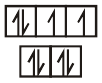
\begin{array}{l} \text { CFSE } \Rightarrow[(-0.6 \times 4)+(4 \times 0.4)] \Delta_{\mathrm{t}}=-0.8 \Delta_{\mathrm{t}} \text { M.M. }=\sqrt{2(2+2)}=\sqrt{8} \mathrm{BM} \end{array}
Show answer
Answer: 10
Report an error in ABC26IN0666