Q1 · 2000-2022 · 2 marks
^{1}\mathrm{H} NMR spectrum of [18]– annulene shows
- (a) Only one peak at \delta\ 7.2\ (18\ \mathrm{H})
- (b) Only one peak at \delta\ 5.0\ (18\ \mathrm{H})
- (c) Two peaks at \delta\ 9.0\ (12\ \mathrm{H}) and \delta\ {-3.0}\ (6\ \mathrm{H})
- (d) Two peaks at \delta\ 9.0\ (6\ \mathrm{H}) and \delta\ {-3.0}\ (12\ \mathrm{H})
Show answer
Answer: (c)
Report an error in ABC26OR0705
Q2 · 2000-2022 · 2 marks
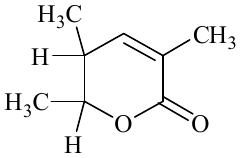
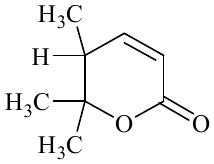
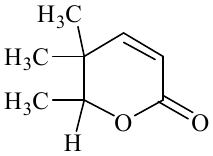
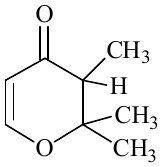
An organic compound having molecular formula \mathrm{C}_{8}\mathrm{H}_{12}\mathrm{O}_{2} exhibits the following peaks in IR and ^{1}\mathrm{H} NMR spectra.
IR : 1720\,(\mathrm{cm}^{-1})
^{1}\mathrm{H} NMR : 6.95\,(1\mathrm{H},\mathrm{d},J=8.5\,\mathrm{Hz})\;5.90\,(1\mathrm{H},\mathrm{d},J=8.5\,\mathrm{Hz}),\;4.53\,(1\mathrm{H},\mathrm{q},J=6\,\mathrm{Hz}),
1.41\,(3\mathrm{H},\mathrm{d},J=6\,\mathrm{Hz}),\;1.20\,(3\mathrm{H},\mathrm{s}),\;1.15\,(3\mathrm{H},\mathrm{s})
- (a)
- (b)
- (c)
- (d)
 GATE-2006
Show answer
Answer: (c)
Report an error in ABC26OR0706
Q3 · 2000-2022 · 2 marks
Match the structure in List - I with the coupling constant \left[{ }^{1} \mathrm{H} \mathrm{J}(\mathrm{Hz})\right] given in List -II List - I List - II (1) 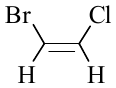 (i) ~ 1Hz (2) (ii) ~ 10 Hz (3) (iii) ~ 15 Hz
- (a)
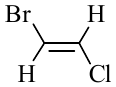
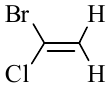 1 - (i), 2 - (ii), 3 - (iii)
- (b) 1 - (ii), 2 - (iii), 3 - (i)
- (d) 1 - (iii), 2 - (ii), 3 - (i) 1 - (iii), 2 - (i), 3 - (ii)
Show answer
Answer: (b)
Report an error in ABC26OR0709
Q4 · 2000-2022 · 2 marks
Match the observed principal absorptions in the visible spectrum shown List – I with the bond show this absorption in List – II
List – I List – II
(1) \sigma \rightarrow \sigma^{*} (i) \mathrm{C}-\mathrm{C}
(2) n \rightarrow \sigma^{*} (ii) \mathrm{C}-\mathrm{O}
(3) n, \pi^{*} (iii) \mathrm{C}=\mathrm{O}
(4) \pi, \pi^{*} (iv) \mathrm{C}=\mathrm{C}
- (a) 1 – (i), 2 – (ii), 3 – (iii), 4 – (iv)
- (b) 1 – (i), 2 – (iii), 3 – (ii), 4 – (iv)
- (c) 1 – (ii), 2 – (i), 3 – (iv), 4 – (iii)
- (d) 1 – (iv), 2 – (ii), 3 – (iii), 4 – (i)
Show answer
Answer: (a)
Report an error in ABC26OR0710
Q5 · 2000-2022 · 2 marks
The IR stretching frequencies \left(\mathrm{cm}^{-1}\right) for the compound X are as follows: 3300-3500(\mathrm{~s}, \mathrm{br}) ; 3000(\mathrm{~m}) ; 2225 (s); 1680 (s). 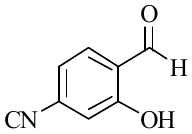 The correct assignment of the absorption bands is:
- (a) \overline{\mathrm{v}}_{(\mathrm{OH})}=3300-3500 ; \overline{\mathrm{v}}_{(\mathrm{CH})}=3000 ; \overline{\mathrm{v}}_{(\mathrm{CN})}=2225 ; \overline{\mathrm{v}}_{(\mathrm{CO})}=1680
- (b) \overline{\mathrm{v}}_{(\mathrm{OH})}=3000 ; \overline{\mathrm{v}}_{(\mathrm{CH})}=3300-3500 ; \overline{\mathrm{v}}_{(\mathrm{CN})}=2225 ; \overline{\mathrm{v}}_{(\mathrm{CO})}=1680
- (c) \overline{\mathrm{v}}_{(\mathrm{OH})}=3300-3500 ; \overline{\mathrm{v}}_{(\mathrm{CH})}=3000 ; \overline{\mathrm{v}}_{(\mathrm{CN})}=1680 ; \overline{\mathrm{v}}_{(\mathrm{CO})}=2225
- (d) \overline{\mathrm{v}}_{(\mathrm{OH})}=3000 ; \overline{\mathrm{v}}_{(\mathrm{CH})}=3300-3500 ; \overline{\mathrm{v}}_{(\mathrm{CN})}=; 1680 \overline{\mathrm{v}}_{(\mathrm{CO})}=2225
Show answer
Answer: (a)
Report an error in ABC26OR0713
Q6 · 2000-2022 · 2 marks
The number of signals that appear in the broad-band decoupled ^{13}\mathrm{C} NMR spectrum of ortho-, meta-and para-dichlorobenzenes, respectively, are
- (c) 4, 4 and 2
- (d) 3, 4 and 4
Show answer
Answer: (a)
Report an error in ABC26OR0716
Q7 · 2000-2022 · 2 marks
In the proton decoupled {}^{13}\mathrm{C} NMR spectrum of 7-norbornanone, the number of signals obtained is
Show answer
Answer: (b)
Report an error in ABC26OR0726
Q8 · 2000-2022 · 2 marks
The ratio of relative intensities of the two molecular ion peaks of methyl bromide (\mathrm{CH_3Br}) in the mass spectrum is:
- (a) \mathrm{M^+ : (M+2)^+ = 1:3}
- (b) \mathrm{M^+ : (M+2)^+ = 3:1}
- (c) \mathrm{M^+ : (M+2)^+ = 1:1}
- (d) \mathrm{M^+ : (M+2)^+ = 1:2}
Show answer
Answer: (c)
Report an error in ABC26OR0727
Q9 · 2000-2022 · 2 marks
The number of signals that appear in the proton decoupled ^{13}\mathrm{C} NMR spectrum of benzonitrile (\mathrm{C}_{7}\mathrm{H}_{5}\mathrm{N}) is
Show answer
Answer: 5
Report an error in ABC26OR0728
Q10 · 2000-2022 · 2 marks
Among the compound given in the option (a) to (d), the one that exhibits a sharp band at around 3300 \mathrm{cm^{-1}} in the IR spectrum is:
- (a) 1,2–butadiene
- (b) 1,3–butadiene
- (c) 1–butyne
- (d) 2–butyne
Show answer
Answer: (c)
Report an error in ABC26OR0729
Q11 · 2000-2022 · 2 marks
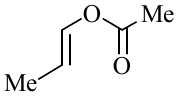
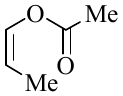
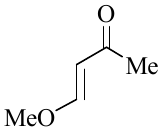
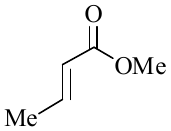
An organic compound Q exhibited the following spectral data:
IR: 1760\ \mathrm{cm}^{-1}
^{1}\mathrm{H} NMR : \delta (ppm) : 7.2\ (1\mathrm{H},\mathrm{d},\mathrm{J}=16.0\ \mathrm{Hz}),\ 5.1\ (1\mathrm{H},\mathrm{m}),\ 2.1\ (3\mathrm{H},\mathrm{s}),\ 1.8\ (3\mathrm{H},\mathrm{d},\mathrm{J}=7.0\ \mathrm{Hz})
^{13}\mathrm{C} NMR : \delta (ppm) : 170 (carbonyl carbon),
Compound Q is
- (a)
- (b)
- (c)
- (d)
 GATE-2014
Show answer
Answer: (a)
Report an error in ABC26OR0730
Q12 · 2000-2022 · 2 marks
The correct order of IR stretching frequency of the \mathrm{C}=\mathrm{C} in the following olefins is (I) (II) (III)
- (a)
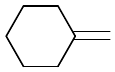 I > II > III
- (b)

 II > III > I
- (c) III > II > I
- (d) III > I > II
Show answer
Answer: (c)
Report an error in ABC26OR0731
Q13 · 2000-2022 · 2 marks
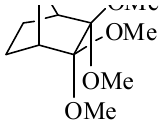
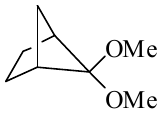
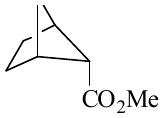
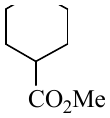
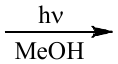
The product of the following reaction gave 6 line { }^{13} \mathrm{C} NMR spectrum with peaks at \delta 175,52,50,46,37,33 ppm. The structure of the product is 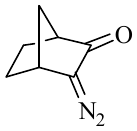
Show answer
Answer: (c)
Report an error in ABC26OR0733
Q14 · 2000-2022 · 2 marks
Given the fact that 1, 3-butadiene has a UV absorption of 217nm, the absorption wavelength (in nm) for the conjugated system shown below is ____ 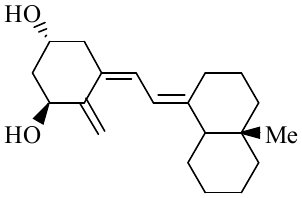 (Use these absorption value for auxochromic groups: alkyl: +5; exo-cyclic double bond: +5; every additional conjugated \mathrm{C}=\mathrm{C}:+30 )
Show answer
Answer: 282
Report an error in ABC26OR0734
Q15 · 2000-2022 · 2 marks
The m/z value of the detectable fragment formed by McLafferty like rearrangement of the following compound in mass spectrometer is ____ 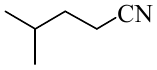 GATE-2016
Show answer
Answer: 41
Report an error in ABC26OR0735
Q16 · 2000-2022 · 2 marks
The total number of lines expected (due to spin-spin coupling of proton with fluorine and deuterium nuclei) in the { }^{1} \mathrm{H} NMR spectrum of the following compound is ____ . 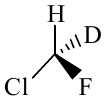 GATE-2017
Show answer
Answer: 6
Report an error in ABC26OR0736
Q17 · 2000-2022 · 2 marks
The {}^{13}C NMR spectrum of acetone – \mathrm{d_6} has a signal at 30 ppm as a septet in the intensity ratio
- (a) 1 : 6 : 15 : 20 : 15 : 6 : 1
- (b) 1 : 3 : 6 : 7 : 6 : 3 : 1
- (c) 1 : 2 : 3 : 5 : 3 : 2 : 1
- (d) 1 : 3 : 7 : 10 : 7 : 3 : 1
Show answer
Answer: (b)
Report an error in ABC26OR0737
Q18 · 2000-2022 · 2 marks
The spectroscopic data for an organic compound with molecular formula \mathrm{C}_{10} \mathrm{H}_{12} \mathrm{O}_{2} are given below. IR band around 1750 \mathrm{~cm}^{-1} .{ }^{1} \mathrm{H} NMR \delta 7.3(\mathrm{~m}, 5 \mathrm{H}), 5.85(\mathrm{q}, 1 \mathrm{H}, \mathrm{J}=7.2 \mathrm{~Hz}), 2.05(\mathrm{~s}, 3 \mathrm{H}), 1.5(\mathrm{~d}, 3 \mathrm{H}, \mathrm{J}=7.2 \mathrm{~Hz}) \mathrm{ppm}. the compound is
- (a) methyl 2-phenylpropionate
- (c) 1-(phenylethyl) acetate 2-(phenylethyl) acetate
- (d) methyl 3-phenylpropionate GATE-2018
Show answer
Answer: (b)
Report an error in ABC26OR0738
Q19 · 2000-2022 · 2 marks
the elimination product of the following reaction is
- (a) \mathrm{I}_{2}
- (b)
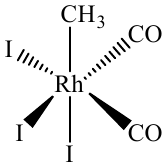 \mathrm{CH}_{3} \mathrm{I}
- (c)
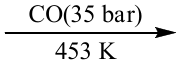 \mathrm{CH}_{3} \mathrm{COI}
- (d) \mathrm{I}_{3}{ }^{-} GATE-2020
Show answer
Answer: (c)
Report an error in ABC26OR0739