






Curtin-Hammett principle: product ratios and conformations
Learn how fast-equilibrating conformers decide product ratios. Rule, exam method, two worked practice questions and a short study plan for PG entrance exams.
This post shows you how to predict a product ratio when two conformers interconvert quickly and each reacts to give a different product.
You will get the rule, a table of when it applies, two worked practice questions and a short study plan.
The idea in plain words
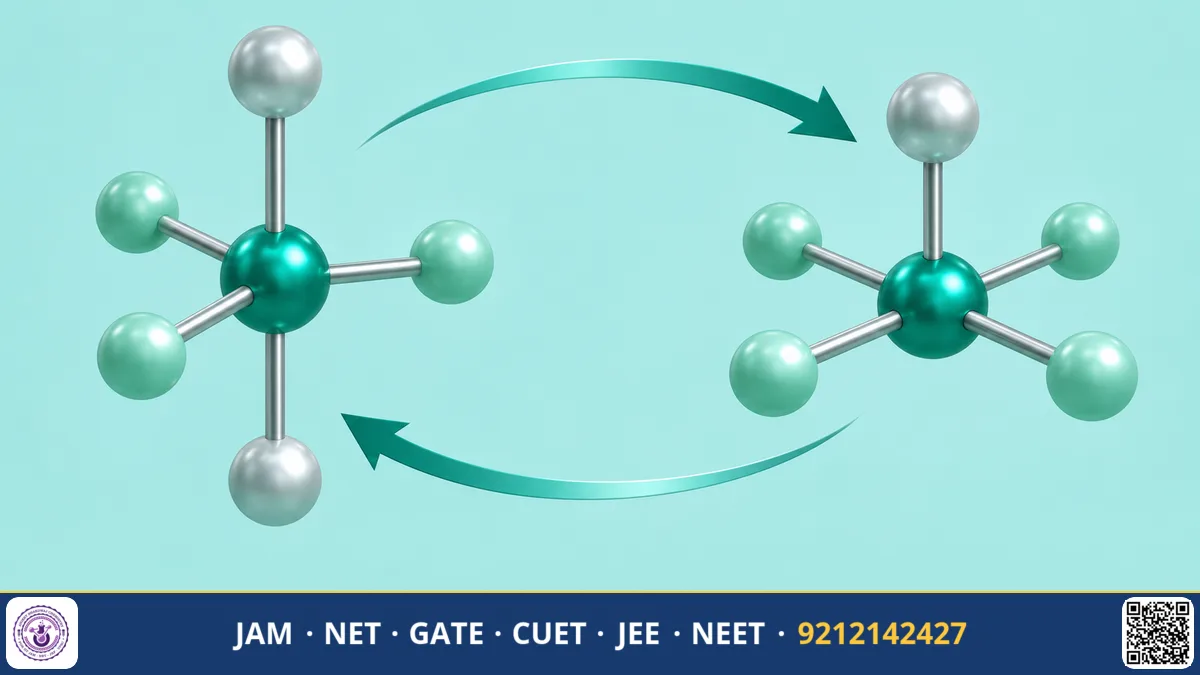
A conformer is a shape of a molecule that you get by rotating around single bonds. A chair cyclohexane with a substituent axial and the chair with the same substituent equatorial are two conformers. They convert into each other by ring flip.
Now suppose conformer A reacts to give product C, and conformer B reacts to give product D. Many students reason like this: A is more stable, so there is more of A, so C must be the major product. That reasoning is incomplete. The Curtin-Hammett principle, from chemical kinetics (the study of reaction rates), corrects it.
Two things decide the product ratio together:
- the energy difference between the two conformers, and
- the energy barrier each conformer must cross to reach its own product.
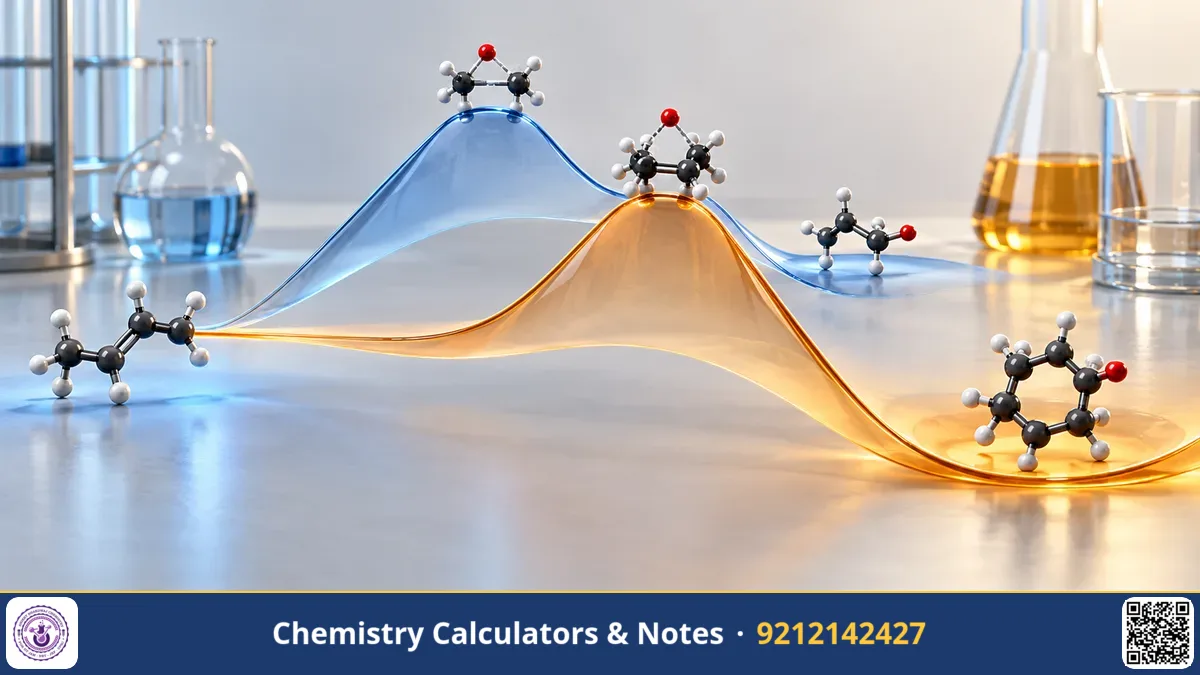
Put another way, the product ratio reflects the difference in energy of the two transition states. A transition state is the highest-energy point on the path from reactant to product. Because the conformers are in fast equilibrium, you can measure both transition states from one common reference, usually the more stable conformer.
The working formula
Let G‡C be the Gibbs energy of the transition state leading to C, and G‡D that leading to D, both on the same energy scale. Then:
[C]/[D] = exp(−ΔΔG‡/RT), where ΔΔG‡ = G‡C − G‡D.
The lower transition state wins. A difference of a few kJ mol−1 is enough to give a clear preference at room temperature, because the energy sits inside an exponential.
Here is why the conformer energies drop out. The equilibrium ratio of conformers is [A]/[B] = K, which depends on the energy gap between A and B. The ratio of rate constants is k1/k2, which depends on the two barriers measured from A and B. The product ratio is the multiplication K × (k1/k2). When you multiply them, the energy gap between the conformers is absorbed into the transition-state positions, and only the transition-state difference remains. A very stable conformer that has a high barrier does not control the outcome.
When the principle applies and when it does not
The principle is not a rule for every pair of conformers. It needs two conditions. First, the conformers must interconvert much faster than either one reacts. Second, product formation must be irreversible, and the two products must not convert into each other.
| Situation | What controls the product ratio | How to spot it in a question |
|---|---|---|
| Interconversion fast, reactions irreversible (Curtin-Hammett) | Difference in transition-state energies | Rapidly equilibrating conformers, low flip barrier, stable products |
| Interconversion slow, reactions fast | Starting population of each conformer | Conformers frozen, very low temperature, high barrier to flip |
| Products can interconvert | Product stability (thermodynamic control) | Reversible conditions, long reaction time, equilibrium mentioned |
If a question does not say that the conformers equilibrate quickly, do not assume it. Read the data given. If the flip barrier is clearly smaller than both reaction barriers, you are in the first row.
Note also that the rapidly interconverting species need not be conformers. They can be stereoisomers or constitutional isomers, as long as both conditions hold. Conformers are simply the most common case in exam questions.
Exam angle
For CSIR-NET, GATE, IIT-JAM and CUET-PG, this idea sits at the meeting point of stereochemistry, conformational analysis and kinetics. Questions usually take one of these forms:
- A numeric question: you are given an energy profile and must find the product ratio at a stated temperature.
- A statement to judge: a claim that the major product must come from the more populated conformer. You must decide whether it holds under the conditions given.
- A cyclohexane question: an axial and an equatorial form react at different rates, and you must say which product dominates.
Use the same method every time:
- Draw the energy diagram of the two conformers and their two transition states.
- Fix one zero point, normally the more stable conformer.
- Mark both transition states from that zero.
- Subtract to get ΔΔG‡.
- Apply the exponential with the right units.
Most errors come from measuring each barrier from its own conformer and forgetting to add the gap between the conformers. The chemistry question bank on this site is organised by chapter, so you can find more problems on kinetics and conformations after the two below.
Worked practice questions
These two are practice questions written for this post. They are not past-paper questions. Take R = 8.314 J mol−1 K−1 and T = 298 K, so RT ≈ 2.48 kJ mol−1.
Practice question 1. Conformer A is 8 kJ mol−1 more stable than conformer B. They interconvert rapidly. A gives product C irreversibly. B gives product D irreversibly. The transition state from B lies 5 kJ mol−1 below the transition state from A, both measured on the same energy scale. Find the ratio D : C and the ratio A : B.
Solution.
- The conformers equilibrate fast and the products are irreversible. Curtin-Hammett applies.
- The product ratio depends only on ΔΔG‡ = 5 kJ mol−1. The 8 kJ mol−1 gap is already built into the position of the two transition states.
- D : C = exp(5 / 2.48) = exp(2.02) ≈ 7.5. So D is the major product, about 7.5 : 1.
- For comparison, A : B = exp(8 / 2.48) = exp(3.23) ≈ 25. A is far more populated, yet C is the minor product.
Answer: D : C ≈ 7.5 : 1, while A : B ≈ 25 : 1. The major product comes from the minor conformer.
Practice question 2. Conformer X (energy 0) is more stable than conformer Y by 6 kJ mol−1. X reacts to give P with an activation energy of 80 kJ mol−1, measured from X. Y reacts to give Q with an activation energy of 70 kJ mol−1, measured from Y. (a) Find Q : P if X and Y equilibrate rapidly. (b) What would the ratio be if X and Y did not interconvert at all during the reaction, and the mixture started at equilibrium?
Solution.
(a)
- Put both transition states on one scale, with X as zero.
- Transition state to P: 0 + 80 = 80 kJ mol−1.
- Transition state to Q: 6 + 70 = 76 kJ mol−1.
- ΔΔG‡ = 4 kJ mol−1, in favour of Q.
- Q : P = exp(4 / 2.48) = exp(1.61) ≈ 5.0.
(b)
- With no interconversion, each conformer reacts completely where it stands. The products then reflect the starting populations.
- X : Y = exp(6 / 2.48) = exp(2.42) ≈ 11.
- So P : Q ≈ 11 : 1.
Answer: (a) Q : P ≈ 5 : 1. (b) P : Q ≈ 11 : 1. The two answers point to opposite major products. This contrast is a natural way for an examiner to test whether you know the condition of fast interconversion.
Common mistakes to avoid
- Using the conformer population as the answer. That is correct only when the conformers do not interconvert during the reaction.
- Measuring barriers from different zero points. Always add the energy gap of the less stable conformer to its own barrier.
- Mixing up ΔG° and ΔΔG‡. The first compares conformers. The second compares transition states.
- Mixing units. If energies are in kJ mol−1, use RT in kJ mol−1 too.
- Ignoring reversibility. If the products can return to the conformers or to each other, the principle does not decide the outcome.
A short study plan
- Day 1: Revise cyclohexane conformations and the idea of activation energy. Draw the energy diagram for two conformers from memory.
- Day 2: Derive the product-ratio formula yourself. Show why the conformer gap is absorbed into the transition-state positions.
- Day 3: Redo both practice questions without looking. Then change the numbers and solve again.
- Day 4: Make a one-page note with the table of three situations. Practise judging statements about whether the major product must come from the major conformer.
- Day 5: Attempt kinetics and conformational-analysis questions from the question bank, chapter by chapter. Write every mistake in a notebook.
- Day 6: Revise the notebook. Explain the principle aloud in under two minutes, as if teaching a friend.
Key takeaways
- Under Curtin-Hammett conditions, the product ratio is set by the difference between transition-state energies.
- The major product can come from the less populated conformer.
- Check both conditions: fast interconversion and irreversible product formation.
- Measure all energies from one zero point before subtracting.
- If the conformers do not interconvert, the product ratio follows their populations instead.
Frequently asked questions
Does the Curtin-Hammett principle say the product ratio equals the conformer ratio?
No. The product distribution does not necessarily reflect the equilibrium distribution of the conformers. It reflects the energy difference between the two rate-limiting transition states.
Which conditions must hold for the principle to apply?
The reactants must interconvert rapidly, and each must go irreversibly to a different product. The products must also be unable to interconvert.
Does it apply only to conformers?
No. Conformers are the usual example, but the rapidly interconverting species can also be stereoisomers or constitutional isomers, if the same conditions hold.
Which field of chemistry does the principle belong to?
It is a principle of chemical kinetics. It is used to explain selectivity in many stereoselective and regioselective reactions.
How do I decide between a Curtin-Hammett case and a population-controlled case in an exam?
Compare the barrier to conformer interconversion with the reaction barriers. If interconversion is much faster, use transition-state energies. If it is much slower, use the starting populations.