






GATE Chemistry Organic Chemistry: Pericyclic Reactions Basics
Master pericyclic reactions and orbital symmetry rules for GATE Chemistry with classifications, worked practice problems, and a four-week study plan.
Mastering pericyclic reactions gives you a reliable method to solve advanced organic mechanism problems. This guide covers reaction classes, orbital symmetry rules, two worked practice problems, and a structured study plan.
What makes pericyclic reactions unique
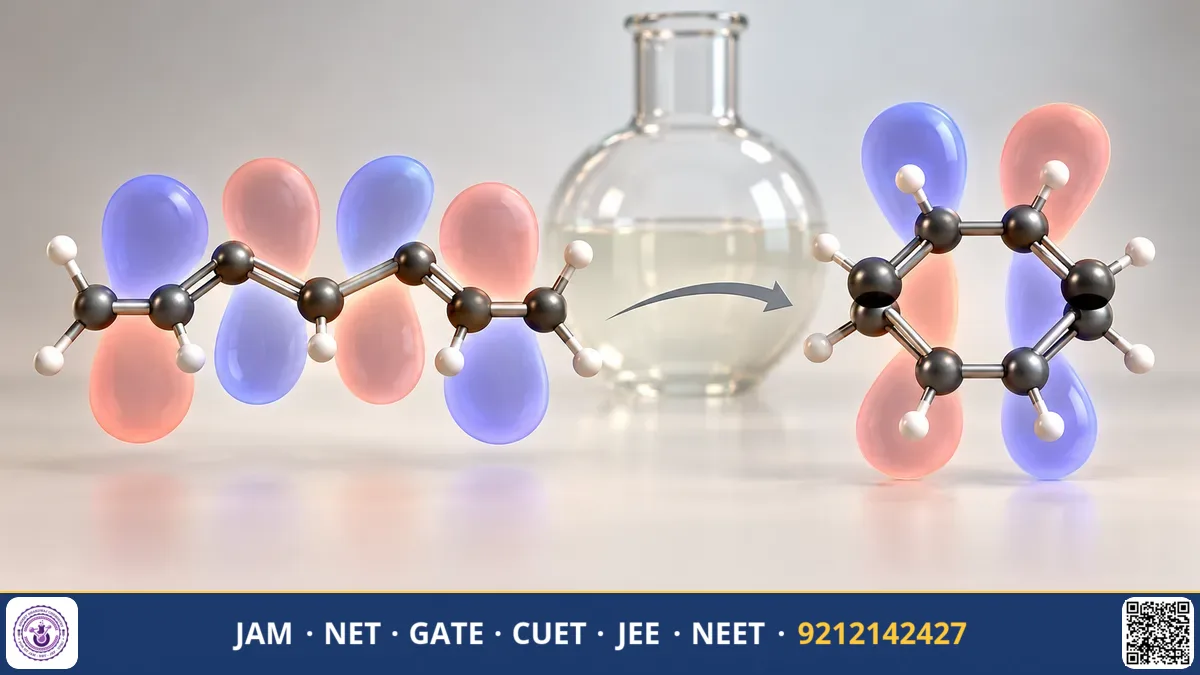
Most organic reactions follow ionic or radical pathways with discrete carbocations, carbanions, or radical intermediates. In contrast, a pericyclic reaction is a concerted transformation where bond-breaking and bond-making occur simultaneously along a closed ring of interacting orbitals.
Because these reactions proceed through a cyclic transition state in a single step, they display distinct characteristics:
- Minimal solvent sensitivity: No formal charges develop in the transition state, so solvent polarity changes rarely alter reaction rates.
- High stereospecificity: Reactant stereochemistry directly dictates product stereochemistry.
- Orbital symmetry control: Feasibility depends on constructive overlap between interacting lobes of frontier molecular orbitals rather than steric accessibility alone.
Pericyclic transformations respond to thermal activation (heat, Δ) and photochemical activation (light, hν). Switching between heat and light alters electronic configurations and reverses stereochemical pathways.
The four fundamental classes of pericyclic transformations
You can classify pericyclic transformations into four major categories based on bond reorganization:
- Electrocyclic reactions: Reversible conversion between an open conjugated polyene and a cycloalkene, forming one new σ bond by consuming one π bond, or the reverse ring opening.
- Cycloadditions: Two independent π systems combine to form a ring, consuming two π bonds to produce two new σ bonds.
- Sigmatropic rearrangements: A σ bond migrates concertedly across a conjugated π framework to a new position, shifting double bonds while keeping total bond counts constant.
- Cheletropic reactions: A subclass of cycloadditions where both new σ bonds form or break at the same single atom, such as sulfur dioxide extrusion from cyclic sulfones.
Orbital symmetry selection rules in plain steps
Selection rules predict whether a pericyclic reaction is symmetry-allowed or symmetry-forbidden under thermal or photochemical conditions. Use this four-step method to find the allowed pathway:
Step 1: Count participating π electrons. Count only electrons in the reacting cyclic loop. Classify the system as 4n (such as 4 or 8) or 4n+2 (such as 2 or 6), where n is an integer.
Step 2: Note the activation mode. Check if the reaction uses heat or light. Thermal reactions proceed from the ground state. Photochemical reactions promote an electron to the lowest unoccupied molecular orbital, creating an excited state.
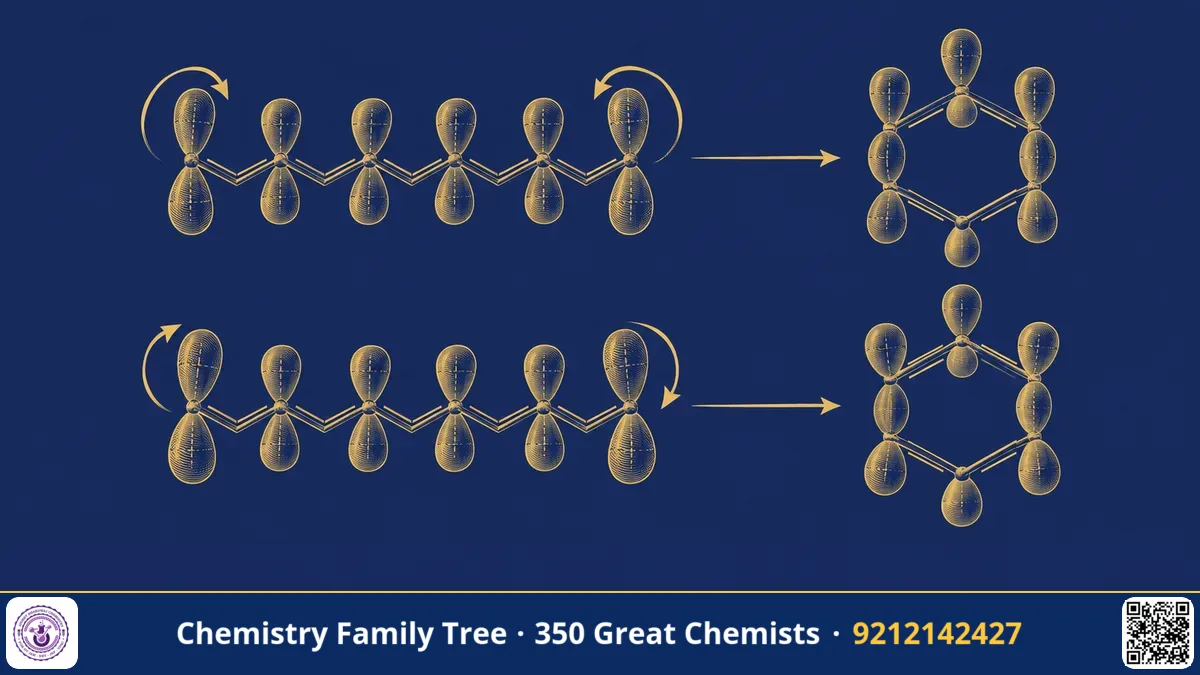
Step 3: Check frontier orbital symmetry. For electrocyclic reactions, inspect terminal lobes of the highest occupied molecular orbital. In thermal reactions, inspect the ground-state orbital. In photochemical reactions, inspect the excited-state orbital. Determine if terminal lobes share the same phase sign or opposite signs on the same face.
Step 4: Select the rotational or facial mode.
- Conrotatory motion: Both terminal lobes rotate in the same direction, bringing opposite signs into constructive overlap.
- Disrotatory motion: Terminal lobes rotate in opposite directions, bringing matching signs into constructive overlap.
- Suprafacial interaction: Bond formation occurs on the same face of the π system.
- Antarafacial interaction: Bond formation occurs on opposite faces of the π system.
| Reaction type | Electron system | Thermal mode (Δ) | Photochemical mode (hν) |
|---|---|---|---|
| Electrocyclic | 4n π electrons | Conrotatory | Disrotatory |
| Electrocyclic | 4n+2 π electrons | Disrotatory | Conrotatory |
| Cycloaddition | 4n π electrons | Antarafacial-suprafacial | Suprafacial-suprafacial |
| Cycloaddition | 4n+2 π electrons | Suprafacial-suprafacial | Suprafacial-antarafacial |
The pericyclic reaction angle in master-level entrance exams
Examinations such as GATE Chemistry, CSIR NET Chemical Science, IIT-JAM Chemistry, and CUET-PG Chemistry test pericyclic reactions through problem-solving rather than rote theory. Master-level papers highlight three question styles:
- Stereochemical mapping: Deducing whether ring substituents become cis or trans starting from configured polyenes.
- Condition toggling: Determining how switching between heat and light alters stereochemical outcomes.
- Cascade sequences: Multi-step problems coupling an electrocyclic ring opening with a subsequent cycloaddition trap or sigmatropic shift.
Do not rely on steric intuition alone. An isomer that appears crowded may be the only symmetry-allowed kinetic product. Determine orbital symmetry first, then assess steric constraints.
Practice questions with step-by-step solutions
Test your understanding with two practice questions from our question bank.
Practice question (QID: CY-PER-01): Predict the stereochemical configuration of the cyclic product formed when (2E,4E)-hexa-2,4-diene is heated. Explain your deduction using orbital symmetry principles.
Solution:
- Electron count: The conjugated diene has 4 π electrons, fitting a 4n system where n = 1.
- Activation mode: Thermal conditions indicate reaction from the ground electronic state.
- Frontier orbital: For a 4-electron polyene, the ground-state highest occupied molecular orbital is ψ2.
- Terminal lobe symmetry: The ψ2 orbital has one node across the carbon chain, giving terminal lobes opposite algebraic signs on the upper face.
- Rotational mode: To achieve constructive bonding overlap between opposite signs, both terminal lobes must rotate in the same direction (conrotatory motion).
- Product stereochemistry: In (2E,4E)-hexa-2,4-diene, both methyl groups point outward. Conrotatory rotation moves one methyl inward-up and the other outward-down, yielding trans-3,4-dimethylcyclobutene.
Practice question (QID: CY-PER-02): Cyclopentadiene reacts with maleic anhydride under thermal conditions. Identify the reaction type, verify its symmetry feasibility, and explain the stereochemical orientation of the major product.
Solution:
- Reaction type: This is a [4+2] cycloaddition between a conjugated cyclic diene and an activated alkene.
- Electron count: The system contains 6 π electrons (4 from cyclopentadiene, 2 from maleic anhydride), which is a 4n+2 system. Under thermal conditions, the suprafacial-suprafacial pathway is symmetry-allowed.
- Stereospecificity: Cycloadditions proceed via concerted suprafacial addition. The cis geometry of maleic anhydride is preserved in the adduct.
- Diastereoselectivity: The major product is endo-bicyclo[2.2.1]hept-5-ene-2,3-dicarboxylic anhydride. Secondary orbital overlap between carbonyl π systems and the diene π framework lowers transition-state energy for the endo approach over the exo approach.
A four-week study plan for pericyclic reactions
Structure your preparation across four weeks to build speed and accuracy for competitive exams:
- Week 1 (Frontier orbital fundamentals): Sketch π molecular orbitals for ethylene, 1,3-butadiene, and 1,3,5-hexatriene. Map nodes and terminal lobe phases for ground and light-excited states.
- Week 2 (Electrocyclic ring closures and openings): Practice thermal and photochemical ring closures on configured dienes and trienes. Trace substituent movements during conrotatory and disrotatory rotations.
- Week 3 (Cycloadditions and sigmatropic shifts): Solve [4+2] and [2+2] cycloadditions. Study secondary orbital interactions governing endo selectivity, and map [1,5]-hydride and [3,3]-sigmatropic shifts using chair-like transition states.
- Week 4 (Tandem sequences and timed problem sets): Solve mixed pericyclic problems and multi-step cascade reactions from our question bank without checking reference tables.
Key takeaways
- Pericyclic reactions proceed through concerted cyclic transition states without ionic or radical intermediates.
- Thermal 4n electrocyclic reactions require conrotatory rotation, whereas photochemical 4n reactions require disrotatory rotation.
- Thermal 4n+2 electrocyclic reactions require disrotatory rotation, whereas photochemical 4n+2 reactions require conrotatory rotation.
- Thermal [4+2] cycloadditions occur through a symmetry-allowed suprafacial-suprafacial pathway favoring endo selectivity through secondary orbital interactions.
- Identifying electron count and activation mode provides a systematic method to predict reaction outcomes in master-level entrance exams.
Frequently asked questions
Why does photochemical activation reverse the stereochemical outcome of an electrocyclic reaction?
Light promotes an electron from the ground-state highest occupied molecular orbital to the lowest unoccupied molecular orbital. The resulting excited-state frontier orbital has an extra node, reversing terminal lobe phases and altering the required rotational mode.
What is the difference between suprafacial and antarafacial processes?
In a suprafacial process, bond changes occur on the same face of the π system. In an antarafacial process, bond changes occur on opposite faces of the π system, requiring framework twisting.
Why do [3,3]-sigmatropic rearrangements prefer a chair-like transition state?
A chair-like cyclic transition state maintains continuous orbital overlap while minimizing steric clash between substituents, making it lower in energy than a boat conformation.
Why are thermal [2+2] cycloadditions of simple alkenes difficult to achieve?
Under thermal conditions, a [2+2] cycloaddition requires a suprafacial-antarafacial alignment to be symmetry-allowed. Simple alkenes cannot adopt this twisted geometry without severe strain, making the thermal pathway unfeasible.