






Update, 2 October 2026: ABC Chemistry teaches online only at present — classroom batches are not running and there is no walk-in centre. D-101 Capital Gateway, Sector 111, Gurugram is the registered office. How the online classes work.
Radius ratio rules and ionic crystal structures explained
Learn how the radius ratio r+/r- fixes coordination number and geometry in ionic crystals, with exam traps, two solved practice questions and a study plan.
This post shows you how to read a coordination number and geometry straight from a radius ratio.
You will also see the usual exam traps, two worked practice questions and a short study plan.
What the radius ratio rule says
In most ionic solids the cation is smaller than the anion. Each cation sits in a hole surrounded by anions. The number of anions touching the cation is its coordination number (C.N.). The surrounding anions form a polyhedron, such as a tetrahedron or an octahedron.
This is the first of Pauling's rules, published in 1929. The ratio r+/r− (also written rc/ra) fixes the C.N. of the cation and the shape of the polyhedron of anions.
The logic is simple geometry. Treat ions as rigid, hard spheres. For each C.N. there is a minimum ratio at which the cation just touches all the surrounding anions. If the cation is smaller than that, it loses contact with the anions. The structure becomes unstable and shifts to a lower C.N.
Two more points sit behind this. The sum of the ionic radii sets the cation–anion distance. The crystal forms when the lattice energy released by packing is greater than the stabilisation of isolated ion pairs.
The ranges you must memorise
| Radius ratio r+/r− | Cation C.N. | Geometry of anions |
|---|---|---|
| Below 0.414 | 4 (or lower) | Tetrahedral (or a lower-C.N. shape) |
| 0.414 to 0.732 | 6 | Octahedral |
| Above 0.732 | 8 | Cubic |
The two boundary values to hold in your head are 0.414 and 0.732. Examiners build questions around them. Your own textbook table may also list ratios for C.N. 3 and a lower limit for C.N. 4. Learn those from your class notes. The logic below is the same for all of them.
Where the boundary values come from
You should be able to derive at least two limits. Descriptive papers like this, and it helps you remember the numbers.
Octahedral limit (0.414). In an octahedron, four anions lie in one plane around the cation, and two sit above and below. Look at the plane with the four anions. The cation and any two neighbouring anions form a right triangle. The two anions touch, so the side of the square is 2r−. The cation sits at the centre, so the distance from the cation to each anion is r+ + r−. The hypotenuse of the right triangle is the square's edge 2r−, which equals √2 (r+ + r−). This reduces to √2 r− = r− + r+. So r+ = (√2 − 1) r− = 0.414 r−.
Cubic limit (0.732). Place eight anions at the corners of a cube with the cation at the centre. Adjacent anions just touch, so the cube edge is 2r−. The body diagonal is √3 times the edge, and it also equals 2(r+ + r−). So r+ + r− = √3 r−, and r+/r− = 0.732.
Similar geometrical proofs give the minimum ratios for the symmetrical cases C.N. = 3, 4 and 8.
Two standard examples: NaCl and CsCl
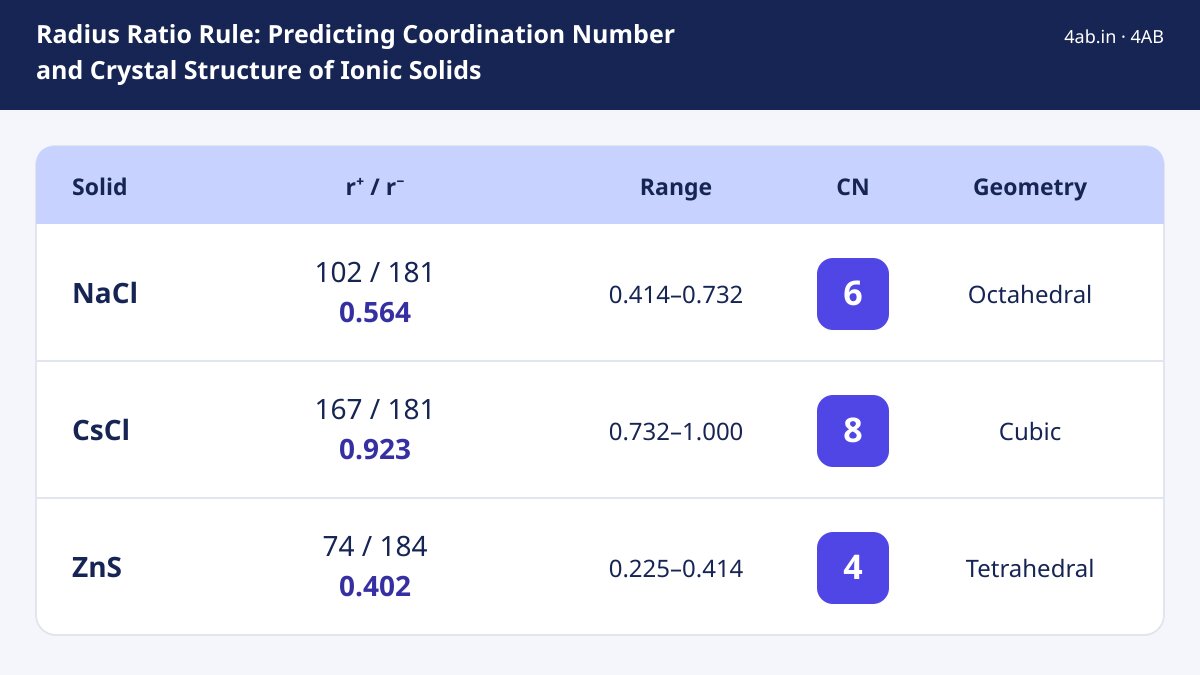
The ratio for Na+ in NaCl is about 0.55. That lies between 0.414 and 0.732, so Na+ is octahedral with C.N. 6.
The ratio for Cs+ in CsCl is about 0.93. That is above 0.732, so Cs+ has cubic coordination, C.N. 8.
Notice what happens when the ratio rises above the minimum for a geometry. The cation still touches all its anions, but the anions move further apart. Their mutual repulsion falls, so the crystal is more stable. An octahedron can exist for any ratio of 0.414 or more. Once the ratio goes above 0.732, the cubic geometry becomes more stable.
The reverse also holds. If the ratio falls below the minimum, two anions tend to leave. The remaining four rearrange into a tetrahedron, all in contact with the cation.
Exam angle: traps to avoid
- Inverting the ratio. The ratio is always cation over anion. If you get a value above 1 for an ordinary salt, you have flipped it.
- Treating the ranges as sharp walls. The rule is a first approximation. It has some success in predicting C.N., but many exceptions exist. If an option claims the rule always works, be suspicious.
- Forgetting the hard-sphere assumption. The rule treats ions as rigid spheres. Bonds with covalent character, or ions that are easily polarised (distorted by a neighbouring charge), can break the prediction.
- Mixing up C.N. and geometry. Questions often ask for both. Write the pair together: 4 and tetrahedral, 6 and octahedral, 8 and cubic.
- Missing a units trap. Radii may be given in pm in one place and in Å in another. Convert before you divide. The ratio itself has no unit.
- Using the rule on the wrong ion. The ratio gives the C.N. of the cation, the smaller ion. In a 1:1 salt such as NaCl, the anion has the same C.N. as the cation.
- Stopping at "unstable". If the cation is too small for a geometry, the answer must name the lower C.N. and its shape.
For CSIR-NET, GATE and IIT-JAM, prepare for three forms of this topic: a short numerical, a statement-based item asking which option is correct, and a derivation inside a larger solid-state question.
Practice question 1: predicting the geometry
Practice question. In a compound MX, the cation radius is 74 pm and the anion radius is 184 pm. Using the radius ratio rule, predict the coordination number and the geometry around M.
Step 1: find the ratio. r+/r− = 74 / 184 = 0.402.
Step 2: place it in the table. 0.402 is below 0.414, so it is not in the octahedral window.
Step 3: read the answer. C.N. = 4 and the anions form a tetrahedron around M.
Check. The value is close to the 0.414 boundary. A small change in the radii data could move the answer to 6. In an exam, show the ratio and the range, because the marks are for that reasoning.
Practice question 2: a derivation with a twist
Practice question. A cation sits in a cubic hole formed by eight anions that touch each other along the cube edges. (a) Find the minimum radius ratio for C.N. 8. (b) If the actual ratio is 0.65, what happens?
(a) Call the anion radius r−. Adjacent anions touch, so the cube edge a = 2r−. The cation touches the corner anions along the body diagonal, so √3 a = 2(r+ + r−).
Put in the value of a: 2√3 r− = 2(r+ + r−). So r+ = (√3 − 1) r− = 0.732 r−.
(b) 0.65 is below 0.732. The cation is too small to touch all eight anions. The structure moves to a lower C.N. Since 0.65 lies between 0.414 and 0.732, the prediction is C.N. 6, octahedral.
Trap check. Many students stop at "unstable" and do not name the new geometry. Always finish by naming the C.N. and the shape.
A short study plan
- Day 1: table and meaning. Write the ranges from memory, with C.N. and geometry. Explain in your own words why a smaller cation means fewer anions.
- Day 2: derivations. Derive 0.414 and 0.732 without looking. Keep the picture in mind: a square plane for the octahedron, a cube for C.N. 8.
- Day 3: numericals. Make five radius pairs of your own, compute the ratios and assign the geometry. Include two that fall close to a boundary.
- Day 4: exceptions. Write down why the rule can fail: covalent character, polarisation and the rigid-sphere assumption. Add the other Pauling rules to your notes.
- Day 5: mixed practice. Solve solid-state questions from the question bank. Revise the same topic again after a week.
Key takeaways
- The ratio r+/r− sets the cation's C.N. and the shape of the anion polyhedron.
- Remember the limits 0.414 and 0.732, and be able to derive both.
- NaCl (about 0.55) is octahedral with C.N. 6, while CsCl (about 0.93) is cubic with C.N. 8.
- The rule is a first approximation with many exceptions, so never call it a law.
- Always write both the C.N. and the geometry in your answer.
Frequently asked questions
What is the radius ratio?
It is the radius of the cation divided by the radius of the anion, written r+/r− or rc/ra. It tells you how many anions can fit around one cation.
Why is the minimum ratio for an octahedron 0.414?
At that ratio the cation touches all six anions, and the anions also touch each other. The right-triangle geometry gives r+ = (√2 − 1) r−, which is 0.414 r−.
Why does CsCl have C.N. 8 but NaCl has C.N. 6?
Cs+ is relatively larger, with a ratio of about 0.93, which is above 0.732. So the cubic arrangement is favoured. Na+ has a ratio of about 0.55, which falls in the octahedral range.
Does the rule always give the correct structure?
No. It is a first approximation. It has some success in predicting coordination numbers, but many exceptions exist. Bond covalency and polarisation are common reasons.
Is it enough to learn only the table?
No. For competitive papers you should also know the derivations, the trap points near boundaries and the reasons for exceptions.