






Zeolites and Molecular Sieves: Structure and Shape-Selective Catalysis
A comprehensive guide to aluminosilicate frameworks, acidity generation, and shape-selective catalytic mechanisms for higher-tier chemistry exams.
Introduction: From Porous Minerals to Molecular Sieves
In classical solid-state and inorganic chemistry, few materials bridge fundamental crystallography and industrial heterogeneous catalysis as effectively as zeolites. First identified historically as natural minerals that release water upon heating (giving rise to the Greek etymology meaning "boiling stones"), modern zeolites are primarily synthetic, crystalline aluminosilicates engineered with absolute crystallographic precision.
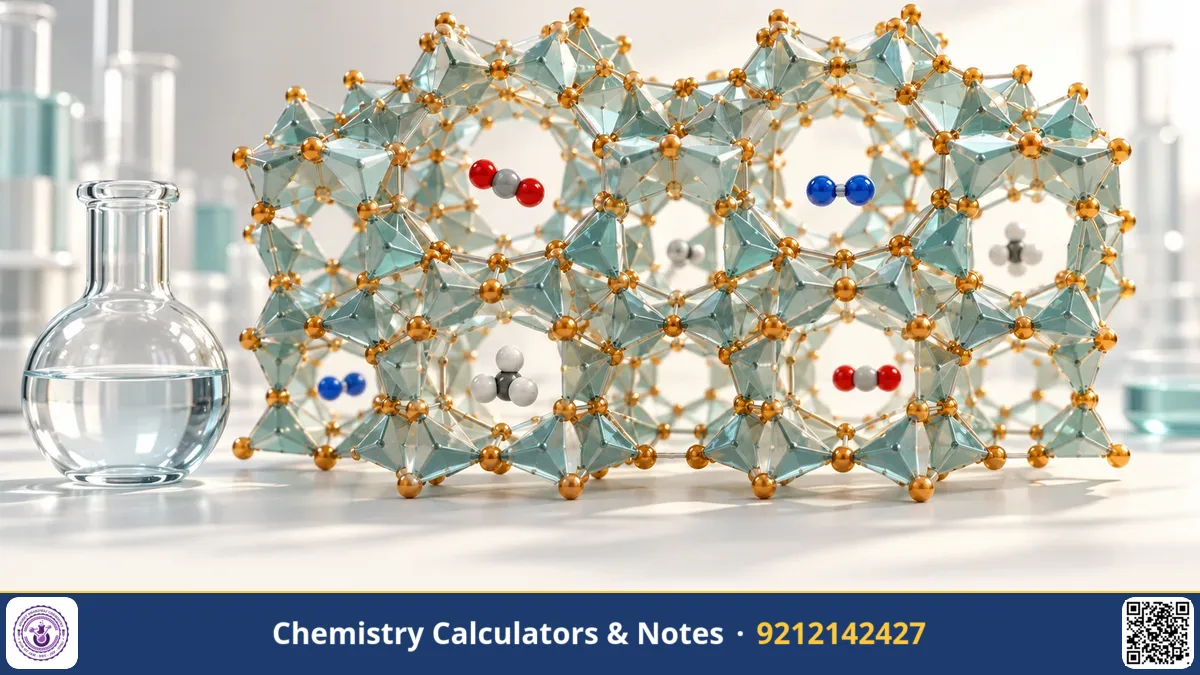
The term molecular sieve refers broadly to any porous material containing pores of uniform, molecular dimensions that can selectively adsorb molecules on the basis of size, shape, or polarity. While the family of molecular sieves includes pure silica polymorphs (such as silicalite-1), aluminophosphates (AlPOs), silicoaluminophosphates (SAPOs), and carbon molecular sieves, classical zeolites represent the aluminosilicate core of this classification. Understanding their crystal topology, defect chemistry, and acid-base behaviour is essential for graduate-level examinations like CSIR NET, GATE, IIT-JAM, and CUET-PG.
The Aluminosilicate Framework and Structural Topology
At the fundamental level, the zeolite lattice belongs to the tectosilicate family (framework silicates). To understand how they fit into broader silicate mineralogy, you can revisit the structural hierarchy in our guide on silicates and silicones classification and structure.
Primary and Secondary Building Units
The architecture of a zeolite is constructed from Primary Building Units (PBUs), which are [SiO4]4− and [AlO4]5− tetrahedra, collectively designated as TO4 units (where T represents the tetrahedral cation, Si or Al). In a fully connected tectosilicate framework, every single oxygen atom is shared between two adjacent tetrahedral centres (Si–O–Si or Si–O–Al linkages), yielding a neutral nominal framework formula of TO2 when only silicon is present.
These primary tetrahedra link via shared oxygen vertices to form regular geometric assemblies termed Secondary Building Units (SBUs). Common SBUs include:
- Single and double rings: 4-rings, 6-rings, double 4-rings (D4R), and double 6-rings (D6R).
- Polyhedral cages: The truncated octahedron, commonly called the sodalite cage (or β-cage), formed by 24 TO4 units arranged into eight 6-membered rings and six 4-membered rings.
- Composite building units: Chains, column assemblies, and larger cavities (such as the α-cage or supercage in Faujasite).
The general crystallographic formula for an aluminosilicate zeolite unit cell is conventionally represented as:
Mx/n[(AlO2)x(SiO2)y] · zH2O
Here, M is an exchangeable extra-framework cation of valence n, x and y represent the number of tetrahedra per unit cell, and z is the number of adsorbed water molecules filling the intracrystalline void space.
Pore Architecture, Ring Classifications, and Molecular Sieving Action
The molecular sieving property (often visualised in Hindi as a crystallographic छलनी or molecular filter) originates from the well-defined apertures that connect internal cavities to one another and to the external crystal surface.
Pore Size Classification by Oxygen Ring Count
The effective diameter of a zeolite pore is determined by the number of oxygen atoms (and corresponding T-atoms) that construct the ring enclosing the channel aperture:
- Small-Pore Zeolites (8-Membered Rings): Aperture windows contain 8 oxygen atoms, providing a free kinetic diameter of approximately 3.8 Å to 4.2 Å. A prime example is Zeolite A (LTA framework). Molecules like water, ammonia, and straight-chain n-alkanes can enter, whereas branched hydrocarbons are excluded.
- Medium-Pore Zeolites (10-Membered Rings): Aperture windows contain 10 oxygen atoms, with free dimensions around 5.3 Å to 5.6 Å. The classic representative is ZSM-5 (MFI framework). This medium window size allows diffusion of single-ring aromatics (such as benzene, toluene, and p-xylene) while strongly restricting bulkier isomers.
- Large-Pore Zeolites (12-Membered Rings): Aperture windows contain 12 oxygen atoms, spanning approximately 7.0 Å to 7.5 Å. Key examples include Zeolite X and Zeolite Y (FAU framework / Faujasite) and Zeolite Beta (BEA). These channels permit polycyclic molecules, branched alkanes, and alkylated aromatics to access internal supercages.
- Extra-Large-Pore Materials (14-Membered Rings and above): Synthetic materials such as VPI-5 (18-ring) and UTD-1, with apertures exceeding 8 Å, bridging the gap toward mesoporous systems.
Channel Dimensionality
Framework connectivity also dictates diffusion kinetics. Zeolites may possess one-dimensional (1D) channels (isolated parallel channels, such as in mordenite or zeolite L), two-dimensional (2D) intersecting networks, or three-dimensional (3D) interconnected systems (such as in Faujasite and ZSM-5). One-dimensional systems are especially prone to catalytic deactivation via pore-mouth "coking" (carbonaceous deposition), whereas 3D networks provide alternative diffusion pathways when a single channel segment becomes obstructed.
Origin and Nature of Zeolite Acidity
Pure silica (SiO2) frameworks are electrically neutral and display negligible Brønsted acidity. The introduction of acidity is directly coupled to isomorphous substitution and defect chemistry.
Generation of Framework Negative Charge
When a trivalent aluminium ion (Al3+) substitutes for a tetravalent silicon ion (Si4+) in a tetrahedral framework site, the [AlO4] unit retains a formal charge of −1. To preserve macroscopic electroneutrality, this negative charge must be compensated by an extra-framework cation located within the channels or cages (typically Na+, K+, or Ca2+ in as-synthesised minerals).
Brønsted Acid Sites: Formation and Mechanism
To convert an aluminosilicate into an active acid catalyst, these exchangeable metal cations are replaced by protons (H+). However, zeolites with moderate-to-low Si/Al ratios cannot simply be treated with concentrated mineral acids (such as HCl), because direct mineral acid exposure leaches framework aluminium and collapses the crystal lattice (dealumination). Instead, solid-state chemists employ an elegant two-step ammonium exchange pathway:
- Ion Exchange: The parent sodium zeolite is treated with an aqueous ammonium salt (such as NH4NO3 or NH4Cl) to exchange extra-framework Na+ for NH4+:
Na+[Zeolite]− + NH4+(aq) → NH4+[Zeolite]− + Na+(aq) - Thermal Calcination: Heating the ammonium-exchanged zeolite to 450–550 °C decomposes the ammonium ion, releasing ammonia gas (NH3) and leaving behind a proton bound to a bridging oxygen atom:
NH4+[Zeolite]− → NH3(g) + H+[Zeolite]−
The resulting proton attaches to the oxygen bridge linking a silicon and an aluminium atom, forming a bridging hydroxyl group: Si–O(H)–Al. This bridging OH group exhibits exceptionally high Brønsted acid strength, behaving as a solid-state analogue to superacids in hydrocarbon transformations.
A second route, the Hirschler-Plank mechanism, operates when multivalent cations (e.g., La3+, Ca2+) are exchanged into the framework and heated in the presence of trace moisture. The high electrostatic field gradient of the multivalent cation polarises and dissociates coordinating water molecules:
[M(H2O)]2+ → [M(OH)]+ + H+
The released proton migrates to a framework oxygen atom, generating active Brønsted sites without ammonium intermediate steps.
Lewis Acid Sites
When an H-form zeolite is calcined at elevated temperatures (typically >500–600 °C), dehydroxylation takes place. Two adjacent bridging Si–O(H)–Al hydroxyl groups eliminate a water molecule, resulting in framework structural rearrangements that produce tricoordinated, electron-deficient aluminium species (extraframework Al or coordinatively unsaturated framework Al). These vacant orbital centres act as powerful Lewis acid sites capable of accepting electron pairs from incoming basic reactants.
The Si/Al Ratio Trade-Off: Site Density vs. Acid Strength
A central concept in advanced heterogeneous catalysis is the inverse relationship between acid site quantity and individual acid site strength:
- Low Si/Al Ratio (e.g., Zeolite X, Si/Al ~ 1.2 to 1.5): High concentration of framework aluminium produces a high density of Brønsted acid sites and high ion-exchange capacity. However, adjacent aluminium atoms exert inductive and electrostatic effects that moderate the acid strength of individual bridging OH groups.
- High Si/Al Ratio (e.g., ZSM-5, Si/Al > 15 to 100+): The total number of acid sites is lower, but the individual sites are isolated from one another. Surrounding electron-withdrawing silicon atoms polarise the bridging O–H bond more strongly, producing substantially stronger individual Brønsted acid sites alongside superior thermal and hydrothermal stability.
For a deeper exploration of how solid surfaces govern catalytic adsorption and reaction kinetics, consult our article on Langmuir adsorption isotherms and surface catalysis.
Shape-Selective Catalysis: Principles and Modes
The concept of shape-selective catalysis, introduced by Paul B. Weisz and Vincent J. Frilette in 1960, describes catalytic processes where the selectivity of a chemical conversion is governed by the steric match between the molecular dimensions of reactants, products, or reaction intermediates and the crystallographic dimensions of the zeolite pores. Shape selectivity is traditionally classified into three distinct mechanisms:
1. Reactant Shape Selectivity
Reactant selectivity occurs when a feed contains a mixture of molecules of different cross-sectional dimensions, but only those molecules with kinetic diameters smaller than the zeolite pore opening can diffuse into the interior channels to access active catalytic sites. Bulky molecules cannot enter and emerge unreacted.
Classical Example: Selective dehydration or cracking of linear alkanes (n-paraffins) in the presence of branched isomers. In small-pore zeolites (such as Zeolite A or erionite), n-octane (kinetic diameter ~4.3 Å) enters the 8-ring pores readily and cracks over internal acid sites, whereas isooctane (kinetic diameter ~6.2 Å) is completely excluded.
2. Product Shape Selectivity
Product selectivity arises when several product isomers are formed inside the internal zeolite cavities, but their diffusion rates out through the channel apertures differ by orders of magnitude. The more compact or slender isomer diffuses rapidly into the external product stream, while bulkier isomers diffuse extremely slowly, remaining trapped inside until they isomerise into the faster-diffusing isomer or crack into smaller fragments.
Classical Example: The methylation of toluene to produce xylenes over ZSM-5:
Toluene + CH3OH → Xylene isomers (ortho, meta, para) + H2O
Thermodynamic equilibrium at standard industrial operating temperatures normally yields an isomer distribution of roughly 50% meta-xylene, 25% ortho-xylene, and 25% para-xylene. However, para-xylene possesses a kinetic cross-section of approximately 5.8 Å, which aligns smoothly with the 10-membered ring channels (5.4 × 5.6 Å) of ZSM-5. In contrast, ortho- and meta-xylene have kinetic diameters around 6.8 Å.
Because para-xylene diffuses through ZSM-5 channels roughly 103 times faster than the bulky ortho and meta isomers, the emerging product stream is heavily enriched in the industrially valuable para isomer, while the slower isomers continually re-equilibrate over internal Brønsted acid sites.
3. Transition-State Shape Selectivity (Spatioselective Catalysis)
Transition-state selectivity occurs when a reaction pathway is kinetically suppressed because the spatial dimensions of the zeolite cavity are too small to accommodate the bulky transition state or reaction intermediate required for that pathway, even though both reactants and anticipated products would comfortably enter and exit.
Classical Example: The disproportionation of m-xylene to produce toluene and trimethylbenzene isomers. The bimolecular transalkylation pathway requires a bulky diphenylmethane-type intermediate. Inside the restricted 10-ring intersections of ZSM-5, there is insufficient spatial volume to assemble this bulky bimolecular intermediate. Consequently, bimolecular transalkylation is suppressed, forcing the reaction to proceed primarily through unimolecular isomerization.
Molecular Traffic Control
In zeolites possessing multi-dimensional, intersecting channel systems with distinct dimensions (such as ZSM-5, which features straight 10-ring channels intersecting sinusoidal 10-ring channels), a fourth phenomenon termed molecular traffic control has been proposed. Reactant molecules diffuse preferentially through one channel type, while product molecules exit through the intersecting channel, minimising counter-diffusion resistance and preventing channel blockages.
Industrial and Technological Roles of Zeolites
Zeolites play indispensable roles across the chemical process and petroleum industries. Rather than relying on memorised figures, graduate students should understand the fundamental chemical logic underlying their primary applications:
- Fluid Catalytic Cracking (FCC): The heavy gas-oil fraction of petroleum is converted into high-octane gasoline and light olefins using Ultrastable Zeolite Y (USY) or rare-earth-exchanged Zeolite Y (REY). The large 12-ring Faujasite supercages accommodate bulky branched carbenium ions, facilitating carbon-carbon bond cleavage via carbocation intermediates.
- Synthetic Fuel and Petrochemicals: The conversion of methanol to hydrocarbons, including the Methanol-to-Gasoline (MTG) and Methanol-to-Olefins (MTO) processes, relies heavily on ZSM-5 or SAPO-34. Their medium-pore systems restrict product growth at the C10 aromatic/aliphatic boundary, preventing excessive polyaromatic condensation that causes rapid catalyst deactivation.
- Detergent Building and Water Softening: Crystalline Zeolite 4A (Na-A) serves worldwide as an eco-friendly builder in laundry detergents. It exchanges its extra-framework Na+ ions for Ca2+ and Mg2+ present in hard water. Unlike legacy polyphosphate additives, zeolites do not contribute to eutrophication (excessive nutrient enrichment and algal blooms in surface waterways).
- Gas Drying, Separation, and Azeotropic Distillation: Potassium-exchanged Zeolite A (known as Zeolite 3A, pore diameter ~3 Å) adsorbs water (kinetic diameter ~2.65 Å) while entirely excluding ethanol and other small organics. This permits clean breaking of ethanol-water azeotropes without hazardous entrainers. Similarly, zeolites 4A, 5A, and 13X are deployed in Pressure Swing Adsorption (PSA) units for oxygen-nitrogen air separation by exploiting cation-quadrupole interactions with molecular nitrogen.
Comparative Analysis: Zeolites Versus Other Porous Solids
To appreciate why zeolites excel specifically in shape-selective acid catalysis, it is instructive to compare their physical and chemical attributes against alternative porous materials commonly encountered in surface chemistry and materials science.
| Material Class | Framework Crystallinity | Typical Pore Size Range | Pore Size Distribution | Intrinsic Acidity & Active Sites | Thermal / Hydrothermal Stability |
|---|---|---|---|---|---|
| Zeolites (Aluminosilicates) | Fully crystalline 3D network | Microporous (< 2.0 nm; typically 0.3–1.0 nm) | Strictly uniform (monodisperse crystallographic pores) | Tunable, strong Brønsted and Lewis acidity via framework Al substitution | High to very high (especially at elevated Si/Al ratios) |
| Mesoporous Silicas (e.g., MCM-41, SBA-15) | Amorphous pore walls with ordered 2D/3D pore channels | Mesoporous (2.0–50.0 nm; typically 2.0–10.0 nm) | Narrow, but not single-crystal monodisperse | Essentially neutral; requires grafting or post-synthetic functionalisation | Moderate thermal stability; sensitive to prolonged hydrothermal steam |
| Metal-Organic Frameworks (MOFs) | Fully crystalline coordination polymers | Microporous to lower mesoporous (0.5–4.0 nm) | Strictly uniform crystallographic apertures | Coordinatively unsaturated metal sites (Lewis) or functionalised organic linkers | Variable; generally lower thermal and moisture stability than aluminosilicates |
| Activated Carbon | Largely amorphous turbostratic carbon | Broad hierarchical (micropores, mesopores, macropores) | Broad and polydisperse pore size distribution | Non-polar surface; weakly acidic or basic surface oxygen functionalities | High thermal stability under inert atmospheres; burns in oxygen; low acid catalysis |
| Silica Gel | Completely amorphous polymeric SiO2 | Mesoporous (typically 2.0–20.0 nm) | Broad, continuous distribution of pore sizes | Weakly acidic surface silanol groups (Si–OH); no strong Brønsted sites | Moderate thermal stability; undergoes sintering and loss of surface area |
Preparation Strategy for Competitive Chemistry Examinations
For students preparing for national-level postgraduate examinations such as IIT-JAM, GATE, CSIR NET, and CUET-PG, solid-state chemistry and heterogeneous catalysis represent consistent, syllabus-aligned scoring areas. However, students should note that exam formats, mark distributions, and section structures vary between organising institutes; always verify current patterns and specific syllabus formulations directly from the official notification or brochure of the respective examining body.
Key Concepts to Consolidate
- Loewenstein's Rule Applications: Predict minimum Si/Al ratios, identify forbidden coordination sequences, and calculate framework charges for given empirical unit cell formulas.
- SBU and PBU Counting: Master the relationship between sodalite units, D6R connectors, and the unit cell stoichiometry of Zeolite A versus Faujasite (Zeolite X and Y).
- Acid Site Formation Pathways: Be ready to write balanced chemical equations demonstrating the conversion of Na-zeolite to H-zeolite via ammonium exchange and calcination, including the Hirschler-Plank multivalent cation mechanism.
- Identification of Selectivity Modes: Given an organic transformation with structural diagrams of reactants and products, determine whether reactant, product, or transition-state shape selectivity dictates the observed product slate.
To test your command of these topics alongside crystal diffraction techniques, explore our dedicated analysis of powder X-ray diffraction, Bragg's Law, and crystal structure determination. You can also benchmark your conceptual readiness using our curated chemistry study material and solve unassisted questions through our repository of previous years' exam papers.
At ABC Chemistry, under the academic mentorship of founder Mr. Aniket Bhardwaj (20+ years of dedicated chemistry teaching), we emphasise structural clarity and rigorous problem-solving over rote memorisation. Students seeking focused coaching can join our structured classroom-centre programmes or enrol in our interactive online batches. For batch schedules, fee details, and academic counselling, contact our team directly at 9212142427 or visit our contact page.
Frequently Asked Questions
Why does Loewenstein's rule forbid Al–O–Al linkages in zeolites?
Loewenstein's rule (the aluminium avoidance principle) is rooted in Pauling's electrostatic valence rule. In an aluminosilicate framework, an oxygen shared between two tetrahedrally coordinated Al3+ ions would receive an electrostatic bond valence sum of 2 × (3/4) = 1.5, which falls significantly short of the formal −2 charge of the oxide anion. This causes a severe local concentration of uncompensated negative formal charge and intense electrostatic repulsion between adjacent [AlO4]5− tetrahedra, rendering Al–O–Al linkages thermodynamically unstable.
How does the Si/Al ratio influence zeolite thermal stability and acid strength?
As the framework Si/Al ratio increases, the total number of framework aluminium atoms decreases, which lowers the overall density of Brønsted acid sites and reduces the cation exchange capacity. However, because the remaining aluminium sites are isolated from one another, the surrounding electron-withdrawing silicate framework polarises the bridging Si–O(H)–Al bonds more intensely, making each individual Brønsted acid site substantially stronger. Furthermore, higher Si/Al ratios enhance the covalent character of the framework, dramatically improving its resistance to thermal collapse and acid dealumination.
What makes ZSM-5 uniquely selective for p-xylene production over its isomers?
The remarkable selectivity of ZSM-5 for p-xylene during toluene methylation or xylene isomerisation is a classic case of product shape selectivity. ZSM-5 features intersecting 10-membered ring channels with dimensions of roughly 5.4 × 5.6 Å. The kinetic cross-section of para-xylene is approximately 5.8 Å, allowing it to diffuse through the channels roughly 1,000 times faster than the bulkier ortho-xylene and meta-xylene isomers (kinetic diameters ~6.8 Å). The slower-diffusing isomers remain trapped in the internal cavities, where they continue to re-equilibrate over Brønsted acid sites into the rapidly exiting para form.
What is the difference between a zeolite and a generic molecular sieve?
All zeolites are molecular sieves, but not all molecular sieves are zeolites. "Molecular sieve" is a broad physical classification for any porous solid with uniform, molecular-sized pores that separates molecules based on dimensions. "Zeolite" specifically denotes a crystalline aluminosilicate constructed from corner-sharing [SiO4] and [AlO4] tetrahedra with an open framework containing extra-framework exchangeable cations and water. Other molecular sieves include pure-silica silicalites, aluminophosphates (AlPOs), silicoaluminophosphates (SAPOs), and carbon molecular sieves.
Why cannot H-zeolites be prepared by directly washing low-silica zeolites with hydrochloric acid?
Low-silica zeolites (such as Zeolite A or Zeolite X, where Si/Al is close to 1) contain a high density of framework aluminium. Direct exposure to mineral acids such as HCl causes hydrolytic cleavage of framework Al–O bonds (dealumination). This leaches aluminium out of the crystalline lattice, leading to partial or complete collapse of the porous framework and loss of crystallinity. Exchanging the cations with ammonium ions (NH4+) followed by controlled thermal calcination generates bridging Brønsted protons safely without structural breakdown.
How should graduate aspirants prepare heterogeneous catalysis topics for exams like CSIR NET and GATE?
Focus on foundational structural principles rather than memorising industrial catalogues. Ensure you can deduce the formal charges of aluminosilicate frameworks, understand Loewenstein's rule, classify pore topologies by oxygen-ring counts (8-, 10-, and 12-rings), explain Brønsted versus Lewis site formation mechanisms, and distinguish between reactant, product, and transition-state shape selectivity. Complement your theoretical revision by consulting standard syllabi in official exam notifications and solving authentic past exam questions.
Preparing for a chemistry entrance exam?
ABC Chemistry runs focused IIT-JAM, CSIR NET, GATE and CUET-PG Chemistry coaching through live online classes for students across India.
Call / WhatsApp: 9212142427