



IIT JAM Chemistry one-day free trial: what you get in 3 hours
How to use a free one-day IIT JAM Chemistry trial: what to check, how the exam tests you, two worked practice questions and a short study plan.
This post shows you how to use a free one-day IIT JAM Chemistry trial well.
You will get a checklist for the three hours, a view of how the exam tests you, two worked practice questions and a short study plan.
What the one-day trial is for
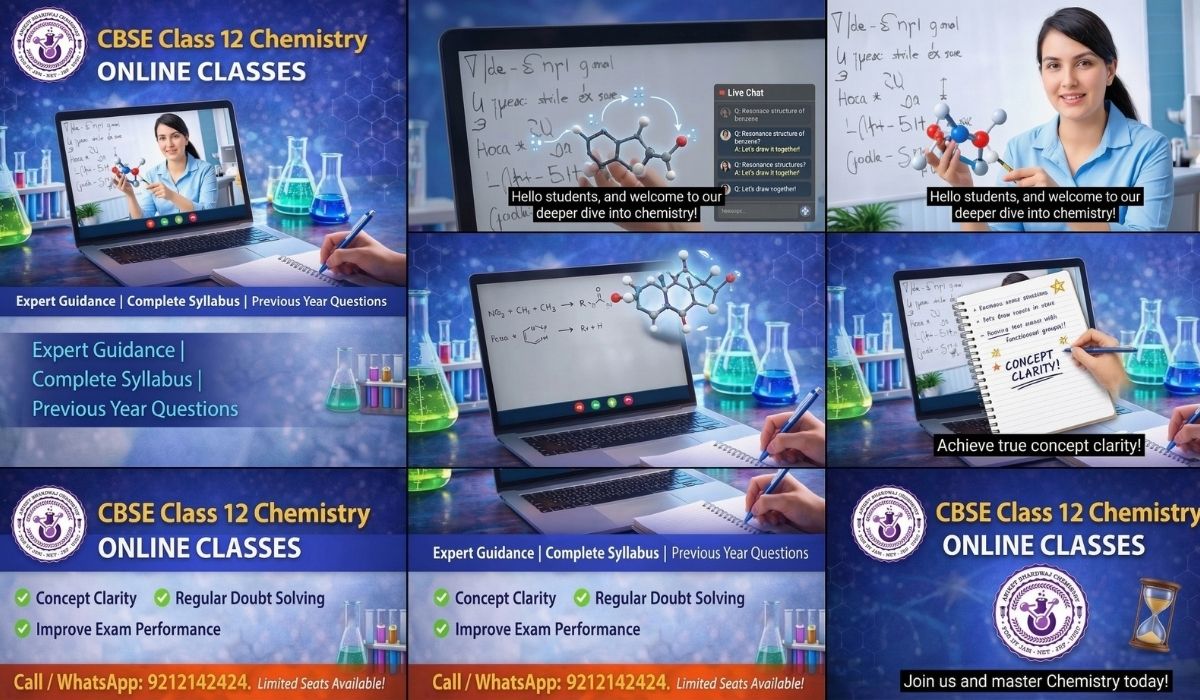
IIT JAM is the entrance test for an MSc at the IITs and IISc. ABC Chemistry runs IIT-JAM Chemistry as a six-month live online batch, taught by Mr. Aniket Bhardwaj, who has been teaching since 2006. The free trial is a demo class in that same live online format.
The exact timetable and topics of your trial slot are confirmed when you book. Check them then. This post does not promise a fixed schedule. It tells you how to make three hours useful.
Think of the trial as a small audit. You are not there to be impressed. You are there to answer four questions:
- Do I understand the explanation the first time, or do I only nod along?
- Does the teacher start from the basic idea and then move to exam-level problems?
- Can I ask a doubt and get a clear answer?
- Will this routine fit my day for six months?
Write these four questions on the first page of your notebook before the class starts. At the end, give each one a plain yes or no. A written answer is more honest than a feeling.
What to check, and how
The live online batch is described as having the same syllabus map, a weekly test and a doubt hour. Classes are recorded, so a missed class is not lost. Use the trial to see how these parts work together. The table turns each part into a simple check.
| What to look at | What to do in the trial | A good sign |
|---|---|---|
| Concept teaching | Write each idea in your own words after the topic ends | You can redo the idea without looking at notes |
| Problem solving | Attempt each example before the teacher solves it | You can see exactly where your method differs |
| Doubt handling | Ask one real doubt from your own preparation | The answer fixes the root of the confusion |
| Recorded class | Ask how a missed lecture should be revised | You get a clear way to catch up |
| Weekly test | Ask how the test connects to the syllabus map | You know what each test is meant to measure |
After the class, write three lines: one thing you learned, one thing that stayed unclear, and one decision. Do this the same evening, while the class is fresh.
The exam angle for IIT JAM Chemistry
The paper covers physical, organic and inorganic chemistry. Each part rewards a different habit.
- Physical chemistry: numerical accuracy. Set up the equation correctly and keep units consistent.
- Organic chemistry: mechanism thinking. Ask where the electrons move and why.
- Inorganic chemistry: structure and periodic trends. Connect bonding, shape and properties.
Questions often look new, but they use textbook ideas in a slightly changed form. A student who only memorises answers gets stuck. A student who knows the reason can adapt. So judge a trial class by whether it builds reasoning, not by how fast it covers material.
Practise under time pressure too. Knowing a topic is one skill. Solving it calmly in limited time is another. A weekly test exists to train the second skill.
Before you plan your preparation, read the official syllabus for your session. Syllabi change every year, so confirm it on the institute's own page. Our syllabus page lists official links only and does not copy anyone's syllabus.
Practice question 1: pH of a mixture
These two questions were written for this post. They are practice questions, not past-paper questions. Try each on paper before you read the solution.
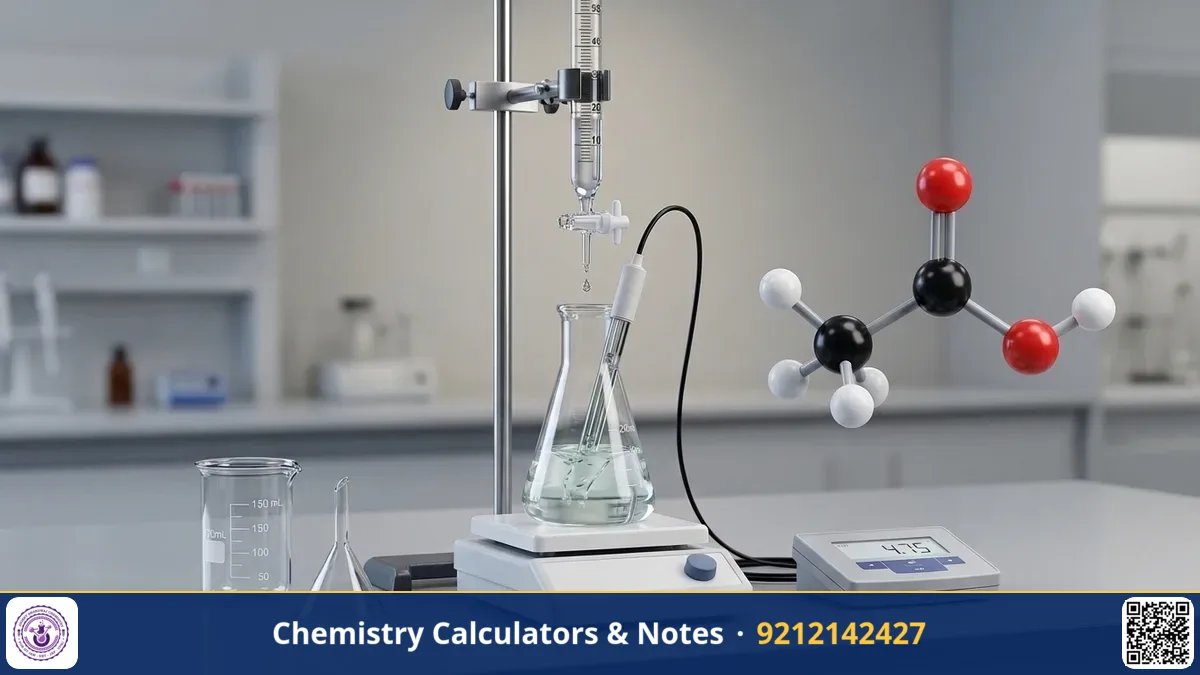
Question. 50 mL of 0.2 M acetic acid is mixed with 50 mL of 0.1 M sodium hydroxide. The pKa of acetic acid is 4.74. Find the pH of the final solution.
Step 1: find the amounts. A mole is a fixed count of particles. We use millimoles, which are one-thousandth of a mole. Millimoles = volume in mL × molarity.
- Acetic acid: 50 × 0.2 = 10 millimoles
- Sodium hydroxide: 50 × 0.1 = 5 millimoles
Step 2: let them react. Sodium hydroxide reacts with acetic acid in a 1:1 ratio and gives sodium acetate and water.
- Acetic acid left: 10 − 5 = 5 millimoles
- Acetate formed: 5 millimoles
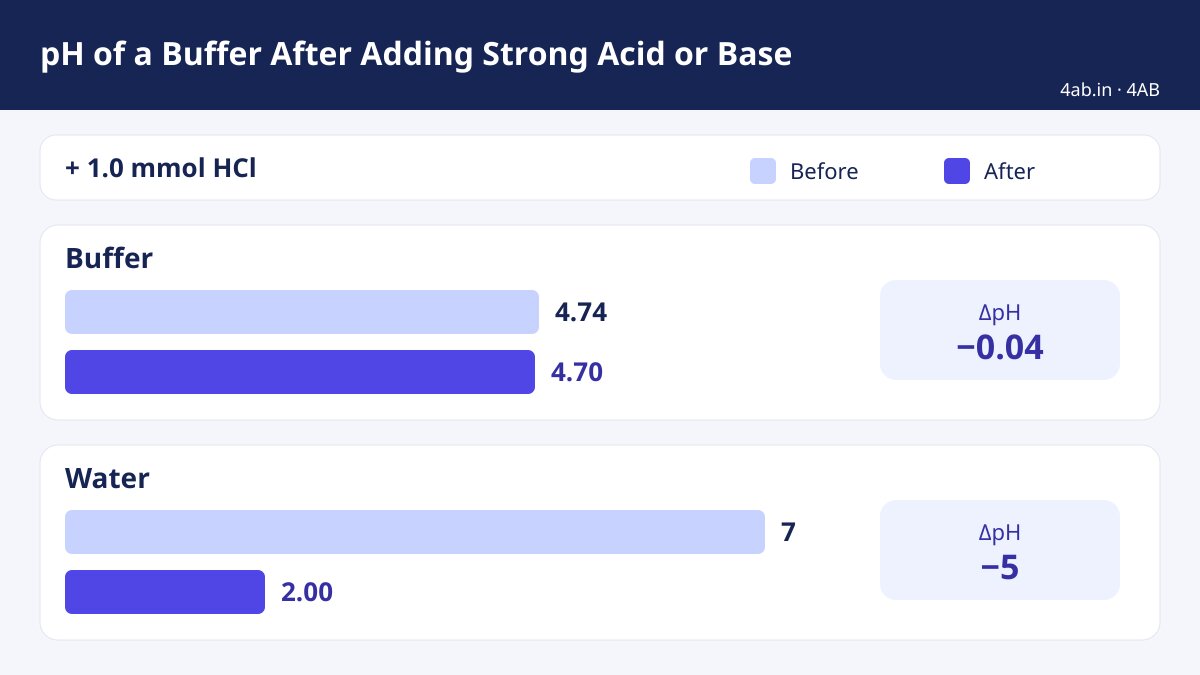
Step 3: spot the buffer. A buffer is a mixture of a weak acid and its salt that resists a change in pH. For such a mixture, use the buffer equation:
pH = pKa + log (salt / acid)
Both species sit in the same final volume, so the ratio of concentrations equals the ratio of millimoles: 5 / 5 = 1. The logarithm of 1 is zero.
pH = 4.74.
Method to keep. When the acid and its salt are present in equal amounts, pH equals pKa. This half-neutralisation point is a quick check in many titration questions.
Practice question 2: first-order kinetics
Question. A first-order reaction is 75% complete in 40 minutes. Find the half-life and the rate constant.
Step 1: recall the key fact. In a first-order reaction, the half-life is constant. It does not depend on how much reactant you start with. Half-life is the time taken for half of the reactant to be used up.
Step 2: count the half-lives. Start with 100 parts of reactant.
- After one half-life: 50 parts remain.
- After two half-lives: 25 parts remain.
If 75% is complete, 25% remains. That is exactly two half-lives.
Step 3: find the half-life. Two half-lives = 40 minutes, so one half-life = 20 minutes.
Step 4: find the rate constant. For a first-order reaction, k = 0.693 / half-life.
k = 0.693 / 20 = 0.0347 min-1 (about 3.5 × 10⁻² min-1).
Check. Use the integrated form, k = (2.303 / t) × log (initial / remaining) = (2.303 / 40) × log 4. Since log 4 is about 0.602, k = 0.0576 × 0.602 = 0.0347 min-1. Both routes agree.
Method to keep. For first-order problems, first try to count half-lives. It saves time and removes logarithm errors. Use the integrated form only when the percentage is not a neat power of one-half.
A short study plan around the trial
The plan does not need to be complicated. Follow these steps.
- Before the trial: Pick one topic you find weak. Solve two problems from it and mark where you got stuck. Bring that exact doubt to the class.
- During the trial: Attempt every example before the solution. Write one line of reasoning for each step.
- Within 24 hours: Redo the same problems without notes. Whatever you cannot redo is your real gap.
- Next week: Fix a daily slot. Split it among physical, organic and inorganic chemistry so that no part is left for the end.
- Every weekend: Take a timed test, however short. For each error, write its cause: concept, calculation or careless reading.
Be honest with yourself at the end of the trial. If the class helped you think more clearly, joining the batch is a reasonable next step. If it did not, you have lost only three hours and you know what to look for elsewhere.
No class can guarantee a result or a seat. Your steady practice and revision decide that.
Key takeaways
- Treat the free trial as an audit of teaching, doubt handling and routine, not as a lecture to sit through.
- Confirm the exact schedule and topics when you book. Do not assume them.
- Attempt every problem before the solution, and redo it without notes within a day.
- In a buffer, equal acid and salt means pH equals pKa.
- In first-order kinetics, count half-lives before using any formula.
Frequently asked questions
Who is the IIT-JAM Chemistry batch for?
It is for students aiming at an MSc at the IITs and IISc through IIT JAM. It runs as a six-month live online batch.
Is the trial class live or recorded?
ABC Chemistry teaches live online. Classes are also recorded, so a missed class is not lost. Confirm the details of your own trial slot when you book.
What should I keep ready for the trial?
Keep a notebook, a pen and one real doubt from your preparation. Also arrange a stable internet connection and a quiet place to study.
Does the batch include tests and doubt support?
The live online batch is described as having the same syllabus map, a weekly test and a doubt hour. Ask how each works during your trial.
Can the trial guarantee a good rank?
No. A trial only helps you judge the teaching style. Your result depends on your practice, your revision and how you handle the paper on the day.