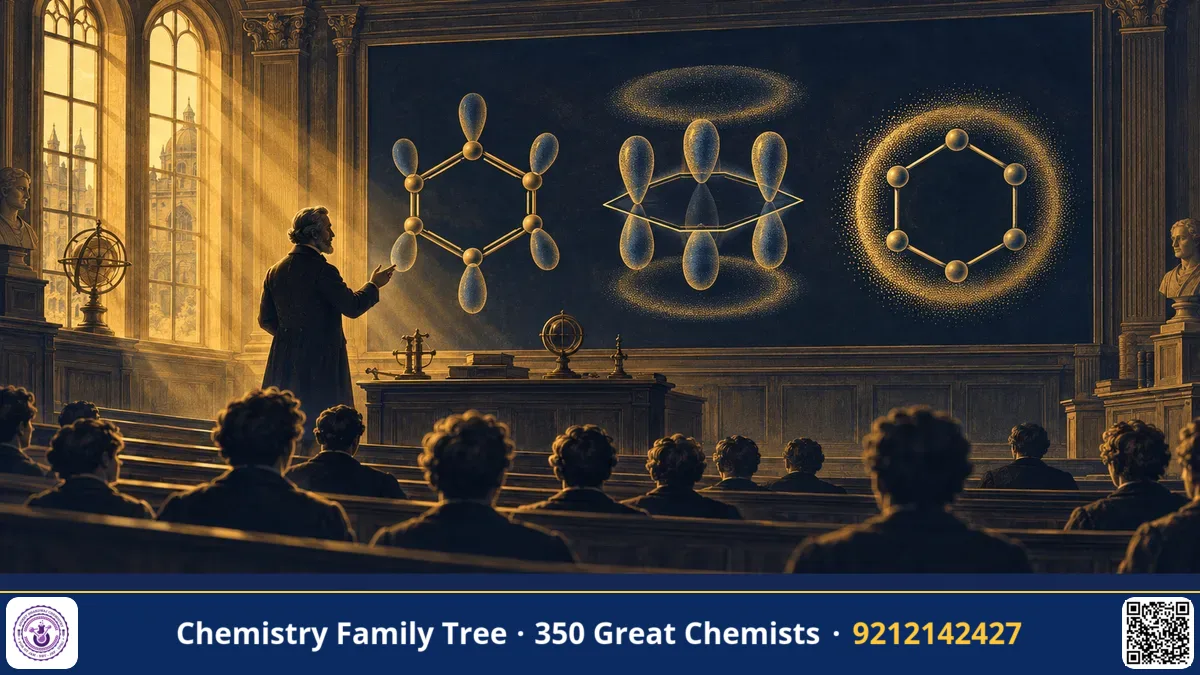







Hückel MO theory: calculating delocalization energy
A step-by-step method to write the Hückel secular determinant, solve for orbital energies and find delocalization energy, with two worked practice questions.
This post gives you a fixed method to write a Hückel secular determinant and solve it.
You will then use the roots to find the delocalization energy of butadiene, benzene and cyclobutadiene.
What Hückel theory assumes
Hückel molecular orbital (HMO) theory is a simple way to find the π molecular orbitals of conjugated molecules. A conjugated molecule has alternating single and double bonds, so the p orbitals overlap across several atoms. Learn the assumptions below, because every step of the method follows from one of them.
- The σ framework and the π system are separated. Only the p orbitals on the sp2 carbons are used.
- Each π molecular orbital is a linear combination of these p orbitals (LCAO).
- The integral α is the same for every carbon atom. It is the energy of an electron in an isolated carbon p orbital.
- The resonance integral β is the interaction between p orbitals on bonded neighbours. For atoms that are not bonded, it is set to zero.
- The overlap between different p orbitals is taken as zero.
Both α and β are negative energies. So a larger positive coefficient of β means a lower, more stable energy. Many students lose marks on this sign point.
The method: from structure to secular determinant
The secular determinant comes from the equations that fix the orbital energies. Setting it to zero gives the allowed energies. Follow these steps every time.
- Number the carbon atoms of the π system.
- Write an n × n determinant for n atoms. Each diagonal entry is α − E.
- Each off-diagonal entry is β if the two atoms are bonded, and 0 if they are not.
- Divide every entry by β and put x = (α − E)/β. Diagonal entries become x. Bonded entries become 1.
- Expand the determinant and solve for x.
- Convert each root back using E = α − xβ.
- Arrange the energies from lowest to highest. Place the π electrons, two per orbital, from the bottom.
Check your work by counting. A system of n atoms must give n roots. For a linear chain, the roots come in pairs of equal size and opposite sign.
Defining delocalization energy
Delocalization energy (DE) is the extra π stabilisation that conjugation gives in this model:
DE = Eπ(conjugated molecule) − Eπ(localised reference)
The localised reference is the same number of electrons placed in isolated ethene-type double bonds. One ethene unit has two π electrons in a level at α + β, so its π energy is 2α + 2β. Because β is negative, a larger positive multiple of β means more stabilisation.
When the electron count is the same, the α terms cancel. So in practice you compare only the coefficients of β.
Energy patterns you should remember
Expanding a determinant for every question wastes time. Two standard results save it and also let you check your roots.
- Linear polyene with n carbons: Ek = α + 2β cos(kπ/(n + 1)), where k = 1, 2, … n.
- Cyclic polyene with n carbons: Ek = α + 2β cos(2πk/n), where k = 0, 1, … n − 1.
The table gives exact values. A surd such as √5 is kept as it is, because it is exact and quicker to handle than a decimal.
| Molecule | π electrons | Orbital energies | Total π energy | Delocalization energy |
|---|---|---|---|---|
| Ethene | 2 | α + β, α − β | 2α + 2β | Reference |
| Allyl cation | 2 | α + √2β, α, α − √2β | 2α + 2√2β | (2√2 − 2)β |
| Butadiene | 4 | x = ±(1 + √5)/2 and ±(√5 − 1)/2 in E = α − xβ | 4α + 2√5β | (2√5 − 4)β |
| Cyclobutadiene | 4 | α + 2β, α, α, α − 2β | 4α + 4β | 0 |
| Benzene | 6 | α + 2β, α + β (two), α − β (two), α − 2β | 6α + 8β | 2β |
Look at the cyclic cases. Benzene gains a lot, while cyclobutadiene gains nothing. This matches the aromatic and antiaromatic behaviour you study in organic chemistry.
Exam angle
This topic belongs to the physical and quantum chemistry part of CSIR-NET, GATE, IIT-JAM and CUET-PG preparation. Questions are usually of these types:
- Write the secular determinant for a given molecule or ion.
- Give the energy of a particular orbital, or name the highest filled and the lowest empty orbital.
- Calculate the total π energy or the delocalization energy.
- Compare two species, for example the cation, radical and anion of the same chain.
Syllabus wording differs from one university to another. For a university MSc entrance test, open that university's own chemistry syllabus and check whether Hückel theory is named. The syllabus page on ABC Chemistry's site collects official syllabus links for Indian universities. Syllabi change every year, so confirm the current session on the university's own page.
Practice question 1: butadiene
These are practice questions written for this post. They are not past-paper questions.
Question. Using Hückel theory, find the π orbital energies of 1,3-butadiene and its delocalization energy.
Step 1: determinant. Number the carbons 1 to 4 in a chain. Only 1–2, 2–3 and 3–4 are bonded. After dividing by β:
| x 1 0 0 |
| 1 x 1 0 |
| 0 1 x 1 |
| 0 0 1 x | = 0
Step 2: expand. The expansion gives x4 − 3x2 + 1 = 0.
Step 3: solve. Treat it as a quadratic in x2. Then x2 = (3 ± √5)/2. Note that (3 + √5)/2 = ((1 + √5)/2)2 and (3 − √5)/2 = ((√5 − 1)/2)2. So x = ±(1 + √5)/2 and ±(√5 − 1)/2.
Step 4: energies. With E = α − xβ, the levels from the bottom are α + ((1 + √5)/2)β, α + ((√5 − 1)/2)β, then the same two with the sign of β reversed. The cosine formula with k = 1 to 4 gives the same set.
Step 5: fill. Four π electrons fill the two lowest levels. Add the two coefficients: (1 + √5)/2 + (√5 − 1)/2 = √5. So Eπ = 2α + 2α + 2√5β = 4α + 2√5β.
Step 6: reference. Two isolated ethene units give 2(2α + 2β) = 4α + 4β.
Answer. DE = (2√5 − 4)β. Since √5 is a little more than 2, this is a small positive multiple of β, well below the 2β of benzene.
Practice question 2: cyclobutadiene
Question. Find the π energy and delocalization energy of cyclobutadiene (square, four carbons). Comment on its stability.
Step 1: determinant. Each carbon is bonded to two neighbours, and atoms 1 and 4 are also bonded:
| x 1 0 1 |
| 1 x 1 0 |
| 0 1 x 1 |
| 1 0 1 x | = 0
Step 2: roots. The cyclic formula with n = 4 gives cos values of 1, 0, −1 and 0. So E = α + 2β, α, α and α − 2β. The middle two levels are degenerate (same energy).
Step 3: fill. Two electrons go into α + 2β. The other two enter the degenerate pair, one in each orbital with parallel spins. Pairing starts only after each degenerate orbital has one electron.
Step 4: energy. Eπ = 2(α + 2β) + 2α = 4α + 4β.
Step 5: compare. Two isolated double bonds also give 4α + 4β. So DE = 0.
Comment. Delocalization gives no stabilisation here. Two electrons also sit in non-bonding orbitals, whose energy is α. This agrees with cyclobutadiene being antiaromatic. Benzene, by the same method, gains 2β.
Study plan
Spend about a week on this topic, in short daily sessions.
- Day 1: Revise the assumptions and the meaning of α and β. Write the determinant for ethene, allyl and butadiene without looking.
- Day 2: Solve butadiene and benzene by hand. Then check with the two cosine formulas.
- Day 3: Practise filling electrons for the cation, radical and anion of the allyl system. The energy levels do not change; only the occupancy does.
- Day 4: Calculate delocalization energies for four or five molecules. Always compare against isolated ethene units.
- Day 5: Attempt timed questions. For multiple-choice papers, use the patterns from the table instead of expanding large determinants.
- Day 6: Revise the errors in your notebook, such as mixing up x = (α − E)/β with its reverse when converting back to energy.
Key takeaways
- Hückel theory uses only the π system, with α on the diagonal and β between bonded atoms.
- Substitute x = (α − E)/β, solve the determinant, and convert with E = α − xβ.
- Delocalization energy is the π energy of the molecule minus the π energy of the same electrons in isolated ethene-type bonds.
- Butadiene gains (2√5 − 4)β, benzene gains 2β, and cyclobutadiene gains nothing.
- Use the cosine formulas to check your roots before you fill electrons.
Frequently asked questions
Why is β negative?
β represents the stabilising interaction between bonded p orbitals, so it is a negative energy. A larger positive multiple of β in an energy expression therefore means a lower, more stable orbital.
Do I need to include α in the delocalization energy?
Not usually. If the number of π electrons is the same in the molecule and the reference, the α terms cancel, and the answer is a multiple of β.
What does a degenerate pair of orbitals change?
It changes how you fill electrons. Put one electron in each degenerate orbital first, with parallel spins, before pairing. Cyclobutadiene is the standard example.
Is the Hückel result exact?
No. It is a simple model that ignores electron repulsion and overlap. It is useful for comparing trends, such as the stability of conjugated systems, and examinations use it in that way.
Which syllabus should I follow for this topic?
Follow the syllabus of the exam or university you are preparing for. Check its official page for the current session, since syllabi change.