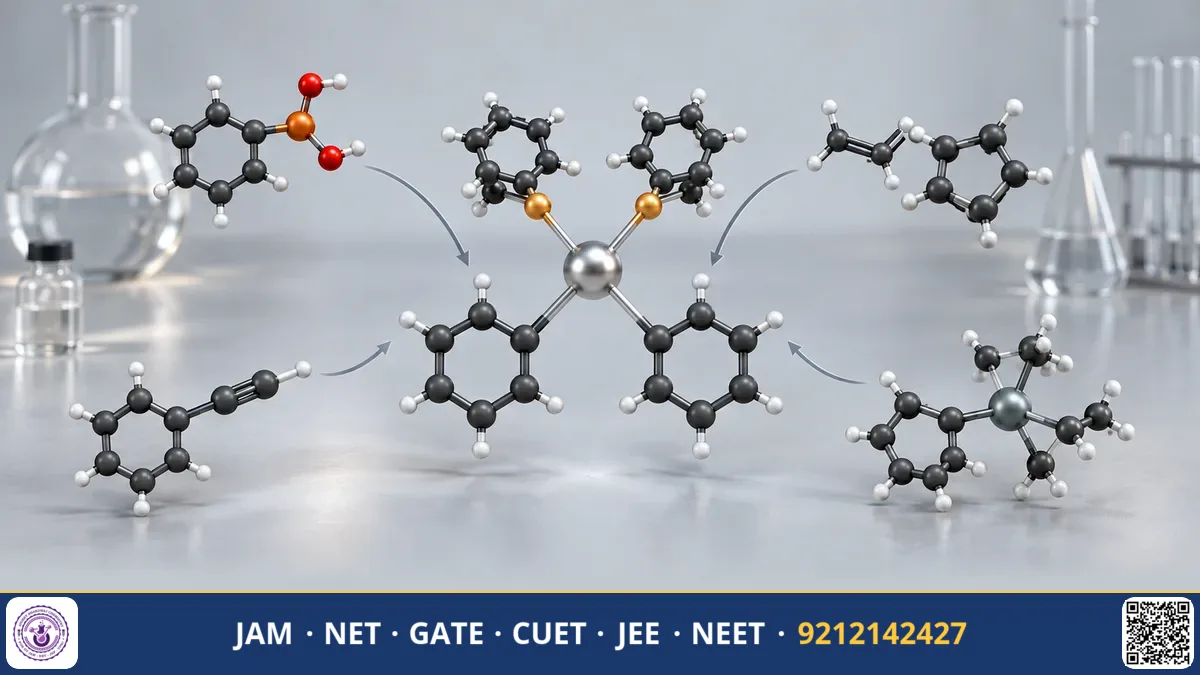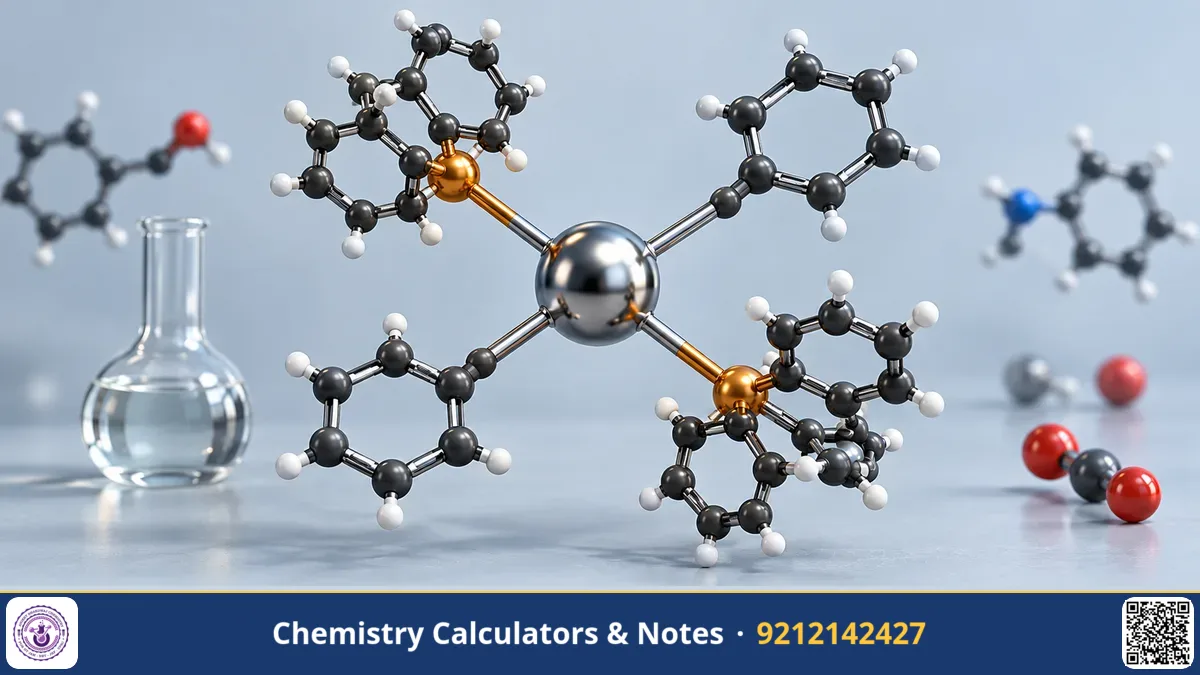





Mechanisms of Suzuki, Heck and Sonogashira Palladium Couplings
Master Suzuki, Heck, and Sonogashira palladium coupling mechanisms, catalytic cycles, practice questions, and study tips for MSc chemistry tests.
This post explains the catalytic cycles, scopes, and stereochemistry of Suzuki, Heck, and Sonogashira cross-couplings. You will also find two fully worked practice questions and a structured revision plan for master's entrance tests.
Fundamental steps in palladium catalytic cycles
Palladium-catalyzed cross-couplings join two carbon fragments using an active palladium(0) complex. Precatalysts in the +2 oxidation state are first reduced in situ to generate a 14-electron palladium(0) species. The catalytic cycle proceeds through three main steps:
- Oxidative addition: Palladium(0) inserts into a C(sp2)–X bond of an aryl or vinyl substrate. Palladium oxidizes from Pd(0) to Pd(II), increasing its coordination number from two to four. The reaction rate follows the leaving group order: I > OTf ≈ Br >> Cl. Electron-withdrawing substituents accelerate this step.
- Transmetallation: An organic group from an organometallic partner transfers to the palladium(II) intermediate, displacing the halide. In the Heck reaction, alkene coordination and migratory insertion replace this step.
- Reductive elimination: The two organic groups couple to form a new carbon-carbon bond, releasing the product and regenerating the palladium(0) catalyst. The two coupling partners must sit mutually cis on the metal center.
Substrates with beta-hydrogens on sp3 carbons are avoided because they undergo rapid beta-hydride elimination, producing unwanted alkene by-products.
Mechanisms and scope of Suzuki, Heck, and Sonogashira couplings
Each reaction adapts the general palladium cycle to a specific organic nucleophile.
Suzuki coupling: This reaction joins an aryl or vinyl halide with an organoboron reagent in the presence of a base. Neutral organoboron compounds are stable but lack sufficient nucleophilicity to transmetallate. The added base coordinates to boron, forming an activated four-coordinate boron complex that transfers its organic group smoothly to palladium(II). Alternatively, base exchanges with halide on palladium to yield an organopalladium hydroxide, which accelerates transmetallation. Suzuki couplings proceed with complete retention of double bond geometry at alkenyl carbons.
Heck reaction: The Heck reaction couples an aryl or vinyl halide with an alkene in the presence of a base without transmetallation. After oxidative addition, the alkene coordinates to palladium. Syn-migratory insertion places the aryl group onto the less substituted carbon of an electron-deficient alkene. The intermediate rotates around its carbon-carbon bond to align a beta-hydrogen with palladium in a syn-coplanar geometry. Syn-beta-hydride elimination releases the trans (E)-alkene and a hydridopalladium(II) species. The base neutralizes the acid by-product, regenerating palladium(0).
Sonogashira coupling: This reaction couples terminal alkynes with aryl or vinyl halides using dual palladium and copper catalysis. In the copper cycle, an amine base deprotonates the terminal alkyne with copper(I) iodide assistance, forming a copper(I) acetylide. In the palladium cycle, oxidative addition generates an arylpalladium(II) complex. Transmetallation between copper acetylide and arylpalladium(II) transfers the alkynyl group to palladium. Reductive elimination yields the internal alkyne and returns palladium(0) under mild conditions.
Comparison of the three palladium coupling pathways
The table below summarizes the distinguishing features of each reaction:
| Reaction | Coupling partners | Key elementary step | Role of base or additive | Main product |
|---|---|---|---|---|
| Suzuki | Aryl or vinyl halide with organoboron compound | Transmetallation via four-coordinate boron intermediate | Activates boron toward transfer | Biaryls and conjugated dienes |
| Heck | Aryl or vinyl halide with alkene | Syn-insertion and syn-beta-hydride elimination | Neutralizes acid by-product to regenerate Pd(0) | Substituted (E)-alkenes |
| Sonogashira | Aryl or vinyl halide with terminal alkyne | Transmetallation from copper acetylide | Cu(I) and base generate copper acetylide | Internal alkynes |
Only the Heck reaction requires a beta-hydrogen to complete the catalytic cycle. Suzuki and Sonogashira couplings avoid beta-hydrogens on sp3 carbons to prevent unwanted side reactions.
Exam angle for postgraduate chemical science papers
Examiners in master's and research entrance tests such as CSIR NET, GATE, IIT-JAM, and CUET-PG test your grasp of selectivity and stereochemical outcomes:
- Leaving group selectivity: Oxidative addition occurs selectively at the weakest carbon-halogen bond (I > OTf ≈ Br >> Cl). Polyhalogenated arenes react first at the iodide position.
- Stereochemical retention: Alkenyl halides and alkenyl boron reagents undergo Suzuki coupling with complete retention of (E) or (Z) double bond geometry.
- Heck regiochemistry and geometry: Electron-deficient alkenes direct the aryl group to the less hindered beta-carbon. Subsequent syn-elimination delivers the trans (E)-alkene.
- Retrosynthetic disconnects: Practice identifying the correct organometallic partner and halide precursor required to synthesize a given target molecule.
Worked practice questions
Work through these two practice problems from our chemistry question bank to apply these mechanistic principles.
Practice question 1
Predict the major product when iodobenzene reacts with methyl acrylate in the presence of catalytic palladium(II) acetate, triphenylphosphine, and triethylamine at 80 °C.
Solution:
- Reaction type: Intermolecular Heck coupling between an aryl halide and an electron-deficient alkene.
- Oxidative addition: In situ generated palladium(0) inserts into the C–I bond of iodobenzene to form an arylpalladium(II) complex.
- Syn-migratory insertion: Methyl acrylate coordinates to palladium. The phenyl group migrates to the less hindered beta-carbon via syn-addition.
- Syn-beta-hydride elimination: Bond rotation aligns an alpha-hydrogen syn-coplanar with palladium. Syn-elimination yields methyl (2E)-3-phenylprop-2-enoate (methyl cinnamate).
- Catalyst regeneration: Triethylamine neutralizes hydroiodic acid, returning palladium(0) to the catalytic cycle.
Final answer: Methyl (2E)-cinnamate.
Practice question 2
Determine the major product when 1-bromo-4-iodobenzene reacts with one equivalent of phenylacetylene at room temperature in the presence of catalytic [Pd(PPh3)2Cl2], copper(I) iodide, and triethylamine.
Solution:
- Reaction type: Coupling an aryl halide with a terminal alkyne using palladium, copper(I), and an amine base is a Sonogashira reaction.
- Chemoselectivity: The substrate contains both C–I and C–Br bonds. Palladium(0) undergoes oxidative addition selectively at the weaker C–I bond under mild conditions.
- Coupling: Copper(I) iodide and triethylamine form copper(I) phenylacetylide. Transmetallation onto arylpalladium(II) followed by reductive elimination delivers 1-bromo-4-(phenylethynyl)benzene, leaving the bromo group intact.
Final answer: 1-bromo-4-(phenylethynyl)benzene.
Structured study plan for cross-coupling reactions
Follow this four-step revision plan to prepare for organometallic questions:
- Step 1: Master elementary steps. Practice writing electron counts and oxidation states for oxidative addition, transmetallation, and reductive elimination.
- Step 2: Draw catalytic cycles. Sketch complete catalytic cycles for Suzuki, Heck, and Sonogashira couplings from memory, noting the specific role of each base and additive.
- Step 3: Drill stereochemistry and regiochemistry. Practice predicting (E) versus (Z) outcomes in Heck couplings and retention of double bond geometry in Suzuki reactions.
- Step 4: Solve retrosynthesis problems. Practice selecting the optimal coupling precursors and chemoselective leaving groups for target biaryls and conjugated systems.
Key takeaways
- All three couplings start with oxidative addition of palladium(0) into a C(sp2)–X bond (reactivity: I > OTf ≈ Br >> Cl).
- Suzuki coupling requires a base to form an activated four-coordinate boron intermediate for transmetallation.
- Heck coupling avoids transmetallation, proceeding via syn-migratory insertion and syn-beta-hydride elimination to yield trans (E)-alkenes.
- Sonogashira coupling relies on a copper(I) co-catalyst to generate a copper acetylide for transmetallation at room temperature.
- Suzuki and Sonogashira couplings retain the stereochemistry of alkenyl coupling partners.
Frequently asked questions
Why does the Suzuki reaction require a base?
Neutral organoboron compounds do not readily undergo transmetallation. The base coordinates to boron to form a negatively charged intermediate that accelerates transfer of the organic group to palladium.
Why does the Heck reaction favor trans (E) alkenes?
Syn-beta-hydride elimination requires palladium and a beta-hydrogen to be coplanar. Rotation into the lowest-energy conformer minimizes steric clash between substituents, selectively delivering the trans (E) isomer.
What is the role of copper(I) iodide in Sonogashira coupling?
Copper(I) coordinates to the alkyne, increasing the acidity of the terminal proton. The amine base deprotonates it to form a copper(I) acetylide, which transmetallates smoothly onto palladium.
Why are alkyl halides with beta-hydrogens avoided in cross-coupling?
Alkylpalladium intermediates with beta-hydrogens undergo rapid beta-hydride elimination, producing alkene side products instead of cross-coupled compounds.