Q1 · Dec 2019 · 2 marks
Consider the following statements for Allred-Rochow electronegativity (\chiAR): (i) \chiAR is directly proportional to Z_{\mathrm{eff}} (ii) \chiAR is inversely proportional to Z_{\mathrm{eff}} (iii) \chiAR is inversely proportional to r(covalent). (iv) \chiAR is inversely proportional to r^2(covalent). The correct statements are
- (a) (i) and (iv)
- (b) (ii) and (iv)
- (c) (i) and (iii)
- (d) (ii) and (iii)
Show answer
Answer: (a)
Report an error in ABC26IN0074
Q2 · June 2019 · 2 marks
\mathrm{O}_{2}^{-} is
- (a) having a shorter \mathrm{O}-\mathrm{O} bond length than that in \mathrm{O}_{2}
- (b) a stronger oxidising agent than \mathrm{O}_{2}
- (c) IR active
- (d) unable to abstract proton from weak acids
Show answer
Answer: (b)
Report an error in ABC26IN0972
Q3 · June 2019 · 2 marks
Among the following, the correct statement about \pi-molecular orbitals ( \pi-MOs) of benzene is
- (a) Only the lowest energy MO is doubly degenerate
- (b) Only LUMO is doubly degenerate
- (c) Only HOMO is doubly degenerate
- (d) Both the HOMO and LUMO are doubly degenerate.
Show answer
Answer: (d)
Report an error in ABC26IN0973
Q4 · Dec 2019 · 2 marks
The ion having the highest bond order is
- (a) \mathrm{NO}^{+} \mathrm{NF}_{3}>\mathrm{SbF}_{3}>\mathrm{SbCl}_{3}
- (b) \mathrm{O}_{2}^{+} \mathrm{SbCl}_{3}>\mathrm{SbF}_{3}>\mathrm{NF}_{3}
- (c) \mathrm{N}_{2}^{+} \mathrm{SbF}_{3}>\mathrm{SbCl}_{3}>\mathrm{NF}_{3}
- (d) \mathrm{C}_{2}^{+} 8 \mathrm{NF}_{3}>\mathrm{SbCl}_{3}>\mathrm{SbF}_{3}
Show answer
Answer: (a)
Report an error in ABC26IN0975
Q5 · Dec 2019 · 2 marks
The magnitude of bond angles in gaseous \mathrm{NF}_{3}, \mathrm{SbF}_{3} and \mathrm{SbCl}_{3} follow the order
- (a) \mathrm{NF}_{3}>\mathrm{SbF}_{3}>\mathrm{SbCl}_{3}
- (b) \mathrm{SbCl}_{3}>\mathrm{SbF}_{3}>\mathrm{NF}_{3}
- (c) \mathrm{SbF}_{3}>\mathrm{SbCl}_{3}>\mathrm{NF}_{3}
- (d) \mathrm{NF}_{3}>\mathrm{SbCl}_{3}>\mathrm{SbF}_{3}
Show answer
Answer: (d)
Report an error in ABC26IN0976
Q6 · Dec 2019 · 2 marks
The species for which the shapes (geometry) can be predicted by VSEPR theory is/are
- (a) \left[\mathrm{PtCl}_{4}\right]^{2-} A and C
- (b) \left[\mathrm{TeCl}_{6}\right]^{2-} B and C
- (c) \mathrm{PF}_{3} and \mathrm{SF}_{6} C only
- (d) A and B
Show answer
Answer: (c)
Report an error in ABC26IN0977
Q7 · Dec 2019 · 2 marks
Choose the correct order of energy of 2 \sigma_{\mathrm{g}} and 1 \pi_{0} molecular orbitals for \mathrm{B}_{2}, \mathrm{C}_{2} and \mathrm{O}_{2} :
- (a) 2 \sigma_{\mathrm{g}}>1 \pi_{\mathrm{u}} for all the three
- (b) 2 \sigma_{\mathrm{g}}>1 \pi_{\mathrm{u}} for \mathrm{B}_{2} and \mathrm{C}_{2} only
- (c) 1 \pi_{\mathrm{u}}>2 \sigma_{\mathrm{g}} for \mathrm{C}_{2} and \mathrm{O}_{2} only
- (d) 2 \sigma_{g}>1 \pi_{u} for \mathrm{B}_{2} and \mathrm{O}_{2} only
Show answer
Answer: (b)
Report an error in ABC26IN0978
Q8 · Dec 2019 · 2 marks
Consider the following statements for Allred-Rochow electronegativity (AR): (i) AR is directly proportional to \mathrm{Z}_{\text {eff }} (ii) AR is inversely proportional to \mathrm{Z}_{\text {eff }} (iii) AR is inversely proportional to r(covalent) (iv) AR is inversely proportional to \mathrm{r}^{2} (covalent) The correct statements are
- (a) (i) and (iv)
- (b) (ii) and (iv)
- (c) (i) and (iii)
- (d) (ii) and (iii)
Show answer
Answer: (a)
Report an error in ABC26IN0980
Q9 · Dec 2019 · 2 marks
The total bond order between adjacent carbon atoms of benzene is
- (a) 0.5
- (b) 2
- (c) 1.5
- (d) 2.5
Show answer
Answer: (c)
Report an error in ABC26IN0981
Q10 · June 2018 · 2 marks
Removal of an electron form NO molecule results in
- (a) An increase in the \overline{\mathbf{v}} (NO) in the IR spectrum
- (b) An EPR active species
- (c) Electrons in HOMOs being closer to the oxygen than to nitrogen 2p orbital's
- (d) Electrons in HOMOs being closer to the nitrogen than to oxygen 2p orbital's
Show answer
Answer: (b)
Report an error in ABC26IN0966
Q11 · Dec 2018 · 2 marks
Among \mathrm{SiCl}_{4}, \mathrm{P}(\mathrm{O}) \mathrm{Cl}_{3}, \mathrm{NF}_{3}, trans- \left[\mathrm{SnCl}_{4}(\mathrm{py})_{2}\right] (py-pyridine), those with zero dipole moment are
- (a) \mathrm{SiCl}_{4}, and \mathrm{NF}_{3}
- (c) \mathrm{SiCl}_{4}, and trans- \mathrm{SnCl}_{4}(\mathrm{py})_{2}
- (b) \mathrm{SiCl}_{4}, \mathrm{P}(\mathrm{O}) \mathrm{Cl}_{3}, and trans- \mathrm{SnCl}_{4}(\mathrm{py})_{4}
- (d) \mathrm{NF}_{3} and trans- \mathrm{SnCl}_{4}(\mathrm{py})_{2}
Show answer
Answer: (c)
Report an error in ABC26IN0969
Q12 · Dec 2018 · 2 marks
Arrange the following molecules in order of increasing fundamental vibrational frequencies
- (a) \mathrm{O}_{2}^{2-}<\mathrm{O}_{2}^{-}<\mathrm{O}_{2}<\mathrm{O}_{2}^{+}
- (b) \mathrm{O}_{2}<\mathrm{O}_{2}^{+}<\mathrm{O}_{2}^{-}<\mathrm{O}_{2}^{2-}
- (c) \mathrm{O}_{2}^{2-}<\mathrm{O}_{2}^{-}<\mathrm{O}_{2}^{+}<\mathrm{O}_{2}
- (d) \mathrm{O}_{2}^{2+}<\mathrm{O}_{2}<\mathrm{O}_{2}^{-}<\mathrm{O}_{2}^{2+}
Show answer
Answer: (a)
Report an error in ABC26IN0971
Q13 · Dec 2017 · 2 marks
Among \mathrm{ClO}_{3}, \mathrm{XeO}_{3} and \mathrm{SO}_{3}, species with pyramidal shape is/are?
- (a) \mathbf{C l O}_{\mathbf{3}}{ }^{-}and \mathbf{X e O}_{\mathbf{3}}
- (b) \mathbf{X e O}_{\mathbf{3}} and \mathbf{S O}_{\mathbf{3}}
- (c) \mathbf{C l O}_{\mathbf{3}}{ }^{-}and \mathbf{S O}_{\mathbf{3}}
- (d) \mathrm{SO}_{3}
Show answer
Answer: (a)
Report an error in ABC26IN0069
Q14 · Dec 2017 · 2 marks
Geometries of \mathrm{SNF_3} and \mathrm{XeF_2O_2} respectively, are
- (a) square planar and square planar
- (c) square planar and trigonal bipyramidal
- (d) tetrahedral and trigonal bipyramidal
- (b) tetrahedral and tetrahedral
Show answer
Answer: (d)
Report an error in ABC26IN0070
Q15 · June 2017 · 2 marks
Based on VSEPR theory, the predicted shapes of \left[\mathrm{XeF}_{5}\right]^{-}and \mathrm{BrF}_{5} respectively, are
- (a) pentagonal planar and square pyramidal
- (b) square pyramidal and trigonal bipyramidal
- (c) trigonal bipyramidal and square pyramidal
- (d) square pyramidal and pentagonal planar
Show answer
Answer: (a)
Report an error in ABC26IN0960
Q16 · Dec 2017 · 2 marks
Among \mathrm{ClO}_{3}, \mathrm{XeO}_{3} and \mathrm{SO}_{3}, species with pyramidal shape is/are?
- (a) and \mathrm{XeO}_{3}
- (b) \mathrm{XeO}_{3} and \mathrm{SO}_{3}
- (c) and \mathrm{SO}_{3}
- (d) \mathrm{SO}_{3}
Show answer
Answer: (a)
Report an error in ABC26IN0961
Q17 · Dec 2017 · 2 marks
Geometries of \mathrm{SNF_3} and \mathrm{XeF_2O_2} respectively, are
- (a) square planar and square planar
- (b) square planar and trigonal bipyramidal
- (c) tetrahedral and trigonal bipyramidal
- (d) tetrahedral and tetrahedral
Show answer
Answer: (d)
Report an error in ABC26IN0962
Q18 · Dec 2017 · 2 marks
Allred-Rochow electronegativity of an element is
- (a) directly proportional to the effective nuclear charge
- (b) directly proportional to the covalent radius
- (c) inversely proportional to the square of the covalent radius
- (d) directly proportional to the square of the effective nuclear charge
Show answer
Answer: (b)
Report an error in ABC26IN0964
Q19 · Dec 2016 · 2 marks
The oxidation state of gold in the following complex is 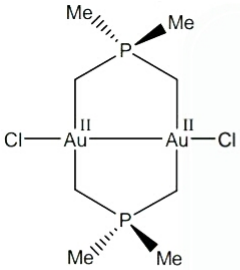
Show answer
Answer: (c)
Report an error in ABC26IN0067
Q20 · Dec 2016 · 2 marks
When a hydrogen atom is placed in an electric field along the y-axis. The magnetic moment i.e electron density will he oriented along y-axis and therefore the orbital that mixes most with the ground state 1 s orbital is 2 \mathrm{p}_{\mathrm{y}}.
- (a) 8, 20 and 14
- (b) 8, 20 and 12 (c)10,12 and 14
- (c) 10, 12 and 12
Show answer
Answer: (a)
Report an error in ABC26IN0068
Q21 · June 2016 · 2 marks
Correct combination for \pi and \pi^{*} orbitals in \mathrm{B}_{2} molecule is - (a) Gerade Ungerade
- (b) Ungerade Gerade
- (c) Gerade Gerade
- (d) Ungerade Ungerade
Show answer
Answer: (b)
Report an error in ABC26IN0954
Q22 · June 2016 · 2 marks
The correct shape of \left[\mathrm{TeF}_{5}\right]^{-1} ion on the basis of VSEPR theory is
- (a) Trigonal bipyramidal
- (b) Square pyramidal
- (c) Pentagonal planar
- (d) See-saw
Show answer
Answer: (b)
Report an error in ABC26IN0955
Q23 · June 2016 · 2 marks
The number of 3c-2e bonds present in \mathrm{Al}\left(\mathrm{BH}_{4}\right)_{3} is-
- (a) four
- (b) three
- (c) six
- (d) zero
Show answer
Answer: (c)
Report an error in ABC26IN0956
Q24 · Dec 2016 · 2 marks
The expected \mathbf{H}-\mathbf{H}-\mathbf{H} bond angle in \left[\mathbf{H}_{3}\right]^{+}is
- (a) 180°
- (b) 120°
- (c) 60°
- (d) \mathbf{9 0}^{\boldsymbol{\circ}}
Show answer
Answer: (c)
Report an error in ABC26IN0957
Q25 · June 2016 · 2 marks
The numbers of triangular faces in square antiprism, icosahedron and tricapped trigonal prism (capped on square faces), respectively, are
- (a) 8, 20 and 14
- (b) 8, 20 and 12
- (c) 10,12 and 14
- (d) 10, 12 and 12
Show answer
Answer: (a)
Report an error in ABC26IN0959
Q26 · Dec 2014 · 2 marks
The geometries of \left[\mathrm{Br}_{3}\right]^{+}and \left[\mathrm{I}_{5}\right]^{+}respectively, are
- (a) trigonal and tetrahedral
- (b) tetrahedral and trigonal bipyramidal
- (c) tetrahedral and tetrahedral
- (d) linear and trigonal pyramidal
Show answer
Answer: (b)
Report an error in ABC26IN0947
Q27 · Dec 2015 · 2 marks
The structures of \mathrm{XeF}_{2} and \mathrm{XeO}_{2} \mathrm{~F}_{2} respectively are
- (a) bent, tetrahedral
- (b) linear, square planar
- (c) linear, see-saw
- (d) bent, see-saw
Show answer
Answer: (c)
Report an error in ABC26IN0948
Q28 · 2011-2020 · 2 marks
The molecule \mathrm{C}_{3} \mathrm{O}_{2} has a linear structure. This compound has
- (a) 4 \sigma and 4 \pi bonds.
- (b) 3 \sigma and 2 \pi bonds
- (c) 2 \pi and 3 \pi bonds
- (d) 3 \sigma and 4 \pi bonds
Show answer
Answer: (a)
Report an error in ABC26IN0949
Q29 · Dec 2015 · 2 marks
The number of lone pair(s) of electrons on the central atom in \mathrm{[BrF_4]^-}, \mathrm{XeF_6} and \mathrm{[SbCl_6]^-} are respectively
- (a) 2, 0 and 1
- (b) 1, 0 and 0
- (c) 2, 1 and 1
- (d) 2, 1 and 0
Show answer
Answer: (c)
Report an error in ABC26IN0952
Q30 · Dec 2015 · 2 marks
The ground state electronic configuration of \mathrm{C}_{2}, using all electron is
- (a) \sigma_{1 \mathrm{~s}}^{2} \sigma_{1 \mathrm{~s}}^{* 2} \sigma_{2 \mathrm{~s}}^{2} \sigma_{2 \mathrm{~s}}^{* 2} \sigma_{2 \mathrm{p}}^{2} \pi_{2 \mathrm{p}}^{2}
- (b) \sigma_{1 \mathrm{~s}}^{2} \sigma_{1 \mathrm{~s}}^{* 2} \sigma_{2 \mathrm{~s}}^{2} \sigma_{2 \mathrm{~s}}^{* 2} \sigma_{2 \mathrm{p}}^{2} \pi_{2 \mathrm{p}}^{* 2}
- (c) \sigma_{1 \mathrm{~s}}^{2} \sigma_{1 \mathrm{~s}}^{* 2} \sigma_{2 \mathrm{~s}}^{2} \sigma_{2 \mathrm{~s}}^{* 2} \pi_{2 \mathrm{p}}^{2} \sigma_{2 \mathrm{p}}^{1} \sigma_{2 \mathrm{p}}^{* 1}
- (d) \sigma_{1 \mathrm{~s}}^{2} \sigma_{1 \mathrm{~s}}^{* 2} \sigma_{2 \mathrm{~s}}^{2} \sigma_{2 \mathrm{~s}}^{* 2} \pi_{2 \mathrm{p}}^{4}
Show answer
Answer: (d)
Report an error in ABC26IN0953
Q31 · June 2014 · 2 marks
The correct non-linear and iso-structural pair is
- (a) \mathrm{SCl}_2 and \mathrm{I}_3^{-}
- (b) \mathrm{SCl}_2, and \mathrm{I}_3^{+}
- (c) \mathrm{SCl}_2, and \mathrm{ClF}_2^{-}
- (d) \mathrm{I}_3^{+} and \mathrm{ClF}_2^{-}
Show answer
Answer: (b)
Report an error in ABC26IN0064
Q32 · June 2014 · 2 marks
The correct non-linear and iso-structural pair is
- (a) \mathrm{SCl}_{2} and \mathrm{I}_{3}^{-}
- (b) \mathrm{SCl}_{2}, and \mathrm{I}_{3}^{+}
- (c) \mathrm{SCl}_{2}, and \mathrm{ClF}_{2}^{-}
- (d) \mathrm{I}_{3}^{+}and \mathrm{ClF}_{2}
Show answer
Answer: (b)
Report an error in ABC26IN0941
Q33 · June 2014 · 2 marks
Structures of \mathrm{SbPh}_{5} and \mathrm{PPh}_{5} respectively are
- (a) trigonal bipyramidal, square pyramidal
- (b) square pyramidal, trigonal bipyramidal
- (c) trigonal bipyramidal, trigonal bipyramidal
- (d) square pyramidal, square pyramidal
Show answer
Answer: (b)
Report an error in ABC26IN0942
Q34 · June 2014 · 2 marks
The maximum bond order obtained from the molecular orbitals of a transition metal dimer, formed as linear combinations of d-orbitals alone, is
Show answer
Answer: (c)
Report an error in ABC26IN0943
Q35 · June 2013 · 2 marks
The number of lone-pairs are identical in the pairs
- (a) \mathrm{XeF}_{4},\ \mathrm{ClF}_{3}
- (b) \mathrm{XeO}_{4},\ \mathrm{ICl}_{4}^{-}
- (c) \mathrm{XeO}_{2}\mathrm{F}_{2},\ \mathrm{ICl}_{4}^{-}
- (d) \mathrm{XeO}_{4},\ \mathrm{ClF}_{3}
Show answer
Answer: (a)
Report an error in ABC26IN0061
Q36 · Dec 2013 · 2 marks
The energy of 2s and 2p orbitals is the same for
- (a) Li
- (b) \mathrm{Li^{+2}}
- (c) \mathrm{Be^{+2}}
- (d) \mathrm{H^{-}}
Show answer
Answer: (b)
Report an error in ABC26IN0063
Q37 · June 2013 · 2 marks
The number of lone-pairs are identical in the pairs
- (a) \mathrm{XeF}_{4}, \mathrm{ClF}_{3}
- (b) \mathrm{XeO}_{4}, \mathrm{ICl}_{4}^{-}
- (c) \mathrm{XeO}_{2} \mathrm{~F}_{2}, \mathrm{ICl}_{4}^{-}
- (d) \mathrm{XeO}_{4}, \mathrm{ClF}_{3}
Show answer
Answer: (a)
Report an error in ABC26IN0935
Q38 · Dec 2013 · 2 marks
The molecule in which the bond order increases upon addition of an electron
- (a) \mathrm{O}_{2} Li
- (b) \mathrm{B}_{2} \mathrm{Li}^{+2}
- (c) \mathrm{P}_{2} \mathrm{Be}^{+2}
- (d) \mathrm{N}_{2} 2 \mathrm{H}^{-}
Show answer
Answer: (b)
Report an error in ABC26IN0937
Q39 · June 2013 · 2 marks
The energy of 2s and 2p orbitals is the same for
- (a) \mathrm{Li}
- (b) \mathrm{Li}^{+2}
- (c) \mathrm{Be}^{+2}
- (d) \mathrm{H}^{-}
Show answer
Answer: (b)
Report an error in ABC26IN0938
Q40 · Dec 2013 · 2 marks
If a homonuclear diatomic molecule is oriented along the Z-axis, the molecular orbital formed by linear combination of px, orbitals of the two atoms is
- (a) \sigma
- (b) \sigma^{*}
- (c) \pi
- (d) \delta
Show answer
Answer: (c)
Report an error in ABC26IN0939
Q41 · Dec 2013 · 2 marks
According to VSEPR theory, the geometry (with lone pair) around the central iodine in \mathrm{I}_{3}^{+}and \mathrm{I}_{3}^{-} ions respectively are
- (a) tetrahedral and tetrahedral
- (b) trigonal bipyramidal and trigonal bipyramedal
- (c) tetrahedral and trigonal bipyramidal
- (d) tetrahedral and octahedral
Show answer
Answer: (c)
Report an error in ABC26IN0940
Q42 · June 2012 · 2 marks
The size of the d orbitals in Si, P, S and Cl follows the order.
- (a) Cl > S > P > Si
- (b) Cl > P > S > Si
- (c) P > S > Si > Cl
- (d) Si > P > S > Cl
Show answer
Answer: (d)
Report an error in ABC26IN0056
Q43 · June 2012 · 2 marks
The decreasing order of dipole moment of molecules is
- (a) \mathrm{NF_3 > NH_3 > H_2O}
- (b) \mathrm{NH_3 > NF_3 > H_3O}
- (c) \mathrm{H_2O > NH_3 > NF_3}
- (d) \mathrm{H_2O > NF_3 > NH_3}
Show answer
Answer: (d)
Report an error in ABC26IN0058
Q44 · Dec 2012 · 2 marks
Which ones among \mathrm{CO}_{3}^{-2}, \mathrm{SO}_{3}, \mathrm{XeO}_{3}, and \mathrm{NO}_{3}^{-1}, have planar structure?
- (a) \mathrm{CO}_{3}^{-2}, \mathrm{SO}_{3}, and \mathrm{XeO}_{3}
- (b) \mathrm{SO}_{3}, \mathrm{XeO}_{3}, and \mathrm{NO}_{3}^{-}
- (c) \mathrm{CO}_{3}^{-2}, \mathrm{XeO}_{3}, and \mathrm{NO}_{3}^{-}
- (d) \mathrm{CO}_{3}^{-2}, \mathrm{SO}_{3}, and \mathrm{NO}_{3}^{-}
Show answer
Answer: (d)
Report an error in ABC26IN0059
Q45 · June 2012 · 2 marks
The total number of lone pairs of electrons in \mathrm{I}_{3}{ }^{-}is:
- (a) Zero
- (b) Three
- (c) Six
- (d) Nine
Show answer
Answer: (d)
Report an error in ABC26IN0929
Q46 · 2012 · 2 marks
The strength of \mathrm{p} \pi-\mathrm{d} \pi bonding in \mathrm{E}-\mathrm{O}(\mathrm{E}=\mathrm{Si}, \mathrm{P}, \mathrm{S} and CI) follows the order
- (a) \mathrm{Si}-\mathrm{O}>\mathrm{P}-\mathrm{O}>\mathrm{S}-\mathrm{O}>\mathrm{Cl}-\mathrm{O}
- (b) \mathrm{P}-\mathrm{O}>\mathrm{Si}-\mathrm{O}>\mathrm{S}-\mathrm{O}>\mathrm{Cl}-\mathrm{O}
- (c) \mathrm{S}-\mathrm{O}>\mathrm{Cl}-\mathrm{O}>\mathrm{P}-\mathrm{O}>\mathrm{Si}-\mathrm{O}
- (d) \mathrm{Cl}-\mathrm{O}>\mathrm{S}-\mathrm{O}>\mathrm{P}-\mathrm{O}>\mathrm{Si}-\mathrm{O}
Show answer
Answer: (d)
Report an error in ABC26IN0930
Q47 · June 2012 · 2 marks
The decreasing order of dipole moment of molecules is
- (a) \mathrm{NF_3 > NH_3 > H_2O}
- (b) \mathrm{NH_3 > NF_3 > H_3O}
- (c) \mathrm{H_2O > NH_3 > NF_3}
- (d) \mathrm{H_2O > NF_3 > NH_3}
Show answer
Answer: (d)
Report an error in ABC26IN0931
Q48 · Dec 2012 · 2 marks
Which ones among \mathrm{CO}_{3}^{-2}, \mathrm{SO}_{3}, \mathrm{XeO}_{3} and \mathrm{NO}_{3}^{-1}, have planar structure?
- (a) \mathrm{CO}_{3}^{-2}, \mathrm{SO}_{3} and \mathrm{XeO}_{3}
- (b) \mathrm{SO}_{3}, \mathrm{XeO}_{3} and \mathrm{NO}_{3}^{-}
- (c) \mathrm{CO}_{3}^{-2}, \mathrm{XeO}_{3} and \mathrm{NO}_{3}^{-}
- (d) \mathrm{CO}_{3}^{-2}, \mathrm{SO}_{3} and \mathrm{NO}_{3}^{-}
Show answer
Answer: (d)
Report an error in ABC26IN0932
Q49 · June 2011 · 2 marks
The highest occupied MO in N_2 and O_2^+ respectively are (take x-axis as internuclear axis)
- (a) \sigma_{2p_x},\ \pi^*_{2p_y}
- (b) \pi_{2p_y},\ \pi_{2p_z}
- (c) \sigma^*_{2p_x},\ \sigma_{2p_x}
- (d) \pi^*_{2p_y},\ \pi^*_{2p_z}
Show answer
Answer: (a)
Report an error in ABC26IN0054
Q50 · 2011-2020 · 2 marks
Among the following, species expected to show fluxional behaviour are (A) \mathrm{[NiCl_4]^{-2}} (tetrahedral) (B) \mathrm{IF_7} (pentagonal bipyramidal) (C) \mathrm{[CoF_6]^{-3}} (octahedral) (D) \mathrm{Fe(CO)_5} (trigonal bipyramidal)
- (a) B and C
- (b) B and D
- (c) C and D
- (d) A and D
Show answer
Answer: (b)
Report an error in ABC26IN0065
Q51 · June 2011 · 2 marks
According to VSEPR theory, the molecule/ion having ideal tetrahedral shape is
- (a) \mathrm{SF}_{4}
- (b) \mathrm{SO}_{4}{ }^{-2}
- (c) \mathrm{S}_{2} \mathrm{Cl}_{2}
- (d) \mathrm{SO}_{2} \mathrm{Cl}_{2}
Show answer
Answer: (b)
Report an error in ABC26IN0923
Q52 · June 2011 · 2 marks
The highest occupied MO in \mathrm{N}_{2} and \mathrm{O}_{2}^{+}respectively are (take x -axis as internuclear axis)
- (a) \sigma_{2 \mathrm{px}}, \pi_{2 \mathrm{py}}^{*}
- (b) \pi_{2 \mathrm{py}}, \pi_{2 \mathrm{pz}}
- (c) \sigma_{2 \mathrm{py}}^{*}, \sigma_{2 \mathrm{px}}
- (d) \pi_{2 \mathrm{py}}^{*}, \pi_{2 \mathrm{pz}}^{*}
Show answer
Answer: (a)
Report an error in ABC26IN0924
Q53 · June 2011 · 2 marks
The molecule with highest number of lone-pairs and has a linear shape based on VSEPR theory is:
- (a) \mathrm{CO}_{2}
- (b) \Gamma_{3}
- (c) \mathrm{NO}_{2}^{-}
- (d) \mathrm{NO}_{2}^{+}
Show answer
Answer: (b)
Report an error in ABC26IN0925