






BET isotherm: multilayer gas uptake and surface area
Learn the BET isotherm: assumptions, linear plot, how to get monolayer amount and surface area, with two worked practice questions and a short study plan.
This post explains the BET equation step by step and shows how a straight-line plot gives you surface area.
You will also solve two practice questions and get a short plan to revise the topic.
Why the single-layer model is not enough
Adsorption means gas molecules stick to the surface of a solid. The solid is the adsorbent. The gas is the adsorbate.
The simplest isotherm (a curve of amount adsorbed against pressure at fixed temperature) assumes only one layer can form. Once every site is filled, nothing more sticks. This suits chemisorption, where molecules bind to the surface by chemical bonds.
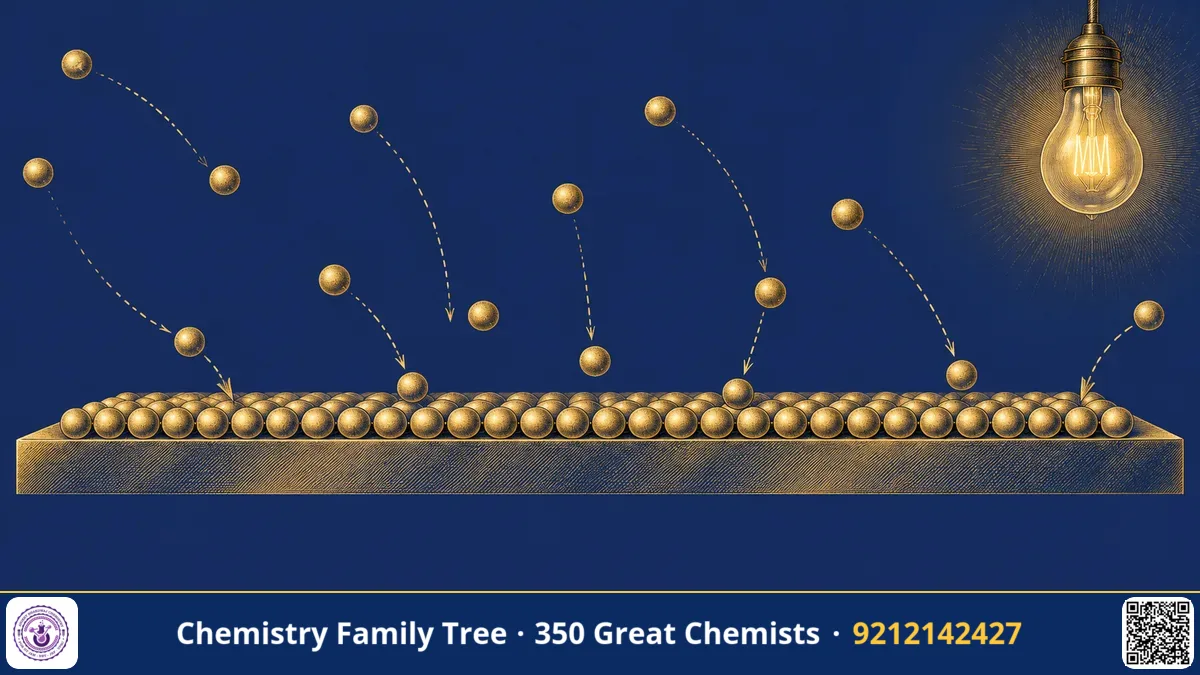
Physisorption is adsorption through weak intermolecular forces. It behaves differently. As the pressure approaches the saturation pressure of the gas, molecules keep piling up in layers. The measured curve rises steeply and does not level off. A single-layer model cannot explain this. The BET model can.
Assumptions behind the BET model
BET is named after the initials of its three proposers. Learn the assumptions, because exam questions often ask which one is wrong or missing.
- The surface is uniform. All sites are equal.
- Molecules can adsorb on top of already adsorbed molecules. Layers can build up without a fixed limit.
- The first layer has its own heat of adsorption. Every layer above it has the heat of liquefaction of the gas.
- Molecules in the same layer do not interact with each other.
- At equilibrium, each layer keeps a constant number of molecules. Molecules join and leave at equal rates.
The third point is the key idea. The second and later layers behave like a liquid, so the gas sticks to itself the way it condenses.
The BET equation and its linear form
The linear form used in calculations is:
P / [n(P0 − P)] = 1/(nmc) + [(c − 1)/(nmc)] × (P/P0)
Here is what each symbol means.
- P is the equilibrium pressure of the gas.
- P0 is the saturation vapour pressure of the gas at the temperature of the experiment.
- n is the amount of gas adsorbed at pressure P. Some books use volume instead of moles. The algebra is the same.
- nm is the amount needed to cover the surface with exactly one layer.
- c is a constant. It grows as the first-layer heat of adsorption becomes larger than the heat of liquefaction.
This has the form y = intercept + slope × x. So plot y = P/[n(P0 − P)] on the vertical axis and x = P/P0 on the horizontal axis.
Two short results follow from the slope and intercept:
- Slope + intercept = 1/nm, so nm = 1/(slope + intercept).
- Slope ÷ intercept = c − 1, so c = 1 + slope/intercept.
Check the algebra once yourself. Add the intercept and the slope. The two terms combine to give 1/nm, because the factor c cancels. Once you have done this, you will not forget the formula.
Using the straight line properly
The BET equation fits real data only over a limited middle range of P/P0. At very low pressure the surface is not uniform. At high pressure the assumptions break down and the points bend away from the line. Use only the points in the straight region. In a question, the points to be used are normally given to you.
The area covered by one adsorbed molecule is also given in a question. Do not rely on memory for it. Read the value and its unit carefully, because it is often in nm2 and the answer is wanted in m2.
From monolayer amount to surface area
Follow the same order every time.
- Find nm from the slope and intercept.
- Make sure it is in moles. Convert from mmol if needed.
- Multiply by the Avogadro constant, 6.022 × 10²³ mol−1. This gives the number of molecules in the monolayer.
- Multiply by the area per molecule. This gives the total surface area.
- Divide by the sample mass to get the specific surface area in m2 g−1.
Remember that 1 nm = 10−9 m, so 1 nm2 = 10−18 m2.
| Feature | Single-layer model | BET model |
|---|---|---|
| Layers | One only | Many |
| Typical use | Chemisorption, low pressure | Physisorption, surface area |
| Heat of adsorption | Same for all sites | First layer differs; later layers equal heat of liquefaction |
| Linear plot | P/n against P | P/[n(P0 − P)] against P/P0 |
| Shape at high pressure | Plateau | Rises steeply |
The exam angle
This topic belongs to the surface chemistry portion of the syllabus for IIT-JAM, CSIR NET, GATE and CUET-PG. Check your own exam's current syllabus before you plan. Questions usually come in a few types.
- Numerical: a slope and intercept are given, and you find nm, c or surface area.
- Conceptual: which assumption is dropped from the single-layer model, or what a large c means.
- Graph reading: identify which axes give a straight line.
- Statement based: true or false about the pressure range and the heat of adsorption.
A common error is using P/P0 as y. Another is forgetting that the intercept is positive and small compared with the slope. A third is forgetting to divide by the sample mass at the end. Always check units before the last step.
Two practice questions
These are practice questions written for revision. They are not past-paper questions. Try each one before reading the solution.
Practice question 1. A BET plot for nitrogen on 1.00 g of a porous solid is a straight line. The y-axis is P/[n(P0 − P)], with n in mmol per gram. The slope is 0.40 g mmol−1 and the intercept is 0.010 g mmol−1. One nitrogen molecule covers 0.16 nm2. Find nm, c and the specific surface area.
Solution.
- nm = 1/(0.40 + 0.010) = 1/0.41 = 2.44 mmol g−1.
- c = 1 + 0.40/0.010 = 1 + 40 = 41.
- Moles per gram = 2.44 × 10⁻³ mol.
- Molecules = 2.44 × 10−3 × 6.022 × 1023 = 1.47 × 10²¹.
- Area = 1.47 × 1021 × 0.16 × 10−18 m2 = 235 m2.
The sample is 1.00 g, so the specific surface area is about 235 m2 g−1.
Practice question 2. For 0.80 g of another solid, n is the total amount adsorbed in mmol for the whole sample. Two points on the linear BET plot are (x, y) = (0.10, 0.070 mmol−1) and (0.30, 0.170 mmol−1), where x = P/P0. Use the same area per molecule as above, 0.16 nm2. Find the specific surface area.
Solution.
- Slope = (0.170 − 0.070)/(0.30 − 0.10) = 0.100/0.20 = 0.50 mmol−1.
- Intercept = 0.070 − 0.50 × 0.10 = 0.020 mmol−1.
- nm = 1/(0.50 + 0.020) = 1.92 mmol. Also c = 1 + 0.50/0.020 = 26.
- Moles = 1.92 × 10⁻³ mol. Molecules = 1.16 × 10²¹.
- Area = 1.16 × 1021 × 0.16 × 10−18 m2 = 185 m2.
- Specific area = 185 / 0.80 = about 232 m2 g−1.
Note the last step. The 185 m2 belongs to the whole 0.80 g sample, so you must divide by the mass.
Study plan
- Day 1: Revise the single-layer isotherm. Write its assumptions and linear form from memory.
- Day 2: Write the BET assumptions. Derive the link between slope, intercept, nm and c.
- Day 3: Solve the two practice questions above without looking at the solutions.
- Day 4: Practise more surface chemistry problems from the chemistry question bank, topic by topic. Note every unit mistake.
- Day 5: Redo your wrong answers. Then attempt a timed set of five questions.
Key takeaways
- BET allows multilayer adsorption. Layers above the first behave like a liquid.
- Plot P/[n(P0 − P)] against P/P0. Use only the straight region.
- nm = 1/(slope + intercept), and c = 1 + slope/intercept.
- Surface area = moles × Avogadro constant × area per molecule. Divide by mass for specific area.
- Check units at every step, especially mmol to mol and nm2 to m2.
Frequently asked questions
What does the constant c tell us?
It reflects how strongly the first layer is held compared with the later layers. A large c means the first layer binds much more strongly than liquefaction would.
Why is the BET method used for surface area?
The straight-line plot gives the amount needed for one complete layer. If you know the area one molecule covers, that amount converts directly into area.
Why not use the whole pressure range for the plot?
The model's assumptions hold only in a middle range of P/P0. Outside it, the points curve away from the line.
Is the intercept positive or negative?
It is positive, since it equals 1/(nmc). A negative intercept in your working means a calculation error.
How is BET different from the single-layer model in one line?
The single-layer model allows one layer and levels off. BET allows many layers and keeps rising as P approaches P0.