





Amines: Basicity Order and Laboratory Distinction Tests
Understand amine basicity trends in gas and aqueous phases, key distinction tests, synthetic conversions, worked practice problems, and an exam study plan.
Mastering amine chemistry requires an exact grasp of basicity, laboratory distinction tests, and synthetic conversions. This guide delivers mechanistic principles, diagnostic methods, solved practice questions, and an actionable study plan for chemical science examinations.
Basicity trends of alkylamines and arylamines
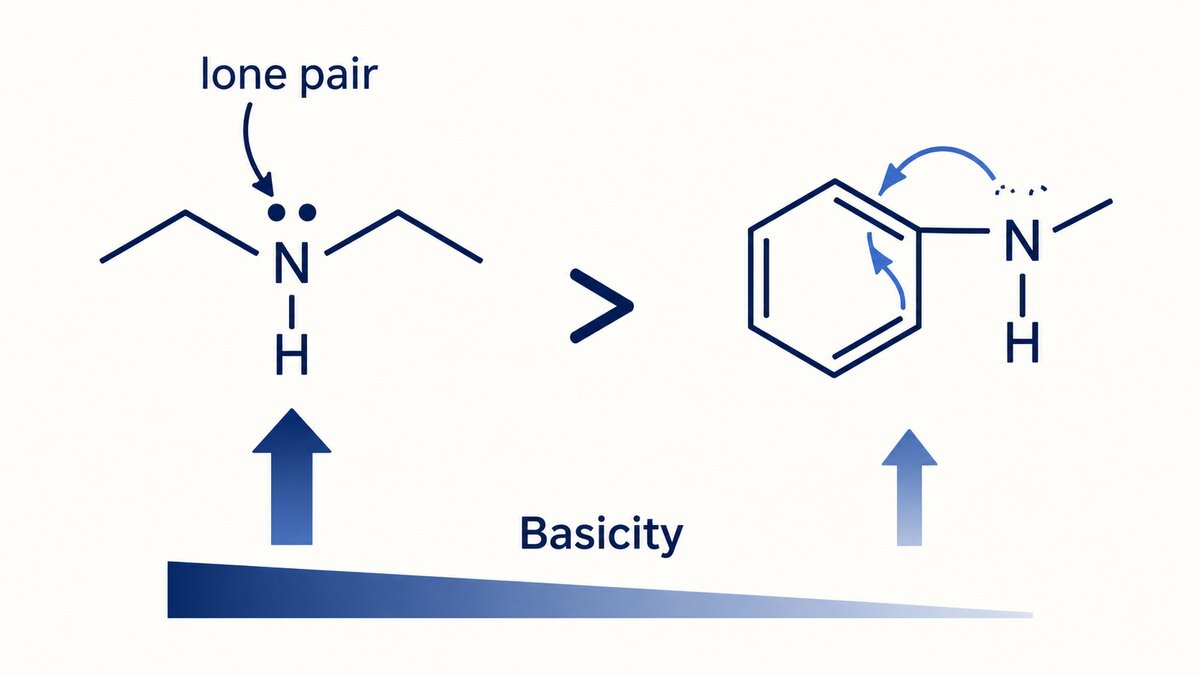
An amine acts as an electron pair donor because nitrogen carries an unshared electron pair. In the gas phase, basicity tracks alkyl inductive electron donation (+I), dispersing positive charge on the conjugate cation: tertiary > secondary > primary > ammonia.
In aqueous solution, basicity balances three factors: inductive release, steric hindrance, and cation hydration. A primary ammonium cation (R-NH3+) forms three hydrogen bonds with water, releasing substantial hydration energy. A secondary cation forms two, and a tertiary cation forms only one. Secondary amines balance inductive stabilization and hydration without excessive steric crowding, making them the strongest aqueous bases.
| Alkyl group | Gas-phase order | Aqueous-phase order |
|---|---|---|
| Methyl (-CH3) | tertiary > secondary > primary > ammonia | (CH3)2NH > CH3NH2 > (CH3)3N > NH3 |
| Ethyl (-C2H5) | tertiary > secondary > primary > ammonia | (C2H5)2NH > (C2H5)3N > C2H5NH2 > NH3 |
Arylamines such as aniline are weaker bases than alkylamines because nitrogen's unshared electron pair delocalises into the benzene ring. Ortho-substituted anilines are weaker bases than aniline regardless of substituent electronic character. This ortho effect arises because steric crowding hinders proton approach and disrupts planar hydration of the anilinium ion.
Laboratory distinction tests for primary, secondary, and tertiary amines
Identifying amine classes in the laboratory relies on hydrogen substitution at nitrogen:
- Benzenesulfonyl chloride test: Reacting an amine with benzenesulfonyl chloride (C6H5SO2Cl) in aqueous potassium hydroxide separates amine classes. A primary amine forms an N-alkylbenzenesulfonamide whose acidic proton dissolves in alkali and reprecipitates on acidification. A secondary amine forms an alkali-insoluble N,N-dialkylbenzenesulfonamide lacking an acidic proton. A tertiary amine does not react in alkali and dissolves only after acidification.
- Carbylamine test: Heating a primary amine with chloroform and alcoholic potassium hydroxide yields an isocyanide (carbylamine) with a foul odour. Secondary and tertiary amines do not react.
- Nitrous acid test: Primary aliphatic amines react with cold nitrous acid (from sodium nitrite and hydrochloric acid) to liberate nitrogen gas quantitatively. Primary aromatic amines form arenediazonium salts that couple with 2-naphthol in alkali to give an orange azo dye. Secondary amines form yellow, oily N-nitrosamines without gas release.
Key synthetic conversions and reaction mechanisms
Synthetic transformations involving nitrogen demand control over carbon-chain length:
- Bromamide degradation: Treating a primary amide with bromine and aqueous alkali expels the carbonyl carbon as carbonate, yielding a primary amine with one fewer carbon atom. The pathway forms an N-bromoamide that undergoes intramolecular 1,2-rearrangement to an alkyl isocyanate (R-N=C=O), followed by hydrolysis with retention of stereochemistry.
- Phthalimide synthesis: Potassium phthalimide undergoes SN2 displacement with a primary alkyl halide to form an N-alkylphthalimide, which on alkaline hydrolysis yields a pure primary aliphatic amine. Aryl halides cannot be used because partial double-bond character prevents substitution.
For chain extension, catalytic reduction of alkyl nitriles (R-CN) using hydrogen over nickel or lithium aluminium hydride yields primary amines with an added carbon unit.
Exam angle in postgraduate chemical science tests
Postgraduate entrance papers such as CSIR NET, GATE, IIT-JAM, and CUET-PG evaluate amine chemistry through multi-step reasoning. Questions frequently test differences between gas-phase proton affinities and aqueous basicity values.
Another common pattern tests structural deduction of isomeric amines using sulfonamide solubility and diazotisation coupling. Always check whether the question specifies gas-phase or solution conditions before ranking basicity, and verify whether a conversion demands carbon-chain shortening or retention.
Worked practice questions from our question bank
Practice question 1 (QID-AM-2026-01): An organic compound A with molecular formula C3H9N yields an insoluble product B when treated with benzenesulfonyl chloride in aqueous potassium hydroxide. Compound A does not liberate nitrogen gas on treatment with cold nitrous acid, producing a yellow oily layer. Deduce the structure of A, identify product B, and explain why B fails to dissolve in aqueous potassium hydroxide.
Solution: With zero unsaturation, C3H9N is a saturated amine. Because compound A forms an alkali-insoluble sulfonamide and a yellow nitrosamine without gas release, it is a secondary amine: N-methylethanamine. Product B is N-ethyl-N-methylbenzenesulfonamide, C6H5SO2N(CH3)(CH2CH3). Product B cannot dissolve in aqueous alkali because it lacks an acidic hydrogen atom on nitrogen to form a soluble salt.
Practice question 2 (QID-AM-2026-02): Propose a sequence to synthesise pure ethanamine from propanenitrile. Specify reagents, identify the reactive intermediate responsible for carbon-chain shortening, and state which diagnostic test confirms the product is free from secondary amine impurities.
Solution: First, partially hydrolyse propanenitrile (CH3CH2CN) with alkaline hydrogen peroxide to obtain propanamide. Second, treat propanamide with bromine and aqueous sodium hydroxide under bromamide degradation conditions to yield ethanamine (CH3CH2NH2). The intermediate responsible for chain shortening is ethyl isocyanate (CH3CH2N=C=O), formed by 1,2-migration of the ethyl group to nitrogen. To confirm the absence of secondary amine impurities, apply the benzenesulfonyl chloride test: ethanamine forms an alkali-soluble sulfonamide, whereas secondary amine impurities remain insoluble.
Four-week study plan for amine chemistry
Follow this four-week framework to master amine chemistry systematically:
- Week 1: Structure and basicity equilibria: Derive gas-phase versus aqueous basicity trends. Practice protonation equilibria and evaluate substituent and ortho effects on substituted anilines.
- Week 2: Diagnostic tests and distinction: Work through problem sets on the benzenesulfonyl chloride test, carbylamine reaction, and nitrous acid pathways to separate unknown isomeric mixtures.
- Week 3: Rearrangement mechanisms and synthesis: Map electron movement for bromamide degradation and phthalimide synthesis, noting stereochemical outcomes.
- Week 4: Timed question-bank practice: Solve chapter-wise problems from our question bank, timing each synthetic conversion and reviewing common test pitfalls.
Key takeaways
- Gas-phase basicity tracks alkyl inductive donation (+I), whereas aqueous basicity reflects induction, steric hindrance, and cation hydration.
- In water, dimethylamine is more basic than methylamine and trimethylamine (secondary > primary > tertiary), while diethylamine is more basic than triethylamine and ethylamine (secondary > tertiary > primary).
- The benzenesulfonyl chloride test differentiates primary, secondary, and tertiary amines by alkali solubility and acid-precipitation behaviour.
- Bromamide degradation shortens the carbon chain by one unit via an isocyanate intermediate, preserving stereochemistry at the migrating centre.
Frequently asked questions
Why is secondary amine more basic than tertiary amine in aqueous medium?
In water, basicity depends on inductive donation and hydration stability of the conjugate cation. Although a tertiary amine has three electron-donating alkyl groups, its cation has only one hydrogen for hydrogen bonding with water. A secondary amine cation has two hydrogens for hydration and less steric hindrance, making its protonated form more stable.
Can aniline be prepared by phthalimide synthesis?
No, aniline cannot be prepared by phthalimide synthesis. The reaction requires an SN2 displacement of a halide by the phthalimide anion. Aryl halides do not undergo SN2 substitution because the carbon-halogen bond possesses partial double-bond character due to resonance with the benzene ring.
Why does an ortho substituent decrease the basicity of aniline?
An ortho substituent decreases aniline basicity through the ortho effect. Steric hindrance near the amino group obstructs proton approach and distorts the conjugate cation out of planarity, preventing stabilising hydration by water molecules.