






Haloalkanes and Haloarenes: SN1 vs SN2 Decision Guide
Master SN1 vs SN2 mechanisms in haloalkanes: decision hierarchy from substrate, solvent, and nucleophile with worked practice questions and study plan.
Deciding between SN1 and SN2 mechanisms in haloalkanes requires evaluating substrate structure, nucleophile strength, and solvent polarity together. This guide provides a direct decision hierarchy, worked practice problems, and an exam study plan.
Mechanisms of nucleophilic substitution
Nucleophilic aliphatic substitution occurs when an electron-rich nucleophile displaces a leaving group from an sp3-hybridised carbon. Two principal pathways govern these reactions: substitution nucleophilic unimolecular (SN1) and substitution nucleophilic bimolecular (SN2).
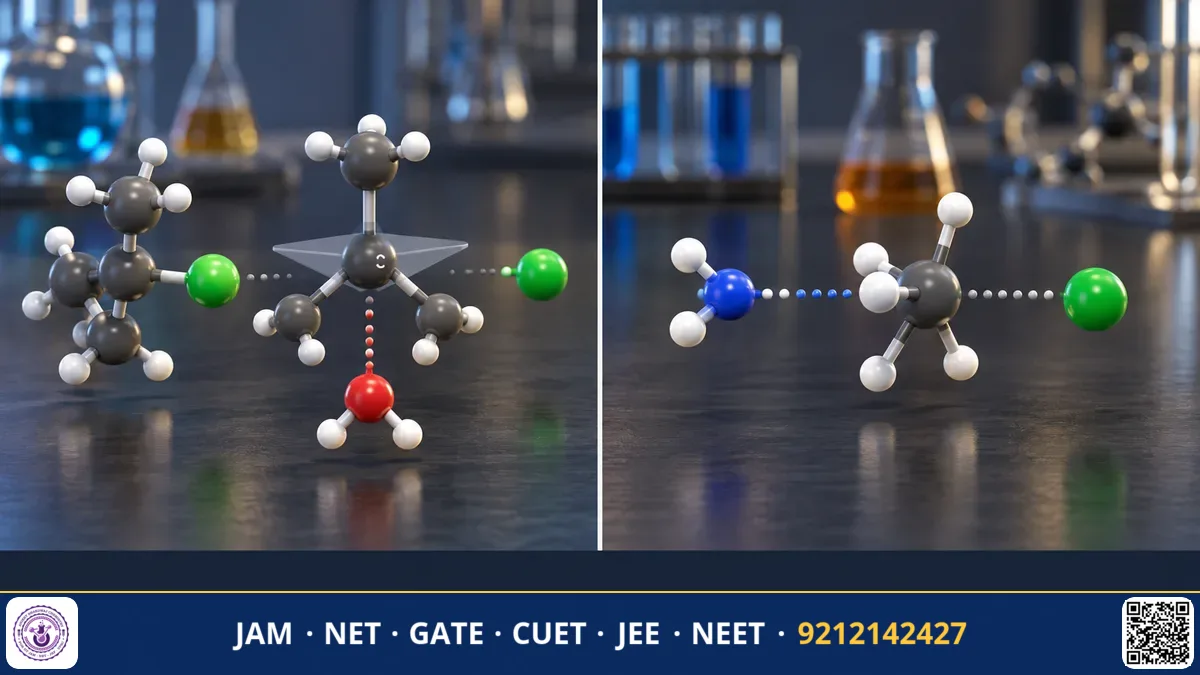
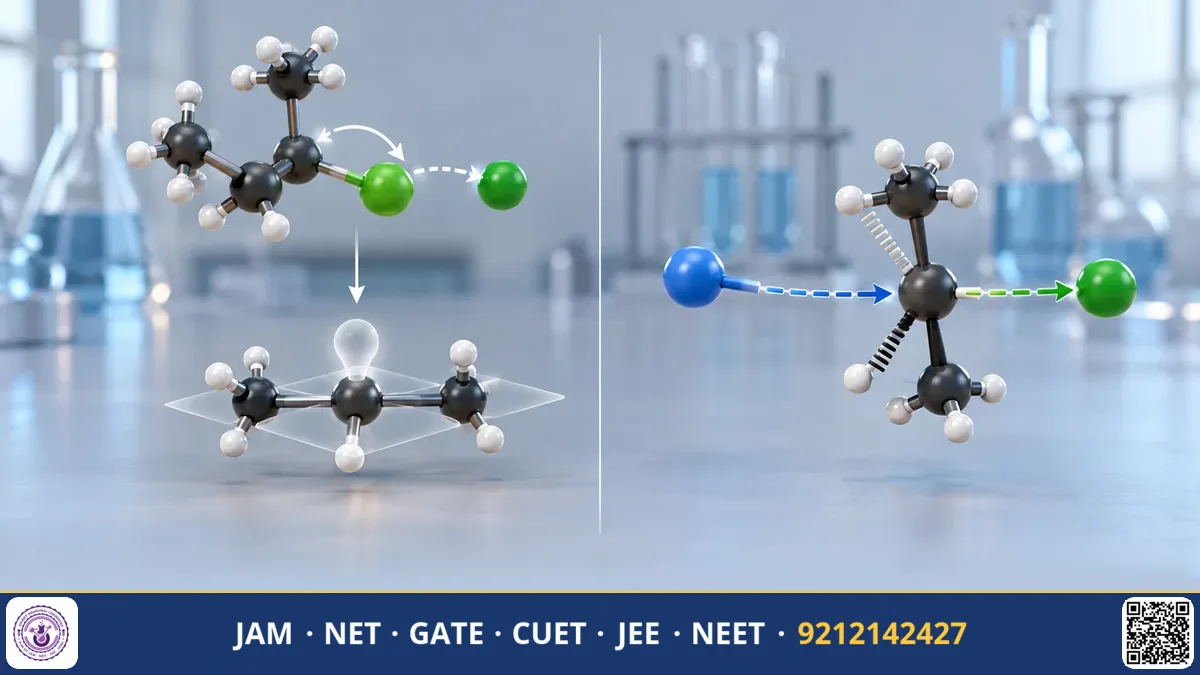
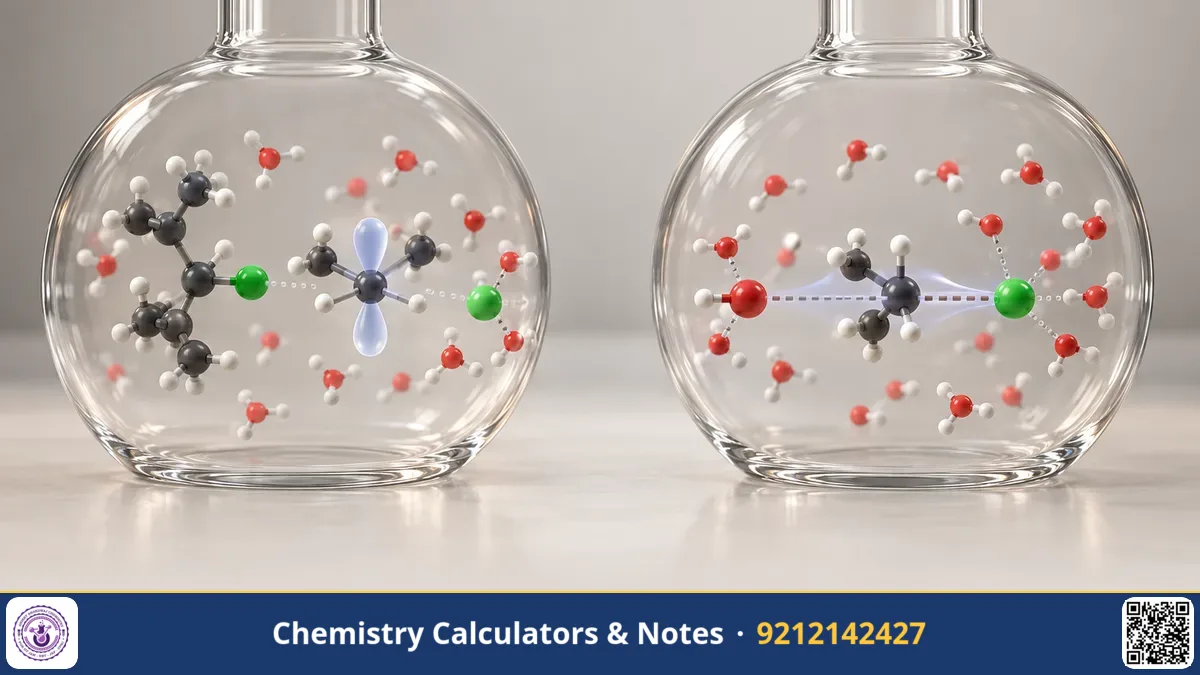
The SN1 mechanism involves two steps. The carbon-halogen bond breaks first in a slow rate-determining step to form a planar carbocation intermediate. The nucleophile then captures the carbocation. The reaction follows first-order kinetics: rate = k[haloalkane]. Because the carbocation is planar, attack occurs from both faces, resulting in racemisation.
The SN2 mechanism is a concerted one-step reaction. The nucleophile attacks the carbon centre from the backside, directly opposite the departing halogen, passing through a pentacoordinate transition state. The reaction follows second-order kinetics: rate = k[haloalkane][nucleophile]. Backside attack produces complete inversion of configuration.
The three-variable decision hierarchy
To identify the operating pathway, evaluate three variables in sequence: substrate structure, nucleophile strength, and solvent polarity. Substrate structure is always the dominant factor.
Steric crowding around the alpha carbon dictates access. Methyl and primary haloalkanes have minimal crowding, enabling rapid backside attack and reacting primarily through SN2. Tertiary haloalkanes block backside attack, but their alkyl substituents stabilise a carbocation intermediate through hyperconjugation, reacting exclusively through SN1. Secondary haloalkanes represent borderline cases that follow either pathway depending on conditions.
Allylic and benzylic halides react rapidly through both pathways because resonance stabilises both the carbocation in SN1 and the transition state in SN2. Haloarenes do not undergo regular substitution: lone pair delocalisation gives the bond partial double-bond character, phenyl cations are unstable, and the ring shields backside approach.
| Feature | SN1 Pathway | SN2 Pathway |
|---|---|---|
| Kinetics | First order: rate = k[haloalkane] | Second order: rate = k[haloalkane][nucleophile] |
| Mechanism | Two steps via carbocation | One concerted step |
| Substrates | 3° > 2° >> 1° | Methyl > 1° > 2° |
| Nucleophile | Weak, neutral species | Strong, anionic species |
| Solvent | Polar protic (such as water or alcohols) | Polar aprotic (such as acetone) |
| Stereochemistry | Racemisation | Inversion of configuration |
| Rearrangements | Common via carbocation shifts | Never observed |
Nucleophile strength provides the second criterion. Strong, charged nucleophiles (such as hydroxide, cyanide, azide, and thiolates) force bimolecular displacement. Weak, neutral nucleophiles (such as water and alcohols) lack the driving force for backside attack and wait for unimolecular ionisation.
Solvent polarity provides the final criterion. Polar protic solvents hydrogen-bond with anionic nucleophiles, lowering nucleophilicity while stabilising carbocations and halide ions to favour SN1. Polar aprotic solvents coordinate cations while leaving anions naked and reactive, accelerating SN2.
Stereochemistry and elimination competition
Stereochemical outcomes distinguish the two pathways. In SN2 substitution on an optically active secondary haloalkane, backside attack causes clean inversion. For example, (2R)-2-bromooctane yields an inverted (2S) product when substituent priorities remain unchanged.
In SN1 reactions, the planar carbocation intermediate permits attack from either face, yielding a racemic mixture. In practice, shielding by the departing halide ion often causes a slight excess of inversion.
Substitution always competes with beta-elimination. Bulky bases like tert-butoxide suppress substitution, forcing E2 alkene formation. Higher reaction temperatures also favour elimination because bond cleavage increases entropy.
The chemical science examination perspective
In national examinations such as CSIR NET, GATE, IIT-JAM, and CUET-PG, examiners focus on borderline substrates, rearrangement pathways, and stereochemical outcomes.
Whenever an SN1 pathway is identified, determine whether the carbocation can undergo a 1,2-hydride or 1,2-alkyl shift to form a more stable tertiary or resonance-stabilised cation before capture. Examiners also test solvent effects, shifting a secondary substrate from SN1 solvolysis in an alcohol to rapid SN2 displacement in an aprotic solvent.
Worked practice questions from the question bank
Practice question 1 (qid-sn-201): An optically active sample of (2R)-2-bromopentane is treated under two distinct reaction set-ups:
- Reaction 1: Sodium azide in acetone at 25 °C.
- Reaction 2: Heating in ethanol.
State the mechanism, major product, and stereochemical outcome for each reaction.
Working and solution:
In the first reaction, the substrate is secondary, azide is a strong nucleophile, and acetone is a polar aprotic solvent. Acetone leaves azide anions unshielded, enforcing SN2 substitution. Azide attacks the second carbon from the backside, displacing bromide in one concerted step. The reaction proceeds with complete inversion of configuration, yielding (2S)-2-azidopentane as the major product with retained optical activity.
In the second reaction, ethanol acts as a weak neutral nucleophile and polar protic solvent. Heating promotes heterolytic cleavage to form a planar secondary carbocation via SN1. Ethanol attacks both faces of the carbocation with equal likelihood, followed by deprotonation to yield 2-ethoxypentane. This produces an equimolar mixture of (2R)- and (2S)-2-ethoxypentane, forming an optically inactive racemic mixture.
Practice question 2 (qid-sn-202): Compare the reactivity of 1-chlorobutane and 1-chloro-2,2-dimethylpropane (neopentyl chloride) when treated with sodium iodide in acetone. Explain the mechanistic rationale.
Working and solution:
Sodium iodide in acetone operates through the SN2 mechanism. Iodide is an effective nucleophile, and acetone is a polar aprotic solvent that drives displacement by precipitating insoluble sodium chloride.
In 1-chlorobutane, the primary carbon has only one alkyl chain at the beta position. The backside is accessible, allowing smooth approach of iodide to form the pentacoordinate transition state.
In neopentyl chloride, the beta carbon is quaternary and bears three bulky methyl groups that block the backside. Severe steric clash raises the activation energy of the transition state, making it unreactive toward SN2 displacement. Under forcing protic conditions, it reacts through SN1 with a concurrent 1,2-methyl shift to yield a stable tertiary carbocation.
Four-week structured study plan
To master aliphatic substitution for national chemical science examinations, follow this weekly progression:
- Week 1: Kinetics and transition states. Derive rate laws, sketch transition states, and correlate leaving group departure ability with conjugate acid relative acidity.
- Week 2: Nucleophiles and solvent classes. Compare polar protic and aprotic solvents, assess nucleophilicity trends, and identify ambient nucleophile preferences.
- Week 3: Stereochemistry and rearrangements. Track inversion versus racemisation, and solve problems involving 1,2-hydride and 1,2-alkyl shifts.
- Week 4: Timed question-bank problem solving. Work through mixed practice sets where substitution competes with E1 and E2 pathways.
Key takeaways
- Substrate crowding dictates the pathway: primary halides favour SN2, tertiary halides favour SN1, and secondary halides depend on reagents.
- Polar aprotic solvents accelerate SN2 by keeping nucleophiles unsolvated and reactive.
- Polar protic solvents facilitate SN1 by stabilising carbocations and departing halide ions.
- SN2 reactions proceed with stereochemical inversion, whereas SN1 reactions result in racemisation.
- Beta-branching suppresses SN2 attack despite a primary alpha carbon.
Frequently asked questions
Does a polar protic solvent always cause an SN1 reaction?
No. While polar protic solvents stabilise carbocations, primary alkyl halides cannot form carbocations under standard conditions due to high energy barriers. They react via SN2, though slower than in aprotic media.
Why are haloarenes unreactive toward SN1 and SN2 pathways?
Haloarenes exhibit partial double-bond character from resonance delocalisation of halogen lone pairs into the ring. Furthermore, phenyl cations are unstable for SN1, and the ring blocks backside attack for SN2.
How does basicity differ from nucleophilicity in these reactions?
Basicity measures thermodynamic affinity for a proton, whereas nucleophilicity measures kinetic attack on an electrophilic carbon. Bulky bases promote E2 elimination, whereas unhindered polarisable nucleophiles promote substitution.